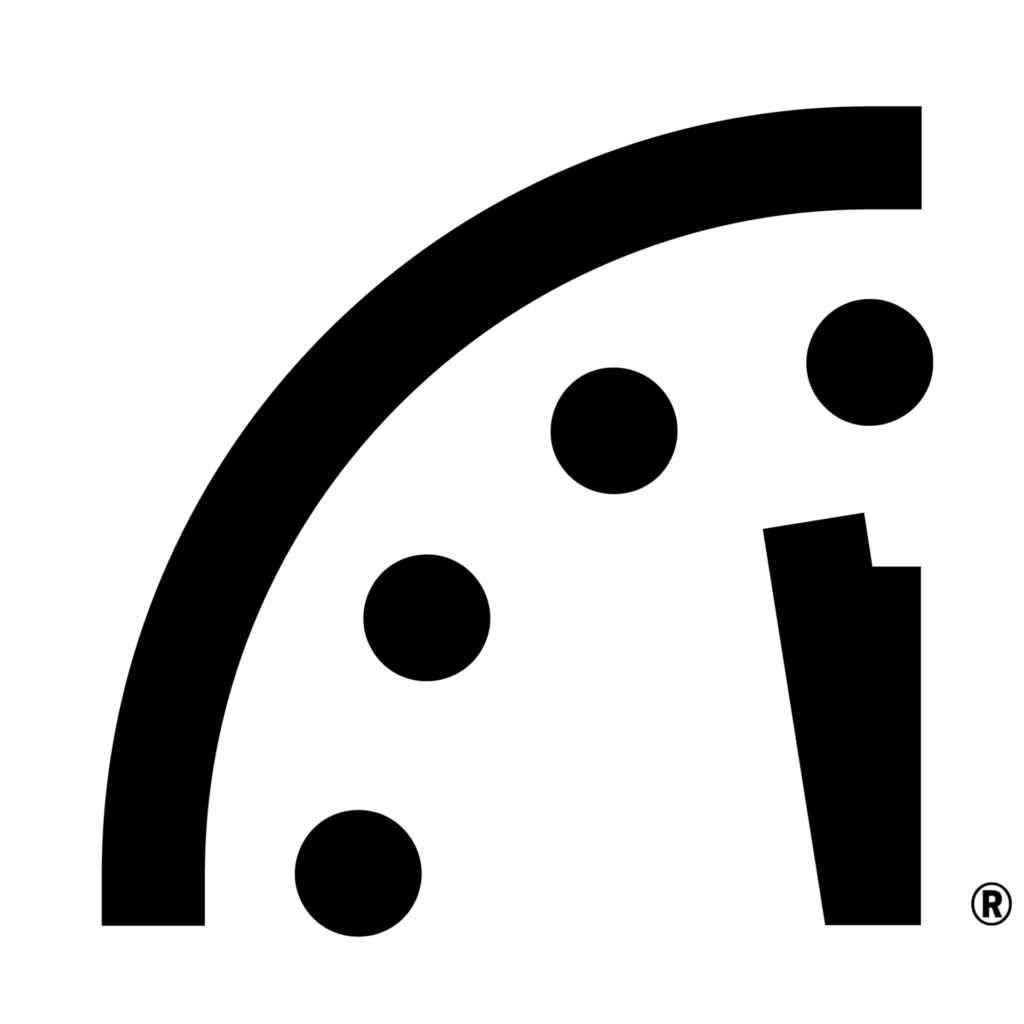
It is now 85 seconds to midnight
2026 Doomsday Clock Statement
Science and Security Board
Bulletin of the Atomic Scientists
Editor, John Mecklin
January 27, 2026
Sliding further down a slippery nuclear slope
Last year started with a glimmer of hope raised by some encouraging remarks that incoming US President Donald Trump made regarding denuclearization, the dangers of nuclear weapons, and efforts to halt the Russia-Ukraine conflict. But 2025 ended with no reassuring nuclear developments. Rather, old and new negative trends solidified.
The year witnessed military operations in three theatres under the shadow of nuclear weapons, with each conflict posing a risk of escalation.
The risk of nuclear weapons use continued in the third year of the Russia–Ukraine war, which has featured innovative and potentially destabilizing military tactics and lightly veiled Russian nuclear threats. Russian drone incursions into NATO countries heightened European threat perceptions as the United States nudged European countries to take more responsibility for their own security by increasing defense spending. Meanwhile, Europeans continued debating nuclear deterrence options that do not involve the United States. Explorations include the possibility of a Euro-deterrent supported by the French and UK nuclear arsenals or by allowing other European countries to develop nuclear latency so they could quickly build nuclear weapons, if necessary. Similar conversations in South Korea and Japan have raised the specter of nuclear proliferation among countries that have traditionally been under the US nuclear umbrella.
In South Asia, a conflict between India and Pakistan broke out in May following an incident of cross-border terrorism in India. The conventional operations breached new redlines as they involved the first-ever use of drones and missiles and were accompanied by nuclear brinkmanship and disinformation campaigns. A ceasefire was obtained after 88 hours of fighting, but the risk of renewed conflict hangs over the two nuclear armed states.
In June, Israel and the United States launched aerial attacks on Iranian nuclear facilities suspected of supporting the country’s nuclear weapons ambitions. The amount of damage caused by the attacks remains unclear, as does the fate of more than 400 kilograms of uranium that had been enriched to contain 60 percent of the fissile uranium 235 isotope—enough to build several nuclear weapons, even without further enrichment. With no concrete plans at hand to politically resolve the outstanding issues involving Iran’s nuclear program, it is unclear whether the attacks constrained the Iranian program—or persuaded the country’s leaders to pursue nuclear weapons covertly.
North Korea’s nuclear build-up continued in 2025 with the testing of new delivery systems aimed at refining the country’s nuclear triad. North Korea claimed to have tested a new intercontinental ballistic missile with a hypersonic delivery vehicle and also announced a nuclear-powered submarine. Russian assistance to North Korea’s strategic nuclear and missile capabilities will likely expand, perhaps as a quid pro quo for North Korea sending soldiers to fight for Russia in the war against Ukraine—potential developments that drive desire among some US allies to seek their own nuclear weapons.
As divisions between nuclear and non-nuclear countries deepen amid rising geopolitical tensions, the outlook for the Nuclear Non-Proliferation Treaty remains cloudy. With no progress on arms control, strategic competition among major powers is showing signs of becoming a full-blown arms race, as evidenced by rapidly increasing numbers of nuclear warheads and platforms in China; the US decision to begin the Golden Dome missile defense program; the continued modernization of nuclear delivery systems in the United States, Russia, and China; and new concerns about the possible resumption of nuclear testing. With each of those countries having leaders with nationalist and autocratic tendencies, nuclear issues are being framed around the importance of retaining strategic superiority. This sentiment spills over into other areas, such as the race for being the first to have a human settlement on moon, deploy new military applications of AI, or weaponize space.
Amid the geopolitical and technological tensions surrounding nuclear weapons, climate change concerns are driving interest in nuclear energy, including a growing optimism about small modular reactors. Consequently, several countries could emerge as first-time users of nuclear power. While there is no automatic connection between nuclear energy and proliferation of nuclear weapons, to ensure that the spread of nuclear energy does not spur proliferation, strong governance of the nuclear fuel cycle is needed. This, however, demands international consensus, a commodity in short supply in present times. Meanwhile, there are continuing safety and security concerns about nuclear power plants that have come under attack during the Russia-Ukraine war.
In 2025, the world slipped closer to normalizing nuclear risks. There was an almost complete absence of communication on strategic stability among nuclear adversaries and no sustained pressure from non-nuclear weapons countries for engagement. Also worrying is a lack of leadership on nuclear issues, with no country stepping up to stem the growing sense of disorder and breakdown of norms.
To prevent a further slide down the slippery slope toward catastrophe, international cooperation must replace international competition. First, to begin changing the negative atmosphere of the current nuclear moment, the United States and Russia should agree to adhere to the central limits of New START, conduct a data exchange in a sign of good faith, and immediately commence negotiations focused on the next steps in US-Russia arms control. Second, all nuclear adversaries must open dialogues to learn about each other’s nuclear doctrines, current capabilities, and future plans, and to put in place channels of communication to ensure crisis prevention and management. Third, the countries with nuclear weapons should also make clear that they will not return to explosive nuclear testing, and that they support the NPT’s core precepts.
These initiatives would reduce the immediate threats from nuclear weapons, lower nuclear tensions around the world, and help push the Doomsday Clock away from midnight.
Learn more about how each of the Bulletin's areas of concern contributed to the setting of the Doomsday Clock this year:
About the Bulletin of the Atomic Scientists
At our core, the Bulletin of the Atomic Scientists is a media organization, publishing a free-access website and a bimonthly magazine. But we are much more. The Bulletin’s website, iconic Doomsday Clock, and regular events equip the public, policy makers, and scientists with the information needed to reduce man-made threats to our existence. The Bulletin focuses on three main areas: nuclear risk, climate change, and disruptive technologies, including developments in biotechnology. What connects these topics is a driving belief that because humans created them, we can control them.
The Bulletin is an independent, nonprofit 501(c)(3) organization. We gather the most informed and influential voices tracking man-made threats and bring their innovative thinking to a global audience. We apply intellectual rigor to the conversation and do not shrink from alarming truths.
The Bulletin has many audiences: the general public, which will ultimately benefit or suffer from scientific breakthroughs; policy makers, whose duty is to harness those breakthroughs for good; and the scientists themselves, who produce those technological advances and thus bear a special responsibility. Our community is international, with more than half of our website visitors coming from outside the United States. It is also young. Half are under the age of 35.
Learn more at thebulletin.org/about-us.