Leo Szilard
Leo Szilard (1898–1964) occupies a singular place in the history of science and international security. Known for his foundational work in nuclear physics and his pivotal role in launching the Manhattan Project, Szilard also emerged as a prescient critic of the arms race he helped to inaugurate.
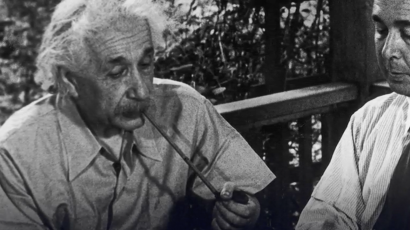
Born in Budapest into an affluent Jewish family, Szilard demonstrated early intellectual promise. He studied engineering at the Technische Hochschule in Berlin before turning to physics under Max von Laue at the University of Berlin, where he earned his doctorate in 1922.1 During his postdoctoral work at the Kaiser Wilhelm Institute, he began a productive intellectual relationship with Albert Einstein that would continue for decades.2
In 1933, Szilard fled Nazi Germany for England. That same year, while crossing a street in London, he conceived the theoretical basis for a self-sustaining nuclear chain reaction.3 By 1938, amid growing concerns over fascist aggression, Szilard relocated to the United States. At Columbia University, he collaborated with Enrico Fermi and others on nuclear fission research and co-authored a seminal paper outlining the principles of neutron multiplication in uranium-carbon systems.4
Szilard’s concern over Nazi Germany’s potential nuclear ambitions led him to draft a letter, signed by Einstein, and delivered to President Franklin D. Roosevelt in October 1939.5 This document catalyzed the formation of the US Advisory Committee on Uranium and, eventually, the Manhattan Project. Szilard played a vital role in the project, particularly in the development of the first nuclear reactor, Chicago Pile-1, successfully demonstrated in December 1942.6
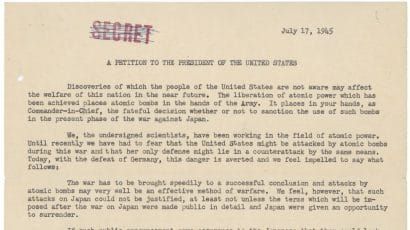
Yet Szilard was never fully comfortable with the direction of the wartime nuclear program. Disturbed by military control, government secrecy, and ethical ambiguity, he became an outspoken critic.7 In 1945, he helped author the Franck Report, which recommended a non-combat demonstration of the atomic bomb to avoid initiating a nuclear arms race.8 He also organized a petition—signed by dozens of Manhattan Project scientists—urging President Truman to refrain from using the bomb against Japan. The petition, however, never reached the president.9
Following the war, Szilard actively opposed the May–Johnson Bill, which would have placed nuclear energy under military jurisdiction. His advocacy, along with that of fellow scientists, led to the bill’s defeat and the subsequent passage of the civilian-administered Atomic Energy Act of 1946.10
In the postwar years, Szilard shifted focus to molecular biology and biophysics, holding academic appointments at the University of Chicago and later the Salk Institute for Biological Studies. His contributions to cell biology and aging were supported by grants from the Office of Naval Research and the National Advisory Health Council.11
Szilard remained engaged in Cold War diplomacy, helping to found the Pugwash Conferences on Science and World Affairs in 1957. In 1960, he met with Soviet Premier Nikita Khrushchev and proposed the establishment of a direct US–Soviet communication link—an idea later realized in the Washington–Moscow “Hot Line.”12
His 1960 allegorical book The Voice of the Dolphins explored the ethical responsibilities of scientists and the global consequences of nuclear mismanagement. Throughout his career, Szilard consistently emphasized the necessity of ethical restraint and international cooperation and the role of scientists as public intellectuals.
Leo Szilard died of a heart attack on May 30, 1964, just months after moving to the Salk Institute in La Jolla, California. His life’s work—spanning physics, biology, and diplomacy—remains a powerful reminder of the profound ethical questions posed by scientific progress.
—David A. Wargowski
Notes
- William Lanouette with Bela Silard, Genius in the Shadows: A Biography of Leo Szilard, the Man Behind the Bomb (New York: Charles Scribner’s Sons, 1992), 22–25.
- , 45–49.
- , 92–94.
- Leo Szilard, “Divergent Chain Reactions in a System Composed of Uranium and Carbon,” Columbia University, February 1940. See also Enrico Fermi, Experimental Production of a Divergent Chain Reaction, CP-413 (Declassified: November 7, 1951; U.S. Atomic Energy Commission, 1952).
- Albert Einstein and Leo Szilard, “Letter to President Roosevelt,” August 2, 1939. See U.S. National Archives, Manhattan Project Files.
- Richard Rhodes, The Making of the Atomic Bomb (New York: Simon & Schuster, 1986), 513–517.
- Lanouette, Genius in the Shadows, 249–261.
- James Franck et al., “Report of the Committee on Political and Social Problems” (The Franck Report), June 11, 1945, Bulletin of the Atomic Scientists Archive.
- Szilard Petition, July 1945, available in Atomic Heritage Foundation
- “The Manhattan Project: Making of the Atomic Bomb, Part VI: The Manhattan District in Peacetime, The May-Johnson Bill,” AtomicArchives.com, accessed May 2025.
- Lanouette, Genius in the Shadows, 330–335.
- , 362–365.