Disinformation and deepfakes: Improving crisis communications in India and Pakistan
By Qamar Shahzad Rajoka | Voices of Tomorrow | January 29, 2026
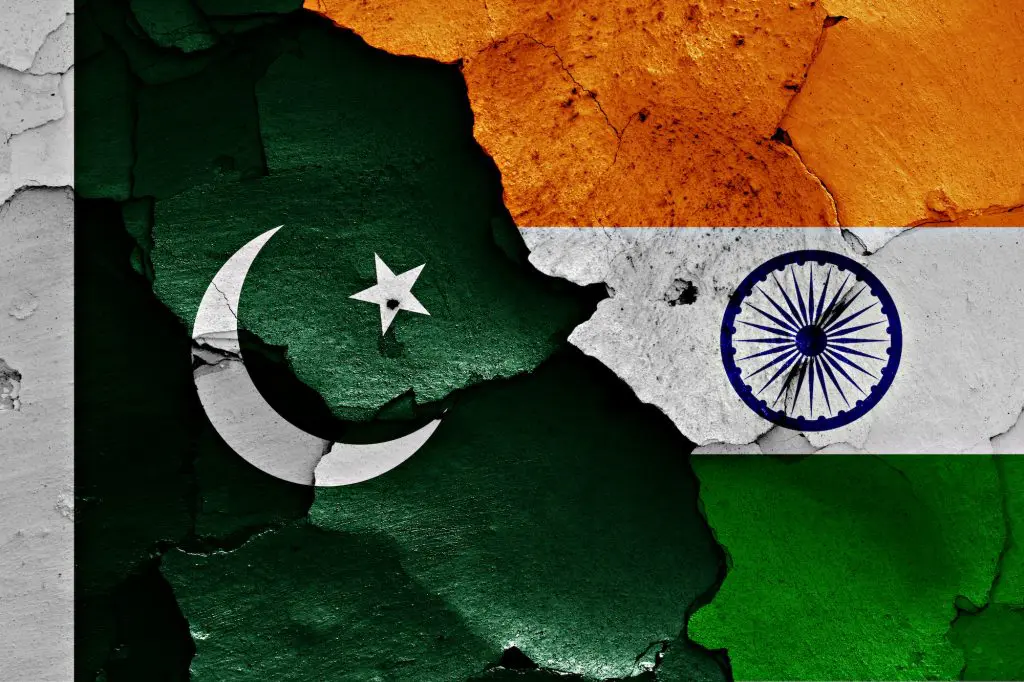 India and Pakistan flags on cracked wall. Shutterstock image
The four-day military crisis between India and Pakistan in May 2025 became even more dangerous when both countries integrated disinformation and fake images into their conventional warfighting. The speedy generation of false information and realistic deepfakes, aided by AI, made it difficult to verify what was really happening during the crisis. Even reputable journalists, government officials, and politicians were misled by fabricated content shared as authentic battlefield footage.
Such material might not trigger a crisis, but it can dangerously intensify one. The type of synthetic data that was unleashed during the May 2025 crisis poses two big challenges in South Asia: strategic confusion and the danger of reading the other side wrong. Fortunately, there are several policies that can help counter viral disinformation within the nuclear dyad of India and Pakistan.
The 2025 crisis. Disinformation spreads faster than correct information. That makes it extremely hard to verify narratives emerging on social media. Respected figures who have many followers on social media can unwittingly spread fake news to large audiences who accept the information as truth.
For instance, misinformation circulating on social media during the 2025 crisis alleged that India had attacked Pakistan’s Kirana Hills nuclear site and caused radioactive leakage. A doctored letter about this incident also went viral. The next day, the Indian Defense Minister Rajnath Singh stated that “Pakistan is an irresponsible state and [the International Atomic Energy Agency] should take charge of the nuclear weapons of Pakistan.” Although the IAEA later denied any radioactive leakage, Singh’s statement led many to believe that the incident had happened.
Misinformation amplified by officials can escalate quickly and create serious consequences. Even when it is debunked, such news creates a trust deficit and public confusion about what to believe.
Disinformation shared by news outlets, officials, and journalists can close the space for clear signaling during the crisis. For example, the Indian news outlet WION claimed that Pakistan had called a meeting of its federal agency responsible for nuclear weapons. Pakistan’s defense minister Khawaja Asif denied the accusation: “There has been no meeting of the National Command Authority, nor is any such meeting scheduled.”
A lack of reliable information and credible sources during a crisis not only intensifies the fog of war but also increases the risk that decision makers will read the other side wrong and act on false signals. Deepfakes and disinformation fuel nationalism and resentment, increasing public pressure for escalation. A fabricated satellite image or a deepfake of a military general ordering an attack, even if false, could provoke catastrophic misperception and miscalculation.
Information blackout and narrative control. After terrorists killed more than two dozen people during the April 2025 Pahalgam attack within India-administered Kashmir, India expelled Pakistani diplomats and recalled its own diplomats from Pakistan. This reduced direct communication, which could have helped de-escalate the situation. It also added another layer of fragility to communication channels, which are already limited. Backdoor diplomacy channels also shut down, eliminating opportunities for clarification and mutual investigation, resulting in heightened mistrust.
India went further by banning the social media accounts of some Pakistani celebrities and scholars. Both sides tried to immunize their citizens against any narratives other than their own. This created an environment in which only one-sided narratives were covered in the media, and the government monopolized the narratives. In such an environment, exploitation of the masses becomes easy. By shutting down communication and blocking the other side’s voices, both states limited their ability to understand each other’s intentions, which led to an increased risk of miscalculation.
Fortunately, there are ways to reduce the dangers of disinformation in a conflict like the ongoing one between India and Pakistan. Here are five specific policy recommendations:
State-run fact-checking. Both India and Pakistan need better state-run mechanisms to counter viral disinformation. India has a fact-checking platform within its Ministry of Planning and Broadcasting, called the Press Information Bureau, which debunked many claims during the May 2025 crisis. However, its sole focus was countering disinformation from Pakistan.
Pakistan needs to reactivate a similar platform it established in 2018. Fake News Buster, which operated under the Ministry of Information and Broadcasting, was dysfunctional during the crisis. Pakistan should restart and properly staff its Fake News Buster with round-the-clock monitoring teams and rapid debunking protocols. During the May 2025 crisis, the absence of a credible Pakistani fact-checking body allowed false claims like the Kirana Hills hoax to spread unchecked.
Independent media fact-checking. The 2025 crisis revealed how mainstream media, instead of acting impartially, spread misinformation. To address this, reputable news channels in both countries should establish independent fact-checking desks within their organizations similar to international models like Reuters Fact Check and BBC Verify.
In Pakistan, Geo News has an initiative called Geo Fact Check, which could serve as a model for other news organizations. In India, almost no major news channel has any fact-checking desk of its own. At a minimum, media outlets should verify crisis-related claims made by government officials before publishing them to prevent the amplification of false information.
Cross-border journalistic presence. Until 2014, Pakistan and India both maintained at least two correspondent journalists in each other’s country. Having correspondents on both sides allowed a better understanding of the other country’s perspective and helped verify viral claims at their source. During the crisis, the absence of cross-border correspondents left both publics dependent on unchecked social media claims. Pakistan and India should reinstate the foreign correspondents to make it easier to verify provocative information.
Backdoor diplomacy. A common belief in India and Pakistan is that if official diplomacy (also known as Track 1 diplomacy) fails, semi-official and purely unofficial diplomacy (known respectively as Track 1.5 and Track 2) should also be suspended. In fact, the opposite approach is more likely to yield better results. Informal channels can help generate policy outcomes that later translate into Track 1 diplomacy.
For instance, some analysts believe that tabletop exercises in the 1990s resulted in the Lahore Declaration, a bilateral treaty signed by India and Pakistan in 1999. More such initiatives could lead to improved policy outcomes. Past initiatives like the Neemrana Dialogue demonstrated how informal exchanges can reduce mistrust and feed useful ideas into formal policymaking. Joint intellectual exchanges, negotiations, and peace games could help India and Pakistan understand each other and develop strategic empathy.
Neutral countries should provide more platforms for sustained Track 1.5 and Track 2 exchanges. US think tanks, such as the Stimson Center and the Carnegie Endowment for International Peace, have long convened Pakistani and Indian experts for structured dialogues on sensitive issues. These intellectual negotiations have already proven valuable. For example, Rabia Akhtar from Pakistan and Rohee Neog from India co-edited a report on nuclear responsibilities for the British American Security Information Council, proving that even in tense political climates, experts from both sides can work together productively when supported by neutral hosts. By participating in unofficial diplomacy, both countries can keep communication alive during crises, reduce mistrust, and create informal pathways that support formal agreements.
Leader-to-leader hotline. The current hotline between the two countries’ militaries is usually used for communication only at the peak of crises, when escalation is already underway. It is reserved for operational matters and plays a very limited role in preventing miscalculation at the political level. Pakistan and India established a prime-minister-to-prime-minister hotline in 1989. It was used during the Kargil War of 1999, but its later use is less well known. In 2019, Pakistani Prime Minister Imran Khan reportedly sought direct contact with Indian Prime Minister Narendra Modi, but his concerns were instead relayed through diplomatic channels. The hotline between prime ministers should be revived so that any crisis can be clearly communicated through direct contact. Quarterly direct communication would help with understanding intentions and building trust. It would also make it easier to contact the other side in the wake of any conflict. Disinformation, institutional biases, and misperception can be countered effectively through direct contact, helping to terminate any crisis before it becomes full blown.
Implementation challenges. Several obstacles must be overcome to implement these proposed measures. State-run mechanisms to counter disinformation must move beyond telling a one-sided story that only debunks information originating from the other side. Reinstating correspondents and diplomats will require basic trust.
The political will to use these channels remains the biggest challenge to crisis communication. The BrahMos incident of 2022, when India accidentally fired a cruise missile into Pakistan, showed that the available channels for communication are not being used when needed.
Both sides’ confidence that the other side would not escalate up to certain limits was proved wrong by the May 2025 crisis. Analyzing the post-2016 landscape in South Asia, it is evident that the escalation ladder is getting steeper each time. The May 2025 crisis clearly indicates how a crisis can quickly go off the rails in an environment saturated with fabricated information. In South Asia’s nuclear environment, the difference between restraint and catastrophe may come down to whether communication and verification channels exist and are used when they are needed most.
Together, we make the world safer.
The Bulletin elevates expert voices above the noise. But as an independent nonprofit organization, our operations depend on the support of readers like you. Help us continue to deliver quality journalism that holds leaders accountable. Your support of our work at any level is important. In return, we promise our coverage will be understandable, influential, vigilant, solution-oriented, and fair-minded. Together we can make a difference.
Keywords: debunking, deepfakes, disinformation
Topics: Artificial Intelligence, Disruptive Technologies, Nuclear Weapons, Voices of Tomorrow
Get alerts about this thread
0 Comments
Oldest

Qamar Shahzad Rajoka
Qamar Shahzad Rajoka is a student in international relations at the University of the Punjab. He has previously worked at the Center for Security, ... Read More