How an India-Pakistan nuclear war could start—and have global consequences
By Alan Robock, Owen Brian Toon, Charles G. Bardeen, Lili Xia, Hans M. Kristensen, Matthew McKinzie, R. J. Peterson, Cheryl S. Harrison, Nicole S. Lovenduski, Richard P. Turco | Issue Article | October 31, 2019
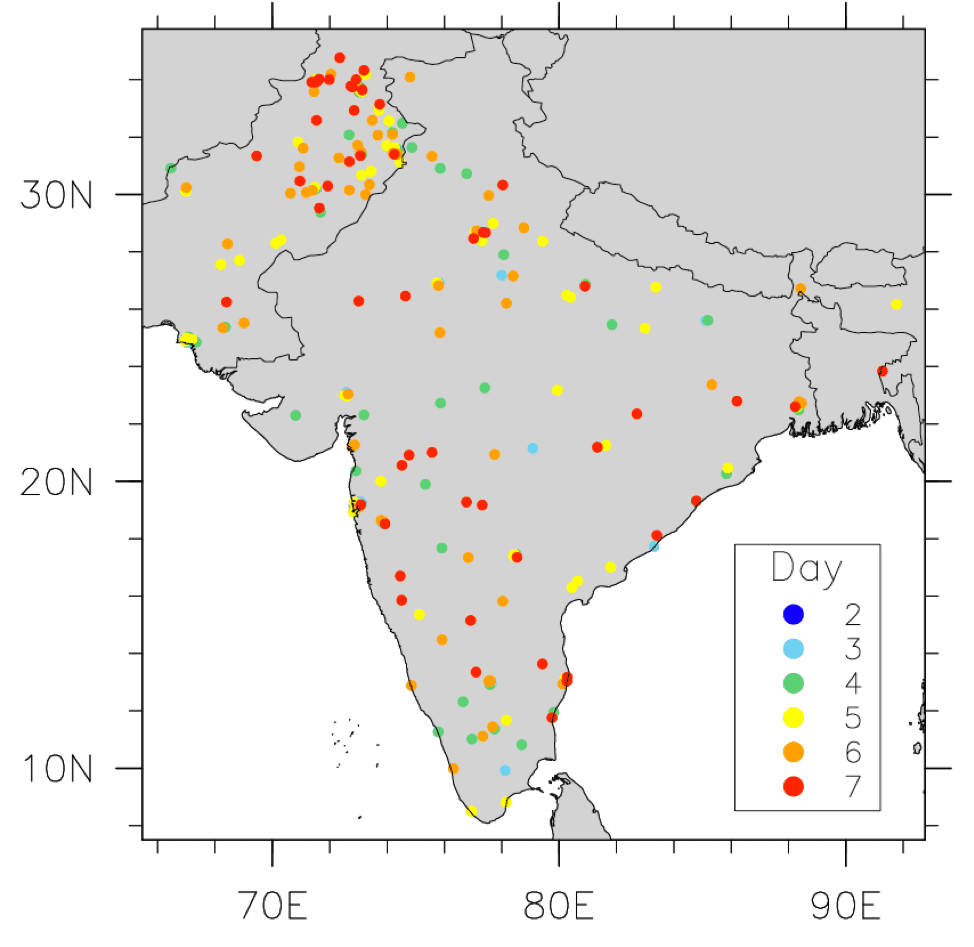 A map showing nuclear strikes, by the day, during an India-Pakistan war scenario
This article describes how an India-Pakistan nuclear war might come to pass, and what the local and global effects of such a war might be. The direct effects of this nuclear exchange would be horrible; the authors estimate that 50 to 125 million people would die, depending on whether the weapons used had yields of 15, 50, or 100 kilotons. The ramifications for Indian and Pakistani society would be major and long lasting, with many major cities largely destroyed and uninhabitable, millions of injured people needing care, and power, transportation, and financial infrastructure in ruins. But the climatic effects of the smoke produced by an India-Pakistan nuclear war would not be confined to the subcontinent, or even to Asia. Those effects would be enormous and global in scope. Free-access until June 30, 2025.
Together, we make the world safer.
The Bulletin elevates expert voices above the noise. But as an independent nonprofit organization, our operations depend on the support of readers like you. Help us continue to deliver quality journalism that holds leaders accountable. Your support of our work at any level is important. In return, we promise our coverage will be understandable, influential, vigilant, solution-oriented, and fair-minded. Together we can make a difference.
Issue: Bulletin of the Atomic Scientists Volume 75 Issue 6
Keywords: Cold start, Kashmir, South Asia, nuclear war, nuclear winter, tactical nuclear weapons
Topics: Doomsday Clock, Nuclear Weapons
Get alerts about this thread
0 Comments
Oldest

Alan Robock
Robock is a Distinguished Professor in the Department of Environmental Sciences at Rutgers University. He graduated from the University of Wisconsin, ... Read More
Owen Brian Toon
Owen Brian Toon is a professor in the Department of Atmospheric and Oceanic Sciences and a research associate at the Laboratory for Atmospheric and ... Read More
Charles G. Bardeen
Bardeen is a research scientist in the Atmospheric Chemistry Observations and Modeling laboratory at the National Center for Atmospheric Research. ... Read More

Hans M. Kristensen
Hans M. Kristensen is the director of the Nuclear Information Project with the Federation of American Scientists in Washington, DC. His work focuses ... Read More
Matthew McKinzie
McKinzie is the director of the Nuclear Program of the Natural Resources Defense Council (NRDC) in Washington, DC. He and Kristensen recently ... Read More
R. J. Peterson
Peterson is a Professor Emeritus of physics at the University of Colorado and a former Jefferson Science Fellow for the U.S. Department of State. ... Read More
Cheryl S. Harrison
Harrison is a biophysical oceanographer and Assistant Professor in Earth, Environmental and Marine Science at the University of Texas Rio Grande ... Read More
Nicole S. Lovenduski
Lovenduski is an oceanographer and Associate Professor at the University of Colorado Boulder. She studies the biogeochemistry of the ocean with a ... Read More
Richard P. Turco
Turco is a Distinguished Emeritus Professor of Atmospheric and Oceanic Sciences at the University of California, Los Angeles, and is the Founding ... Read More