Who were Richard Garwin and Hans Bethe? A response to the recent attack on their integrity in the Bulletin by Benjamin Wilson
By Frank von Hippel | Opinion | February 19, 2026
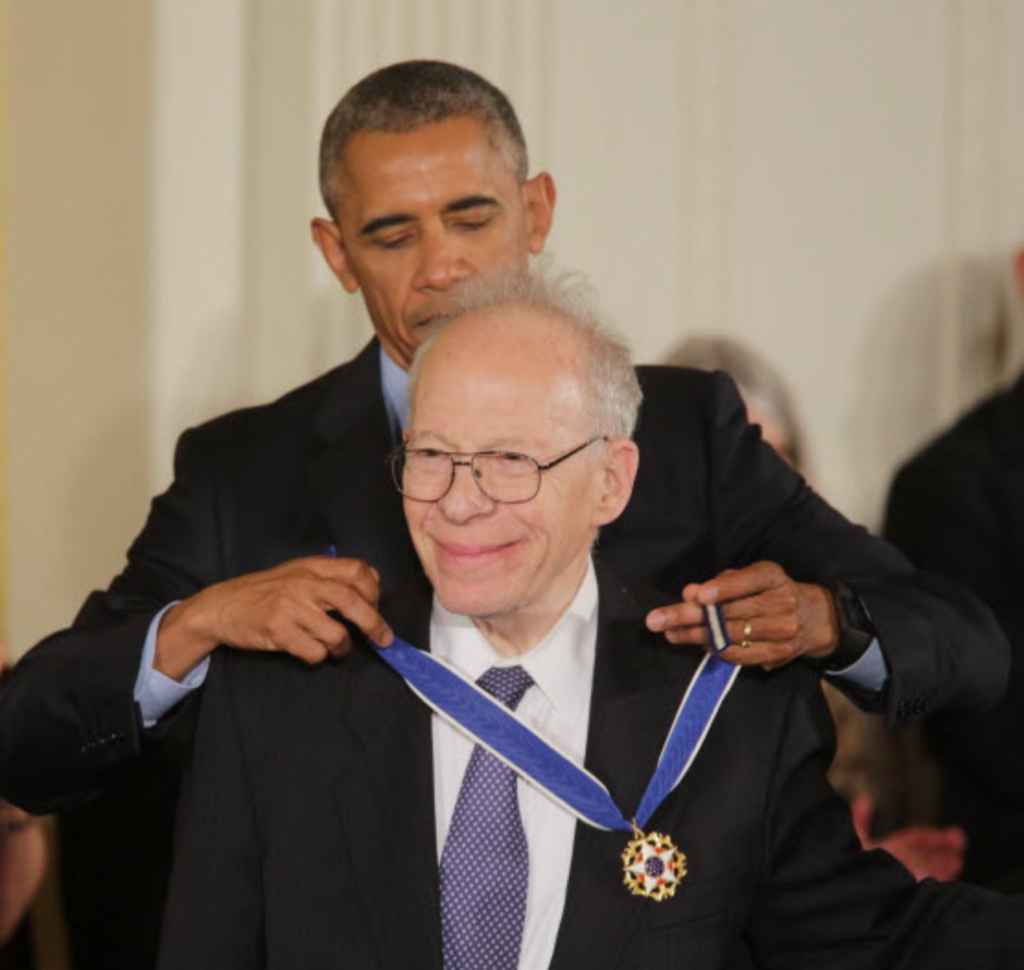 Dick Garwin received the Presidential Medal of Freedom in 2016 (White House photo).
Richard Garwin (1928-2025) and Hans Bethe (1906-2005) were two of the most revered American physicists of the 20th century. Both were stars in their twenties and continued to make important contributions into their 90s. Both received great recognition. Bethe was awarded the Nobel Prize in Physics in 1967 “for his contributions to the theory of nuclear reactions, especially his discoveries concerning the energy production in stars”[1]—that is, the fusion processes that power their enormous energy outputs for billions of years. Both were awarded the highest US award for science, the National Medal of Science, and, in 2016, Garwin received the Presidential Medal of Freedom, the highest civilian honor a US President can award for, among other things, advising “nearly every President since Eisenhower.”[2]
In his acclaimed 2000 book, In the Shadow of the Bomb, physicist and science historian S.S. Schweber compared the ways in which Bethe responded to the ethical challenges of nuclear weapons favorably with the responses of J. Robert Oppenheimer, who served as director of the Los Alamos Laboratory during the Manhattan Project and was therefore responsible for the research on the design of the Hiroshima and Nagasaki atomic bombs.[3] After Garwin died, William Broad, the senior science writer of the New York Times, wrote a long appreciation. Last year, the Bulletin of Atomic Scientists ran a number of appreciations, including by Rose Gottemoeller, the negotiator of the New START Treaty—“Dick Garwin: A fine human being at the forefront of international nuclear arms control negotiations”—and by me: “Richard Garwin, the socially responsible public and government advisor.”
How quickly we forget! Less than a year later, the Bulletin published a takedown article by Benjamin Wilson, a Harvard historian of science, “How Hans Bethe and Richard Garwin served the missile defense system they publicly criticized.” His article described Bethe and Garwin as having no convictions and that their historic joint article on the vulnerabilities of ballistic missile defenses in the March 1968 Scientific American was a result of manipulation by the editor. He even claims that Bethe, as a member of the President’s Science Advisory Committee (PSAC) corruptly “helped Avco [a defense contractor for which Bethe consulted] win major contracts.” (Wilson’s book,[4] which does contain a great deal of interesting historical information, states that Bethe did disclose his consulting relationship with Avco to the White House and makes clear that the basis for Wilson’s indictment of Bethe is that PSAC recommended more work on decoy discrimination and Bethe’s substantial contributions to Avco’s research and development made it more competitive in that area.)
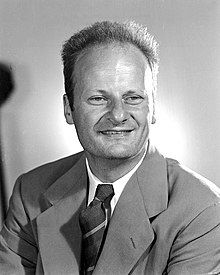
I have complained to the Bulletin about the lack of balance of Wilson’s article and have been invited to write a rebuttal. Rather than describing the errors (some of which have been corrected) and innuendo in Wilson’s article, I have decided to remind the readers and editors of the Bulletin one more time who Bethe and Garwin were and their roles in both the development of nuclear weapons and in trying to control them.
Driven like others by the fear that Hitler could become the sole possesor of fission bombs, Bethe was chosen by Oppenheimer to be the leader of the Los Alamos theory group during the World War II atomic bomb project.
After radioactivity was discovered downwind from first Soviet test of a fission bomb in September 1949, the United States panicked, and President Harry Truman ordered the US development of thermonuclear bombs—weapons expected 1,000 times more destructive than the Hiroshima bomb. Bethe spoke out powerfully against this decision:
What would an all-out war fought with hydrogen bombs mean? It would mean the obliteration of all large cities and probably of many smaller ones, and the killing of most of their inhabitants. After such a war, nothing that resembled present civilization would remain. The fight for mere survival would dominate everything. The destruction of the cities might set technology back a hundred years or more. In a generation even the knowledge of technology and science might disappear, because there would be no opportunity to practice them. Indeed it is likely that technology and science, having brought such utter misery upon man, would be suspected as works of the devil, and that a new Dark Age would begin on earth.[5]
But Bethe returned to Los Alamos to work in the H-bomb project. He said that he hoped he could prove it impossible. He also thought “if I were around Los Alamos I might still be a force for disarmament.”[6] He later acknowledged, however, “my inner troubles stayed with me and are still with me and I have not resolved the problem. I still have the feeling that I have done the wrong thing. But I have done it.”[7]
Like famed Soviet physicist Andrei Sakharov, Richard Garwin first became known within his government for his contributions to its H-bomb program. They both had meteoric careers as government advisors. The great physicist Enrico Fermi, who invited Garwin to join him at Los Alamos as a summer consultant, reportedly described Garwin as “the only true genius I have ever met.”[8]
Garwin’s moment of truth came during the Nixon administration, while Garwin was serving as a member of the President’s Science Advisory Committee (PSAC) and insisted on accepting invitations from Congress to give testimony on two issues: the likely ineffectiveness of the administration’s proposed national defense against long-range nuclear-armed ballistic missiles; and the poor economic prospects of the government’s program to develop a supersonic commercial passenger aircraft.
He declined to discuss with Congress the confidential studies he had done for the White House on these matters, but President Nixon found Garwin’s supposed lack of “loyalty” intolerable and, in January 1973, abolished both the PSAC and the White House Office of Science and Technology, which naturally irked some of Garwin’s fellow advisors.[9], [10]
Garwin and Bethe’s March 1968 Scientific American article, “Anti-Ballistic Missile Systems,”[11] was a landmark in nuclear arms control because it opened up the technical issues of such systems both to the public and to outsider physicists like me. (At the time, I was an assistant professor of physics at Stanford University.) Garwin and Bethe explained the measures an attacker could use to penetrate the proposed US missile defense system with “back-of-the-envelope” calculations that any physicist could understand.
By coincidence, tens of millions of US citizens suddenly wanted to know more about the proposed US ballistic missile defense system because the Army had decided to put nuclear-armed interceptor missiles in the suburbs of many major US cities. This set off “not in my back yard” movements that in turn triggered congressional interest and hearings by a subcommittee of the Senate Foreign Relations Committee, which invited Bethe and others to explain the technical issues involved in missile defense.
After he came into office in January 1969, President Nixon tried to defuse the situation by moving the interceptors away from the cities. By that time it was too late, however; too many senators had understood that the defense system being proposed could easily be rendered ineffective, and, by 1970, the Nixon Administration could only get funding for the system by promising that it would be used as a bargaining chip to obtain a treaty with the Soviet Union to limit missile defense to insignificant levels.[12]
The 1972 Anti-Ballistic Missile treaty between the Soviet Union and the United States limited each side to two sites (later reduced to one) with up to 100 interceptors each. By that time, the United States had 5,000 warheads deployed on its strategic ballistic missiles, and the Soviet Union had 2,000. A decade later, the United States had 7,000 and the Soviet Union 8,000,[13] and both sides had equipped their missiles with decoys and other “penetration aids.” One cause of this tremendous buildup of destructive power was that each side wanted to be sure that it could overwhelm worst-case projections of the other’s defenses.
The Soviet Union did deploy 84 nuclear-armed interceptor missiles outside Moscow.[14] The Nixon-Ford administration deployed 100 in North Dakota in 1975 to defend a field of intercontinental ballistic missiles,[15] but Congress deactivated it less than a year later. The US then had no missile defenses until George W. Bush took the country out of the ABM treaty in 2002 and deployed a small number of interceptors (currently 48) in Alaska and California at a cost to date of more than $63 billion.[16] Those interceptors are armed with non-nuclear hit-to-kill warheads that could easily be neutralized via decoys and other countermeasures.[17]
It takes two sides to make a deal and the initial posture of the Soviet leadership was that “offense is bad, defense is good.”[18] The Garwin-Bethe article also had readers in the Soviet Union, however. In the chapter on “The Threat of Nuclear War” in Sakharov’s great book, Progress, Coexistence and Intellectual Freedom, translated and published by the New York Times in 1968, he says:
The third aspect of thermonuclear peril (along with the power and cheapness of warheads) is what we term the practical impossibility of preventing a massive rocket attack. This situation is well known to specialists. In the popular scientific literature, for example, one can read this in an article by Richard L. Garwin and Hans A. Bethe in the Scientific American of March, 1968.
Of course, convincing Sakharov was not enough. There was extensive debate over ballistic missile defenses among senior Soviet and American scientists who met regularly at the Pugwash Conferences on Science and World Affairs. Those discussions finally convinced the Soviet scientists that ballistic missile defenses would be both futile and counterproductive. Then the Soviet scientists convinced the Soviet leadership.[19] Garwin participated in many of those meetings and later, as a member of the National Academy of Sciences’ Committee on International Security and Arms Control, helped educate Soviet counterparts who advised Mikhail Gorbachev to respond “assymetrically” to President Reagan’s Strategic Defense Initiative, i.e. with countermeasures instead of a Soviet “Star Wars” system.
In summary, contrary to Benjamin Wilson’s account, Bethe and Garwin, in addition to being great scientists, were men of great integrity who made important contributions in advising the US government, the public, and even their Soviet counterrparts.
Notes
[1] https://www.nobelprize.org/prizes/physics/1967/summary/.
[2] https://obamawhitehouse.archives.gov/the-press-office/2016/11/22/remarks-president-presentation-presidential-medal-freedom
[3] In the Shadow of the Bomb: Oppenheimer, Bethe, and the Moral Responsibility of the Scientist was originally published by the Princeton University Press in 2000.
[4] Benjamin Wilson, Strange Stability: How Cold War Scientists Set Out to Control the Arms Race and Ended Up Serving the Military-Industrial Complex (Harvard University Press, 2025).
[5] Hans Bethe, “The Hydrogen Bomb II,” Scientific American, April 1950, 18-23.
[6] S. S. Schweber, In the Shadow of the Bomb: Oppenheimer, Bethe, and the moral responsibility of the scientist (Princeton University Press, 2000) p. 166.
[7] Ibid.
[8] https://www.science.org/doi/10.1126/science.212.4496.763.
[9] Richard L. Garwin, “Presidential Science Advising” in Technology in Society, Vol. 2 (1980) 115-128, https://doi.org/10.1016/0160-791X(80)90030-5.
[10] Congress reestablished the office of President’s Science Advisor in 1976, but a presidential science advisory committee (renamed the President’s Council of Advisors on Science and Technology) was not reestablished until 1990 by President George H.W. Bush.
[11] https://rlg.fas.org/03%2000%201968%20Bethe-Garwin%20ABM%20Systems.pdf.
[12] Joel Primack and Frank N. von Hippel, Advice and Dissent: Scientists in the Political Arena (Basic Books, 1974) chapter 13, https://sgs.princeton.edu/sites/default/files/2019-10/Advice-and-Dissent-Chapter13.pdf.
[13] https://nuke.fas.org/cochran/nuc_01009701a_181.pdf
[14] https://www.atlanticcouncil.org/in-depth-research-reports/issue-brief/russian-and-chinese-strategic-missile-defense-doctrine-capabilities-and-development/.
[15] https://srmsc.org/sov1000.html.
[16] https://www.armscontrol.org/factsheets/current-us-missile-defense-programs-glance.
[17] Countermeasures: A Technical Evaluation of the Operational Effectiveness of the Planned US National Missile Defense System (Union of Concerned Scientists, 2000), https://www.ucs.org/resources/countermeasures (co-authored by Garwin).
[18] https://nsarchive.gwu.edu/briefing-book/nuclear-vault/2021-12-07/strategic-stability-during-middle-cold-war.
[19] Matthew Evangelista, Unarmed Forces: The Transnational Movement to End the Cold War (Cornell University Press, 1999).
Together, we make the world safer.
The Bulletin elevates expert voices above the noise. But as an independent nonprofit organization, our operations depend on the support of readers like you. Help us continue to deliver quality journalism that holds leaders accountable. Your support of our work at any level is important. In return, we promise our coverage will be understandable, influential, vigilant, solution-oriented, and fair-minded. Together we can make a difference.
Keywords: Benjamin Wilson, Hans Bethe, Richard "Dick" Garwin, defense policy, missile defense
Topics: Analysis, Opinion
Frank von Hippel
Member, Board of Sponsors Frank N. von Hippel is a professor of Public and International Affairs emeritus, Princeton University, a ... Read More













Thank you, Frank. I was appalled by Wilson’s hit piece and its insinuation that Bethe and Garwin were motivated by conflicts of interest.