
In January 2025, President Donald Trump signed an executive order directing his administration to build a missile defense system—now called Golden Dome—intended to address a wide range of threats, including long-range ballistic missiles launched by Russia, China, and North Korea. The order stipulated that the system include space-based interceptors to destroy ballistic missiles during their boost phase, before they release their warheads and decoys.
The military was already upgrading and augmenting its existing missile defense and related sensor systems. Much of that effort now falls under Golden Dome.
Golden Dome’s space-based system is reminiscent of President Ronald Reagan’s Strategic Defense Initiative (SDI, also known colloquially as Star Wars) of the 1980s, which also planned to put boost-phase interceptors in space. SDI’s “Brilliant Pebbles” system would use thousands of hit-to-kill satellites to ram into boosting missiles. There was also a wide range of proposals for directed energy weapons, including particle beam weapons and X-ray lasers. Ultimately, the entire space-based system collapsed—defeated by physics and cost.
Since then, advances in technology have led to smaller and more capable satellites and dramatically lower launch costs. Some people have suggested technology has advanced to the point that a boost-phase defense is now workable.
In April 2026, the Pentagon announced that 12 companies have been awarded a total of $3.2 billion to begin developing boost-phase defenses.
The idea of a space-based defense that could destroy a boosting missile is so compelling—because it would solve the intractable midcourse-countermeasure problem—that the Pentagon has pursued such systems for decades. But the physics and cost ensured that none of those systems has gotten off the drawing board. Even a very limited system would cost hundreds of billions of dollars, would have no meaningful defensive capabilities, and would incentivize other countries to pursue countermeasures and respond in ways that could make the United States less secure than it is now. Still, hope springs eternal, as does the Pentagon’s ability to ignore lessons from the past.
Booz Allen’s “Brilliant Swarms” system. The idea that space-based boost-phase defense might now be possible was the basis for a low-cost system using lightweight interceptors proposed by the technology and consulting firm Booz Allen Hamilton in spring 2025.
Of the companies receiving awards, only Booz Allen has publicly presented a version of its proposal—which it called “Brilliant Swarms” and described at a March 27, 2025, press conference and on its website.[1] While some details will likely change, these descriptions provide enough information to assess the company’s claims about this system.
Booz Allen stated that Russia and China “possess advanced ballistic missiles with sophisticated countermeasures, decoys, and re-entry vehicles. America’s MDS [missile defense system] was not designed to address these near-peer threats.” This makes clear that Brilliant Swarms is intended to intercept missiles before they can release decoys and other countermeasures.
Even a very limited system would cost hundreds of billions of dollars and would have no meaningful defensive capabilities, making the United States less secure
Booz Allen described Brilliant Swarms as having 2,000 interceptor-satellites arranged with 100 satellites in each of 20 orbits, and with satellites grouped in sets of five. The satellites would orbit at altitudes of 300 to 600 kilometers.
Having five interceptors co-located in orbit would, in principle, allow the system to intercept multiple missiles launched from the same area at the same time, either as part of a salvo launch or an attack on the satellites themselves
A key feature of the proposal is the small size of its interceptor-satellites, which would have a mass of 40 to 80 kilograms (88 to 176 pounds). This is one-tenth to one-twentieth the typical mass estimates of interceptors for boost-phase defense. A smaller satellite would be less expensive to build and launch into orbit.
Booz Allen gave a deployment cost of $25 billion, which is also much less than typical estimates for such a system.
Satellites like these in low Earth orbits would lose altitude with time and burn up as they reenter the atmosphere, so the entire constellation would need to be replaced on a regular basis, roughly every four to five years. Assuming $5 billion is devoted to initial research and development, which leaves $20 billion for producing and launching the satellites, a 5-year satellite lifetime would give a 20-year cost of $85 billion.
The basics of ballistic missiles
The trajectory of a warhead launched on a long-range missile has three phases: boost, midcourse, and reentry. The boost phase of a long-range missile lasts 3 to 5 minutes, depending on the type of missile, and ends when the missile is at an altitude of a few hundred kilometers. The missile releases its warhead (or set of warheads) along with decoys and other countermeasures shortly after it burns out (see Figure 1).
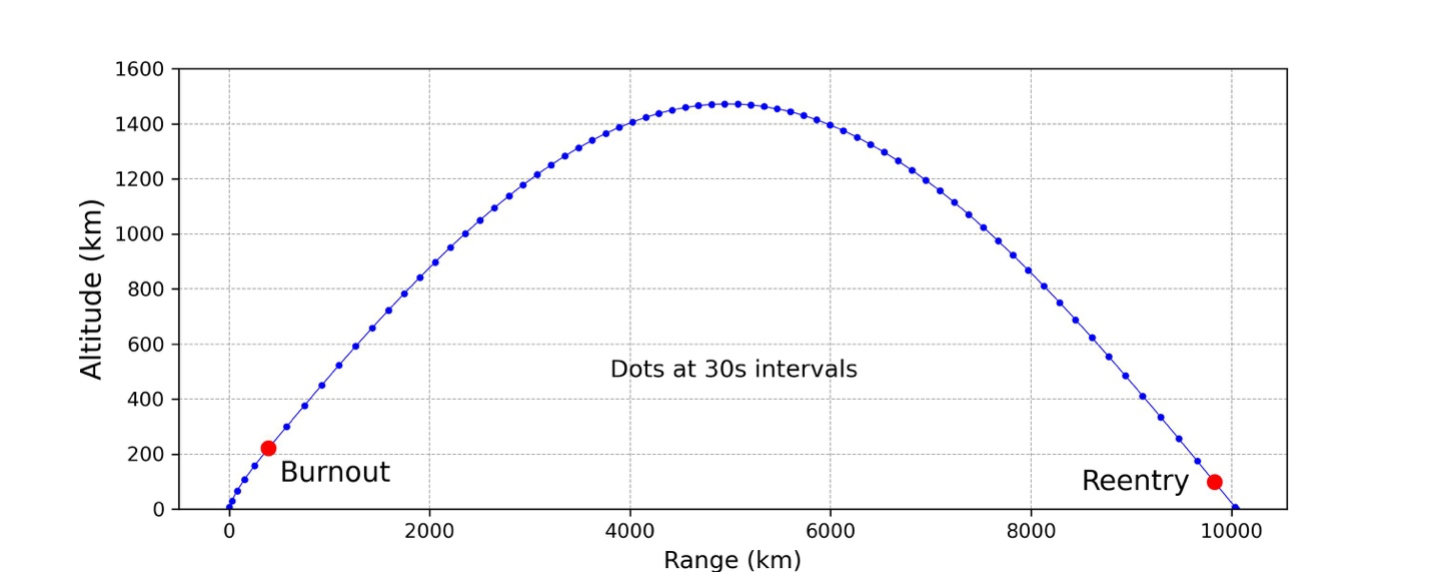
The booster’s speed at the end of the boost phase determines the distance a warhead travels, just as the speed of a ball when it is released determines how far it travels. Long-range missiles typically have speeds of 6 to 7 kilometers per second at burnout—some 25 times faster than a passenger jet.
The midcourse phase makes up most of a missile’s trajectory and, if the missile is covering an intercontinental distance, can last for roughly 30 minutes. This phase occurs in outer space, above the atmosphere. The warheads and decoys are not powered and travel on ballistic trajectories under only the influence of gravity.
The reentry phase, when the warhead reenters and travels through the atmosphere, lasts only a minute or less. The warheads and decoys experience air resistance during reentry, and lightweight decoys would be swept aside.
Long-range missile defense today: ground-based midcourse interception. The United States now deploys a strategic defense system, the Ground-based Midcourse Defense (GMD), whose 44 interceptors are based in silos in Alaska and California. The Pentagon will deploy additional interceptors as part of Golden Dome.
Intercepting warheads during midcourse has two advantages. This phase lasts for tens of minutes, which allows significant time for the defense to track the warhead using space- and ground-based sensors. And because the warheads follow a simple ballistic trajectory determined only by gravity during midcourse, the defense system can accurately determine future positions based on tracking data.
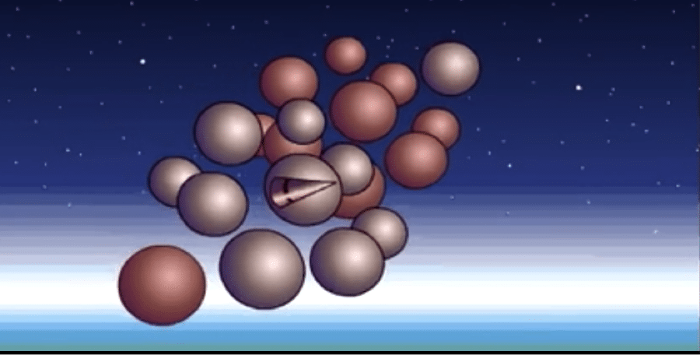
But midcourse defenses face a daunting problem: This phase of a missile’s flight occurs in outer space, where there is no air resistance, so lightweight objects follow the same trajectory as a heavy warhead. This opens the door to a wide range of countermeasures, including lightweight decoys to confuse and overwhelm the defense (see Figure 2). Any country that could build a long-range missile and a nuclear weapon small enough to put on it would have the capability to deploy these straightforward countermeasures. And therefore, despite decades of work, the midcourse countermeasure problem remains an unsolved challenge.
A (future?) option: boost-phase defense. A potential solution to the problem of midcourse interception is boost-phase defense. This is a key motivation for Golden Dome’s call for developing such a system.
Midcourse missile defenses aim to hit and destroy a warhead, whereas boost-phase defenses attempt to destroy the missile booster shortly after launch—and at least 5 seconds before burnout of the missile’s booster rocket—to prevent the warhead from reaching the speed it needs to get to its target.[2]
Because the boost time is short, interceptors must be positioned close to a missile’s launch site so they can reach the missile while its rocket motors are still burning. Interceptors based on drones or ships might be able to intercept missiles launched from a relatively small country like North Korea, depending on the boost time of its missiles. A global boost-phase defense, however, would require placing interceptors in space, in low-altitude orbits (300 to 500 kilometers in altitude) that pass near the missile’s trajectory during its boost phase.
In principle, space-based boost-phase interceptors could defend against missiles launched from Russia, China, North Korea, and Iran (should Tehran develop nuclear-armed missiles in the future). But how feasible is such a missile defense system?
A space-based system would consist of interceptor-satellites, each of which would include a kill vehicle designed to physically collide with the body of a missile while the missile’s engines are burning, and a rocket booster that accelerates the kill vehicle out of orbit and toward its target.
If the defense detected a missile launch, it would determine which interceptor (or interceptors) would pass close enough to the missile’s predicted trajectory to attempt an intercept. That interceptor would fire its booster and propel the kill vehicle toward the boosting missile. The kill vehicle would then use its own sensors to track the booster and its own thrusters, propellant, and guidance system to maneuver as it approaches the boosting missile to collide with it.
While in orbit, the interceptor would be carried in a “lifejacket” that shields it from the space environment and carries the solar panels that provide power, as well as other equipment. That lifejacket would be left behind when the interceptor accelerates toward its target, and its mass is estimated at roughly half that of the interceptor.
Despite their perceived potential, space-based boost-phase defense systems face serious technical problems.
The first is that the boost phase is very short. US and Russian long-range missiles, which use solid propellant, burn out in about 3 minutes, and China’s are believed to do the same.[3] While North Korea’s older, liquid-propellant missiles burn for 4 to 5 minutes, its more recent Hwasong-18 missile uses solid propellant and reportedly burns out in 170 seconds. If Iran develops or acquires long-range missiles, they are expected to use solid propellant.
The warhead or warheads and any decoys and other countermeasures can be released within tens of seconds after the end of boost phase, and there are techniques that could be implemented to allow current missiles to deploy such objects by the end of boost phase.
The short boost time requires the interceptor’s rocket motor to be large enough to accelerate the kill vehicle quickly to very high speed. The large amount of propellant the interceptor must carry accounts for most of the interceptor’s mass. Past technical studies have shown that this results in interceptor masses of many hundreds of kilograms.
A very large number of orbiting interceptors is required even to cover a relatively small launch area
Second, the interceptor-satellites in low-altitude orbits move relative to the surface of the Earth, both because they are traveling in their orbits and because the Earth is rotating under their orbits. An interceptor that at a particular moment is in position to intercept a launched missile will therefore quickly move out of position, and another interceptor must be in place to move into position so there are no gaps in coverage. This means that a very large number of orbiting interceptors is required even to cover a relatively small launch area on the ground, such as North Korea, and even against a small number of attacking missiles.
Third, atmospheric drag will eventually cause satellites in low-altitude orbit to spiral towards the Earth, where they will burn up in the atmosphere. This means the entire constellation of satellites must be replaced every four to five years, at a cost similar to deploying it in the first place.
These high costs may make these types of systems untenable. Space Force Gen. Michael Guetline, who heads Golden Dome, recently told Congress that “[I]f boost-phase intercept from space is not affordable and scalable, we will not produce it.”
Can Brilliant Swarms provide boost-phase defense? Since the goal of Golden Dome is to build missile defenses in the next few years, it must rely on existing space-tested technology rather than possible future systems. Under this assumption, the kill vehicle alone (without its propellant and thrusters) would have a mass of about 30 kilograms. Based on previous studies, we also calculate that it would need about 65 kilograms of propellant to intercept a boosting missile, giving a total kill vehicle mass of 95 kilograms.
The mass of the kill vehicle alone would exceed the mass of the entire interceptor-satellite described in the Booz-Allen proposal. The full interceptor mass also includes the massive rocket booster that accelerates the kill vehicle. Mass calculations alone make it clear that the Brilliant Swarms proposal—which posits 80-kilogram interceptors—could not provide a boost-phase defense.
We calculated the booster mass required by a boost-phase defense using the constellation Booz Allen presented in its press conference. The constellation included 2,000 interceptors with 20 groups of five interceptors distributed in each of 20 orbits (see Figure 3), and Booz-Allen cited an orbital altitude of 300 to 600 kilometers; we assume an altitude of 300 kilometers, a conservative value making the task of the defense easier.
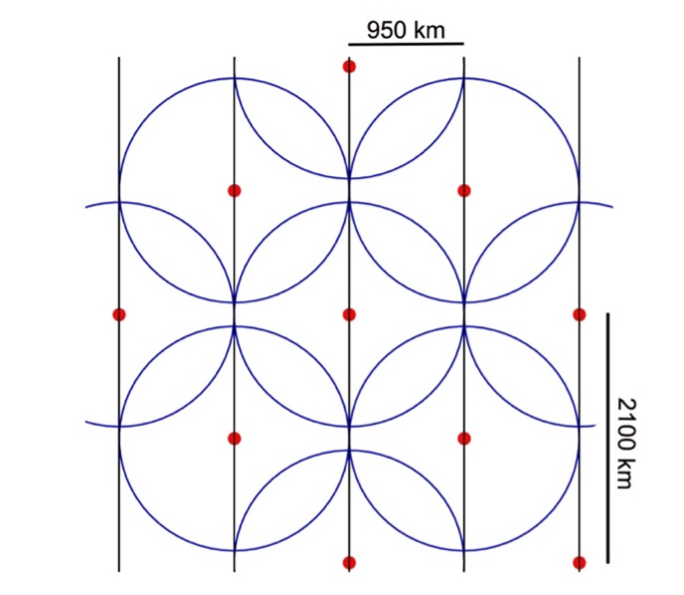
Each interceptor will have a region around it called the “coverage area,” throughout which it must be able to intercept a missile for the system to provide full defense coverage. The interceptor must be able to travel anywhere in the coverage area before the attacking missile burns out. It must also fly some distance above or below this area depending on the intercept altitude.
To be effective, the system must defend against missiles launched at 25 degrees latitude or above, which includes Russia, China, North Korea, and Iran. At 25 degrees, orbits would be separated by about 950 kilometers, which is then the radius of the required coverage area for each interceptor. Because some of the circles will overlap, some areas will be covered by two sets of interceptors.
Previous technical studies have shown that it would take about 45 seconds after launch to detect the missile and track it long enough to determine a “firing solution”—namely, which interceptor (or set of interceptors) could reach the missile while it is boosting. Launching an interceptor at this time—or earlier—may not be a wise strategy.[4] These past studies have recommended allowing an additional 30 seconds of decision time before firing an interceptor, giving it 100 seconds to reach a booster with a 3-minute burnout time and hit it 5 seconds before burnout.
Even for the unwise case of zero-decision time, assuming a kill vehicle like the one described above, each interceptor would need to have a rocket booster that brings the interceptor to a mass of more than 14 tons. The mass of the full satellite carrying such an interceptor would be roughly 20 tons—or some 250 times that of the proposed Brilliant Swarms satellites. Providing two-on-one targeting against a salvo of five missiles would require a constellation of 4,000 satellites with a total mass in orbit of some 80,000 tons—again, to be replaced every 5 years or so.
Booz Allen describes its proposed system as a boost-phase defense. Physics shows that the proposed system could not provide such a defense.
A midcourse defense? A system with lightweight interceptors and large spacing between them has all the hallmarks of a midcourse defense.
As noted above, for midcourse intercepts, the kill vehicles would have a much longer time—15 minutes or longer—to fly to their targets. The interceptor mass could be relatively low for two reasons. First, the long flight time would require a less powerful booster. Second the kill vehicle would require less propellant for endgame maneuvering since the trajectory of an object in midcourse is determined only by gravity, so that the intercept location could be determined accurately by tracking.
Last fall, the Pentagon called for proposals to develop space-based midcourse interceptors. However, doing so simply resurrects the problem boost-phase defense was intended to avoid: A midcourse defense—whether based on the ground or in space—faces the unsolved problem of decoys and other countermeasures.
A space-based midcourse defense would be much more expensive than a ground-based one like the current US system, and no more effective.
Other space-based boost-phase systems. Aside from Booz Allen, none of the recipients of Pentagon funding to develop space-based boost-phase defenses has provided public information about its plans. To understand what type of satellite arrangement these systems might use, we considered a different arrangement of boost-phase interceptors than the one Booz Allen described: the hexagonal constellation.
In particular, placing interceptor-satellites in a hexagonal pattern with a single interceptor at each location is an efficient way to cover space (see Figure 4). The orbit spacing changes with latitude so the interceptor spacing is chosen to leave no gaps in coverage at the lowest latitude from which a missile attack might be launched. As noted, for a potential Iranian missile, that latitude would be about 25 degrees.
At the minimum latitude, this arrangement provides coverage against a single missile over about 80 percent of the sky and against two missiles in the remaining 20 percent of the sky where the coverage circles overlap. Those fractions change slowly as the latitude increases, and there is more overlap of the circles. At 45 degrees, near North Korea and Chinese missile fields, roughly half the sky has single coverage; most of the rest has double coverage, with about 5 percent of the sky having triple coverage.
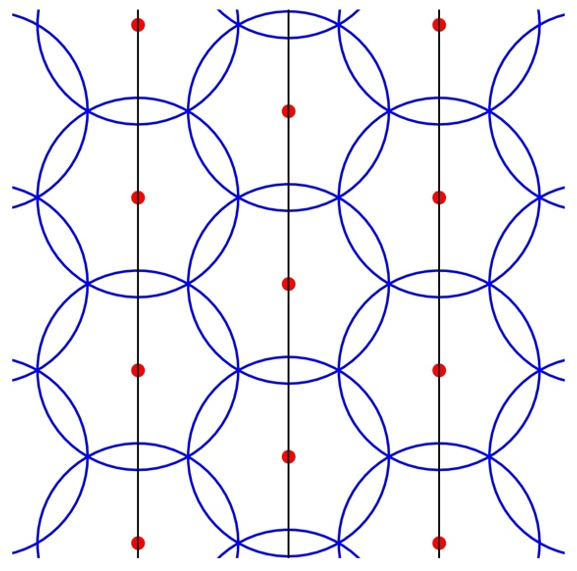
The spacing of the interceptors and the size of each interceptor’s coverage area is set by the speed of the interceptors, which determines how far they can travel during an attacking missile’s boost phase. This means there is a tradeoff between the amount of fuel required for each interceptor, which determines its mass, and the number of interceptors required in the constellation.
Our calculations show that if the interceptors carried the kill vehicle described above with a mass of 95 kilograms, the mass of an interceptor-satellite with a speed of five kilometers per second would be more than 1,100 kilograms each, which is consistent with previous technical studies.
This constellation would require some 4,200 of these interceptor-satellites in orbit to provide complete coverage against a single missile, assuming two-on-one targeting and 30 seconds of decision time before firing the interceptor. A constellation that could defend against just five missiles in a salvo would therefore need 21,000 interceptors and would require launching 24,000 tons into space.
This total mass is only 30 percent of the 80,000 tons in orbit we calculated for the Brilliant Swarms constellation, even though we assumed zero decision time for that case. But even if the plans of other companies call for constellations similar to the hexagonal constellation arrangement just described, there are fundamental reasons why such a system could not provide a reliable missile defense.
Countermeasures to boost-phase defenses. Countries could take numerous countermeasures to boost-phase defenses, using existing missiles and technologies they could deploy if a boost-phase defense were built.
Current missiles can maneuver during boost phase, which changes the location of the intercept point that the defense must hit. This can prevent the defense from firing an interceptor, or if it does fire, can exhaust the interceptor’s fuel supply as it maneuvers to reach the changing intercept point. This countermeasure could be particularly successful against interceptors fired early during a missile’s boost phase (described here as zero decision time).
Moreover, overwhelming a boost-phase defense would be easy and highly effective.
If the defense were designed to intercept a salvo of five missiles, the attacker could launch a salvo of more than five missiles. The attacker could also launch inexpensive decoy boosters without nuclear warheads, in which case the defense would not distinguish the decoys from real missiles. Such an attack by Russia or China could completely overwhelm the defense.
Satellites in low-altitude orbits are also vulnerable to direct attack and to jamming of communications with ground sensors and other interceptors. Experts view the vulnerability of satellite constellations as an important issue that must be addressed. For example, inexpensive, short-range missiles carrying direct-ascent interceptors could destroy the satellites prior to the launch of long-range missiles, creating a hole in the defense.
If the United States had a serious plan to deploy a boost-phase defense and began to do so, other countries could take additional steps to render the defense ineffective. The calculations above assumed a missile burn time of three minutes. A particularly effective countermeasure would shorten this time. Defense Department studies have shown that if boost-phase defenses become a concern, long-range missiles can be designed with boosters that burn out in less than a minute.
These potential adversary responses mean that a boost-phase defense will prove pointless.
As seems typical in its pursuit of long-range missile defenses, the Pentagon is developing systems capable only of defending against cartoonish versions of attacking missiles. Its current midcourse ground-based system is not designed to defend against real-world attacks, which would include decoys and other countermeasures. Now, the Pentagon is funding development of space-based midcourse defenses that would face the same countermeasures as the GMD system but would be far more expensive.
In the same way, the Pentagon’s thinking about space-based boost-phase systems seems geared to a world in which adversaries do not take one or more of several straightforward countermeasures. In essence, the Pentagon appears to assume the adversary will be cooperative or that the outside world is fixed.
Booz Allen’s proposed Brilliant Swarms system has no chance of providing an effective boost-phase or midcourse defense
Our analysis shows that Booz Allen’s proposed Brilliant Swarms system has no chance of providing an effective boost-phase or midcourse defense. The company was nonetheless awarded one of the Pentagon’s first grants to develop a system of space-based satellites. Other awardees are likely taking different approaches, but their systems will also be technically unable to deliver a useful and cost-effective defense capability.
Even though long-range missile defenses will be ineffective, if the United States deploys interceptors in space, it will push its adversaries to engage in worst-case thinking—all but guaranteeing increased tensions that exacerbate underlying risks and arms racing. Doing so could make adversaries believe the United States is trying to gain the ability to launch a first strike and then protect itself behind a broad set of defenses. While many countermeasures are available, these countries may want a more visible response and simply build more missiles. Even a small constellation of space-based missile interceptors would be a potent anti-satellite weapon—likely causing US adversaries to respond in ways (including further development of their own anti-satellite weaponry) that undercut US and international security.
Building a space-based defense system that will have no meaningful defensive capabilities, cost hundreds of billions of dollars, and make the United States less secure is simply irresponsible and reckless.
Notes
[1] A video of the Booz Allen press conference on March 27, 2025 was posted at https://edge.media-server.com/mmc/p/s6yshtkc/, but is no longer publicly available.
[2] This attack on the booster is unlikely to destroy the nuclear warhead it propels. US, Russian, and presumably Chinese warheads include safety features that prevent a nuclear detonation unless the warhead has flown on its planned trajectory. However, if it crashed into land, the conventional explosive would detonate, spreading plutonium over the surrounding area. This is still vastly better than a nuclear explosion and would be considered a successful intercept. It is not known whether North Korean warheads have such a safety feature, without which the warhead would undergo a nuclear detonation at the end of its trajectory, but not at the planned target.
[3] Burn times of US Minuteman III ICBM stages can be found at astronautix.com and give a total burn time of about 180 seconds; the Trident II missile burn time is given as 181 seconds in John Harvey and Stefan Michalowski, “Nuclear Weapons Safety: The Case of Trident,” Science and Global Security 4 (1994): 261, https://scienceandglobalsecurity.org/archive/sgs04harvey.pdf; the MX/Peacekeeper burn time is given as 170 seconds in Ashton Carter, “Directed Energy Missile Defense in Space–A Background Paper,” U.S. Congress, Office of Technology Assessment, OTA-BP-ISC-26, April 1984, 7, https://www.princeton.edu/~ota/disk3/1984/8410/8410.PDF; Russia’s Start-1 satellite launcher uses the stages of the RT-2PM Topol ballistic missile, and a burn time of 186 seconds is given in Steven J. Isakowitz, Joshua B. Hopkins, Joseph. P. Hopkins, Jr., International Reference Guide to Space Launch Systems, Fourth Edition, (Reston, VA: American Institute of Aeronautics and Astronautics, 2004), 463.
[4] By 45 seconds, the missile will have traveled less than 20 kilometers, giving the defense very limited information on its ultimate trajectory—especially since the missile can change its direction during boost. Since there are few interceptors in the right place to attempt an intercept, launching an interceptor this early would risk wasting it on a missile flying on a trajectory it could not reach, or that would not pose a serious threat. For this reason, while presenters at the Booz Allen press conference argued that “advanced tracking” using AI would allow Brilliant Swarms to fire interceptors very early, doing so is not likely to be an effective strategy, even if technically feasible.








Leave a Reply