Congress has the power to fix the Trump-Saudi nuclear deal
By Alan J. Kuperman | Analysis | October 13, 2026
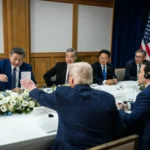
 The classified portion of the US-Saudi nuclear agreement that President Trump submitted to Congress includes a blank page labeled "to be filled in later"—making it impossible for lawmakers to certify that the deal complies with the law. (Illustration by François Diaz-Maurin; source images via canva.com)
Listen to this article:
Listen to this article
--:--
This audio was generated using an automated voice. Learn more.
Press reports claim that Congress cannot stop the Trump administration’s nuclear agreement with Saudi Arabia, despite significant proliferation concerns, because it will enter force automatically in a mere 90 days after its August 24 submittal to Capitol Hill. Democrats and a handful of dissenting Republicans could try to pass a disapproval resolution that was introduced recently in both houses. But President Donald Trump could veto it, and Republicans in Congress would not override that veto, which means the deal is essentially a fait accompli.
In reality, however, the prospects of Congressional action are not so bleak. Because of the US Atomic Energy Act’s fine print and the deal’s legal shortcomings, Congress has at least 9 months and considerable leverage to make things right.
Proliferation concerns. Three aspects of the Saudi deal are most objectionable. First, the agreement explicitly refers to uranium enrichment “technologies that could be deployed in the Kingdom of Saudi Arabia.” The danger is that any enrichment technology provided for peaceful purposes could also make weapons-grade uranium or be duplicated to do so secretly elsewhere in the country. Moreover, allowing Saudi enrichment could spur similar demands from other countries in the region and beyond, spreading the risks.
Second, the Saudis have refused to sign the Additional Protocol of the International Atomic Energy Agency (IAEA), which allows “environmental sampling” to detect illicit nuclear activity at sites “other than those” disclosed by the country. Riyadh instead has signed a bilateral safeguards agreement with Washington, which does not permit such inspections of undeclared facilities. This feeds suspicion that the Saudis are contemplating secret bomb plants.
Third, the Saudis have said repeatedly that if Iran were to get nuclear weapons, they would pursue them too, which would violate their promises under the Nuclear Non-Proliferation Treaty. This means their commitment in the US deal to exclusively “peaceful uses” is, at best, conditional.
An illegal deal? Fortunately for Congressional Democrats, the Atomic Energy Act does not allow nuclear agreements to enter force automatically unless they are fully compliant with the law’s nonproliferation requirements. If such an agreement violates even one of those requirements, according to Section 123d of the act, it “shall not become effective unless the Congress adopts, and there is enacted, a joint resolution stating that the Congress does favor such agreement.” The Saudi deal currently appears not to comply on four grounds.
First, the law’s Section 123a requires UN inspections of “all” nuclear facilities in the country. However, the Saudis refuse to grant permission for such inspections at undeclared nuclear facilities. Neither their “comprehensive” agreement with the IAEA nor their bilateral agreement with the United States permits inspections at undeclared nuclear facilities. Despite this, the administration declares in its submission to Congress that the Saudi-IAEA agreement—which does not permit inspections at undeclared nuclear facilities—“shall be considered to fulfill” the law’s requirement for inspections of all nuclear facilities. That is Orwellian, essentially redefining “all” facilities as only the ones that the Saudis voluntarily reveal. The last time a US administration attempted such a stark end-run of the law’s requirements was in a 1987 nuclear deal with Japan. In that case, Congress requested the American Law Division of the Congressional Research Service prepare a detailed legal assessment, which raised questions about the agreement’s compliance. Congress could do that again this time, but more importantly, it should take the question to the courts, which increasingly have enjoined President Trump from willfully misinterpreting US law.
Second, the Saudis have delayed committing in writing not to misuse enrichment technology that the United States would provide for a bilateral study. The administration’s submission says only that, “The Parties expect to memorialize that understanding in an exchange of diplomatic notes.” Until such a commitment is documented in writing, the agreement cannot possibly comply with the law.
Third, as disclosed by Rep. Brad Sherman, the ranking Democrat on the House Middle East and North Africa subcommittee, “The classified portion of the Agreement includes a blank page labeled ‘to be filled in later.’” This too makes it impossible to certify that the deal complies with the law.
Fourth, two side-letters between Saudi Arabia and the Trump administration have not been publicly released. As a bipartisan Senate group recently told the administration, sharing these with the American people is essential “to have a clear understanding of the commitments … being made by Saudi Arabia.” Therefore, they also are needed to determine if the deal complies with the law.
It seems unlikely that both houses of Congress would vote affirmatively to approve the pending agreement, as required if it indeed violates the law, because the Republicans have razor-thin majorities and several members who already have expressed concerns about the deal.
After the elections. If the Trump administration could convince the courts that the pending deal complies with the law—or if the Saudis would accept changes to bring it into compliance—the agreement still could not automatically enter force quickly. The statute says the 90 days must be of “continuous session.” This includes only days when both houses of Congress are in session or in a recess of less than four days—not when either house has authorized a longer “adjournment.”
As the November elections approach, Congress is taking long recesses. It was in one when the agreement was submitted, and since then the clock has run for only about one week and likely will remain stopped until November. That means this Congress will end before the 90-day period expires, thereby invalidating Trump’s submission of the Saudi deal, unless Congress votes to approve it before then.
Next January, a new Congress will convene. Trump could resubmit the agreement to Congress, but the Saudi deal’s clock would reboot to zero and then likely require at least five more months to reach 90 days. (When a Congress ends, the previous submission is no longer valid, and the agreement must be resubmitted. “Continuous session” does not extend from one Congress to the next.) One or both houses might also be controlled by Democrats, giving them more institutional power to insist the agreement does not comply with the law and therefore cannot enter into force without an affirmative vote.
Such prospects mean that even today the Democrats have greater leverage than reported—perhaps more than they themselves realize.
The Democrats’ best strategy would be to offer to vote in favor of the Saudi agreement this session—but only if an approval resolution included two stipulations. First, Saudi Arabia must sign the IAEA’s Additional Protocol, allowing inspections of suspected secret nuclear facilities. Second, any enrichment or reprocessing under the deal must be conducted in the United States, thereby promoting the US “Gold Standard” objective of not allowing any new countries to acquire such bomb-prone technologies.
President Trump has put himself in this box. If he had finalized the text rather than inserting placeholders—which cannot satisfy the law’s requirements because they make it impossible to determine if the agreement is compliant—and submitted it to Congress during the first 15 months of his term, it might well have gone into force automatically.
Instead, the president waited too long and then submitted an incomplete agreement. In so doing, he handed all the cards to the Democrats. They should play them now.
Together, we make the world safer.
The Bulletin elevates expert voices above the noise. But as an independent nonprofit organization, our operations depend on the support of readers like you. Help us continue to deliver quality journalism that holds leaders accountable. Your support of our work at any level is important. In return, we promise our coverage will be understandable, influential, vigilant, solution-oriented, and fair-minded. Together we can make a difference.
Keywords: Saudi Arabia, Trump administration, US-Saudi nuclear deal
Topics: Analysis, Nuclear Risk
Get alerts about this thread
0 Comments
Oldest

Alan J. Kuperman
Alan J. Kuperman is an associate professor and coordinator of the Nuclear Proliferation Prevention Project at the LBJ School of Public Affairs, ... Read More