The US-Saudi nuclear deal isn’t dead—It’s dragging Washington into nonproliferation quicksand
By Sharon Squassoni | Analysis | July 30, 2026
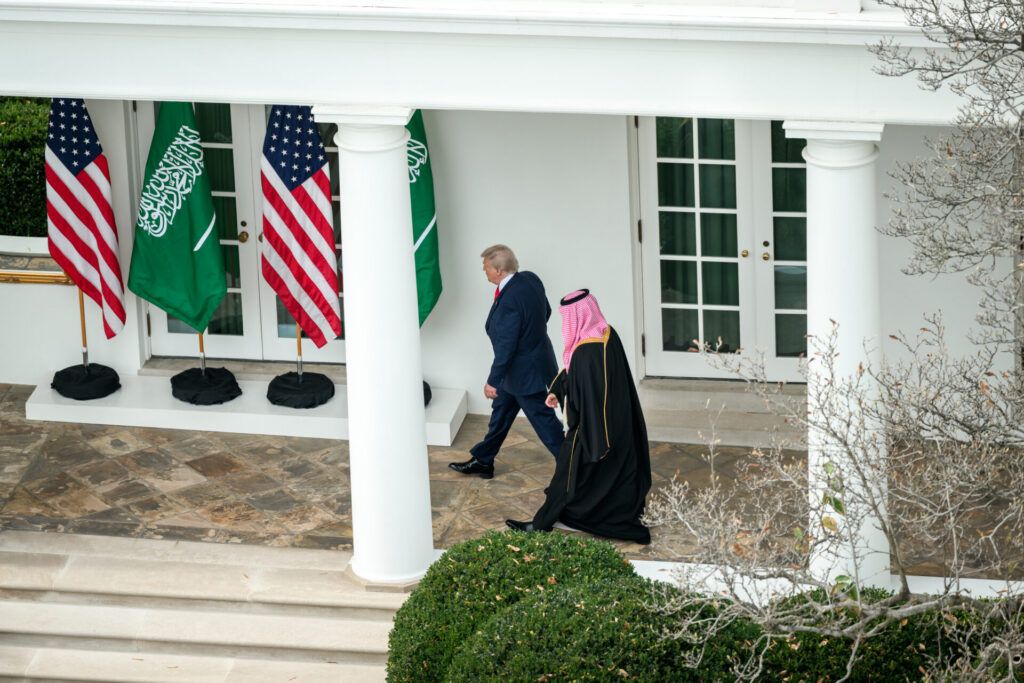 Behind President Trump's claims that uranium enrichment is off the table, the administration's deal with Saudi Arabia risks overturning 50 years of nonproliferation policy and dragging Washington straight into a Middle Eastern nonproliferation trap. (Photo by Molly Riley/White House)
Listen to this article:
Listen to this article
--:--
This audio was generated using an automated voice. Learn more.
The Trump administration continues to flounder about its nuclear aims in the Middle East. The on-again, off-again war to get Iran to give up its nuclear program appears no closer to resolution, despite continued efforts to broker peace. And the very capability that triggered the US-Israeli attack on Iran—uranium enrichment—was on the menu of a nuclear cooperation agreement recently signed between the United States and Saudi Arabia—until President Donald Trump declared it was off the menu. In an abrupt turnabout, the president declared on July 23, one day after the signing of the agreement, that the Saudis would have to normalize relations with Israel by means of signing the Abraham Accords before moving ahead with the nuclear deal.
Is the deal dead or on hold? Three elements of the negotiations so far suggest that rumors of its death are premature.
First, this deal is not a spur-of-the-moment fantasy President Trump has dreamt up—although it may have started that way in the first Trump administration. The Biden administration also made nuclear cooperation with the Saudis contingent on the kingdom recognizing Israel and included some form of uranium enrichment capability to sweeten the deal. But the October 2023 attack on Israel dramatically shifted the political landscape and put talks on ice. Saudi Arabia, which traditionally has tied its recognition of Israel to Palestinian statehood, may see such statehood as an increasingly distant prospect.
Second, the Saudi enrichment option has been an integral part of the deal. We know this because of reports that the deal requires a two-year study of the commercial feasibility of uranium enrichment on Saudi soil and that US enrichment technology would be protected by using a “black box” approach. We also know this because the White House told Congress last fall that it had negotiated a bilateral safeguards agreement at the same time to cover sensitive fuel cycle facilities. If enrichment is part of the deal, it must be because the deal is important to both the United States and Saudi Arabia.
Third, whether the Saudis sign the Abraham Accords or not, transmitting the agreement to Congress in a timely fashion almost ensures its passage. Congress has but 90 days of continuous session to disagree, either by passing a joint resolution of disapproval or passing a veto-proof bill. If the agreement had been submitted when signed, it could enter into force as early as the end of October. However, if the president seeks to pressure the Saudis into signing the Abraham Accords by withholding transmission of the agreement, he could jeopardize its approval. Given the current target adjournment date for the Senate of December 18, President Trump effectively has about two months to convince the Saudis that their future aligns with that of Israel. Failing that, the agreement would need to be submitted to the next Congress, which may not look so favorably upon this cooperation agreement.
There is every reason to believe that the Saudis will call Trump’s bluff by simply sitting back and waiting, confident that the Trump administration will succumb to the pressure of meeting the 90-day review period. If so, Trump officials may double down on the “no enrichment” narrative to stress that the risks of engaging in nuclear cooperation with the kingdom are low, while arguing at the same time that nuclear commerce will make Saudi Arabia feel more secure—not less—therefore improving the chances of eventual rapprochement with Israel.
Congress and the American public should read the fine print of the deal, which has not yet been publicly released.
To enrich or not to enrich? Why are President Trump, Energy Secretary Chris Wright, and several other Trump officials claiming that the deal does not include enrichment? For example, Trump posted on social media on Thursday morning that there will be no enrichment as part of the deal with Saudi Arabia. Then on Sunday, US Ambassador to the UN Mike Waltz repeated the president’s claim that the agreement does not give enrichment technology or enrichment capability to Saudi Arabia. Waltz also stated that there would be no enrichment on Saudi soil, adding that all the enrichment would be done in the United States.
There are several possible explanations for these claims.
First, the agreement might contain the usual language, which leaves pathways for enrichment but doesn’t guarantee it. Here, the president and the energy secretary may be technically accurate because framework agreements contain permissions and potential permissions rather than actual technology and equipment. Waltz, however, may have overstepped his mandate by claiming that there would be no enrichment on Saudi soil or that all the enrichment for Saudi Arabia would be done in the United States. The latter kind of agreement is more typical of 1950s-style agreements, in which the United States required recipients to buy their reactor fuel only from the United States.
The conclusion of a bilateral safeguards agreement to cover sensitive fuel cycle cooperation, however, would not have been necessary if the parties did not envision such cooperation. If finalized, this arrangement would be unique among all modern US nuclear cooperation agreements (also known as “123 agreements,” after Section 123 of the Atomic Energy Act).
If the safeguards are meant to cover elements of the fuel cycle besides enrichment, this raises other questions. It is unlikely that uranium conversion (the step before enrichment) and fuel fabrication would warrant such arrangements. But if it is intended to cover reprocessing of used nuclear fuel to produce plutonium, collaboration would require the United States to seek exemptions from Section 102 of the Arms Export Control Act (the Glenn amendment), which turns off US aid and imposes sanctions against countries that import reprocessing technology, materials and equipment, regardless of safeguards status. Saudi Arabia would lose a mere $5 million in economic aid from the United States if such sanctions were triggered, a paltry amount compared to the $4 to $5 billion the United States receives from the kingdom each year in return for military equipment.
Provision of enrichment equipment would also trigger Section 101 of the Arms Export Control Act if the arrangement does not have multilateral auspices and management. The United States might argue that the bilateral safeguards arrangement for fuel cycle facilities, which would include IAEA inspections in some form, is multilateral, but it will be harder to argue that the deal involves multilateral management.
Waltz’s comments suggest that US officials might not be serious about a reported two-year study of the commercial feasibility of uranium enrichment on Saudi soil. The most telling element of the agreement, reported by the Wall Street Journal, is the provision for a 10-year cooling-off period in case the two-year study does not bless Saudi uranium enrichment. In effect, the Saudis would be barred from seeking enrichment technology from other international partners for that length of time. Perhaps Waltz meant to say that the Saudis would not enrich for 12 years—it’s hard to tell.
All these explanations suggest the Trump administration is indeed serious about providing some kind of enrichment capability to Saudi Arabia. This is a radical departure from 50 years of US policy of containing the spread of nuclear fuel cycle capabilities.
What’s in a black box? One defense of providing enrichment technology is that it can be “black-boxed.” This would mean that Saudi nationals would not have access to sensitive nuclear information.
In theory, the idea is to protect key information that could help a foreign national build a clandestine enrichment plant or divert material within the plant for further enrichment for nuclear weapons. This could include details of centrifuge design (rotor materials, wall thickness, rotational speeds, bearing types) and cascade configurations, including how many centrifuges are linked together and in what arrangement. A black-box approach would likely encompass blueprints, operating data, information about materials, equipment, and approaches.
Have we done this before? Yes, with URENCO centrifuge technology. And no, not with any country that didn’t already have design knowledge of centrifuges. Twenty years ago, after the United Kingdom, the Netherlands, and Germany had developed their own centrifuge technologies nationally, the consortium of the three (URENCO) hived off the technology in a separate company, the Enrichment Technology Corporation. Operators of URENCO centrifuge facilities in the United States and Europe do not have access to the underlying technology. The firebreaks are not absolute, however. In practice, classified information may be shared to ensure the safe operation of the plants, which in the US case means that a small number of Nuclear Regulatory Commission staff and URENCO USA staff have been provided some classified design information. Would this be a problem in the Saudi case?
A separate question is how to handle facility operation data, which the United States classifies as Restricted Data. Will Saudi nationals be involved in operating and maintaining the plant? How would Saudi Arabia handle legal liability, safety, and security if not involved in operations? In practice, operators consider access to the cascade halls to be rather revealing, which is why IAEA inspectors refuse to be denied access, although operators have developed ways to manage what they see. Would Saudis be content with providing the IAEA with more access than they have themselves?
Whatever the arrangements, the location of an enrichment plant in Saudi Arabia will act in many ways to mask potential indicators of clandestine activities, perhaps with the aid of Pakistan or China. Fuel cycle facilities like enrichment and reprocessing are notoriously difficult to monitor in terms of material that goes missing, providing a greater opportunity to hide clandestine activities.
No-compete clause. From limited reporting, it appears that the nuclear deal commits Saudi Arabia to purchase Westinghouse nuclear power reactors and to refrain from seeking enrichment technology from foreign partners for 10 years, should the United States refuse to provide it.
In the case of purchasing US nuclear reactors, it is hard to see how the United States can hold Saudi Arabia legally to such a commitment. When the United States signed a nuclear deal with India 20 years ago, there was every expectation that reactor sales would follow, but this has not been the case, and India turned to other partners, including France. The provision of uranium enrichment to Saudi Arabia, in contrast, would offer a powerful incentive for the Saudis to follow through on a commitment to buy reactors from American firms or American-led consortiums. Congress should consider whether the proliferation risk is worth the $40 to $60 billion that would result from the sale of a handful of reactors. (By comparison, in 2025 the United States announced a $142 billion sales agreement with the kingdom for conventional weapons).
One important uncertainty in the entire arrangement is what enrichment technology the United States seeks to deploy on Saudi soil. The only US-designed centrifuges now operating in the United States are the AC-100Ms, which produce high-assay low-enriched uranium (HALEU) fuel for use in advanced reactors. These centrifuges can be configured to enrich at commercial levels (about 4- to 5-percent uranium 235), but the individual centrifuges produce 350 Separative Work Units (SWU, which is a measure of the effort and capacity required to enrich uranium using gas centrifuges) per machine—orders of magnitude of capability higher than the 8 to 10 SWU per machine that US officials are most concerned about in Iran. Another uranium enrichment technology, albeit not yet commercially available and still posing significant proliferation risks, is separation of isotopes by laser excitation (SILEX) developed by the Australian-Canadian company GLE.
Nuclear quicksand. Like quicksand, the US-Saudi nuclear deal may seem solid on the surface but is subject to change under pressure. It stands on the assumption that a Saudi Arabia on better terms with Israel and facing a significantly weakened Iran would have few motivations to acquire nuclear weapons. From this perspective, Saudi Arabia would be less likely to use peaceful nuclear cooperation to pursue a clandestine nuclear weapons program.
If this were the case, however, the Saudis would show no resistance in adopting the IAEA’s Additional Protocol to its comprehensive safeguards agreement. This would provide the highest assurances that the Saudi nuclear energy program is driven by peaceful intentions. Saudi fuel cycle decisions would also be guided by economics, not prestige or politics. This would suggest relying on the international market for fuel services, like the United Arab Emirates’ gold standard. The United States, the world’s largest deployer of nuclear energy, has proven a thousand times over that relying on commercial markets for uranium enrichment and foregoing spent fuel reprocessing are the two most economically effective approaches for civilian nuclear energy.
The notion that a close ally without strong proliferation motivations can be trusted with fuel cycle capabilities is not a new one.
Japan’s technical capabilities to enrich uranium and reprocess spent nuclear fuel to produce plutonium are rarely criticized, as it is seen as above reproach in terms of proliferation risk. But private conversations in Japan among experts will often yield the conclusion that such latent capabilities are a nuclear weapons insurance policy. A similar narrative is being crafted now for South Korea, which pursued a clandestine nuclear weapons program in the 1970s but later abandoned it under US pressure. While political dynamics can change rapidly and for the better, the underlying physics of the nuclear fuel cycle does not: The same processes can yield fissile material that countries choose to—or choose not to—divert to military explosive purposes. Monitoring under the Nuclear Non-Proliferation Treaty (NPT) will be as good as we have seen in the case of Iran.
Up to now, the United States has never transferred enrichment or reprocessing technology through its civilian nuclear cooperation program to other non-nuclear-weapon states because of legal and policy restrictions based on proliferation risk. Sharing sensitive fuel cycle technology with Saudi Arabia now would be the equivalent of wading into that nuclear quicksand, with the potential to get dragged down into a proliferation spiral. For if Saudi Arabia is a good ally, why not then also Turkey, the United Arab Emirates, or other countries in the Middle East?
Congress: Sit up and take notice. Nuclear nonproliferation was for many years a bipartisan affair in Congress because the spread of nuclear weapons was something both sides could agree was a bad thing, both for economic and security interests of the United States. Support for the global expansion of nuclear energy also seems to be bipartisan now. But Congress needs to be nuanced here and understand that some kinds of nuclear sales bring more proliferation risks than others.
Sen. John Kennedy, a Republican from Louisiana, noted the irony: “We’re bombing a country to keep them from getting a nuclear weapon, but we’re signing a deal with another country, I know it’s a commercial agreement, but that the world perceives, as possibly, someday, leading to a nuclear weapon.”
How can Congress, therefore, ensure this deal does not lead to nuclear weapons?
Congress should hold hearings, early and often, with mixed panels of government and non-governmental experts. Congress should be most interested in how Israel might react if the agreement enters into force without a Saudi-Israeli normalization agreement. Without resolution of the war on Iran, how motivated is Saudi Arabia to pursue nuclear weapons? How would an agreement that includes Saudi enrichment affect Iran’s future plans?
Congress should pay particular attention to the two side letters the administration has made with Saudi Arabia, and demand copies of them if they do not accompany the 123 agreement itself. President Trump’s July 16 determination about the agreement, published in the Federal Register, made specific mention of those letters and the bilateral safeguards agreement. Members should ask how the administration plans to ensure contracts for Westinghouse reactors and who will conduct the two-year study on enrichment. If Saudi Arabia chooses another enrichment provider down the road, how will the United States minimize the proliferation risks?
Congress members should demand technical details of black box approaches for uranium enrichment and an assessment of potential enrichment suppliers under this deal and the prospects for foreign suppliers of enrichment to Saudi Arabia. Members should also demand an assessment of Russian and Chinese intentions and proposals regarding Saudi nuclear cooperation to ascertain whether Russia and (or) China have ever offered enrichment.
Most important, US lawmakers should require the administration to share the text of the bilateral safeguards arrangement and request an analysis of the information on Saudi Arabia’s nuclear program that will not be available because it has not concluded an Additional Protocol. What mechanisms could help prevent Saudi Arabia from nationalizing any enrichment facility in the future?
These inquiries could be handled as questions for the record or added as reporting requirements in any final bill covering the nuclear deal should the administration fail to respond adequately during hearings.
Perhaps the most effective approach for Congress is to place conditions, large or small, on its approval of the deal. A big-ticket item would be support for President Trump’s idea of a normalization agreement with Israel, which would need to take effect before the nuclear cooperation agreement enters into force. Congress could also condition entry into force on the conclusion of the two-year study on enrichment, on a certification by the president of the absence of corruption in the nuclear sector in Saudi Arabia, and on an agreement by Saudi Arabia to forego enrichment and reprocessing permanently.
Finally, Congress should pay close attention to the Nuclear Proliferation Assessment Statement, both in its classified and unclassified form, that the Executive Branch must submit to Congress along with the agreement for review. A clear picture and transparent debate about the proliferation risks that nuclear cooperation with Saudi Arabia poses will reduce the panic that will follow if the United States chooses to wade into the nuclear quicksand.
Together, we make the world safer.
The Bulletin elevates expert voices above the noise. But as an independent nonprofit organization, our operations depend on the support of readers like you. Help us continue to deliver quality journalism that holds leaders accountable. Your support of our work at any level is important. In return, we promise our coverage will be understandable, influential, vigilant, solution-oriented, and fair-minded. Together we can make a difference.
Keywords: 123 agreement, Additional Protocol, Gold Standard, IAEA, IAEA safeguards, Iran, JCPOA, MBS, Middle East, Mohammed bin Salman, Saudi Arabia, Trump administration, US-Saudi nuclear deal, US-Saudi relations, executive orders, spent fuel reprocessing, uranium enrichment
Topics: Analysis, Nuclear Energy, Nuclear Risk
Get alerts about this thread
0 Comments
Oldest

Sharon Squassoni
Sharon Squassoni is a research professor at the Institute for International Science and Technology Policy, Elliott School of International Affairs, ... Read More