A blind spot in climate models: Slower tree growth in a warming world
By Jessica McKenzie | News | August 14, 2026
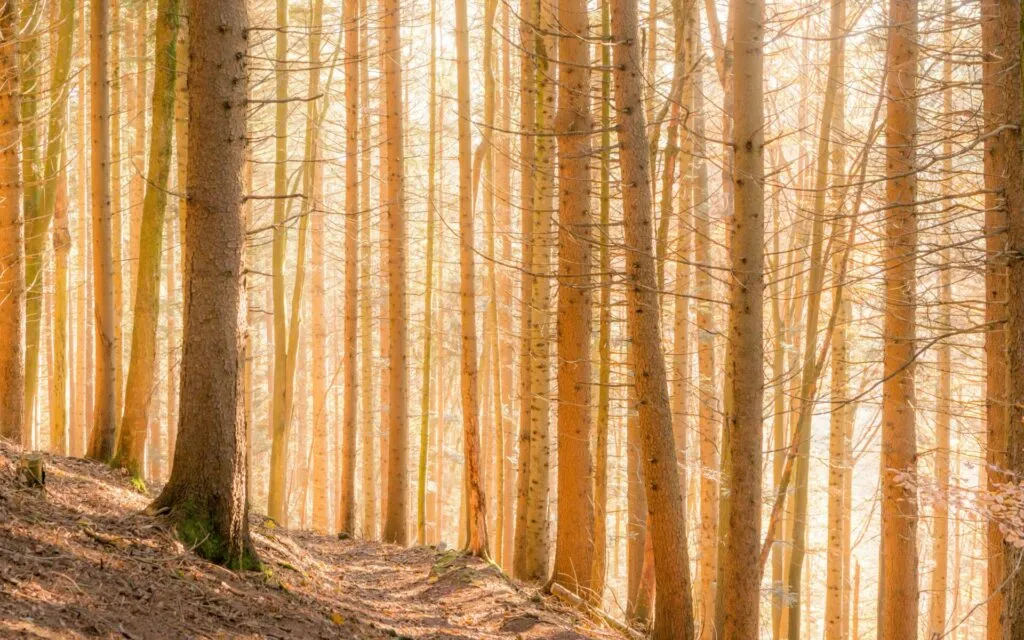 Earth system models could be overestimating future carbon storage by trees by up to 30 percent. (Photo by Christian Regg on Unsplash)
A new study suggests climate models may be overestimating how much carbon forests will absorb in a warming world, raising the possibility that global temperatures could rise even more than current projections anticipate.
Climate models are essential tools for scientists and policymakers, helping them forecast what will happen in the climate system over decades or even centuries. They incorporate the basic laws of physics, fluid dynamics, and chemical and biological mechanisms at work in the Earth system.
But as with all computer products, climate models are only as good as the data provided, and researchers at Cornell University say they’ve identified a potential flaw in many Earth system models that could be overestimating future carbon storage by trees by up to 30 percent.
“Right now, the land absorbs like, a third of all human carbon dioxide emissions, but as the climate warms and things get drier and hotter, that’s not going to stay the same,” says the lead author of the study, Brendan Clark, a postdoctoral researcher at Cornell. “The ability for the land to absorb carbon dioxide will change in the future, and that’s a really big uncertainty.”
The study’s finding points to potential blind spot in climate models, which assume forests remove a significant share of carbon dioxide emission from the atmosphere. As temperatures increase, however, trees are less able to convert the carbon they absorb into new woody growth and long-term carbon storage, meaning the current models may fail to capture the full risks of climate change.
Up to this point, most models for land carbon storage have assumed that new tree growth is correlated with how much carbon a tree produces through photosynthesis, which is partially determined by the amount of carbon dioxide in the air.
“Carbon dioxide is plant food,” is a popular factoid among so-called climate contrarians—those who disagree with the mainstream scientific consensus on manmade climate change. There’s an entire nonprofit, the CO2 Coalition, which was first led by former American Petroleum Institute CEO William O’Keefe, dedicated to this idea. It asserts that, under higher carbon dioxide concentrations in the atmosphere, plants and forests grow faster and crops yield more—a claim that was repeated in the climate report commissioned by the Trump administration’s Energy Department and roundly criticized by climate scientists.
However, a growing body of scientific evidence shows that there are limits to how much plants benefit from higher levels of carbon dioxide, especially under hotter, drier conditions. Researchers have found that corn, wheat, and barley yields have declined as a result of climate change. Perhaps more troubling, at least in terms of how much carbon dioxide nature can absorb in a warming world, is that North American oak trees are not converting carbon dioxide into woody growth when conditions are hot and dry, because they also need water to grow. Similar trends have been observed in forests in Switzerland, particularly in silver fir, beech, and spruce trees. This means that trees are sequestering less carbon long term.
This makes intuitive sense; who doesn’t remember learning in school that you can tell which years were wet and which dry by measuring growth rings in a tree trunk? But it’s not just rainfall that determines how much a tree will grow or how much carbon it can sequester. Humidity is also a big factor; when the air is hot and dry, trees will close their stomata—the pores that plants use to take in carbon dioxide and expel oxygen—to reduce water loss. This also limits the amount of carbon dioxide a tree can absorb for photosynthesis. And if tree cells don’t have enough water, they may not be able to use available carbon dioxide to make new growth.
Clark says that this information is particularly important for the next generation of climate models used by the Intergovernmental Panel on Climate Change. Before, scientists would provide an estimate for atmospheric carbon dioxide and then run the model to see what happens in the Earth system.
Climate scientist Zeke Hausfather says that these “concentration-driven runs” underestimate the uncertainty in carbon cycle feedbacks, or how the ability of the land and ocean to absorb emissions will change as the Earth warms. “These carbon cycle feedback uncertainties can be quite large and lead us to systematically underestimate future warming risks,” Hausfather tells the Bulletin. A 2020 analysis by Hausfather and Richard Betts estimated that these uncertainties could translate to nearly 25 percent more warming than the climate panel’s current projections.
With the newer, more sophisticated models that the next report will use, scientists provide annual carbon dioxide emissions, then run the model and see how much the land absorbs, how much the ocean absorbs, and then calculate how much carbon dioxide is emitted to the atmosphere afterwards. These models will better capture carbon cycle feedback uncertainties, but this new research suggests they could still overestimate the carbon storage by trees and forests in a warmer world.
Clark acknowledges that the work on this is still early and incomplete. When he started researching the issue last year, the only good data on how much carbon trees were or were not sequestering was from a study in Switzerland, which is what he based his analysis on. But since then there have been similar studies published on forests in North America, and other researchers are studying what’s happening in tropical forests.
Having accurate climate models is important for both climate adaptation and mitigation, Clark says. Climate models are used to forecast—and subsequently prepare for—numerous climate change impacts. These models are also used by governments to set and track emissions pledges. If countries assume that a certain amount of carbon dioxide will be absorbed by forests and other land sinks, they might underestimate the amount of emissions reductions they need to do to get to net neutral emissions.
“These models, a lot of them just say, okay, you keep dumping carbon dioxide into the atmosphere, carbon dioxide is basically plant food, they like that, they keep growing more and more,” says Clark. “I think for a lot of reasons, that’s probably overly optimistic.”
Together, we make the world safer.
The Bulletin elevates expert voices above the noise. But as an independent nonprofit organization, our operations depend on the support of readers like you. Help us continue to deliver quality journalism that holds leaders accountable. Your support of our work at any level is important. In return, we promise our coverage will be understandable, influential, vigilant, solution-oriented, and fair-minded. Together we can make a difference.
Keywords: IPCC, carbon storage, climate adaptation, climate change, climate mitigation, global warming, land degradation, trees
Topics: Climate Change

Jessica McKenzie
Jessica McKenzie is an editor at the Bulletin of the Atomic Scientists. Her work has been published in The New York Times, National Geographic, Audubon Magazine, Backpacker, The Counter, and ... Read More






A question almost no one is asking, at least not in public: How much permafrost is the current heat anomaly thawing this year? Methane emissions from former permafrost is a driver of global warming that almost no one talks about. Ton for ton, methane is about 80x more effectiv than CO2 for trapping Solar heat. If methane has not already overtaken CO2 as the primary driver of global warming, it will shortly. The bad news: This process is well underway, and will become a self driving feedback loop shortly if it has not already done so. Here’s a progress report:… Read more »
There was a study with field monitoring on a small scale a decade or so ago on the same crossing point question for .au Eucalypts with similar findings. I’ll try to find some references.
Glad you remembered the relationship of tree rings to climate. More heat means less CO2 sequestered in trees!
One aspect not covered as far as I can see is the reduced photosynthesis from the actions of glyphosate based herbicides (GBHs) and fluoride in phosphate fertilizers. In the last decade there has been a huge increase in the use of GBHs to desiccate crops prior to harvest. This, in effect, shortens the growing season, reduces total carbon sequestration and destroys the microbiota in soils, the reservoir for carbon storage. Although much less than forest reduction for alternative agriculture use this is a significant factor in CO2 sequestration, and inferior nutrient food value in animal and human diets.
It’s all well saying more co2 means more plant growth but if trees die because temperatures are too high this argument is invalid. It’s just anotger justification for the fossil fuel lobby to carry on as normal. Where I live, mitigation trees for a new housing estate have all died in the current drought and heatwaves. Says it all really.
Since when does the Bulletin uncritically report the views of : “a post-doctoral researcher at Cornell . . . who began studying the issue of forest growth factors last year ” and who claims that : “the only good data on how much carbon trees were or were not sequestering was from a study in Switzerland, which is what he based his analysis on.” Surely the Bulletin would agree that no paper should pass peer review that fails to integrate the information of the sum of previous papers in the field, whether that is to affirm or to refute individual… Read more »