President Trump wants a historic legacy. He should start by resurrecting Reagan’s nuclear diplomacy
By Juan Manuel Santos | Opinion | October 19, 2026
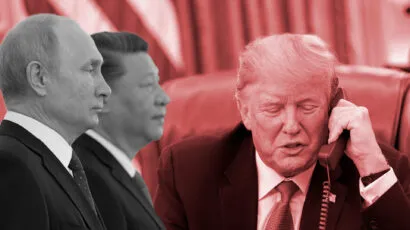
 Photo illustration by François Diaz-Maurin (source images: White House/Flickr, kremlin.ru/Wikimedia)
Listen to this article:
Listen to this article
--:--
This audio was generated using an automated voice. Learn more.
On October 11, 1986, US President Ronald Reagan and Soviet Leader Mikhail Gorbachev met in Reykjavik, where they confronted the threat of nuclear weapons and found common ground despite the Cold War. This historic meeting reduced the danger of nuclear war and led to major reductions in global nuclear weapons stockpiles.
Forty years on, in an increasingly dangerous world, President Donald Trump should take inspiration from Reagan’s leadership to address the resurgent nuclear threat.
The foundation of Reagan and Gorbachev’s commitment to removing the nuclear Sword of Damocles hanging over humanity was their shared understanding that “a nuclear war cannot be won and must never be fought.” This declaration, which came a year before the two leaders first met in Geneva, helped overcome their mutual distrust and underpinned subsequent efforts to pursue disarmament.
At the time, more than 70,000 nuclear weapons were hanging over the world. Some 12,000 nuclear warheads remain in existence today—enough to destroy humanity many times over. The nuclear threat today is also more complex. China is rapidly expanding its nuclear arsenal, US-Russia cooperation on arms control has broken down, and the integration of AI into nuclear command and control systems raises alarming questions around humanity’s control over nuclear decision-making. In addition, nuclear threats have increasingly become part of the deterrence playbook in conventional conflicts involving nuclear and non-nuclear-armed states, raising the risk of unpredictable escalation. Meanwhile, nuclear proliferation risks are growing across Europe, the Middle East, and Asia.
This is a moment for leadership, not despair. President Trump has repeatedly highlighted the existential threat nuclear weapons pose to humanity, himself acknowledging the world has enough nuclear weapons to “destroy the world 50 times over, 100 times over.” He has been blunt in criticizing the enormous costs of maintaining a large nuclear arsenal. His calls last year for a “denuclearization” agreement with Russia and China suggest an uncommonly high level of presidential ambition on addressing nuclear risk.
The challenge now is translating this intent into tangible progress. Reagan and Gorbachev showed that such good-faith engagement had the capacity to transform the nuclear landscape 40 years ago. The spirit of Reykjavik should help guide the way forward for tackling the nuclear dangers of today. President Trump has worked hard to build strong relations with both Presidents Vladimir Putin and Xi Jinping. He could use those relations to strike historic deals.
Encouraging US-Russia engagement on nuclear issues does not imply endorsing President Trump’s wider interest in normalizing ties with Russia, or undermining Ukraine in its existential war against Russia. Deals such as the recent diesel agreement between the United States and Russia illustrate the risk of putting short-term electoral and domestic interests ahead of lasting peace and global security. Cooperation on nuclear weapons is a strategic necessity that serves both global and US interests.
What Reagan would pursue today. Since the expiration of New START in February, there are no longer any limitations on US or Russian nuclear arsenals, leaving the world’s two largest nuclear powers in an unstable status quo.
President Putin has indicated a willingness to negotiate a short-term agreement to continue to stay below New START’s deployment cap of 1,550 strategic warheads. President Trump should engage with him on this point, which could perhaps form a basis for an agreement to stabilize the current situation. Washington could then seek to get other nuclear states, particularly China, to commit not to exceed New START’s warhead cap. Even though China is unlikely to exceed this limit for some years, that would be a notable step forward for strategic stability.
President Trump should also explore the potential for productive dialogue on other aspects of nuclear risk. Nuclear weapons testing is one example in which the United States has accused China of violating the Comprehensive Nuclear Test Ban Treaty, and President Trump has threatened to resume testing. A structured dialogue, either as a bilateral US-China conversation or a wider dialogue—bringing in Russia, the United Kingdom, and France—could help identify verification measures to address concerns about Chinese testing.
The role of artificial intelligence in nuclear command and control is another area in which sustained dialogue amongst the nuclear states would be valuable for increasing mutual understanding and reducing risks.
How to build peace. I know from my experience negotiating peace in Colombia that making war is far easier than making peace. War relies on orders; peace requires persuading people that compromise offers a better future than continued conflict. I have done both: I fought the FARC as defense minister and negotiated peace as president. [Editor’s note: The Revolutionary Armed Forces of Colombia (FARC) was a far-left guerrilla group active between 1964 and 2017. In June 2016, the FARC signed a ceasefire accord with President Santos in Havana, Cuba. Santos received the 2016 Nobel Peace Prize “for his resolute efforts to bring the country’s more than 50-year-long civil war to an end.”]
Nuclear diplomacy differs from ending a guerrilla war, but shares three important rules: Negotiating parties must reach a balance in which both sides recognize that further military escalation will only produce a lose-lose outcome. Second, they must be convinced that negotiation offers a better alternative to war. And ultimately, they shall secure strong regional and international support for the negotiations and any resulting agreement. I had to face many threats and attacks for making peace with the FARC, some of which continue to this day. But this is a price worth paying for peace requires political courage. This is needed now to tackle the escalating nuclear risk. Washington, Moscow, and Beijing will continue to disagree on many things, as competitors do. Their leaders must nevertheless find ways to negotiate verifiable agreements that prevent nuclear catastrophe and put humanity’s survival before immediate political gain. No legacy could matter more.
Maintain disarmament ambitions. Immediate steps to stabilize strategic relations and reduce nuclear risks should not be a substitute for more expansive ambition. Reagan and Gorbachev’s progress on nuclear reductions was driven by the goal of eliminating the nuclear threat for good—not just reducing the risks. As the history of Reykjavik and other peace processes shows, once negotiating parties establish a productive dialogue, they sometimes can go far further than they would have imagined at the outset.
Nelson Mandela famously said that “the best weapon is to sit down and talk.” President Trump has an opportunity to channel his welcome concern about nuclear risks into a serious attempt to bring the leaders of the nuclear-armed states together. If this paves the way for progress toward eventual nuclear disarmament by all states, President Trump could leave a historic legacy equal to that of Reagan, save American taxpayers billions of dollars, and help make the United States and the world a much safer place.
Together, we make the world safer.
The Bulletin elevates expert voices above the noise. But as an independent nonprofit organization, our operations depend on the support of readers like you. Help us continue to deliver quality journalism that holds leaders accountable. Your support of our work at any level is important. In return, we promise our coverage will be understandable, influential, vigilant, solution-oriented, and fair-minded. Together we can make a difference.
Get alerts about this thread
0 Comments
Oldest
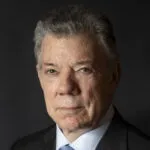
Juan Manuel Santos
Juan Manuel Santos is the chair of The Elders, a former President of Colombia, and a Nobel Peace Prize laureate. ... Read More