What are the health risks of the Army lead plume over Iowa farm country?
By Matt Field | Analysis | November 25, 2026
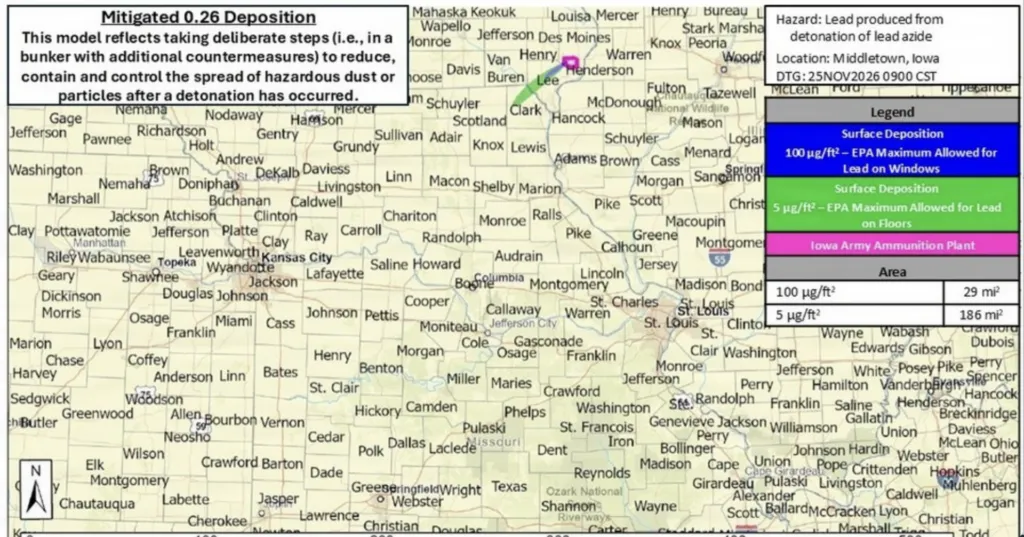 A US Army map projecting the direction a plume will travel following the detonation of lead azide ammunition at the Iowa Army Ammunition Plant. Credit: US Army.
The last time the US Army blew up thousands of pounds of aged lead-containing explosive was in 1977. Though the military did little then to prevent any contamination from spreading beyond the detonation, three quarters of the lead remained on site anyway. On Wednesday, when the Army will explode 9,500 pounds of lead azide in Iowa farm country, it hopes to do better.
“Without doing anything whatsoever, only 25 percent of the lead particulate went into the atmosphere,” Col. Aaron Teller told reporters Tuesday. “We believe we can significantly reduce that last 25 percent with the mitigation strategy we’ve put in place.”
Wednesday’s detonation will test whether the Army is indeed able to prevent lead from contaminating nearby Iowa farms and beyond.
Officials say the military realized in March that the lead azide, a sensitive compound used to trigger explosions, was crystalizing and at risk of self-detonating. The Army had been storing the material in dozens of barrels in deteriorating 80-year-old structures. Though the military initially considered alternative methods to process the lead azide, Teller said using a chemical neutralization agent to eliminate the substance, “proved to be an unsafe method.” The barrels couldn’t be moved or opened without risking an explosion.
Lead is a neurotoxin that can cause acute poisoning and impair normal cognitive development in young children and infants. It’s particularly dangerous for young children and pregnant women. Unleaded gasoline was introduced in the United States in1975 and “unleaded” paint with very low levels of lead was mandated in 1978.
Since the 1970s, blood lead levels have decreased precipitously. According to government data, the median blood lead level of children between ages one to five was 15 micrograms per deciliter in the years between 1976-1980, according to government data, but by 2017- 2020 that figure had dropped by 96 percent to 0.6 micrograms per deciliter.
In the mid 1970s, Brown said, “By current definitions, virtually every child in the country was lead poisoned.”
Lead still poses threat, however, with greater risks found in poorer and less white populations.
“It’s easy to say it’s over, but it’s not over unless we clean up the places where it has been, where ambient contamination levels are still high, and we stop putting it in stuff,” Mary Jean Brown, a former chief of the Lead Poisoning Prevention Branch at the Centers for Disease Control and Prevention (CDC) and faculty member at Harvard’s T.H Chan School of Public Health, told the Bulletin.
How far could the lead dust travel?
Media reports suggested a plume from the explosion—scheduled for 9 a.m. Central—could travel up to 100 miles from the Middletown, Iowa, where the lead azide is being stored. Winds are forecast to be blow the plume southwest toward Missouri, spreading over farms and livestock.
Brown said lead is a heavy metal, meaning a lot of it will fall out of the air relatively quickly, but, she added, not all of it. “When there was lead in gasoline, some of that lead made it to Greenland.”
What’s the risk to the food supply?
The US Department of Agriculture USDA said that it would increase testing “meat, poultry, and egg products in the affected region” expanding on normal sampling to ensure lead and other heavy metals don’t contaminate the food supply. The US Food and Drug Administration is responsible for monitoring milk and shelled eggs. It urged producers to test livestock for lead before slaughter .
Officials at the Tuesday’s press conference emphasized direct contact with lead dust as a primary concern. Even in highly contaminated soil, lead does not absorb uniformly in all vegetables. Root vegetables like carrots or potatoes absorb more lead than fruits like tomatoes or cucumbers. In Chicago, where average soil lead levels are 10 times higher a natural background level, a 2022 study showed that tomatoes grown in soil with high lead concentrations can be safe to eat.
“It’s very important to do soil sampling, both within the blast site, the estimated blast site, and perhaps a few kilometers beyond that, just to see how much contamination there is, and that includes people that have gardens,” Brown told the Bulletin.
What can be done to mitigate the risk?
The Army is surrounding the lead-azide bunkers with sandbags, dirt, large water tanks, and other barriers. The military will “submerge” the structures with a “suppressing foam” and will spray the area with high-volume misters and sprayers to weigh down particles of lead so they drop quickly out of the air.
The Environmental Protection Agency plans to do extensive pre- and-post monitoring of soil and air, according to a press release. The Federal Emergency Management Agency began evacuating residents within five miles of the plant on Tuesday. Outside of that zone, officials recommend people stay inside, shut doors and windows, set heating units to recirculate indoor air, and turn off fans that draw in air inside.
Did the Army give people enough warning?
The story morphed into national news when the Army issued a release about the detonation on Nov. 15. Though the Army arranged for a public meeting in October with Middletown residents, officials elsewhere said they were left in the dark. Iowa Governor Kim Reynolds said she learned about the plans through the Army’s press release.
Together, we make the world safer.
The Bulletin elevates expert voices above the noise. But as an independent nonprofit organization, our operations depend on the support of readers like you. Help us continue to deliver quality journalism that holds leaders accountable. Your support of our work at any level is important. In return, we promise our coverage will be understandable, influential, vigilant, solution-oriented, and fair-minded. Together we can make a difference.
Keywords: lead
Topics: Biosecurity

Matt Field
Matt Field is the biosecurity editor at the Bulletin of the Atomic Scientists. Before joining the Bulletin, he covered the White ... Read More













Leave a Reply