Imperfect guardrails: Why unverified space arms control can be better than no arms control
By Cara Wilson | Voices of Tomorrow | November 17, 2026
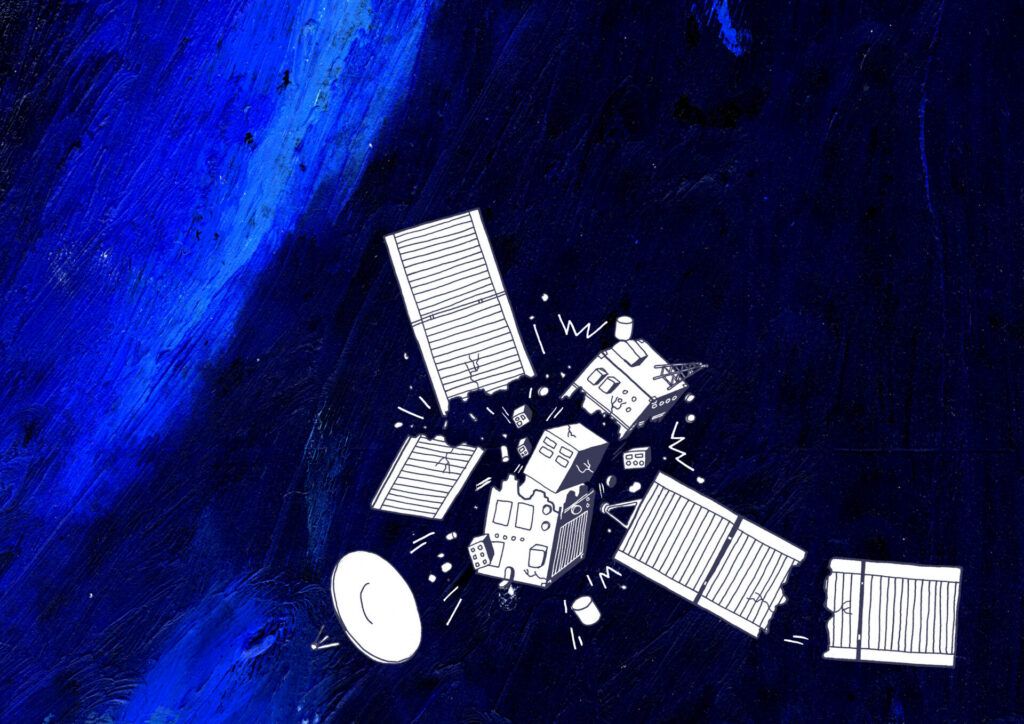 Declassified archives show declaratory restrictions on weapons, without verification, can significantly reduce risk of conflict or arms race in space. Credit: ESA / Marianne Tricot (Ecole Estienne Paris)
In 2024, US lawmakers warned of a new “serious national security threat” in space, which the Pentagon later confirmed was Russia’s development of a nuclear-armed anti-satellite weapon. Such a weapon could destroy satellites by generating an electromagnetic pulse and releasing large quantities of radiation to fry satellite circuitry. Since the Pentagon’s confirmation, US officials have planned for a “worst-case scenario,” in which Russia would potentially use a nuclear-armed anti-satellite weapon (ASAT) against one or several US assets in space.
Russian President Vladimir Putin has denied the initial US allegations, saying that Russia is “categorically against the deployment of nuclear weapons in space.” But the head of US Space Command assessed that Russia’s weapon could hold “all of low Earth orbit,” home to over 10,000 satellites, at risk. Amid these developments, the United States acknowledged last month that it possesses (non-nuclear) on-orbit space control weapons publicly for the first time, which Russia and China immediately warned would further a conflict or arms race in space.
But the year 2024 was not the first time US policymakers contended with an adversary’s potential nuclear weapons in space. In the early 1960s, the US intelligence community tracked Soviet space technology developments and interpreted them as evidence that the Soviet Union could place nuclear warheads on orbiting satellites. Soviet Premier Nikita Khrushchev’s repeated bellicose claims that his state already possessed such a capability, along with threats from the Soviet military, inflamed fears in the United States. In response, the United States pursued both the development of its own nuclear-armed anti-satellite weapons and vigorous diplomacy at the United Nations, laying the foundation for the 1967 Outer Space Treaty, which banned the placement of nuclear weapons in orbit. The diplomatic effort provided relief in a way that developing the anti-satellite capabilities could not.
The US approach to Soviet space ambitions in the Cold War serves as important guidance in today’s security environment. The United States now depends heavily on low Earth orbit satellites for communications and Earth observation imagery. A nuclear explosion in that orbit today would have much greater effect on the United States than it would during the 1960s. Declassified archives and intelligence reports show how the Cold War space nuke scare might have culminated in a space arms race. Its resolution offers a timely lesson for managing a renewed threat in space. When treaty verification is unavailable or politically untenable, declaratory bans may provide durable restraint.

The highest levels of intelligence analysts, the National Security Council, and Kennedy himself were all tracking the threat from Soviet nuclear weapons in space. Although Soviet space and missile capabilities were intentionally overblown by Khrushchev, the United States pursued three lines of effort to mitigate the threat of nuclear weapons in space: developing military contingency plans, pursuing anti-satellite weapons, and multilateral diplomacy.
Lessons from that history matter today. The record of the Outer Space Treaty shows that arms control, without treaty verification, can still significantly reduce risk in a contested environment like outer space. When the geopolitical climate prevents a flawless deal, policymakers would be wise to consider all alternatives available to them—including an unverified agreement.
Contingency planning. In National Security Action Memo 192, President John F. Kennedy directed four agencies to collaborate on preparation for the worst-case scenario of a Soviet deployment of nuclear-armed space weapons. The resulting document presenting a contingency plan for such a deployment was ready by May 1963.
The contingency plan sketches three possible paths available to the United States after the deployment of a nuclear-armed orbital bomb by the Soviet Union. The United States could issue an ultimatum to remove the weapons, or they will be shot down; it could place its own weapons in space, indicating that the Soviets forced it to do so reluctantly; or it could propose a diplomatic agreement to mutually forgo space-based weapons, while still reserving the option to destroy the Soviet orbital bombs if negotiations failed.
The caveat? Each proposed path depended on technical capabilities the United States did not possess.
Shooting down a Soviet asset in space required a functioning anti-satellite weapon and placing a weapon in space required the ability to deploy nuclear warheads on satellites. The United States had neither.
The planners also recognized that the use of anti-satellite weapons would create “a firm precedent for the legitimacy of such countermeasures [like attacks against satellites] … thus increasing the likelihood of unrestricted Soviet action against American satellites.” In other words, those offensive actions would transform the sanctuary of space into a battlefield. Still, the contingency plan resoundingly endorsed pursuing an anti-satellite weapon capability, which led President Kennedy to approve a national ASAT program in 1963 and formalized political support for the weapons.
Anti-satellite weapons. Until the early 1960s, ASAT development had been uneven. Research programs existed, but concerns that developing an anti-satellite capability would invite Soviet retaliation against US reconnaissance satellites hampered funding and political support. Reconnaissance satellites gathered most of the information on the Soviet Union’s strategic offensive weapons, inviting “total” dependence on them.
Fears of a Soviet orbital nuclear weapon overcame this resistance. In August 1963, National Security Advisor McGeorge Bundy approved an ASAT program with the highest priority designation. In his memo to the president requesting the move, Deputy Secretary of Defense Roswell Gilpatric explained that the ASAT program was essential to effectively counter the psychological threat of the Soviet orbital bombardment systems. In the view of Cold War historians, the program was only “a limited insurance policy against Soviet orbital nuclear weapons and was not specifically designed to attack Moscow’s military support and intelligence satellites.”
To shield US satellite programs from any harmful effects of this decision, the National Security Council decided that ASAT development must be completely secret. How secret ASAT weapons could assure the American population of their security was never explained.
Two US nuclear-armed anti-satellite capabilities were fielded in short order: an Army capability in 1963 and the Air Force’s Project 437 in 1964. Ironically, countering non-existent Soviet orbital threats provided the political justification for a US offensive space capability that might never have been deployed otherwise.
Diplomacy. Just as his administration was developing offensive military capability in space, President Kennedy kept pursuing diplomacy. In May 1962, he issued another national security memo (NSAM 156), directing development of a space disarmament and cooperation policy while preserving US freedom of action and classified programs.
The resulting committee called for the president’s decision on whether to propose a ban on orbital nuclear weapons. While divided on the merits of the proposal, the committee assumed that any space weapons ban would include “appropriate verification controls.” In practice, because the Soviets considered the verification measures proposed by the United States, such as inspections of satellites before launch, unacceptable, this requirement would have killed the proposal’s prospects.
But Kennedy was not ready to reject any possible declaratory ban on space weapons. The president did something “very unusual” by repeatedly challenging the committee’s insistence on verification. Ultimately, the committee proposed a “so-called declaratory ban with no provisions for inspection or pre-launch notifications”—a very different recommendation than the agreement initially proposed. The proposal formed the basis for dedicated arms control measures for outer space (NSAM 192), which became an official US policy priority in October 1962—only a few days before the Cuban Missile Crisis.
The Kennedy administration had used a September 1962 speech by Gilpatric to signal its readiness to advance a ban on orbital nuclear weapons. In it, he noted, “I can think of no greater stimulus for a Soviet thermonuclear arms effort in space than a United States commitment to such a program. This we will not do.” The Americans privately proposed the ban to the Soviets a month later, on October 17, 1962—when the Cuban Missile Crisis had just started. Moscow flatly rejected it.
About a year after the Cuban Missile Crisis, Washington and Moscow’s attention shifted to arms control in space once more. In September 1963, US officials raised the issue of a space weapons ban in a private meeting with the Soviet Ministry of Foreign Affairs and disclosed Washington’s willingness to forgo inspections. The Soviets accepted the premise of an unverified ban on orbital nuclear weapons. Two weeks later, Soviet Foreign Minister Andrei Gromyko formalized the shift in Soviet policy in an address at the UN General Assembly, announcing that the Soviet Union was ready to “prevent the spread of the arms race to outer space” and “prohibit the placing in orbit of objects carrying nuclear weapons.”
A month later, the UN General Assembly unanimously passed Resolution 1884, which called on states to refrain from placing nuclear weapons and other weapons of mass destruction in orbit. Although it was non-binding, the resolution laid the groundwork for subsequent formal arms control. In 1967, the Outer Space Treaty, which prohibited the placement of nuclear weapons in orbit, contained language nearly identical to the UN Resolution 1884. (Per Article IV of the Outer Space Treaty, party states “undertake not to place in orbit around the Earth any objects carrying nuclear weapons or any other kinds of weapons of mass destruction, install such weapons on celestial bodies, or station such weapons in outer space in any other manner.”)
Unverified arms control? Today, US officials widely doubt arms control agreements without verification. The current Under Secretary of State for Arms Control and International Security, Thomas DiNanno, reflected this conventional wisdom, testifying last year that arms control agreements “without strong and effective verification regimes” only “give an illusion of security.” But this skepticism is not new; Kennedy faced it, too. The president even had to ask his staff “if the alternative of a ban relying on unilateral verification had really been examined” in their work.
Kennedy’s insistence paid off. While imperfect, the Outer Space Treaty led the Soviet Union to no longer publicly threaten the use of offensive space weapons until recently, and the US Air Force to halt its plans for nuclear space bombers and moon bases.
The Outer Space Treaty now plays a “quasi-constitutional” role in space governance. And although it faced several challenges, none of them were only because of its lack of verification provisions.
In the 1960s, when the Soviet Union first tested and then made operational its Fractional Orbital Bombardment System (a weapon designed to place in orbit nuclear delivery systems that could deorbit before completing a full circuit of the Earth), Washington chose not to make an issue out of this program. The test was detected early and not as a result of treaty verification.
Then in 2024, the space nuke allegations showed how national intelligence can effectively detect violations without verification inspections. Moreover, US official statements characterized the Russian space weapon as a violation of the Outer Space Treaty, demonstrating that even when a treaty is compromised, it still gives states a legal standard to invoke when lodging complaints.
With the political and technological constraints of the 1960s, the choice was never available between an unverified agreement and a verified one; it was between an unverified agreement and none at all. Kennedy was right to champion an unverified agreement.
In the similarly challenging political circumstances of today, unverified arms control may enhance security where treaty verification is impossible. Arms control agreements with inspections and verification are certainly stronger than declaratory restrictions. But unverified arms control agreements still can be safer than unmitigated competition without guardrails. Policymakers who categorically reject unverified arms control options should look again.
Together, we make the world safer.
The Bulletin elevates expert voices above the noise. But as an independent nonprofit organization, our operations depend on the support of readers like you. Help us continue to deliver quality journalism that holds leaders accountable. Your support of our work at any level is important. In return, we promise our coverage will be understandable, influential, vigilant, solution-oriented, and fair-minded. Together we can make a difference.

Cara Wilson
Cara Wilson is a research assistant with the Nuclear Policy Program at the Carnegie Endowment for International Peace. ... Read More














Leave a Reply