‘Earth in flames,’ Brian Toon and Alan Robock on whether humans will die from an asteroid or nuclear war first
By François Diaz-Maurin | Interview | May 14, 2026
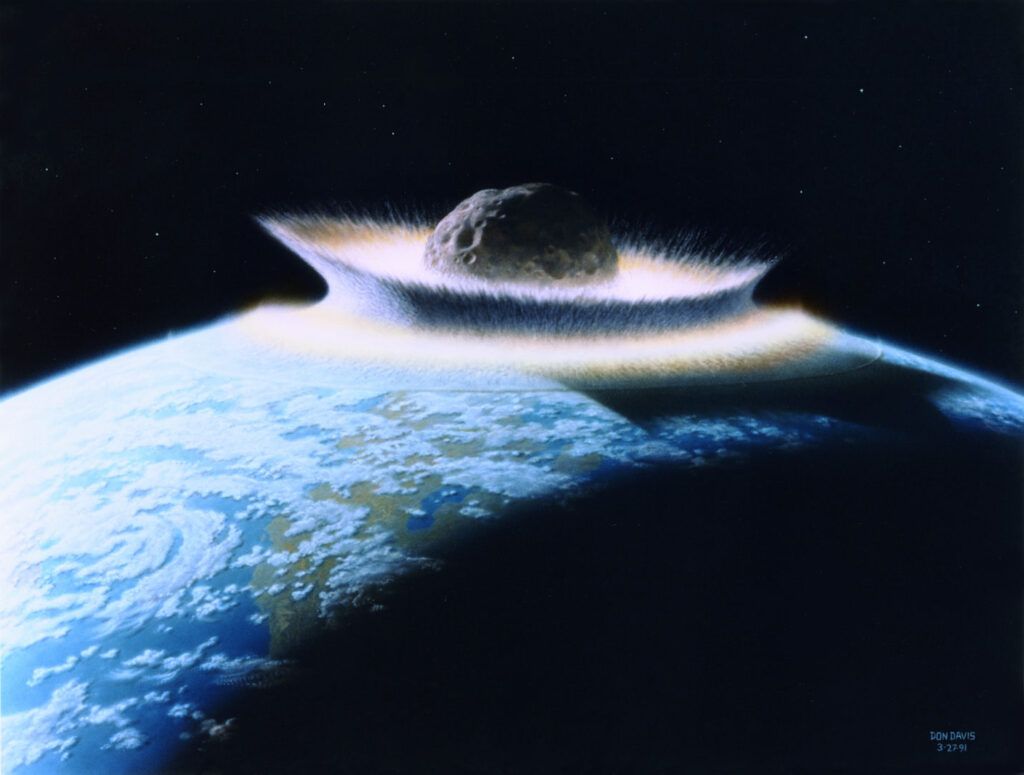 An artist's impression of a giant asteroid colliding with Earth. A similar event—although a much smaller one—occurred 66 million years ago, causing the extinction of dinosaurs. Nuclear war has the potential to lead to human extinction.(Image: Don Davis / NASA, via Wikimedia Commons)
Editor’s note: This is part of the “Nuclear winter: Why study it now?” series.
Earth scientists Brian Toon and Alan Robock discuss their latest book on nuclear winter, “Earth in Flames” (Oxford University Press, 2025). Toon and Robock are leading experts on the environmental consequences of nuclear war and the theory of nuclear winter, a topic they have researched together for decades. Using modern climate modeling, they recently demonstrated that even a limited nuclear conflict could cause global famine and catastrophic climate cooling.
In their book, Toon and Robock draw parallels between the extinction of dinosaurs and potential human extinction from nuclear war. Like asteroids, nuclear explosions can cause large fires, burn vast areas, and produce smoke that lofts into the stratosphere, causing global climatic changes. They emphasize the unpredictability of nuclear war scenarios and the potential for limited nuclear exchanges to escalate, and the need for global efforts to reduce nuclear arsenals. Unlike dinosaurs, who could not avoid the impact of an asteroid 66 million years ago, humans can work to avoid causing their own extinction from nuclear weapons.
Our conversation has been edited for length and clarity.
François Diaz-Maurin: Your book brings together two very different sets of topics. Why did you want to write a book about asteroids and dinosaurs, along with nuclear weapons and humans?
Brian Toon: There are two reasons. First, the discovery that an asteroid had killed the dinosaurs—because it put all kinds of debris into the upper atmosphere and cooled the planet—led us to think about nuclear war. So that was one reason.
The other reason is that, whenever I give a talk, if I advertise that I am going to talk about nuclear weapons, nobody comes to the talk. But if I say I’ll talk about dinosaurs, they all come to hear about the dinosaurs. Then they’re trapped and have to listen to the warnings about nuclear weapons. And actually, we both think that there’s a strong parallel between the effects that occur from an asteroid and those of nuclear weapons.
Alan Robock: Yes, it’s in the subtitle of the book. [“How an Asteroid Killed the Dinosaurs and How We Can Avoid a Similar Fate From Nuclear Winter”.] This is how the dinosaurs died, and we want to avoid the same fate for humans.
And, as Brian said, dinosaurs attract people. The dinosaur story is interesting in the details of how they died. Everybody thinks it’s an asteroid, but how did that actually happen? It turns out there were forest fires and lots of smoke involved—the same mechanism that would happen after a nuclear war. So, the overall reason for us to write this book is that we want people to know that nuclear winter is a possibility after nuclear war. And we want that to lower the probability of ever having a nuclear war.
We write lots of journal articles, and we even wrote articles in places like Scientific American or the Bulletin. We want to touch people’s emotions, not just their intellect, to get them involved. Because when you ask people, what’s the main problem in the world today, nobody lists nuclear war anywhere in the top 10 or 20 things. They assume it will never happen. It certainly hasn’t happened in their lifetimes. But that’s just because of luck. It could happen. We want to get more people aware of this.
Diaz-Maurin: You mentioned probability. Is it more probable to get hit by an asteroid or a nuclear weapon?
Robock: The book goes into the probability of asteroids hitting the Earth because that’s determined by nature. But nuclear war is determined by humans, and I don’t know how to predict how humans will behave.
Toon: We’ve had the Russians threatening to attack Europe and attack the United Kingdom with nuclear weapons continually for the last couple of years. And there is [President Donald] Trump, who talks about nuclear weapons with his generals and admirals…
Robock: Yes, but at some level, he understands how dangerous it is. He doesn’t want to use them. But I agree that there are nine countries with nuclear weapons, and there are unstable people leading several of them, including in Russia, North Korea, and the United States. And so that’s what’s scary.
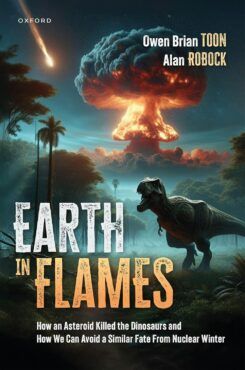
Diaz-Maurin: As its title, Earth in Flames, suggests, your book talks a lot about fires. And we learn that fire is one of the main factors in nuclear winter scenarios. Could you explain how fires drive the climatic changes that follow an exchange of nuclear weapons?
Toon: Nuclear explosions are like bringing a piece of the Sun down to the ground. You get this sudden flash of light when the fireball is created. It only lasts a few seconds, but it’s incredibly intense. It has much more energy than the sunlight. And so easily ignitable things can catch on fire. Leaves, branches, newspapers, people’s clothes, and many other things would catch fire. The area over which those fires would occur would be hundreds of square kilometers. One nuclear weapon of typical size—not a big, megaton-range weapon but a couple of hundreds of kilotons—can burn a couple of hundreds of square kilometers. This is what happened after both explosions at Hiroshima and Nagasaki. There were fires in both cities. And so a feature of nuclear explosions is to start a fire.
If you bomb a city where there’s a lot of fuel, you’ll get a lot of smoke, which will go into the stratosphere. And one thing that Alan’s [research] group found in the late mid-2000s or so is that, heated by the sun, the smoke would rise to really high altitudes. We suspected this in the 1980s. But the climate models were focusing on low altitudes back then, so we didn’t go very high. Now models extend to high altitudes, up to 80 kilometers. This matters because it never rains in the stratosphere. Once you get above commercial airliner altitudes, there’s no more rain, and so the smoke will stay there for years. Whereas if you have a fire in the troposphere closer to the ground, the smoke will be removed in a week or so, which means it can’t really affect the climate.
Robock: Yes. People understand the horrific direct effects of nuclear weapons: the blast, the radioactivity, the fires. And they think that it’s horrible, and that’s one reason why we haven’t had nuclear weapons used again. But the smoke from the fires would be lofted into the stratosphere, where there’s no rain to wash it out, would last for years, and be blown around the whole world. And so it would affect everybody in the world, not just the people who are attacked. The smoke from the fires could kill 15 times as many people as the direct effects of nuclear weapons, as horrific as those are. That’s why I think 74 countries have now ratified the treaty to ban nuclear weapons [Treaty on the Prohibition of Nuclear Weapons or TPNW], and 95 have signed it. The rest of the world understands they’re threatened by nuclear war, even if they’re not targeted. They’re trying to influence the nine [nuclear-armed] countries to get rid of the weapons, because they’re afraid of nuclear war.
Diaz-Maurin: There have been quite a lot of improvements since the 1980s, when you and your colleagues first developed the theory of nuclear winter. First of all, am I correct in talking of nuclear winter as a theory?
Robock: Yes, it’s a theory. There hasn’t been a nuclear winter, unless one argues that what happened to the dinosaurs is the same thing. But it wasn’t a nuclear winter; it was an asteroid winter. My friend Lynda Williams has written a song about nuclear winter, and there’s a line in it that says, “Now we are the Asteroid! We are the Dinosaurs!”
Diaz-Maurin: At the same time?
Robock: At the same time. We can kill ourselves. That’s the point.
Toon: Some things have happened since the 1980s. For example, there were large fires in 2017 in British Columbia and in 2020 in Australia. These forest fires did put smoke up at the altitudes where airliners fly. The sun heated that smoke, and it rose up to 20 kilometers above the ground. It did just what models had said would happen [after large fires]. And so, we can confirm it that far. Moreover, for a year after those forest fires, that smoke was visible to satellites, which tracked it around the globe, expanding and covering hemispherical areas. In the case of the larger fire in Australia, it did change the temperature and the chemistry in the stratosphere. There wasn’t enough smoke there to cool the surface in a measurable way, but it did change the temperature in the stratosphere as predicted. And we observe those things.
Robock: Yes, we observed that once the smoke got into the stratosphere, it was heated by the sun and lofted higher. In the case of the British Columbia fires in 2017, the smoke went up by 20 kilometers in the first 10 days, and in the Australian fires, it went up 30 kilometers, as Brian just said. That’s the same mechanism that we modeled in our climate model from nuclear war, but with a lot more smoke. But we had never seen it until now, and now we’ve seen nature do the predicting thing. So, yes, it’s a theory. But parts of it can be tested with things that have happened in the past.
Diaz-Maurin: Let’s talk about some of the pushback against the nuclear winter theory. There seems to have been a shift in terms of the skepticism it received. Back in the 1980s, skeptics were focusing on whether the mechanisms of nuclear winter were correct. But now you have much better models and, as you say, partial confirmation from other related natural events. The modeling part of nuclear winter is much more robust now than it was back in the 1980s. But it appears that skeptics are now focusing on the scenarios of nuclear war you are considering, and whether they are plausible. Is their criticism warranted?
Robock: The main unknown is the amount of smoke that would result from nuclear war, like 5 million tons (or 5 teragrams) in our India-Pakistan scenario. There have been several different climate models that have done a simulation of what would be the climate response, including one from Lawrence Livermore National Laboratory. That’s the national lab that actually makes the design of the bombs. So everybody agrees that if you put a certain amount of smoke [into the stratosphere] you’ll get the same climate response. That’s not controversial.
The question that we don’t know very well is: How much smoke would you get, given one bomb dropped on one city? How much material is there to burn? Would it just be the frames of the buildings or all the contents, furniture, and stuff inside the buildings? And once there’s a fire, what fraction of that fuel would end up as soot? [Soot is the pure black carbon component of smoke.] And then how much of that soot would be lofted? Would it be washed out by the rain in the big pyrocumulonimbus thunderstorm [a cloud generated by the fires], or would it be injected into the stratosphere? That’s the biggest unknown.
The people at Los Alamos lab claim that, for the same scenario we had, there would be very little smoke, and that if there was smoke, it wouldn’t get into the stratosphere. But they made a lot of assumptions in their first paper that would prevent it from happening, including unrealistic ones that we pointed out. So, the smoke is the thing we’re most unsure about. The estimates we’ve made—and Brian led the way on that—are reasonable, and nobody has shown that they’re wrong. We just need more work on refining them. We have one team working with us that is modeling that. But we need 10 or 50 teams doing it, and there is no funding to do any more work than that. That’s the frustration.
Diaz-Maurin: In your book, you explain that the amount of smoke generated depends on the fuel load. That’s straightforward. But there is one thing that is surprising or counterintuitive, which is that the fuel load of urban areas is actually higher than in forests. Why is that?
Toon: In the 1980s and up until the early 2000s, we found that the relationship between population and fuel load in Europe and the United States looked like about 10 tons of fuel per person. Now they just did a survey of the United States at the 250-meter resolution, looking at every building in the United States and using surveys of what the building contents are. And they found that, in the United States, the fuel load is now close to 20 tons per person.
All this stuff behind you is flammable. With all those books and your bookcase, I can’t see your desk, but it’s probably made of plastic. [Editor’s note: My desk is made of wood, but it’s full of papers.] And you know my bookcase behind me and all those books, all the walls, you know, you can’t see my windows, but they have plastic coverings around them. Your pinball machine, that will burn, too, unless it has some metal. There’s a lot of plastic in there, at any rate. And there’s a lot of wood in the United States and in some European countries that has been used in building materials. Then there’s certainly a growing amount of plastic. Plastics produce a lot more soot per pound than wood. And then there’s a lot of petroleum around, and oil also produces a lot more soot per pound than burning wood does. So, you have to inventory all these asphalt, plastics, wood, oil, gasoline, kerosene, and other things like that. And these high-resolution studies in Europe and in the United States suggest we’re underestimating the fuel load.
And then there is another argument about this, which is very popular in the Department of Energy, which says, “Well, if you blow the bomb, it’ll knock all these buildings down, and they’ll lay on top of the fuel, and you can’t burn it because it’s buried under concrete.” This is one of those red herring things that are true, but only if you were in a really dense city like New York City, where there’s a lot of very high buildings, which, when they fall, the area around them is small compared to the total mass of material in the building. If the building collapses straight down, as the World Trade Centers did, you get this big pile of rubble that would be hard to burn. But that’s not what most cities look like.
Diaz-Maurin: That sounds like a very detailed approach, given all other uncertainties. Why would you need to go that far in modeling how the buildings are pulverized?
Robock: Because they bring it up. So, we have to address it. And it does matter, but as Brian said, only in a small portion of some cities.
Toon: And so if you look at the shock waves, which knock the buildings down sideways, not like the World Trade Center, which collapsed vertically. And that whole area where that happens is only about 10 percent of the area that would burn. Even if you bury all that fuel, it is only 10 percent of the fuel. It doesn’t really make any difference.
We have a [research] group at San Jose State University who are modeling what would happen in the city of San Jose. They’re looking at what buildings would fall down and be big enough to actually create some rubble that would bury something. But mostly it’s just small buildings. These cities are a few stories high, individual houses, and things like that. And even when wildfires around here come in, they burn everything inside the houses. Nothing is left there except bricks, metal, and concrete. They even burn the tires and the interior plastics of the cars. It’s flammable.
It is not just damage to the areas attacked that matters. Nuclear winter is like nighttime or winter: The cooling prevents agriculture, and starvation results [from it]. Agricultural modeling we did with [Rutgers University climate scientist] Lili Xia suggests that, two years after a war involving Russia, China, Europe, and the United States, 95 percent of the people in those countries will have died from starvation.
Diaz-Maurin: In scenarios of nuclear war, missile silos would be the first ones to be attacked. But those are not in urban areas. Aren’t you too pessimistic in terms of the fuel load that would follow a typical scenario of a nuclear exchange?
Toon: Let’s suppose Russia attacked the United States. 450 silos are sitting up just to the north of me with missiles in them. [Editor’s note: US land-based missile silos are located in Colorado, Nebraska, Wyoming, North Dakota, and Montana. Toon is based in Colorado.] Russia has about 1,700 [deployed] nuclear weapons. Let’s say, they blow up the 450 silos. They still have more than 1,000 weapons left. What are they going to do with those? Are they going to attack cities like New York City, try to destroy every city in sight? Or are they going to say, “We don’t want to hurt anybody, we’re too nice. So, we won’t attack any cities. We’ll just go and blow up some isolated military base somewhere.” That’s not a realistic scenario. Same here. The United States keeps saying, “It would be impolite for us to kill any Russians in a nuclear war. So, we would never attack a Russian city.” But if you go back and look at all the nuclear plans that we know about, they all call on the United States to attack Russian cities. It’s just unrealistic to think that the American military is not going to attack a city because there are people there when they know there are military [targets] in it. A lot of military bases are in cities in Russia.
Robock: Yes, there is command and control, there is the infrastructure. Now, if you look at the last [and only] nuclear war, it was at the end of a bombing campaign in Japan in the summer of 1945, after the United States had burned 67 other cities on purpose. They didn’t attack military targets. They burned cities. The United States is guilty of doing that 80 years ago in World War II, and the last two were Hiroshima and Nagasaki. It took only one bomb [each], but the cities still burned. This is what happened in the last World War, and I think some of the targeting scenarios that had been released have about 40 or 50 bombs targeted on Moscow. [Editor’s note: During the Cold War, the Strategic Air Command had 179 Designated Ground Zeros on Moscow. The current number of nuclear warheads targeted at Moscow in current plans is classified.] And of course, in the United States, Russia would be targeting the White House, the Pentagon, National Airport, and all kinds of other sites in Washington, D.C., as well as in other cities. So it’s unrealistic to say that they would only target the silos. And why would they even target the silos? These would be empty by the time they are bombed. It would be wasting them.
Toon: Also, the United States has only 300 cities with more than 100,000 people. Russia has 200. That’s 500 cities. There are about 4,000 weapons. That’s eight nuclear weapons to attack every city of more than 100,000 people. That’s just gross overkill.
Diaz-Maurin: There seems to be a gray area between all-out war and what others are describing as rational wars—the idea that we could have a sort of limited use of nuclear weapons. Are those scenarios of limited nuclear exchange also leading to nuclear winter?
Robock: I gave a talk recently at the Naval War College in Newport, Rhode Island. They have a department there of war gaming, where retired generals and admirals sit in two rooms and decide what to do in response to a certain attack. In almost every war game, they told me, they end up using all [nuclear] weapons. The idea that we could have a war that would stop after a couple of weapons, in which they would say, “Okay, that’s enough,” that’s not what happens in these war games. It’s not what happens when people are confused and afraid and are trained their whole life to kill people.
So, you are right, we are looking at a worst-case scenario. But that’s possible. So that’s why we look at it. The claim that there won’t ever be a full-scale nuclear war, so we don’t have to worry about it, is nonsensical to me.
Toon: The danger here is mostly an accident. It’s not really likely that Vladimir Putin is going to attack the United States, or that we’re going to attack Russia. People are, generally speaking, not irrational when they are in these positions of power.
So it’s more likely that there will be a mistaken threat that an attack is ongoing. This has happened numerous times in the past, and it has gone all the way up to the heads of state in Russia and the United States. In this situation, the President of the United States has about five minutes to decide what to do, because it takes about 30 minutes for the missiles to get from one place to the other. Because it’d probably be nighttime, you’d have to wake up the president and then explain to him or her what’s happening, what the evidence is. And he or she has about five minutes to decide whether and how to respond. What is he or she going to do? Is Donald Trump going to push the button? There’re very interesting games on the web in which you get to play president, and they attack, and you get to decide what to do. It is hard to avoid pushing the button. [Editor’s note: Although the US president has the sole authority to order a nuclear strike, there is no physical button. The president must confirm his identity and order via authorization codes securely transmitted to the Pentagon, which then passes the order to the US Strategic Command for execution.]
Diaz-Maurin: In your book, you lay out several scenarios that I don’t think you had in earlier studies, including a war between the United States and North Korea or China, or between European NATO countries and Russia. I understand that this is a more intertwined world today than it was not so long ago, and that makes it even more difficult for heads of nuclear states to make decisions on whether to use nuclear weapons. Does it make the world more risky and more prone to misinterpretations?
Toon: During the Cold War, President Kennedy was concerned that there soon would be a huge number of nuclear-weapon states, so that it would become impossible [for the United States] to control things because there would be so many different groups with different interests. Now, it’s not just the United States and Russia. It’s also China and others. But in the West, NATO told people they could not study nuclear winter. They forbid people from using NATO funds to study the consequences of nuclear conflict. In the United States, the Department of Defense has not told people what would happen in a nuclear war since 1978, when Congress asked them. And the Department of Defense is still not trying to inform citizens.
Diaz-Maurin: Christopher Yeaw, the Assistant Secretary for the Bureau of Arms Control and Nonproliferation at the US Department of State, said during a presentation to the [National] Academies’ committee working on an independent study on the potential environmental effects of nuclear war that, if we focus too much on the environmental impact of nuclear weapons, we would give a signal to adversaries that we care too much about those impacts, which would undermine nuclear deterrence. Do you think that, to work, nuclear deterrence must maintain a certain level of ignorance about the effects of nuclear war?
Robock: We wrote a paper in the Bulletin titled “self-assured destruction,” which shows that if one country attacked another, and even if this other country didn’t respond, everybody in the first country would die because of the climate effects. In the year following the attack, they wouldn’t be able to grow any food. So, the more people are aware of that, the less the probability of people using these weapons.
Toon: Some years ago already, George Shultz, William Perry, Henry Kissinger, and Sam Nunn wrote multiple op-eds in The Wall Street Journal, saying that mutual assured destruction no longer worked in the post-Cold War era, that it is very dangerous to pretend that it did, and that if we build more nuclear weapons, we’re going to end up with a nuclear conflict. These were two former secretaries of state, a former defense secretary, and a former chairman of the Senate Armed Services Committee. They were not left-wing agitators; these were people who were in charge of the US nuclear doctrine at one point, and now saying [nuclear deterrence] wasn’t working.
Diaz-Maurin: You have a small graph in your book about the number of new nuclear weapon states, which you approximate to be one every five years. But the last nuclear-weapon state was North Korea in 2006 when it tested its first nuclear weapon, and it has been 20 years already with no new nuclear power. Doesn’t it make you more optimistic about the future?
Toon: Not really.
Robock: Because there are nine states with weapons doesn’t mean no more states are getting them. A number of them, like Japan and South Korea, depend on nuclear-weapon states, they think, for their security. When I was at the Naval War College, a guy there had just written an article saying the additional threats from China mean that the United States either has to make more weapons or make its technology available to Japan and South Korea so they can defend themselves. Both of those countries could make nuclear weapons in a few weeks if they wanted to. And Germany and other countries could, too. So, the fact that they don’t exist now doesn’t mean they can’t exist soon.
In addition, five countries in Europe host US nuclear weapons: Turkey, Italy, Belgium, Germany, Netherlands. There are non-nuclear-weapon states that have nuclear weapons on their territory. And the United Kingdom and France have nuclear weapons, too. And then, of course, there is Iran, although they say they’re not interested in making nuclear weapons.
So what gives me hope? The Southern Hemisphere has no nuclear-weapon states. None. They would probably not be targeted by a nuclear war, but they could still suffer greatly.
I was in New Zealand recently. There, they worry about a nuclear war. Maybe they’d have enough food to eat, because they export food, and then they don’t have many people. But they don’t have any fuel. They export oil and bring in refined oil. They don’t have oil refineries. So how could they process their food, refrigerate it, or distribute it? They think that they will have horrible suffering if there’s a nuclear war. They won’t be able to get any medicines or technology from outside the country, fertilizers, things like that. We’re all interdependent. And if that breaks down, it’s not just the direct effects, but all these indirect effects that people would suffer from.
Diaz-Maurin: One last word?
Toon: Alan, go ahead…
Robock: We work to educate the public and policy makers about the consequences of the use of nuclear weapons. Our book shows that the only way to prevent their use, which would be catastrophic for all of humanity, is to rid the world of them, as advocated in the Treaty on the Prohibition of Nuclear Weapons.
A weeklong look at nuclear winter
Come back every two days from May 12 to May 18 for the next piece in the Bulletin's series on nuclear winter.
Together, we make the world safer.
The Bulletin elevates expert voices above the noise. But as an independent nonprofit organization, our operations depend on the support of readers like you. Help us continue to deliver quality journalism that holds leaders accountable. Your support of our work at any level is important. In return, we promise our coverage will be understandable, influential, vigilant, solution-oriented, and fair-minded. Together we can make a difference.
Keywords: atmospheric science, nuclear war, nuclear winter, nuclear winter series
Topics: Interviews, Nuclear Weapons
Get alerts about this thread
0 Comments
Oldest

François Diaz-Maurin
François Diaz-Maurin is the editor for nuclear affairs at the Bulletin of the Atomic Scientists. Previously, Diaz-Maurin was a MacArthur ... Read More