How nuclear war would impact the global food system. And how to prepare for it
By Florian Ulrich Jehn | Interview | May 18, 2026
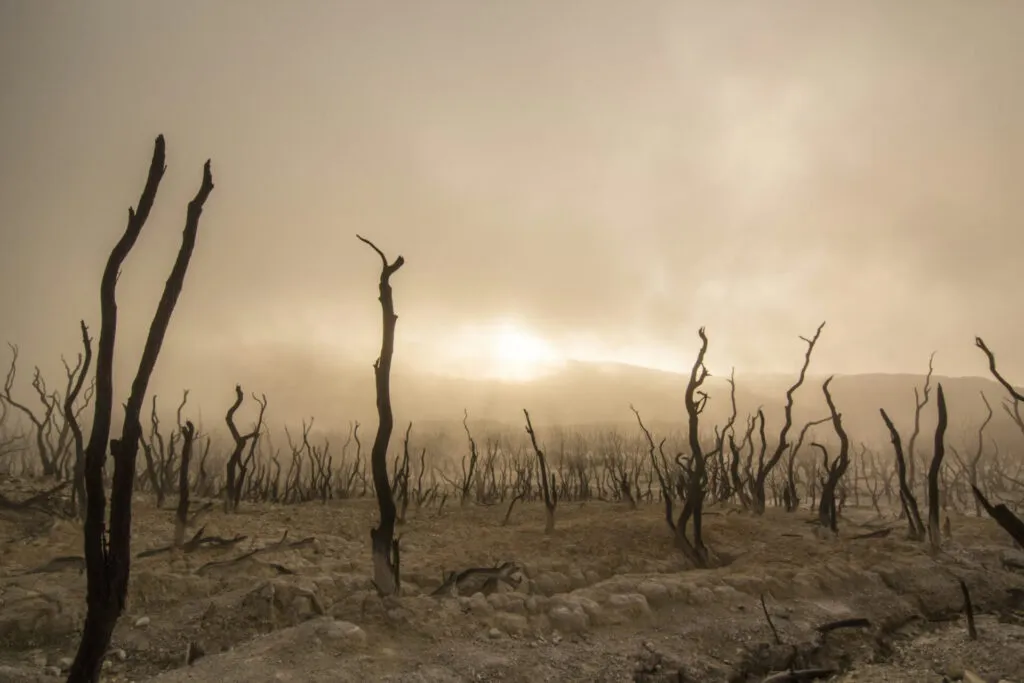 Crop failures from drought in a nuclear winter scenario could abruptly undermine food security. Even in places where crop production would be partially spared, the collapse of transport infrastructure and other societal systems would likely impact the capacity of countries to export food, potentially leading to a catastrophic, global health and political crisis. (Photo by Dikaseva, via Unsplash)
Listen to this article:
Listen to this article
--:--
This audio was generated using an automated voice. Learn more.
Editor’s note: This is part of the “Nuclear winter: Why study it now?” series.
The Russian invasion of Ukraine has revealed how easily modern, interconnected food systems can be disrupted by armed conflict. After the war started in February 2022, Ukraine’s wheat production fell by nearly 37 percent. In addition, the blockade of the Black Sea prevented a significant fraction of food exports, leaving lower- and middle-income countries in Africa and Asia with significantly reduced imports.
Much of this disruption stems from the high degree of concentration in the food system at multiple levels. Roughly a quarter of all food is traded internationally, yet the global food trade system is dominated by a small number of major exporters, focused on a narrow set of staple crops (soy, wheat, rice, and maize), which are transported by a handful of major food trading companies. This creates fragile chokepoints: If any of these nodes is disrupted, it can quickly have serious consequences for the many food-importing countries.
The war in Ukraine has been enough to disrupt the food system on a global scale. A nuclear conflict would not only be much more destructive, but it would also lead to much more severe disruptions in the food system, especially if followed by a nuclear winter.
The disruption to the food system in a nuclear war scenario would happen through direct destruction, a colder climate, and cascading disruptions of the food trade system. Recent research has particularly advanced the understanding of impacts on the climate and food production. This research shows that global temperature could drop by several degrees in a matter of months. Subsequent food production studies that built on these climate simulations predict a food production decline of up to 90 percent in the most severe scenarios.
The disruption of food production after a nuclear war would have clear implications for the global food trade.
Food trade disruptions. Countries don’t trade with each other at random; rather, trade is the product of decades of mutual relationships, manifested in built infrastructure, trade agreements, and communities of preferential trading partners (Figure 1). Each of these trade communities is usually anchored in a single country or a small number of countries, producing most exports for their community.
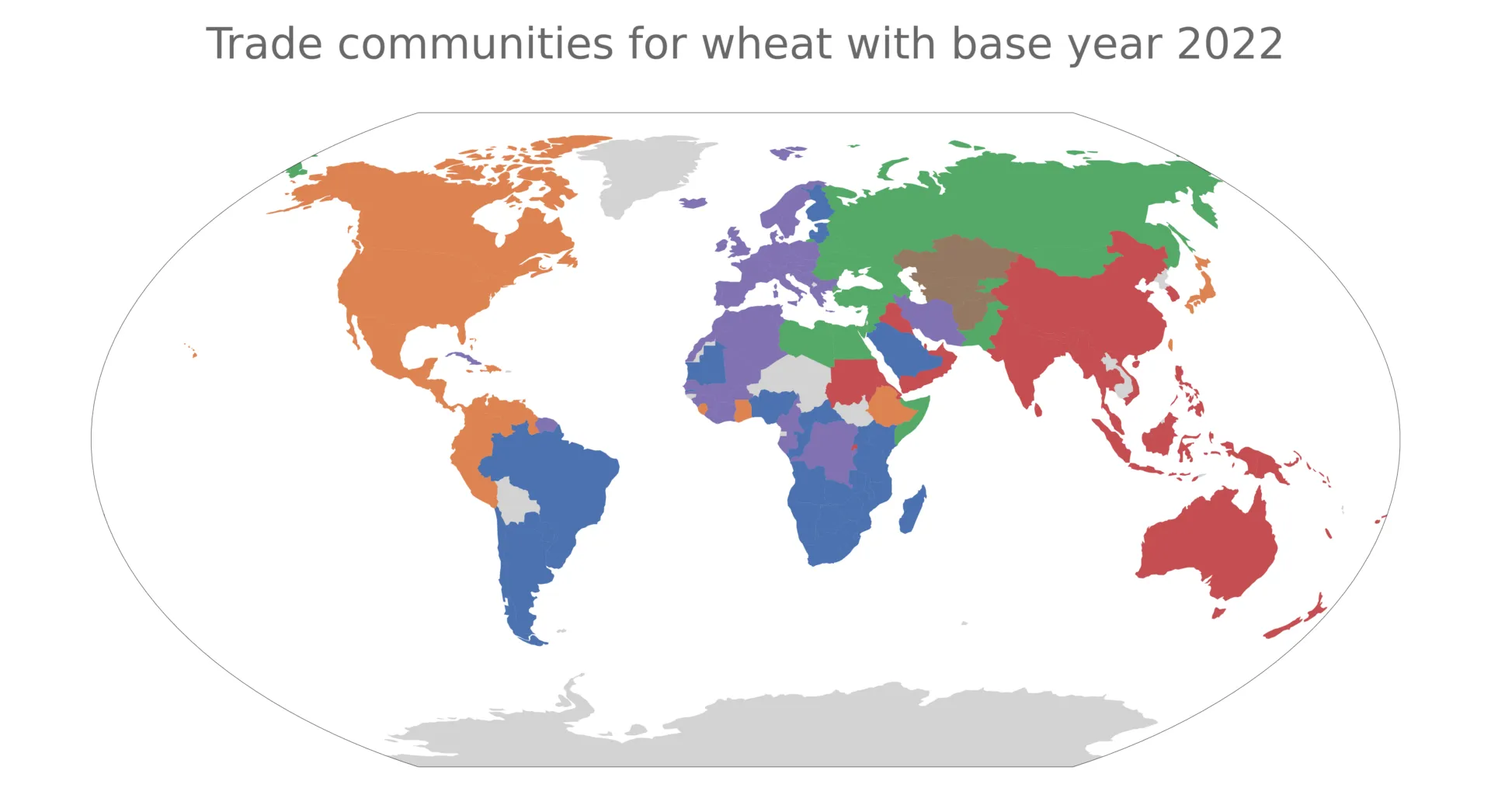
Russia and the United States are major exporters at the center of their respective trade communities. In many nuclear war scenarios, however, they would also be the two most involved countries. Direct destruction alone would likely render them unable to produce or export food. Even if they could maintain some production capacity, it would likely be at a very low technological level due to widespread destruction and the loss of agricultural inputs such as fertilizers and pesticides. This alone could reduce the crop yields in the United States by more than 70 percent.
In other nuclear war scenarios that do not directly involve Russia or the United States but still lead to climate disruption due to nuclear winter, the picture is similarly bleak. The estimated climate impacts of a nuclear winter are especially severe in the northernmost regions of the world, where a large share of global food trade takes place. Depending on the scenario, land in many parts of Europe, Russia, the United States, and Canada would remain frozen for months to years, making traditional agriculture impossible.
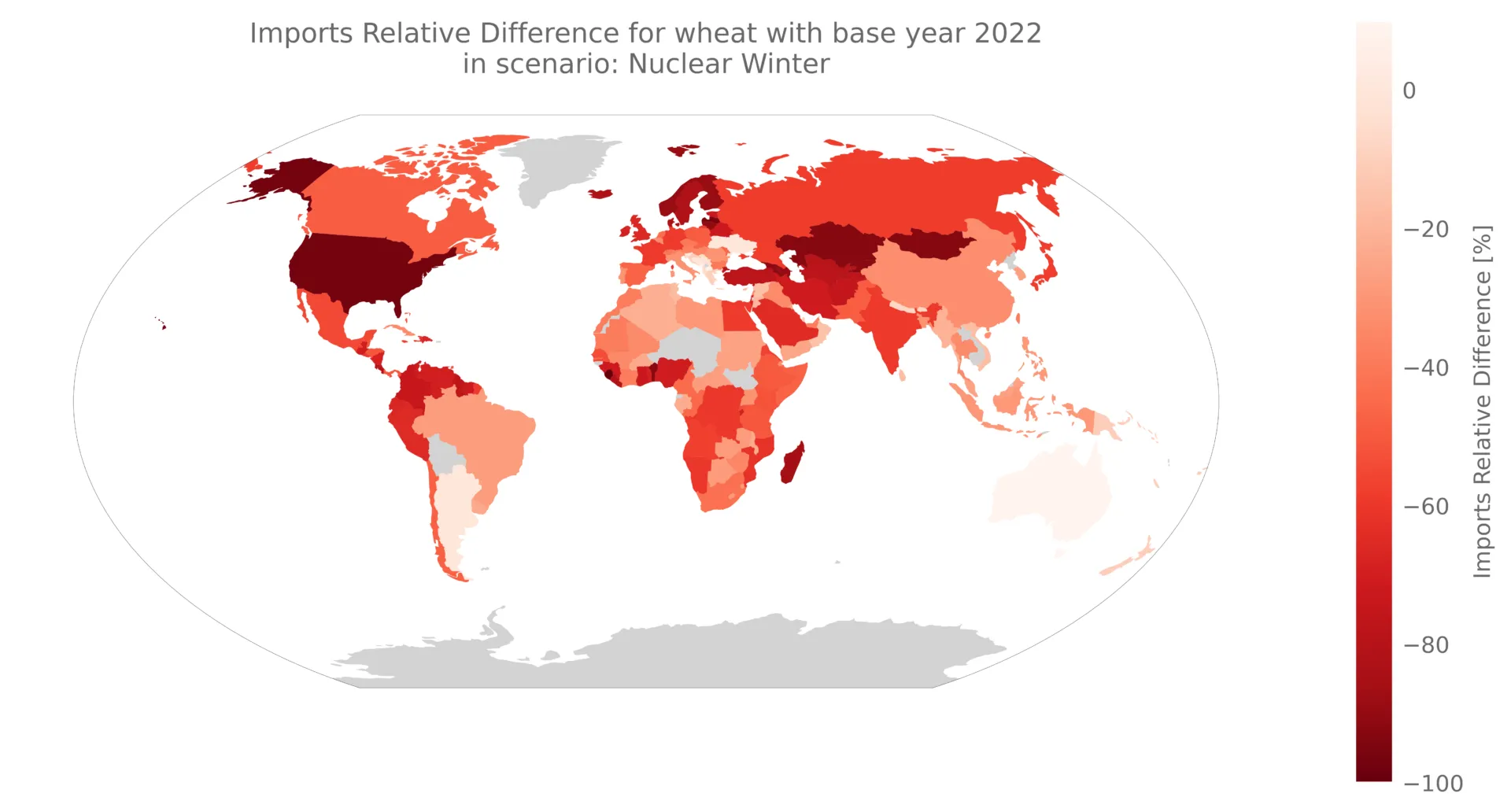
In both cases, global food trade would lose most of the production of the largest exporters, and most countries would also lose most of their food imports as a result (Figure 2). In absolute terms, the disruption could reach staggering amounts. For example, Turkey could lose 8 million tons of imported wheat, which is enough to provide sufficient calories for around 30 million people for a year.
Making food trade nuclear-war resilient. Existing studies about the impacts of nuclear war on food trade assume little to no preparation or adaptation once a war begins. But countries can attempt to take protective measures that lessen the impacts to their food systems.
Preparedness for the impacts of nuclear war receives little prominence in policy, largely for the good reason that nuclear war cannot be won and therefore shall never be fought. Concerns often center on the idea that acknowledging the possibility of survival might undermine deterrence by implying that nuclear war is manageable. Thinking about how to adapt the food trade system to scenarios of nuclear war, therefore, is equivalent to breaking the nuclear taboo. But, just as the consequences of nuclear war would always be catastrophic for those involved, most protective measures would benefit countries not directly involved in the conflict. The countries waging nuclear war would still face hundreds of millions of casualties, no matter how well the global food system is prepared. But for other countries, most in the Global South, while they cannot directly prevent nuclear weapons from ever being used, can still take steps to protect themselves as much as possible from their potential impacts.
Working to make food trade systems more resilient in countries not involved in nuclear war is therefore not meaningfully weakening deterrence; leaders willing to risk destruction brought by nuclear strikes on their own territory are unlikely to be swayed by whether distant countries avoid famine.
Preparing against nuclear war could also improve resilience to other climate-cooling or food-disrupting catastrophes. The 1815 eruption of Mount Tambora in Indonesia not only immediately killed thousands of people, but it also led to famine in many faraway places, including much of Europe, due to its cooling effect on the climate. Every century, there is roughly a one-in-six chance that an eruption of this size occurs with potentially global climatic consequences. The chance of an asteroid impact in the coming centuries is likely lower, but it could similarly lead to a cooling climate and the resulting disruption of the food system. Taken together, there is a significant chance that at least one of these three global catastrophes will happen this century. And as things stand, the world would face such an event unprepared.
Preparations for disasters of this magnitude need to happen well ahead of a catastrophe; these measures require global coordination and cooperation, which would be less likely once a catastrophe of this scale is underway. Several measures could significantly reduce the impacts of such a global catastrophe—including nuclear war—on the global food system.
The dynamics of catastrophic events should be better studied and understood. Although it is encouraging that the United Nations has started the Independent Scientific Panel on Effects of Nuclear War to assess the state of research around nuclear war, it is already clear that much about global catastrophes remains generally poorly understood. The social consequences, for instance, are especially understudied and would be difficult to predict. For example, there are few insights in the literature on how trade bans could be prevented from cascading in a severe global shock, even if there is theoretically enough food for everyone. However, the COVID-19 pandemic showed how disruptive large, catastrophic events can be for trade. Countries scrambled to buy masks and vaccines on a scale that unprepared markets were unable to meet.
Existing agreements around international collaboration and trade between countries also do not account for global catastrophes. Trade agreements should consider what happens after large catastrophes. This could include regulations on who would still receive imports if production plummets, and mechanisms for reaching agreements under time pressure. Countries should also consider with whom they could trade if their current main trading partners stop exporting.
More exploration and research should also go into resilient food products. These are alternatives to traditional agriculture that can still produce large quantities of calories, even under severe climatic conditions. Such food products that could be resilient to nuclear winter include seaweed or single-cell protein. In addition to making the food system more resilient in a catastrophe, these products could also contribute to reducing hunger now by, if given the right circumstances, producing many calories at a relatively low cost.
Preparation for rapidly adapting the existing food system would be valuable. For instance, countries could prepare to relocate crops to cooler areas in warming scenarios, and to warmer areas in cooling scenarios. Biofuel-producing countries could commit to reducing biofuel production in favor of food crops in a catastrophe.
Countries should work to reduce concentration in their own trade communities and in the global food system. Reliance on a few countries and a narrow range of crops creates inherent single points of failure in a catastrophe. This is not only true for global catastrophes like nuclear war, but also for current threats like climate change. One intervention includes making sure that food imports are diversified throughout different climate zones, so that no shift in climate can rob countries of all their food imports.
There are multiple pathways for strengthening the resilience of the global food system to global catastrophic shocks. But progress must begin now. Once a global catastrophe is underway, opportunities for effective action quickly shrink. Preparation made in advance could save millions of lives; attempting to make the food system catastrophe-proof after the fact will be far harder, and far deadlier.
Notes
[1] The 37 Tg scenario used here is based on a major nuclear exchange between India and Pakistan. The climate impacts of those emissions are simulated in Toon et al. (2019), while the food system impacts based on those climatic changes are from Xia et al. (2022). The food system impacts are the basis for the food trade simulations shown here. Nuclear winter scenarios are typically ordered by the soot emissions which cause them and usually range from 5 Tg of soot for a smaller nuclear exchange between India and Pakistan to 150 Tg for a major nuclear conflict between the United States and Russia.
A weeklong look at nuclear winter
Come back every two days from May 12 to May 18 for the next piece in the Bulletin's series on nuclear winter.
Together, we make the world safer.
The Bulletin elevates expert voices above the noise. But as an independent nonprofit organization, our operations depend on the support of readers like you. Help us continue to deliver quality journalism that holds leaders accountable. Your support of our work at any level is important. In return, we promise our coverage will be understandable, influential, vigilant, solution-oriented, and fair-minded. Together we can make a difference.
Keywords: atmospheric science, famine, food security, food trade, nuclear war, nuclear winter, nuclear winter series, societal collapse
Topics: Interviews, Nuclear Weapons

Florian Ulrich Jehn
Florian Ulrich Jehn is a senior researcher at the Alliance to Feed the Disaster (ALLFED). ... Read More







The best preparation for nuclear winter is prevention. Rather than make plans that assume a nuclear war is imminent, might it not be better to use this planning time to explain to governmental leaders and the public what nuclear winter would mean, and to convince everyone that avoiding this apocalyptic catastrophe makes much more sense? On the other hand, if by having this planning exercise and publicizing its recommendations, the possibility of nuclear winter becomes better known and more publicly visible, perhaps it will lead the public and national governments to come to the conclusion that prevention is much preferrable.… Read more »