Supersonic airliners, ozone, and wildfire smoke: Origins of the nuclear winter theory
By John Birks | Analysis | May 12, 2026
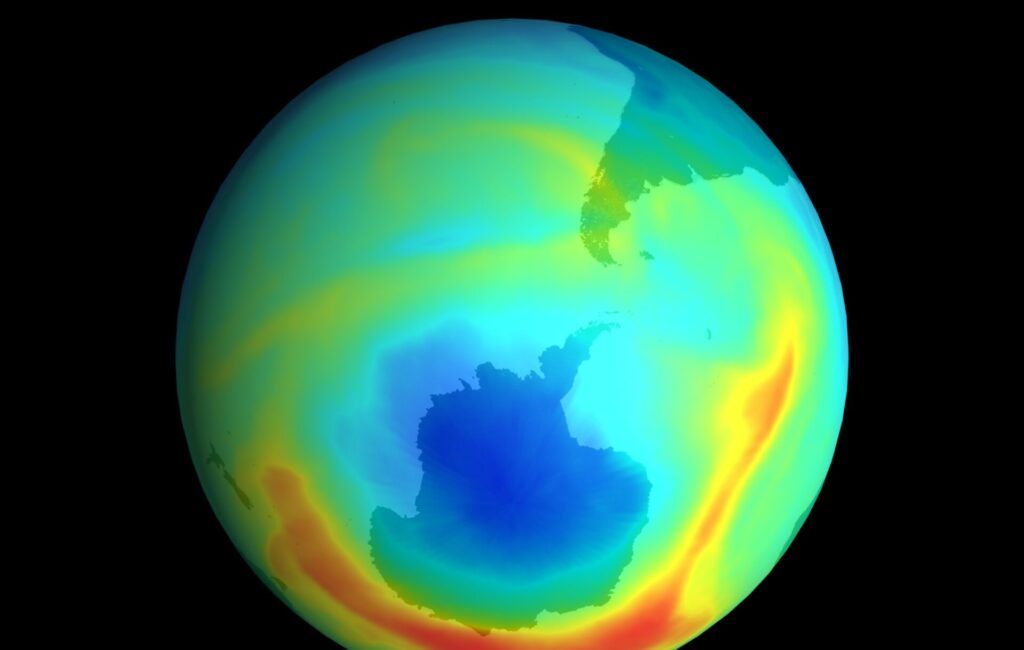 A color-coded satellite image of Earth showing the ozone hole over Antarctica, with blue representing low ozone concentrations and red indicating higher levels, in 1981. That same year, atmospheric chemists Paul Crutzen and John Birks discovered that smoke from nuclear war would have devastating, global climatic effects that are worse than the impact on the ozone layer. (Credit: NASA/Goddard Space Flight Center)
Listen to this article:
Listen to this article
--:--
This audio was generated using an automated voice. Learn more.
Editor’s note: This is part of the “Nuclear winter: Why study it now?” series.
In November of 1981, atmospheric chemist Paul Crutzen and I sat in his office at the Max Planck Institute in Mainz, Germany puzzling over the results of our run of his computer model of the atmosphere. That run showed that a nuclear war scenario would not harm the ozone layer. In fact, the model showed that it would even thicken the ozone layer by a small amount, reducing the harmful effects of the sun’s ultraviolet (UV) radiation. This was in stark contrast to the prevailing understanding, confirmed in a 1975 study by the US National Academy of Sciences, that a major nuclear war would roughly halve the amount of ozone in the stratosphere, making it impossible to be outdoors without protective clothing and glasses for more than a few minutes.
Did this new computer modeling mean that nuclear war would be good for humans and the planet?
This is the story of how Crutzen and I discovered another, likely more devastating, global climatic effect of nuclear war that—with further advances by other scientists, including astronomer Carl Sagan—became known as “nuclear winter.” This theory likely influenced US President Ronald Reagan and Soviet Premier Mikhail Gorbachev to negotiate and sign the 1987 Intermediate-range Nuclear Forces Treaty (INF)—the first US-Soviet agreement to reduce nuclear stockpiles. The INF treaty significantly reduced tensions between the two superpowers and aided in the de-escalation of the Cold War.

Although the influence of nuclear winter on policy debates and popular culture is well documented, the origins of the theory remain largely untold.
Supersonic airliners and an awakening. The theory of nuclear winter emerged from the scientific work on the impact of supersonic transport (SST) airliners on the Earth’s protective ozone layer. In August 1972, as the Vietnam War continued to slog on, I returned to the University of California, Berkeley, to complete my Ph.D. thesis, which had been interrupted by two years of alternative service at the Kansas University Medical Center.
During my absence, my research advisor, Professor Harold Johnston, had published his landmark paper in Science on the harmful effects of SST aircraft on the stratospheric ozone layer. Crutzen, who was then at Stockholm University and did not know Johnston, had independently discovered that nitrogen oxides (NOx, which groups together nitric oxide, NO, and nitrogen dioxide, NO2) from the exhaust of supersonic airliners could act as a catalyst for ozone destruction. A proposed fleet of 500 such aircraft flying in the lower stratosphere was projected to cause a 50-percent depletion of the ozone layer, which protects life on Earth from the sun’s harmful ultraviolet radiation.
Upon my return to his Berkeley lab, Johnston had a new task for me: to help him and his postdoc, Gary Whitten, respond to a paper submitted for publication just days earlier by two Columbia University physicists, professors Henry Foley and Malvin Ruderman. Foley and Ruderman’s paper, funded by the Institute for Defense Analyses, challenged the theory that NOx emissions from supersonic airliners would harm the ozone layer. In their clever paper, they argued that an inadvertent experiment had already tested this theory during atmospheric nuclear weapons tests in the 1950s and 1960s and that it showed no significant impact.
A nuclear explosion heats air, composed almost entirely of nitrogen and oxygen, to extremely high temperatures—in the millions of degrees initially. The fireball produced is so hot that it combines these two atmospheric gases to produce nitric oxide—the same catalyst produced by the jet engines of supersonic airliners. As the hot fireball expands, cools, and rises in the atmosphere, some fraction of the nitric oxide produced is deposited in the stratosphere, the second-lowest atmospheric layer, extending to about 50 kilometers above the Earth’s surface. For a nuclear detonation with an explosive energy of 1 megaton of TNT equivalent or more, the resulting fireball will be completely stabilized in the stratosphere.[1] Foley and Ruderman calculated that the amount of NOx injected into the stratosphere from past atmospheric nuclear tests was roughly equivalent to a year of emissions from a fleet of 500 supersonic airliners. They then examined data from five of the nearly 100 global ozone monitoring stations and found no significant change in ozone levels, allowing them to conclude that Boeing’s proposed supersonic airliner fleet would have no measurable impact on the ozone layer.
However, we found that in their analysis, Foley and Ruderman had greatly overestimated the amount of nitric oxide being produced in nuclear fireballs and the amount deposited within the stratosphere. Past studies of nuclear weapons effects allowed us to show that the size of the individual nuclear explosion was key to its effects on stratospheric ozone. Fireballs of bombs having yields less than 1 megaton—which represent the vast majority of today’s estimated 13,000 nuclear weapons—would not fully penetrate the stratosphere, depositing part or all of the bomb-produced nitric oxide in the troposphere, the lower atmospheric layer we live in, which extends to about 12 kilometers above ground level. During and following nuclear tests, the United States used balloons and aircraft to measure the levels of radioactive isotope strontium-89 deposited in the stratosphere. We used those measurements as a proxy for NOx to show that the oxides of nitrogen formed by the nuclear explosions were mostly distributed low in the stratosphere and at high northern latitudes, where NOx has a minimal effect on ozone. We concluded that not enough nitric oxide from nuclear tests had been injected at a high enough altitude and low enough latitude to have significantly affected the ozone layer.[2]
Although Foley and Ruderman failed to disprove the effect of supersonic airliners on the ozone layer, their paper inadvertently raised the question for the first time of whether the detonations of thousands of nuclear weapons would severely damage the ozone layer. This hypothesis was first suggested by John Hampson of Université Laval in an article in Nature in 1974 and would soon be confirmed by other scientists using stratospheric models.
The US National Academy of Sciences convened a study by leading atmospheric scientists to evaluate such a scenario. The study, released in 1975, concluded that the reduction in the global ozone concentration could be as much as 30 to 70 percent in the months following a major nuclear war. This result depended on the number and size of warheads used, with most of the ozone depletion occurring in the northern hemisphere, where the weapons would be detonated. The report concluded that a nuclear war would have severe consequences for human health, leading to increased risks of skin cancer, cataracts, and other health issues. It would also impact natural ecosystems, particularly phytoplankton in the oceans that are critical to the marine food chain.
The National Academy study was the first to show that the impacts of nuclear war would extend beyond the immediate blast damage to global atmospheric and ecological systems. This work formed the basis of Jonathan Schell’s 1982 bestselling book, The Fate of the Earth, first published as three articles in The New Yorker in February of the same year. Although this book had an enormous impact on the public perception of the global consequences of nuclear war, it was already out of date by the time it was published, as an even more consequential effect of nuclear war had just been uncovered.
Unexpected results. My family and I arrived in Mainz, Germany in August 1981 to begin my first sabbatical leave from the University of Colorado to work with Crutzen at the Max Planck Institute. By then, Crutzen was already a widely recognized scientist in the field of atmospheric chemistry from his earlier work on the effect of NOx on the ozone layer, which would eventually earn him the Nobel Prize in Chemistry in 1995.
Fears of an outbreak of nuclear war ran high in the early 1980s due to deployments of short-range ballistic missiles by NATO in western Europe and the Warsaw Pact in the east. Soon after I arrived in Mainz, Crutzen received an invitation from Jeannie Peterson, then the editor of the journal Ambio published by the Royal Swedish Academy of Sciences. He was to contribute an article for a special issue entirely devoted to the environmental effects of a major nuclear war. The editor wanted the authors to quantify as best possible the direct effects of blast, thermal radiation, and radioactivity on human life and the environmental impacts on the atmosphere, land, fresh water, and oceans. The Ambio consultants for this special issue, who included experts on the nuclear arsenals and targeting strategies, provided us with a specific nuclear war scenario to evaluate: 14,747 nuclear weapons were detonated for a total explosive yield of 5,742 megatons. Of these, all but 173 megatons were detonated in the northern hemisphere. A total of 6,620 warheads were targeted against military targets, 4,970 against 1,124 cities, 3,136 against industrial and energy targets, and the remaining 21 warheads for the closing of 14 straits.
Crutzen and I started thinking about how to approach the problem of modeling the impacts of this nuclear war scenario on the atmosphere. We thought we could simply update previous calculations of ozone depletion from nuclear explosions using his new 2D computer model of the stratosphere. My initial task was to calculate the quantity of nitric oxide produced by each explosion and its vertical distribution. These calculations were then used as inputs into Crutzen’s 2D model, along with the latitudes of the targets. (Crutzen’s model assumed a uniform distribution along longitude.) Crutzen coded the data and ran the model overnight. The next day, we were left puzzled by what we saw.
The model’s results indicated that there was no large stratospheric ozone depletion, unlike in the 1975 NAS study. Instead, there was even a small increase in ozone at altitudes corresponding to the upper troposphere and lower stratosphere. In other words, according to these calculations, a nuclear war might be beneficial to the Earth’s ozone layer and the biosphere that it protects from the Sun’s harmful UV rays.
But why did our results differ so drastically from those of past studies?
The answer was in the scenario itself. Nuclear arsenals had significantly changed since the National Academy study. Rather than carrying one large nuclear warhead, say of 10 or 20 megatons, missiles were now being outfitted with as many as 10 much smaller warheads of a few hundred kilotons each. These warheads were loaded in newly developed multiple independently targetable re-entry vehicles, or MIRVs, with each warhead able to reach a different target. MIRVs are much more difficult to intercept because, once deployed, the warheads of a single missile can destroy up to 10 targets.
The scenario we had been given to evaluate included only 769 one-megaton warheads and seven 10-megaton warheads, out of the nearly 15,000 detonations considered. Therefore, only a small fraction of the NOx produced would reach the stratosphere. To verify the dependence of the results on weapon size, we evaluated a second scenario, which was closer to those used in past studies: 5,000 one-megaton warheads and 500 10-megaton warheads for a total of 10,000 megatons of explosive power uniformly distributed between the 20° and 60° North latitudes. This scenario produced a large ozone depletion, with about half of the ozone being destroyed in the Northern Hemisphere, in agreement with past studies. But a modern nuclear war would almost certainly be fought using weapons mostly of sub-megaton size that would not significantly deplete the ozone layer because too little NOx would reach the stratosphere.
A “killer” smog. Of course, these results were insufficient to conclude that nuclear war would have no significant impact on the atmosphere. Nearly all the nitric oxide produced by the bombs would be injected into the troposphere, the lower atmospheric layer where most forms of life on Earth reside. We also had to evaluate the effect of adding NOx to the air we breathe.
In the troposphere, nitric oxide has the opposite effect on ozone that it does in the stratosphere: Instead of catalyzing the destruction of ozone, it catalyzes the formation of ozone in a process known since the 1950s as photochemical smog. Ozone in the lower atmosphere has potent effects on human health, including increasing asthma attacks and other respiratory illnesses, and it damages plants, adversely affecting natural ecosystems and crop yields.
Considering that most of the bomb-produced nitric oxide would be deposited in the troposphere instead of the stratosphere, it occurred to us that a nuclear war might result in a global “killer” smog with high concentrations of ozone and even more toxic air pollutants such as peroxyacetyl nitrate. Photochemical smog requires three ingredients: NOx; a carbon source such as carbon monoxide or hydrocarbons; and sunlight. The bombs produce the NOx, and sunlight is already there. We only missed the carbon source.
From the literature about the direct effects of nuclear explosions, we knew that large fires are responsible for much of the destruction. These fires are ignited by the intense thermal pulse of the initial explosion and by the breakage of electrical power lines and natural gas lines throughout a city. And, while at the National Center for Atmospheric Research, Crutzen had recently led a campaign in Brazil to study the effects of biomass burning on tropospheric chemistry, especially ozone formation. We knew that nuclear explosions would result in fires in cities, oil refineries, forests, and much more. But little was known about the composition and quantities of emissions that occur from any of those sources—except for forests.
Crutzen and I both hit the library to find estimates of forest fire emissions of various chemical species like carbon monoxide, ethane, ethylene, propylene, and NOx that promote the formation of photochemical smog. Armed with some numbers, we met in Crutzen’s office to decide how to proceed. Crutzen asked me what I thought would be a reasonable estimate of the amount of forest that might burn for a hypothetical calculation. I looked at a large map of Europe hanging on the wall and suggested we use 1,000 kilometers by 1,000 kilometers—or 1 million square kilometers—an area that would approximately encompass the countries of Sweden, Norway, and Denmark. This was a nice round number for our example calculation, which would produce a large quantity of emissions and would still be only a tiny fraction (less than 1 percent) of the land area of the Earth, which is about 150 million square kilometers. (It is also comparable to the total urban area of the Northern Hemisphere, although the fuel density of urban areas is much greater than that of forests.)
Many cities are surrounded by forests, especially in Europe, while many military targets like missile silos in Wyoming, Montana, and North Dakota are in areas of low vegetation. Estimating emissions based on burning a million square kilometers of forests due to ignition by nearly 15,000 nuclear explosions throughout Europe, Asia, and North America did not seem unreasonable, especially considering that forest fires were likely only a small component of the total emissions that would include burning of cities, oil refineries, and oil reserves.
After estimating the total amounts of the various hydrocarbons and additional NOx produced by the fires, we entered these into Crutzen’s model. The result was not surprising: The Ambio nuclear war scenario produced an intense photochemical smog similar to that of the Los Angeles basin in the 1950s, with ozone levels reaching more than 160 parts per billion—more than twice the current level of 70 parts per billion of the US ozone air quality standard[3]—and the even more potent oxidant peroxyacetyl nitrate reaching 10 parts per billion or more. These are extremely unhealthy levels of air pollutants, although they would be fatal only for a small fraction of the population. At this point, I started writing the paper, incorporating Crutzen’s edits along the way. Our conclusion was going to be that unless a much larger number of nuclear weapons of 1-megaton explosive yield or more were used, a major nuclear war would not significantly damage the ozone layer. Still, there would be a nasty, dirty, unhealthy ambient air for up to a few months after detonations ceased.
But what about smoke? In earlier studies on forest fire emissions, much attention had been given to the quantities of dark, sooty smoke that is produced. While going over what we thought was a near-final draft of our paper, it occurred to us that we may have overestimated the importance of smog production: We hadn’t considered that smoke from the thousands of forest fires would reduce some of the sunlight driving the photochemical reactions. (Smog forms when pollutants such as nitrogen oxides react with sunlight.) We both whipped out our calculators.
We had an estimate of how much smoke the fires would produce (somewhere between 200 million and 400 million metric tons), and we also had an estimate of the absorption cross section for soot—that is, how strongly a given mass of soot would absorb sunlight. Our calculations agreed: Spread over half the northern hemisphere, the smoke would block somewhere between 50 percent and 99 percent of the sunlight at noon and an even larger fraction at other times of day.
This was our “Eureka” moment.
Nuclear war could darken the atmosphere so much that plant life could not survive for long. Without adequate sunlight, it would be extremely difficult to grow food after a nuclear war, with the result that even rural people surviving the direct effects of blast, thermal radiation, fires, and nuclear radiation would face famine. Natural ecosystems would suffer as well, and notably, the food chain for the entire ocean could possibly collapse due to the death of phytoplankton that, through photosynthesis, begin the food chain.
Our new results also made us realize that by absorbing sunlight, smoke would completely alter the physics of the atmosphere and that there would be huge climatic effects. We knew that, overall, the earth’s surface system—composed of the atmosphere (air), hydrosphere (water), cryosphere (ice), and lithosphere (land)—would heat due to its decreased albedo, in which much more solar radiation would be absorbed in the atmosphere rather than reflected back to space. While the atmosphere would heat by tens of degrees, the land surface might actually heat or cool, depending on the amount of soot loaded into the atmosphere, the physical properties of the aerosols produced by the fires, and their distribution and lifetime in the atmosphere. We didn’t have a global climate model, nor the time to test that before the submission deadline.
Crutzen and I completely rewrote our paper based on our discovery of the effects of smoke from nuclear war fires. We then traveled to Stockholm in early January 1981 to meet with Jeannie Peterson, the editor of Ambio, to explain our unexpected results and discuss how best to proceed. We knew the paper would generate a great deal of controversy, and after briefly considering publishing it anonymously out of fear for our respective careers, we decided that it was important to stand behind and defend our results. To make sure that our paper had no errors, we sent the draft to about two dozen colleagues for internal review. Our paper was finally published in June 1982, with the title: “The Atmosphere after a Nuclear War: Twilight at Noon.” The editorial staff had wanted “Darkness at Noon” as the subtitle, but Crutzen and I didn’t want to mimic the title of Arthur Koestler’s dystopian novel, as distressing as our results certainly were.
“Nuclear winter” is born. At around the time we were writing our paper, a group of scientists, including the astronomer and public educator Carl Sagan, had begun applying their one-dimensional climate model to the problem of climate change due to injections of dust high in the atmosphere from ground-bursts of nuclear weapons. In an equally interesting story, their work had begun with studies of dust clouds on Mars. These studies had led them to examine the climate consequences of the recently discovered Cretaceous-Tertiary event 66 million years ago, when a 10-kilometer-sized asteroid collided with the Earth, creating the Chicxulub crater in the Gulf of Mexico and injecting huge amounts of debris into the atmosphere. This impact, they found, resulted in total darkness, a cooling at the earth’s surface, and the extinction of a large fraction of land and sea animals, notably the dinosaurs.
Based on our results, this group of scientists—among them Richard Turco, Brian Toon, Tom Ackerman, Jim Pollack, and Carl Sagan—found that the soot produced in nuclear war fires would have a much greater effect on climate than dust, which is only produced in ground bursts and mostly scatters sunlight rather than absorbing it. They decisively showed for the first time that a major nuclear war would produce a cooling at the Earth’s surface that the lead author, Turco, cleverly named “nuclear winter.” Their paper, published in Science in December 1983 and summarized by Sagan in Parade magazine, brought world attention to the problem.
Further studies refined the concept of nuclear winter, showing that it would result in far more deaths, potentially several billion more, than the direct effects of the explosions. Nuclear winter would magnify the human tragedy of nuclear war tenfold or more. Both US President Ronald Reagan and Soviet Premier Mikhail Gorbachev publicly acknowledged the nuclear winter phenomenon, which likely influenced their decision to pursue arms control agreements. This culminated in 1987 with the signing of the INF treaty, which eliminated nuclear missiles with intermediate ranges of 500 to 5,500 kilometers. The treaty significantly reduced tensions between the two superpowers, especially in Europe, where these missiles had been deployed, and allowed the de-escalation of the Cold War.
The INF treaty paved the way for further arms reduction agreements, such as the treaties on strategic arms reduction in 1991 (START I), 1993 (START II), and 2010 (New START). These treaties helped reduce the global nuclear arsenal from over 65,000 nuclear warheads in the mid-1980s to less than 13,000 today, of which about 4,500 are deployed. After the collapse of the Soviet Union in 1988, public concerns about nuclear war waned despite nuclear weapons continuing to be a global danger.
Recent studies led by Alan Robock of Rutgers University, Toon, Turco, and a new generation of scientists using modern climate models show how even a limited nuclear war, such as between India and Pakistan, would lead to large reductions in Earth’s surface temperature, even with as few as 100 nuclear weapons. As Carl Sagan and other scientists pointed out long ago, the amount of soot that reaches the stratosphere, where the residence time is up to several years, is what drives nuclear winter. Nuclear weapons would simply serve as “matches” to ignite firestorms in cities that produce the soot and inject it into high altitudes. In addition, when fires spread over large areas, models show that the smoke clouds rise on their own as they are heated by absorbed sunlight, reaching altitudes where the smoke particles are long-lived and not rained out. It is, therefore, the overall amount of material that burns that ultimately drives the scale of global climatic impacts from nuclear war, not the numbers or yields of nuclear weapons being used. Even small tactical nuclear weapons make good matches.
Although the cold and dark of nuclear winter captured the imaginations of both scientists and the public, we must not forget the other horrible direct effects of blast, thermal radiation, and radioactive fallout, in addition to the complete loss of infrastructure for food production, transportation, and distribution. When Crutzen and I wrote our paper in 1982, nuclear war was considered by many leaders as fightable and winnable, with perhaps the loss of a few million or tens of millions of people on the prevailing side. Now it is generally recognized by sane people that because of the climate consequences, there can be no winner.
Since we published our Ambio paper in 1982, India, Pakistan, North Korea, and possibly Israel have joined a nuclear club previously limited to the United States, the United Kingdom, France, Russia, and China. And Iran and other countries are seeking membership, too. The risk of nuclear war is once again high, with the possibility of rapid nuclear escalation in the Russia-Ukraine war, the Iran-Israel conflict, and the Pakistan-India confrontation. Growing political tensions within and between nations, food insecurity, increased migratory pressures caused by climate change, and both internal and external attacks on democracies all contribute to increasing the risk of nuclear war at an alarming rate.
It takes only one person to start a nuclear war with inevitable global catastrophic consequences for all of humanity. The need to continue to make the world aware of the horrendous effects of nuclear war will continue so long as nuclear weapons exist.
Notes
[1] Between 1961 and 1962, the United States and the Soviet Union tested 38 nuclear weapons in the atmosphere, all hydrogen (fusion) bombs with yields of over 1 megaton for a total yield of 252 megatons. The largest of these weapons, the Tsar Bomba, detonated by the Soviet Union on October 30, 1961, had a yield of 50 megatons—more than 3,000 times the explosive power of the Hiroshima fission bomb.
[2] In fact, the analysis of the measurements from the nearly 100 ozone-observing stations around the globe would show that there had been a 5-percent increase in ozone levels over the decade following the nuclear weapons tests. This increase was later shown to likely be due the Southern Oscillation (El Niño & La Niña), a global climate phenomenon that was just beginning to be studied.
[3] Established in 2015, the current Ozone National Ambient Air Quality Standards (NAAQS) are 70 parts per billion, measured as the fourth-highest daily maximum 8-hour concentration, averaged across three consecutive years. See: https://www.epa.gov/ground-level-ozone-pollution/ozone-national-ambient-air-quality-standards-naaqs
A weeklong look at nuclear winter
Come back every two days from May 12 to May 18 for the next piece in the Bulletin's series on nuclear winter.
Together, we make the world safer.
The Bulletin elevates expert voices above the noise. But as an independent nonprofit organization, our operations depend on the support of readers like you. Help us continue to deliver quality journalism that holds leaders accountable. Your support of our work at any level is important. In return, we promise our coverage will be understandable, influential, vigilant, solution-oriented, and fair-minded. Together we can make a difference.
Keywords: atmospheric science, nuclear war, nuclear winter, nuclear winter series
Topics: Analysis, Nuclear Weapons

John Birks
John W. Birks is a professor emeritus at the University of Colorado Boulder. ... Read More








Leave a Reply