
A still from the 1966 film "The War Game," via BBC
Since the dawn of the atomic era, the threat of nuclear annihilation has played a role in the popular imagination. A remarkable number of horror movies—in America, Europe, and Asia— have used radiation as a plot device, while others have focused on the sheer scale of devastation that would occur from an exchange of nuclear weapons.
As time went on and new existential threats arose—in the form of climate change, pandemics, genetic manipulation, artificial intelligence, and the debasement of democracy, to name just a few—films tried to keep up, by incorporating these themes into their worlds.
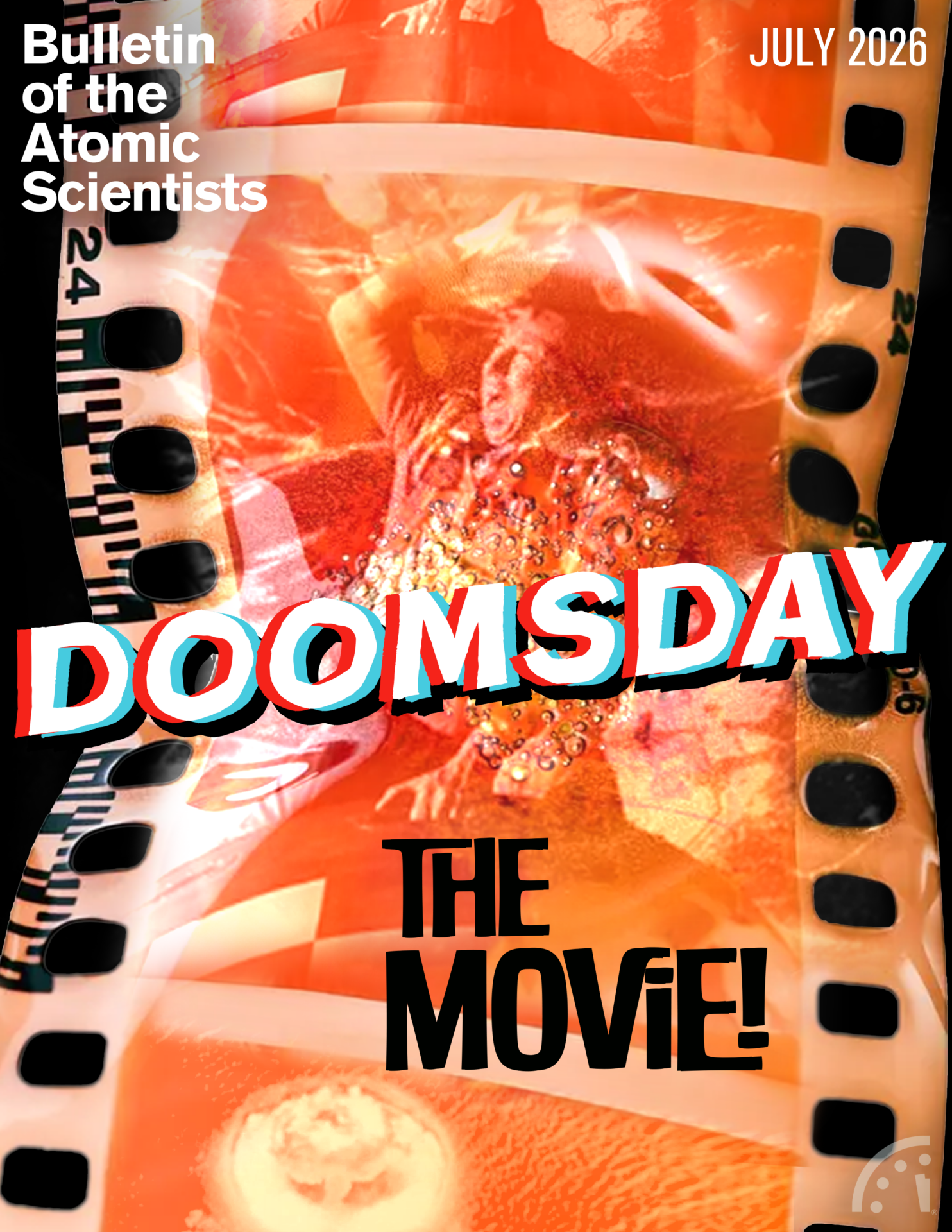
For this issue of our magazine, the staff of the Bulletin of the Atomic Scientists thought it would be enlightening (and fun) to learn more about what the movies have to say about the collective fears of our society when it comes to Doomsday. And, in the case of science fiction films made a mere couple of decades ago, to find out if Hollywood’s predictions of a dystopia in the 2020s turned out to have a kernel of truth.
The essays found here delve into whether these films have or have not been effective in bringing ethical concerns to light, raising public awareness, and inspiring public activism—and even take a stab at the quality of these movies as art. The articles go into some of the best (and mention some of the worst) depictions of existential risk.
The result is by no means exhaustive, and no doubt some readers will notice that one of their favorite Doomsday movies is missing. This was in part purposeful, as one goal of this special issue was to highlight films that were little-noticed when they first appeared, only to become big later.
As an editor, one thing that I found fascinating in preparing this special issue was how often certain titles came up among nearly all of our potential authors. Experts in the realm of nuclear risk and international relations, for example, kept mentioning the name of what to me was an obscure, 1980s British apocalyptic film—which, it turns out, may very well be the first feature-length film to depict the effects of a nuclear winter. In “The brutal, powerful legacy of Threads,” Dan Drezner, academic dean of international politics at the Fletcher School of Law and Diplomacy at Tufts University, examines how this film goes far beyond depicting the initial devastation of a nuclear weapons exchange to delve into the long-term degradation of social order, language, and human development across generations. He also found that Threads contained a powerful critique of civil defense and emergency planning, using the subplot of city officials trapped in a bunker to illustrate the absurdity of what sociologists call “fantasy documents”—disaster plans that are completely detached from reality when it comes to worst-case outcomes.
Not all of the authors for this issue are experts in international relations; this magazine also contains the viewpoint of someone whose full-time, paid job is as an expert on movies. In “A film about nuclear war ‘too horrifying for the medium of broadcasting,’ ” Rebecca Fons—a film curator and director of programming at the historic Iowa Theater, who is now Head of Cinema at London’s Barbican Centre (arguably the largest performing arts complex in Europe)—describes the curious, twisted tale of a 47-minute movie about nuclear war that those who commissioned it found was too realistic, and too painful, to watch. Called “The War Game,” the BBC quickly yanked it from distribution—only for it to be rediscovered, and revered, years later.
And not all Doomsday-related tales are downers. In “How the movies (and the rest of the media) made me into an anti-nuclear weapons campaigner,” legendary activist Helen Caldicott describes how books and films such as 1959’s “On the Beach” inspired her. Nuclear weapons and nuclear testing—and, just as important, media coverage of them—may have kept following her around like a radioactive shadow. But rather than making her want to run and hide, their presence made her determined to respond, by using the power of that same media.
Now in her late eighties, Caldicott also describes how an effort to muzzle press coverage of her and the anti-nuclear weapons movement backfired: In 1982, a young Canadian filmmaker named Terre Nash recorded a speech Caldicott was giving in a city which had long been home to a large and important US Strategic Air Command Base. Titled If You Love This Planet; the film was labeled as so-called “foreign propaganda” by the Reagan administration’s Department of Justice in an attempt at censorship—which only served to create a media firestorm of interest. The film went on to win an Oscar for Best Short Documentary.
In her acceptance speech at the Academy Awards, Nash thanked the US Justice Department “for their tremendous effort in promoting If You Love This Planet.”
Speaking from a less glamorous pulpit, David Kirby highlights in “Gattaca and the quiet Doomsday of genetic determinism” how films can sometimes do a better job than academic treatises in bringing alive concerns about new technologies and how they will be applied. Kirby—a former geneticist himself—says that this 1997 movie was eerily accurate in many respects, in its imagination of a society where a person’s worth, opportunities, and identity are determined exclusively by their genetic profile; meanwhile, willpower, imagination, and labor count for little. Genetic probability is mistakenly reduced to absolute certainty, and a person’s future is determined within seconds of being born. The result, Kirby finds, is a different, slow-burning form of existential risk: “A society primed to interpret genetic information as destiny may gradually narrow its imagination of what is possible.”
Or, as the tagline for Gattaca’s ad campaign put it: “There is no gene for the human spirit.”
Together, we make the world safer.
The Bulletin elevates expert voices above the noise. But as an independent nonprofit organization, our operations depend on the support of readers like you. Help us continue to deliver quality journalism that holds leaders accountable. Your support of our work at any level is important. In return, we promise our coverage will be understandable, influential, vigilant, solution-oriented, and fair-minded. Together we can make a difference.
Keywords: disaster, doomsday, existential threat, films, movies, nuclear winter
Topics: Magazine, Personal Essay, Satire, Special Topics, Uncategorized

Dan Drollette Jr
Dan Drollette Jr is the executive editor of the Bulletin of the Atomic Scientists. He is a science writer/editor and foreign correspondent ... Read More
ALSO IN THIS ISSUE














The 1983 ABC made for TV movie “The Day After” really horrified viewers. I find the 1964 movie “Fail Safe” equally nerve-wracking.
I agree with Mr. Ford. I have never heard of the movies mentioned here, of course I grew up in the US and I saw “Fail Safe” many times on television. I saw “The Day After” in Bagdad, Irag by renting the film from a movie rental store.
As a kid of the 50’s-60’s, I never realized that ‘Godzilla’ was about nuclear doomsday for the world. And I was not a sci-fi fan much as I grew up. It was seeing ‘Dr. Strangelove’ in my college years in a film study class that I realized how dark comedy could be used for sending an anti nuclear message. Even the supposedly serious Civil Defense films, such as those gathered up on VHS tapes such as ‘Radio Bikini’ and ‘Atomic Cafe’ were turned into dark lessons that probably resulted in an uncomfortable, or guilty feeling if you laughed.. But I… Read more »