
Screenshot of real 2025 ad for the Nucleus Embryo company. Image courtesy of the author.
One of Gattaca’s most famous lines of dialogue is delivered by a geneticist to prospective parents. He is explaining to them why he has chosen a specific embryo for their future child: “I’ve taken the liberty of eradicating any potentially prejudicial conditions: premature baldness, myopia, alcoholism and addictive susceptibility, obesity, and so on.” That line was meant to feel ominous in 1997. It was supposed to show how easily a society’s definition of “harm” could expand from genuine illness to traits that were just socially inconvenient.
Today, however, that line sounds more like ad copy for a real-life fertility company than dystopian dialogue. Nucleus Embryo, for example, advertises embryo screening as a tool for managing disease risk (Nucleus Embryo homepage 2026). But it also promises predictions about traits such as intelligence, height, eye color, male-pattern baldness, alcohol dependence, and even left-handedness. The website does not describe these as “prejudicial conditions.” It calls them information which is presented as empowerment and parental choice. They even have a whole ad campaign designed around the phrase “Have your best baby.” (See real life ad at top of page, above, from 2025.) The moral language of “prejudice” has been replaced with the technical vocabulary of “risk” and “optimization.” And it is far from the only company marketing the genetic testing of embryos created through in-vitro fertilization (IVF) in terms that extend beyond disease prevention (Moe, Pampoulov, Franco, Han, Ha, Fife and Stone 2026).
The blurring of that line was anticipated by the film’s own marketing. When Gattaca was released in 1997, the movie’s print advertising campaign included newspaper ads deliberately designed to look like real fertility clinic advertisements. They offered genetic enhancement services as though they were routine medical options. What used to be speculative fiction now resembles a plausible element of market-driven genomics. (See Gattaca fictional ad below, from 1997.)
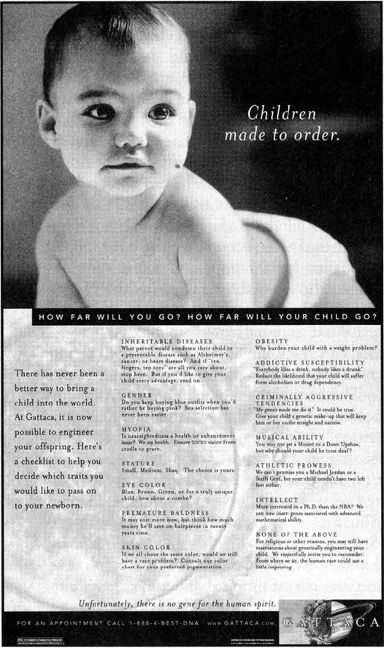
That is why Gattaca belongs in any conversation about existential risk and cinema. The film depicts a near-future world in which a person’s genetic makeup determines everything in their life including employment, insurance, education, and social mobility. Individuals conceived without genetic enhancement, so-called “in-valids,” face systemic discrimination, while those engineered for optimal traits enjoy institutional privilege. The film’s protagonist, Vincent Freeman, circumvents this system by passing off the genetically superior “borrowed” DNA of Eugene Morrow as his own.
Gattaca’s story is not about runaway biotechnology. What it portrays is a society that has been reorganized around the (mistaken) belief that DNA alone determines destiny (Kirby 2000). The film remains relevant because it shows how easily genetic information can become a measure of human worth—and how readily that standard can harden into a discriminatory hierarchy.
It’s the ideology, not the technology
The rapid expansion of embryo genetic testing, what is called preimplantation genetic diagnosis (Genetic Science Learning Center 2014), and the emergence of gene-editing technologies such as CRISPR force us to confront the ideological question the film posed nearly three decades ago: How far will we go in allowing genetic information to decide who is valued, who gets opportunities, and who we consider worthy of full humanity? Gattaca does not depict parents as villains. The film portrays them as participants in a system that makes genetic optimization seem necessary, responsible, and even loving. It is not warning us that biotechnology will destroy humanity. Instead, it shows how a culture that treats enhancement as responsible parenting redefines who counts as fully human.
At first glance, Gattaca might appear to be a cautionary tale about genetic engineering. However, the film does not portray biotechnology as the problem. The film’s true villain is the ideology of genetic determinism—which the American Psychological Association defines as “the doctrine that human and nonhuman animal behavior and mental activity are largely (or completely) controlled by the genetic constitution of the individual and that responses to environmental influences are for the most part innately determined.” Genetic determinism is a belief that reduces complex human identity to the biochemical properties of DNA. In Gattaca, this worldview has become socially dominant. Genetic information is not treated as probabilistic but as conclusive. The genome becomes a comprehensive risk assessment that is simultaneously medical data, predictive model, and social judgment.
The existential threat in this scenario is not biological extinction. It is the quiet redefinition of humanity entirely in genetic terms and the willingness to call that “progress.” If a society accepts that human worth can be quantified genetically, then discrimination becomes rationalized as scientific necessity. Hierarchies appear to be natural rather than constructed. The film’s most chilling line captures this shift: Discrimination has been refined “down to a science.”
A consumer-driven eugenics
Fears about human genetic engineering have historically been framed around scientist-driven or state-imposed eugenics (Sutto and Gardiner 2021). The imagined nightmare scenario involved Nazi-like mad scientists directly manipulating DNA to create “supermen,” or authoritarian governments dictating which traits should be eliminated before birth. Gattacadeparted from this traditional narrative in two important ways. First, it shifted the eugenic logic from direct genetic manipulation to the selection among embryos. Second, and more importantly, it relocated eugenics from top-down control to the logic of the market.
Contemporary anxieties about CRISPR echo familiar fears of scientists directly altering DNA based on what they believe makes a “superior” human (Stein 2023). The controversial 2018 birth of gene-edited babies in China seemed to support this narrative (Raposo 2019). But what Gattaca recognized was that the new eugenics would not center on rewriting the genome but would involve the more palatable practice of preimplantation genetic diagnosis and embryo selection. These technologies do not require the same scale of intervention as altering the human genome. They only require choosing among embryos. That is an act that can be framed as sensible rather than transformative.
The change in technological mechanism is only part of the story. More significant is how Gattaca depicts the shift in the locus of decision-making from coercion to consumer participation. In Gattaca, the geneticist is not the architect of a top-down eugenic program. He is a service provider responding to parental demand. That subtle shift is the film’s most revealing insight. The promise offered to Vincent’s parents is not dominance but reassurance. The geneticist was not using the language of superiority. He was invoking the language of precaution. His appeal was not to ambition, but to care. To decline such options begins to feel less like restraint and more like negligence.
In this framework, selection is presented as conscientious parenting. Choosing among embryos becomes analogous to choosing a school district or a vaccination schedule. It is just another responsible decision among many parental decisions. The move to genetic screening and embryo selection appears incremental rather than revolutionary. No genes are rewritten. Nothing dramatic occurs. A comparison is made, a parental choice is exercised, and, by doing so, a life trajectory is set.
The film suggests that what makes eugenics possible is not a technological breakthrough, but an intensification of the desire to give one’s child every possible advantage. When having a child becomes an exercise in risk reduction, then ordinary differences begin to feel like preventable defects. Gattaca shows how disease avoidance can gradually expand into genetic optimization.
Genetic determinism as social infrastructure
The film’s deeper argument concerns what happens after reproductive choices are reframed as genetic optimization. It shows how personal decisions turn into social infrastructure. Eventually, your genetic profile shapes where you can work, how you are treated, and what you are allowed to become. What makes Gattaca so effective is that this transformation does not emerge through revolution, but through routine administrative procedure. A job interview is reduced to a blood test. School admissions are decided by genetic profiles. Insurance decisions are made in seconds. No one declares a new caste system. It simply materializes through hiring policies, risk calculations, and everyday prejudice. In this way genetic determinism becomes infrastructure. Vincent’s struggle is not against a mad scientist but against a system that mistakes genetic probability for merit. Genetic engineering does not produce a society of villains. It produces a society of HR departments.
In Gattaca, surveillance is not spectacular. It is simply everywhere. Every part of the body (blood, hair, skin, eyelashes, saliva) becomes an identifier that is constantly sampled, scanned, and verified. Even privacy must be engineered. Vincent’s daily ritual of scrubbing away loose skin cells and vacuuming stray hairs is not merely a precaution. It is self-surveillance. In a society where genetic traces equal identity, individuals become both subjects of monitoring and managers of their own biological residue.
The film’s director, Andrew Niccol, visualizes this system of genetic discrimination through architectural motifs, including shots of gates and doors closing on the genetically unmodified Vincent. Other scenes depict the “glass ceiling” that exists when genetic discrimination is illegal but openly practiced. Vincent constantly presses his face against windows and looks up through a skylight at the Gattaca Corporation. These glass barriers literalize the predicament faced by Vincent, who should legally be able to work on the inside but is shut out due to the discriminatory practices of Gattaca’s society.
This is the culmination of the transformation the film depicts. When genetic information is embedded in institutional procedures, exclusion no longer requires covert prejudice. It operates through screening protocols, eligibility standards, and risk classifications that appear neutral and technical. Discrimination is refined “down to a science” not through spectacle, but through process. When genetic profiles are treated as official criteria, exclusion can be defended as compliance. Once biology is codified as a primary sorting criterion, inequality begins to seem like an administrative necessity.
Genetic prophecy and self-fulfilling identity
Gattaca does more than show how society’s belief in genetic determinism structures institutions. It illustrates how that belief reshapes identity. A major theme in the film is genetic prophecy, which is the idea that genetic readouts are not treated as probabilities but as predictions. In Gattaca, Vincent’s birth is accompanied by a genetic readout predicting a high probability of heart disorder and a sharply reduced life expectancy. These numbers are meant to be presented as medical possibilities. But they are received as certainty. Vincent’s future is determined before he can even give his first cry.
The film’s society does not just enforce genetic hierarchy through rules, it also enforces it through expectations. When everyone treats probability as fate, prediction begins to shape behavior. Employers assume limits long before any individual has failed. Parents recalibrate ambition to align with genetic forecasts. Even those labeled genetically superior feel the pressure of living up to their DNA. Genetic prophecy operates not only through exclusion but through internalization. In such an environment, predictive genetics can become self-fulfilling. If a child is told that their genome predicts limitation, institutions may narrow their opportunities, but the child is likely to also limit their own prospects. The deeper effect is not only external classification but the reshaping of the self.
Many visual motifs express the overriding belief in genetic prophecy within Gattaca’s society. Mimicking a DNA sequence, the title of the film itself (GATTACA) is composed of the four DNA bases—A, G, T, and C, which stand for Adenine, Guanine, Thymine, and Cytosine. The opening credits highlight those letters within actors’ names before letting the other letters fade away, indicating that in this world genetic information is considered identity. The double helical staircase in Eugene’s apartment visualizes the burden of genetic expectation. Eugene was paralyzed following a suicide attempt after failing to achieve the success promised by his perfect genome. The DNA-shaped staircase is a daily reminder of his inability to reach the upper floors. Thus, it symbolizes his inability to live up to his perfect genetic makeup, and Vincent’s ability to transcend his imperfect genome.

Body matter serves as a visual metaphor for a person’s genetic identity (Kirby 2007). Blood, skin, hair, eyelashes, urine, and saliva are all used in the film to collect genetic readouts on various characters. The film’s many extreme closeups of these objects reduce human beings to biological samples and residue. At the same time, Gattaca visually conveys the cost of “perfection” with an antiseptic world that has been purged of imperfections. The sets show a sterile and blemish-free world filled with smooth, stainless-steel surfaces. The costuming also suggests homogeneity and uniformity. All the employees of the Gattaca Corporation, men and women alike, wear matching black suits. The film’s set design, costuming and cinematography visualize a culture in which biology has become both destiny and an organizing principle.
Vincent’s resistance is therefore not merely professional. It is existential. He rejects the claim that his genome defines his life’s trajectory. His acceptance into the Gattaca Corporation is more than a triumph over bureaucratic screening. Vincent’s ability to exceed the limits society defined for him calls into question the premise that biology equals destiny. His journey underscores the film’s central claim that a genome may inform a life, but it should not determine it.
Race and the new biological divide
One of Gattaca’s most provocative claims is delivered almost in passing. In a voiceover Vincent explains that discrimination is no longer based on “social status or the color of your skin,” but on genetic profile. The film underscores this visually. Characters of different races occupy positions of power. The interiors of the Gattaca Corporation and its elite social spaces are marked by racial and ethnic diversity, suggesting a world that appears “race-blind.” At first glance, this appears to be an improvement by offering an escape from older forms of bias. It sounds like progress. In this society race and class are meaningless because everything comes down to genetic profiles.
But the film’s apparent racial neutrality is achieved by borrowing the structure of racial discrimination and transferring it to genetics (Kirby 2004). The genetically unmodified are assigned derogatory names, “in-valids,” “faith births,” “God children,” that recall the slurs historically directed at racial minorities. Vincent’s situation mirrors that of minorities who have historically tried to “pass” as a member of the majority group. He conceals biological markers that could expose him at any moment, he undergoes painful physical modification to meet the dominant group’s standards, and he risks everything on the possibility that differences invisible to the naked eye will remain undetected. The film recreates the structure of racial discrimination and uses it to do narrative work while removing the racial content that gives that structure its historical meaning
Gattaca’s vision of a racially harmonious future is not extrapolated from the actual state of racial division in contemporary society. More critically, the film ignores an active and ongoing effort by social conservatives to use genetic determinism as scientific justification for existing racial hierarchies (Suhay and Jayaratne 2013). At the time the film was being made, works like The Bell Curve were making mainstream arguments that disparities in intelligence and behavior between racial groups were due to underlying genetic differences (ELSI Working Group 1994). By framing inequality as a matter of biology rather than history, these claims carried direct implications for social policy. Eugenic ideas have always linked biological narratives to racial and class hierarchies. That line of thinking has not disappeared (National Human Genome Research Institute 2026).
Gattaca’s silence on this is a failure to address the most likely ideological use of the genetic technologies the film depicts. More troubling still, by presenting a racially diverse elite in a genetically sorted world, the film implies that genetic sorting produces racial equality. It suggests that enhancement technologies, given sufficient access, would dissolve rather than reorganize existing hierarchies. But access to enhancement technologies is not evenly distributed (Mackay, Taylor, and Glass 2023). Gattaca’s hierarchy may be written in DNA, but it would still be structured by wealth. And wealth has never been color-blind in the United States. Any system that treats heredity as destiny will inevitably inherit the inequalities of the society that builds it.

Existential risk without apocalypse
Scientists created the Bulletin of the Atomic Scientists to grapple with a technology capable of ending civilization instantaneously: nuclear weapons. Popular culture often features similar stories about biotechnology and sudden catastrophe with bioengineered viral pandemics, mad scientists producing genetic monsters, and rogue governments unleashing bioweapons. Gattaca proposes a different kind of genetically engineered threat. Unlike nuclear weapons, the existential risk that Gattaca outlines is incremental. There is no extinction event. Humanity survives. But what changes is how humanity defines itself. The catastrophe lies in the normalization of a world in which human worth is measured in genetic terms. The catastrophe is an erosion of shared commitments about what human life is for. It is also the loss of human diversity which sustains our resilience, creativity, and innovation. What disappears is not the species, but its moral imagination and tolerance for imperfection.
The world in Gattaca does not end because of human genetic engineering. It is transformed by the belief that DNA determines human worth. What begins as parental choice gradually evolves into administrative routine. Genetic determinism becomes common sense. Genetic prophecy becomes both official policy and self-fulfilling identity. Biological labels begin to function like moral categories. The question is no longer whether we survive, but what kinds of lives are deemed worthy of being considered human.
Existential risk is often framed as the probability of humanity’s disappearance. Gattaca suggests another form of existential risk: A society primed to interpret genetic information as destiny may gradually narrow its imagination of what is possible. The question is not whether genes influence life outcomes, but whether we allow probabilistic genetic information to define the limits of human ambition. Gattaca’s future does not represent the end of humanity. Its danger is something quieter and more insidious. It is the destruction of the values that define what it means to be human: equality, unpredictability, moral agency, and the right to self-definition. When genetic determinism becomes consensus, those values are not immediately destroyed. They are slowly reshaped before they are lost. That reshaping is the film’s quiet Doomsday.
Conclusion: There is no gene for the human spirit
Gattaca’s tagline was meant to reassure audiences that something essential about being human remained beyond the reach of genetic engineering. Given the number of fertility companies selling the idea that it is possible to build your “best baby,” that tagline now seems more like a fading hope. We want to believe that there is no gene for the human spirit, yet we keep building systems that treat biology as destiny. The difficult, ongoing work of building more just institutions can be displaced by the seemingly cleaner task of correcting biological “risk.” Genetic optimization leads to inequality. And when inequality is framed as optimization, it begins to look like progress rather than prejudice.
Gattaca refuses that comforting illusion. Vincent is not extraordinary because he carries a hidden genetic advantage. He is extraordinary because he rejects the premise that his genome determines his identity. The film accepts that genomic intervention may reduce suffering. The story is not a simple morality tale about scientists meddling with nature. Instead, the film forces us to ask a harder question: What do we lose when we begin treating every deviation from the ideal as something that needs to be corrected? A world organized around genetic profiles may become more efficient, more predictable, and more “optimized.” That world may also become less tolerant of variation, less patient with unpredictability, and less willing to recognize dignity beyond the content of our DNA.
There may indeed be no gene for the human spirit. But there is a persistent temptation to behave as if there were. To treat the genome as destiny disguised as data. Gattaca stays relevant because it reminds us that human beings are not reducible to their genetic profiles. The future it warns about does not arrive with catastrophe. It arrives when we forget that truth.
Together, we make the world safer.
The Bulletin elevates expert voices above the noise. But as an independent nonprofit organization, our operations depend on the support of readers like you. Help us continue to deliver quality journalism that holds leaders accountable. Your support of our work at any level is important. In return, we promise our coverage will be understandable, influential, vigilant, solution-oriented, and fair-minded. Together we can make a difference.
Keywords: Crispr, biotechnology, doomsday, embryo screening, eugenics, genetic determinism, surveillance state
Topics: Biosecurity, Magazine
Get alerts about this thread
0 Comments
Oldest

David A. Kirby
David A. Kirby is chair of the Department of Interdisciplinary Studies and professor of Science, Technology & Society at Cal Poly ... Read More
ALSO IN THIS ISSUE