
The Manhattan Project first created the Bomb. Then came its story—as revealed in the documentary “Bombshell”
By Dan Drollette Jr | July 8, 2026
One of the five surviving photographs taken by photojournalist Yoshito Matsushige at Miyuki-bashi Bridge, Hiroshima, a little over two hours after the United States dropped a nuclear bomb on the city. The original caption says “People suffering burns received dabs of transformer oil brought from the nearby Hiroshima Electric Railway… Distance from hypocenter 2200 meters.”
Photo taken in August 1945, by Yoshito Matsushige, Chugoku Shimbun. **Editorial use only, Commercial use not possible** Credit: Chugoku Shimbun/Kyodo News Images
The Manhattan Project first created the Bomb. Then came its story—as revealed in the documentary “Bombshell”
By Dan Drollette Jr | July 8, 2026
There was more to the Manhattan Project than just creating an atomic bomb. There was also the effort to spin the story afterward, by co-opting the press and presenting a benevolent picture of atomic power that minimized the horrific human toll of the bombings. The head of the military end of the Project, Gen. Leslie Groves, even went so far as to tell Congress at a hearing in November, 1945, that radiation poisoning was “a very pleasant way to die.”
Many journalists went along with this effort at spin, including a star reporter for The New York Times, “Atomic Bill” Laurence, who was embedded with the Manhattan Project and became its most vocal cheerleader.
But others did not get on board, and sought to find the truth of the matter—with varying degrees of success. Some intrepid journalists, such as John Hersey, went to newly bombed Hiroshima and dodged censorship to deliver extraordinary first-hand accounts. Others did the same, only to see their work disappear.
How and why is the subject of the recent PBS documentary “Bombshell,” whose creators—Ben Loeterman and Gaia De Simoni—I interviewed for the Bulletin of the Atomic Scientists. Their film delves into the roles of propaganda, censorship, spin, and manipulation about the narrative of the atomic bombings in the early days of the nuclear era—and what that all says about the relationship between the press, the government, the military and science today, as society enters the dawn of the AI era.
(Editor’s note: This interview has been condensed and edited for brevity and clarity. The film can be seen on the PBS app, and on YouTube.)
Dan Drollette Jr: I’m eager to learn more about the PBS documentary you folks did, called “Bombshell.”
Ben Loeterman: Right, that’s us. We did it for American Experience, and it came out on January 6 of this year.
Drollette: Gaia, you had mentioned in an email that what had set you folks down this path was that you both had seen historian Alex Wellerstein’s comments quoted in an article in Undark.[1]
Gaia De Simoni: Our original idea was to do a biographical documentary about John Hersey, author of Hiroshima. To prepare for it, we were reading [investigative reporter] Lesley Blume’s 2020 book Fallout[2] and learned about the many more reporters that covered the bomb and how they did it. We thought: “This could be a film.”
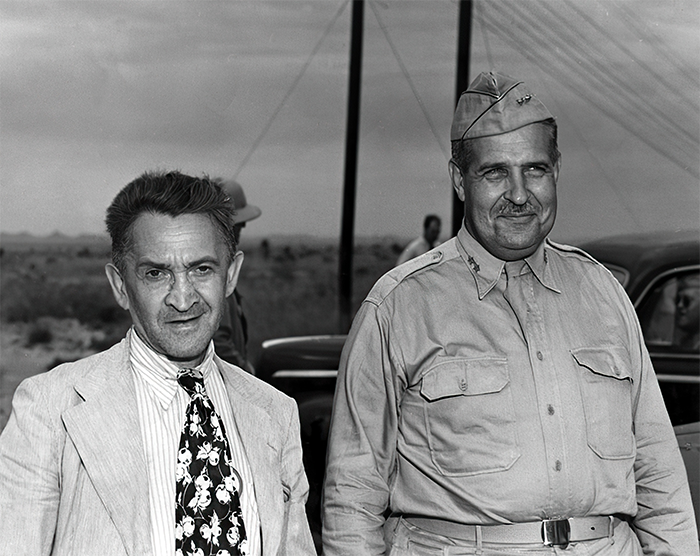
This became even more true after we went to the footnotes of Blume’s book—footnotes are always a great trove of leads for any journalist—and we saw so much more material about the publicity campaign that the government had put into place just before the bombs were dropped. We found more and more mentions of someone named “William Laurence,” and so we thought: “Who is this guy?” I mean, whenever you look at photos of Oppenheimer and Gen. Groves at the Trinity atomic test site in New Mexico, this same guy is always behind their shoulders, in the background.

We started Googling “William Laurence,” and that’s how we discovered Alex, who was quoted in that magazine article. We were really fascinated by his description of Laurence: this short little guy wearing weird clothes, who you can see in the background of major atomic events. So that’s how we found Alex—we wound up approaching him to be one of our advisers for a NEH [National Endowment for the Humanities] grant proposal to do this film. And then also he became an interviewee.
Drollette: I didn’t know about any of those connections. Small world: Alex Wellerstein joined our organization a few months ago.
Loeterman: Small world indeed! Anyway, he came out with a book in 2021 titled Restricted Data: The History of Nuclear Secrecy in the United States[3], which was one of the first to really explore how the government went, step-by-step, from total secrecy to the total opposite: They put in place a publicity machine far in advance of the bombing, to be prepared for (and steer) the public reaction when the bomb was dropped on Hiroshima.[4]
Drollette: I wasn’t aware that the documentary had started out as a profile of John Hersey. I thought “Atomic Bill” Laurence was the focus right from the get-go.
The two journalists are just so different, in so many ways. They are even different physical types. I just viewed your movie again last night, and to me Hersey looks like a matinee idol. I mean, he was photographed by Irving Penn, a guy best-known for his fashion photos for Vogue.
Loeterman: Well, things evolve, and you find interesting avenues and detours as you research more about your subject.
And what we learned was that there was this new crop of young scholars, who were going back into the archives of the early atomic era and re-examining all of its history. They had done a tremendous amount of work but didn’t have much of a platform for presenting it—so we started talking to them and picking their brains.
We looked at Hersey pretty much exclusively first, but then we began to realize a few things. For one, Hersey wrote his book Hiroshima about a year after the bomb was dropped, so he was actually writing in reaction to a body of journalism that was already out there.
And then, when we spoke to Hersey’s family—who were very nice and otherwise very helpful—we discovered that they absolutely would not give us an interview.[5]
So, all that sent us in a different direction from what we’d originally planned.
On top of that, our advisers at the NEH were beginning to think that this story was bigger than just John Hersey alone. It’s about all the different journalists, and how they chose to cover the atomic bombings of Japan: Would they be truly independent like Hersey—or would they toe the publicity machine’s line? Or do something in-between?
And one of the great finds in that process was William Laurence. He was the obvious touchstone, in this point/counterpoint tale. Hersey’s at one end of the spectrum, and Laurence is at the other.
Drollette: Just to quickly follow up on a loose end before we go any further: What was the thinking of the Hersey family in saying that they only wanted his words to tell the Hiroshima story? Offhand, it kind of sounds like something I’ve encountered with some photographers and artists—“My work speaks for itself. It doesn’t need anything else.” Was that their thinking?
Loeterman: Right. It was very much “The words he wrote speak for themselves, our family doesn’t need to add anything.”
But the problem from our end was that for a journalist, Hersey was kind of close-mouthed. He did not talk about his work much; Hersey only gave three major interviews during his life. The first one was in 1984 to Publishers Weekly. The second one to Jonathan Dee, who took a workshop class taught by Hersey when Hersey was a professor at Yale; that interview was published in 1985 in The Paris Review.[6]
And then we found gold: He did a third interview, in 1988, for a tiny public radio station connected to the University of Missouri School of Journalism, as part of their American Audio Prose Library—essentially a collection of interviews and readings by American nonfiction authors, which documents the authors’ renditions and interpretations of their work. It’s held at the State Historical Society of Missouri[7], and Gaia was able to get a copy.
We listened to it, and I said: “Who is that voice?”
And Gaia said authoritatively: “That’s John Hersey.”
And I said: “No, no, no, who’s the other voice asking him the questions?”
And Gaia didn’t know.
So we realized we absolutely had to find that person—and Gaia did, with the help of our production assistant, Caroline Elfland.
Her name is Kay Callison [nee Bonetti], she had founded the American Audio Prose Library, and she had interviewed Hersey one-on-on back in 1988.
And the cool stuff for us was that Kay had asked him all about his works, his influences, and his childhood—and the result had been kind of overlooked for a long time.
There was a lot in it on how Hersey was the son of missionaries—he called himself a “mish kid”—and how he was born in China, grew up there, and even learned to speak Chinese before he spoke English. The interview also had him doing a reading from chapter one of his Hiroshima book—and then doing a reading from a follow-up piece he did for The New Yorker in 1985, after he went to revisit Japan, called “Hiroshima: The Aftermath.”[8] So, in the end, by using this recording, we were able to respect the family wishes, yet get what we needed.
Drollette: What you’re saying ties in to how Hersey chose to portray the people who were at Ground Zero when the bomb was dropped. I guess that because Hersey grew up in Asia, he didn’t see the Japanese as the cartoon villains depicted in the propaganda posters of the time; instead, he saw them as real human beings. And that showed up in the articles he wrote, and in his Hiroshima book.
De Simoni: Right. And you get that same impression from the interview that Kay gave us. She is the radio interviewer in our documentary.
Drollette: How would you loosely sum up your documentary, for the benefit of people who haven’t seen it?
Loeterman: Well, what did you get from it?
Drollette: Hmm. My takeaway was the idea that there were some journalists—not just John Hersey of The New Yorker, but a number of them—who did good, original, independent work…
Loeterman: Okay.
Drollette: …and they came from all kinds of backgrounds and all kinds of publications—ranging from reporter Charles Loeb of, what was it, let me find my notes… of the African-American newspaper the Cleveland Call and Post. Then there was that Japanese-Hawaiian reporter Leslie Nakashima of the United Press [better-known later as UPI], who filed the first article from a reporter on the ground in Hiroshima, a couple days after the atomic bomb was dropped.[9]
Or that Japanese photojournalist, Yoshito Matsushige, who survived the Hiroshima bombing and took photos a little over two hours after the explosion[10].
To me, as a viewer, they all seemed to be sort of on one end of the reporting spectrum, getting firsthand impressions on the scene, and working completely independent of the government publicity machine.
But at the other end there people like “Atomic Bill” Laurence, who was deeply embedded with the US military—maybe too close to his subjects, through contemporary eyes.
Is that a good way to sum it up? — that the film shows journalists at different ends of the spectrum, with one set coming across as kind of heroic, and then there’s some who … are not. And the extreme of that camp was represented by Laurence.
I see you both nodding your heads, but this is a written interview, so you’ll need to say something.
Loeterman: I’ll let Gaia answer.
De Simoni: I think journalists should always be skeptical, but also cautious about their conclusions. And that carries over into what we take away from Bill Laurence.
I feel that from today’s perspective, yes, Laurence was definitely a public relations person—not just in terms of the government’s use of atomic weapons, but in how he behaved as a PR person relentlessly promoting his own brand.
But I would also say that Bill Laurence was also the main newspaper expert about nuclear energy at the time: He started writing about it in the 1930s, so he was one of the very first, if not the first, to write about nuclear energy and nuclear weapons. He was very focused on the topic, and probably the first person in the press to understand what could happen if Nazi Germany got an atomic bomb before the Allies did.
The other thing to understand is that Laurence was into playwriting, so he had a way of writing the press releases about the atomic bomb that were … how can I put it … Ben, help me out here.
Loeterman: He was over the top, florid, overwritten, theatrical, purple…
Drollette: So he comes across as very enthusiastic about the use of the atomic bomb.
Loeterman: Bill Laurence was heavily invested in this, he believed in this, he was over the moon when they asked him to be a part of the Manhattan Project.
And Laurence was sort of prepared for it; he already had an inkling as to what was happening long before he was asked to become what today we would call an “embedded journalist” at the Manhattan Project.
He’d realized that many scientists had suddenly disappeared from all these conferences about atomic energy. And when he called their offices, he couldn’t get hold of them anymore—their office-mates and department secretaries didn’t know where they went. So he knew something was up.
From today’s standards of journalism, what he did next was completely wrong.
But I think you have to put yourself in the mindset of the time, and ask yourself if you would have turned this offer down.
Imagine that it’s 1945, you are in a terrible war, people are dying brutally in the fight against the Nazis—and then this general comes to you and says: “You’re gonna have full access, you can tell whatever you want to tell, you’re gonna write everything about this project, and your stories are gonna come out and be given to all the newspapers all across the country”—although they might not always have your byline. [In an oral history, Laurence later said he was not happy about seeing his articles about appear in all the national newspapers with a War Department byline or Associated Press byline, without his name attached as the author.] He was for sure a PR person from today’s standards. But by the standards of 1945, just about any other journalist would have done the same.
Drollette: Not that it makes it right.
Loeterman: No, no, I’m not saying that. I’m not defending him. I’m just trying to put it into perspective, and think about what was happening then.
And don’t forget that in the current era, we’ve had some journalists who made up sources to win Pulitzer Prizes, and who were embedded as well.
It gets into that whole complicated issue of what happens when a journalist is embedded with a military unit. I mean, you want to have that access, but there’s also the problem of getting too close to your subjects: you’re living next to them, sharing the same experiences.
Drollette: All right. But I guess the difference is that some journalists from the “John Hersey end” of the spectrum some did indeed manage to be embedded but remain independent, if I remember the film correctly.
Loeterman: From today’s perspective, Laurence and Hersey went about their work in two completely different ways, and you can tell who is the good guy and who is not.
To me, the goal is to strive to be a reporter like Ernie Pyle—who was an amazing war correspondent and journalist, giving firsthand accounts of what it was like to be fighting and dying on the front lines in Italy[11].
Pyle talks about the soldiers’ reaction to the death of their commander, and the everyday hardships from the perspective of those who actually do the fighting and the dying.
De Simoni: When we were making the film we found so many photos of Ernie Pyle, just being with soldiers, eating the same food with them, sharing moments with them. And Pyle was not going around promoting himself, upstaging the story or making himself the centerpiece.
But Laurence used his access as an opportunity to make himself into the science journalist expert on atomic bombs. He appeared on Bob Hope’s radio show in 1950 for NBC[12]. He kept using the bomb as a way to promote his own brand.
And Laurence knew how to sell; he coined the phrase “The Atomic Age.”
Drollette: In that Undark piece, Laurence is described as “… part huckster, part journalist, all wild card, improbable in every way, a real-life character with more strangeness than would seem tolerable in pure fiction.” Is that an accurate description of how you folks found Laurence to be, in the course of doing your research for the film?
De Simoni: Yes, absolutely,
Loeterman: Absolutely, yeah.
And again, you can get that sense in part by looking at the photos of the time, of him in these weird outfits and ties that Laurence liked to wear, and his overwrought writing style. In one case, Laurence got so over the top in an official Manhattan Project press release—saying that the fission process that powered the atomic bombs could be turned around to lead mankind to conquer the moon—that the government censor essentially wrote “No, this is not appropriate.” We saw that written in ink on one of his press releases.
But at the same time, Bill Laurence was also one of those guys behind the founding of very professional organizations like the National Association of Science Writers.
So Laurence, to be clear, was a real professional, very capable and very smart, but also an absolutely pro-nuclear cheerleader. He was a fantastic writer, but also an absolute champion of what he was covering. He could not separate promoting it from covering it.
Drollette: I guess if we’re trying to evaluate Bill Laurence, he comes across as sort of a tragic figure in some ways. He had all this potential, and all this amazing access. He could write—even if it was sometimes overwrought—and he understood what was going on long before anyone else, when it came to nuclear weapons. But he kind of squandered it all. Do you think he was co-opted, compromised, corrupted…
Loeterman: I don’t think so. I think he was acting like what he was. He knew what he was doing, I think.
But one interesting aspect is that he never, ever, went to Hiroshima or Nagasaki. He never set foot in those cities—not even when the government organized a press junket for reporters from all the main national newspapers, including The New York Times, where he was nominally employed for the duration of Manhattan Project. They were brought to see the damage to the buildings, and “Atomic Bill” Laurence didn’t go.
Other reporters, like Australian journalist Wilfred Burchett[13], managed to get into the hospitals of Hiroshima a few weeks after the bombing—without any permission from Gen. Douglas MacArthur, the commander in charge—and he did a counter-reporting of what the publicity machine journalists were churning out; he called the bombings an “Atomic Plague.” And because Burchett was Australian, the article was able to be published in Australia, England, and Europe—because those regions were not subject to the censorship rules of MacArthur or the US Army.
De Simoni: When we talk about journalistic ethics, there’s a spectrum. At one end, press people can carry the water for the government to the people. And at the other end of the spectrum they can challenge it.
I think there were maybe four reporters who did this kind of work to challenge the party line, and those voices were marginalized.
And all these challengers were really quite exceptional people: Leslie Nakashima[14] was a Japanese-Hawaiian reporter who found himself in Japan when the war started, and his mother lived on the outskirts of Hiroshima. After hearing of the bombing, he went to Hiroshima to look for his mom. Once he was sure she was safe, he picked his head up and said, “Oh my god” and decided he had to tell the world.
Nakashima’s report was published first—but an odd thing happened as it wended its way across the globe. In Hawaii, his report was published in full, because there were references to Hawaiians who had gone back to their motherland prefecture in Hiroshima. But as that story made its way east, more and more editors cut more and more out of the story, because Gen. Leslie Groves (head of the military end of the Manhattan Project) kept telling them “Don’t trust anything coming out of Japan.”
Consequently, by the time Nakashima’s article came to places like The New York Times, they buried it deep in the paper, far away from the front page.
Burchett, the Australian journalist, knew he didn’t have to play by US censorship rules, so he published his piece and it could be seen everywhere from London to Australia—but not in the United States. We did a thorough search, and his byline did not appear in any of the US press. And don’t forget that was long before the internet or satellites or radio or TV, so the world wasn’t as tightly tied back then. The powers-that-be could get away with this kind of thing.
Then there was the case of a reporter named George Weller—good guy, shoe-leather reporter from the Chicago Daily News, who did the same thing that Burchett did, and went to the same kinds of places on his own, and did his own eyewitness reporting. But because Weller was an old-school guy, he thought that as a gentleman he should hand his text to Gen. Douglas MacArthur before printing it, and that MacArthur would then pass it on. He handed it to MacArthur, and MacArthur put it in the waste bin. (In 2006, George Weller’s son, Anthony, found in the attic of George’s vacation home, a carbon of all the dispatches he wrote and which MacArthur had destroyed.)
So that leaves us with one other voice: Charles Loeb[15] writing in the Black press, right?
And the mainstream media was not paying attention to the Black press—and certainly not the diplomatic corps. So he was sidelined, just like all the other truth tellers.
Consequently, it was not until a year later that a smart young Yale University graduate named John Hersey—who has an affinity for this part of the world—says: “You know, I’m gonna go, see for myself, and report on it” and he has an impact. He found a Catholic priest located in Hiroshima who had survived the bombing [a 38-year-old German Jesuit priest named Wilhelm Kleinsorge, who was only 1,400 yards from the center of the explosion when the bomb dropped] and through him Hersey found other survivors, and he found his interpreters. Hersey wound up taking furious notes for a couple weeks, and then he wanted to get the hell out. He did not want to write a word in Japan, because he knew about the iron grip of MacArthur’s censors.
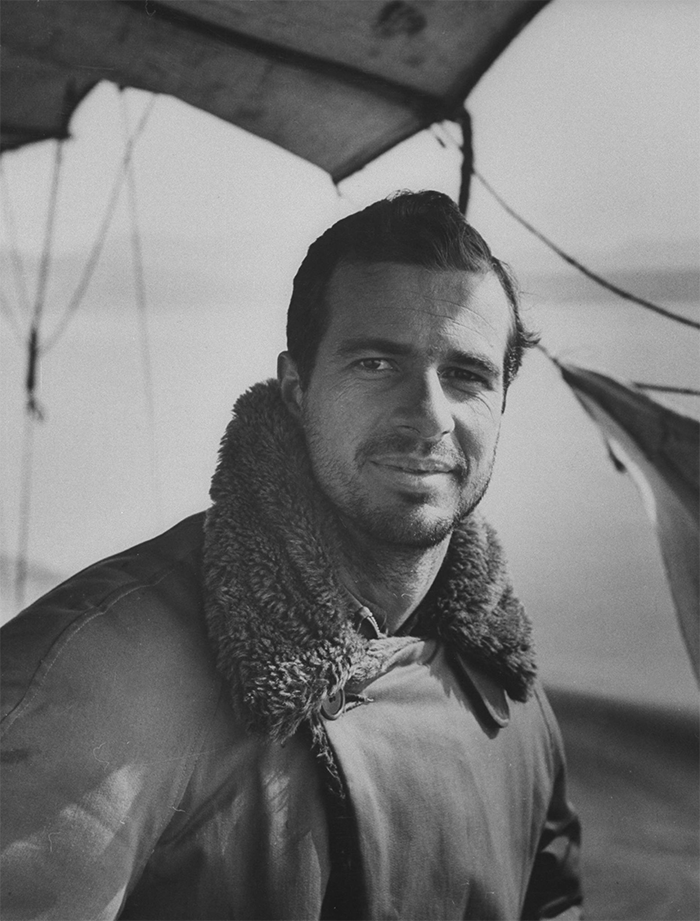
So he hightailed it out. And then he spent something like a good month or two writing the article “Hiroshima.”
It must have made quite an impact, for something like this to actually appear in The New Yorker[16], which at the time was known as more of a light comedy publication that maybe did some theater coverage—and then it devotes the entire issue to this 31,000-word piece.
And nothing we’re saying in the documentary is meant to take anything away from John Hersey. He’s a brilliant reporter and writer, a masterful storyteller of nonfiction, working under extreme conditions.
Drollette: Both of you have backgrounds in journalism. So, what lessons do you think this all has for today’s journalists? Are there warnings about getting too embedded?
De Simoni: I think one lesson is to have a healthy skepticism—to always question the government. For our democracy to survive, it’s crucial for journalism to be the watchdog—the Fourth Estate. I think we have been seeing good journalism by the New York Times in this country, and I also really like what ProPublica does.
Drollette: Ben, did you want to add anything to that? I can see you’re nodding your head in agreement, but this is the typed page.
Loeterman: I think skepticism is the watchword.
And I think firsthand reporting from the ground is terribly important, both for news consumers and for news purveyors and journalists. It’s scary, when you look at how the Pentagon works today: If you and your colleagues don’t toe the line, then the Pentagon will replace you with a whole different news corps, full of people willing to convey the approved message. I think those are the lessons right now.
The dawn of the nuclear era—and how it was covered—can also hold lessons for what’s happening these days with the arrival of artificial intelligence. Overnight, things are changing, although no one really seems to know exactly what the impacts will be. In fact, within the first paragraph of a Wall Street Journal review[17] of our documentary, the author said that it was very hard to see this film as anything other than an allegory for the dawn of artificial intelligence, and the coverage of it.
Drollette: That’s right. Yes, I saw that.
Loeterman: That’s an angle we had not thought of when we were deep in the making of it. But I think it’s true. When you take a broader view of the relationship between the role of the press, the government, and the military and science, I think there are many lessons to learn from looking at this early nuclear-era history, and how it was reported.
Drollette: What’s next for you folks?
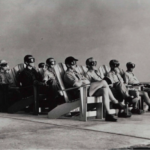
Loeterman: At the very beginning of this conversation, we talked a little about that one photo that shows Gen. Groves leading a bunch of people on a tour of Trinity after the first test of the atomic bomb. It’s not until after I stare at the photo for a little that I can say: “Groves is there, Oppie is there, and that guy in the middle, a few yards back—that’s Atomic Bill Laurence.”
My biggest fear is that we did not spend the time or effort to find out who are the other seven guys around those three people.
Endnotes
[1] For more, see “ ‘Atomic Bill’ and the Birth of the Bomb” by Mark Wolverton in the August 9, 2017 issue of Undark, at https://undark.org/2017/08/09/atomic-bill-laurence-manhattan-project/
[2] The full title is Fallout: The Hiroshima Cover-up and the Reporter Who Revealed It to the World, by Lesley M. M. Blume, published in 2020. Blume also wrote the 2023 Bulletin article, “Collateral damage: American civilian survivors of the 1945 Trinity test”
[3] Restricted Data: The History of Nuclear Secrecy in the United States by Alex Wellerstein, 2021. A review can be found at the Los Angeles Review of Books at https://lareviewofbooks.org/article/taking-it-to-the-grave-secrets-sins-and-nuclear-insecurity/
[4] Sometimes the publicity machine was to over-reach. Groves was to become infamous for telling Congress that dying of radiation was “a very pleasant way to die.” His star aide in this was Atomic Bill Laurence. See “How a Star Times Reporter Got Paid by Government Agencies He Covered” in the August 9, 2021 issue of The New York Times by William J. Broad, at https://www.nytimes.com/2021/08/09/science/william-laurence-new-york-times.html
[5] See the August 31, 2016 New Yorker article by Russel Shorto titled “John Hersey: The writer who let Hiroshima speak for itself” at https://www.newyorker.com/culture/culture-desk/john-hersey-the-writer-who-let-hiroshima-speak-for-itself. Shorto is brother-in-law of Hersey’s son, Baird.
[6] The interview, “John Hersey, The Art of Fiction No. 92” by Jonathan Dee, can be found in the Summer-Fall issue of The Paris Review at https://www.theparisreview.org/interviews/2756/the-art-of-fiction-no-92-john-hersey
[7] For the original recording, go to the State Historical Society of Missouri website, which contains the interview of author John Hersey done by Kay (Bonetti) Callison for the American Audio Prose Library. See Digitized Collection, Literature, John Hersey interview, March 27, 1988 at https://digital.shsmo.org/digital/collection/literature/id/96/
[8] The July 8, 1985 article by John Hersey titled “Hiroshima: The Aftermath—Survivors’ stories” can be found at The New Yorker website at https://www.newyorker.com/magazine/1985/07/15/hiroshima-the-aftermath
[9] See the UPI article by Leslie Nakashima of August 27, 1945 titled “Hiroshima as I saw it” at https://www.upi.com/Archives/1945/08/27/Hiroshima-as-I-saw-it/8051438702501/
[10] More information can be found at this August 6, 2025 article in the Bulletin of the Atomic Scientists, “Atomic testament: Yoshito Matsushige and the first photos of Hiroshima’s nuclear toll” at https://thebulletin.org/2025/08/atomic-testament-yoshito-matsushige-and-the-first-photos-of-hiroshimas-nuclear-toll/.
[11] One of Pyle’s most famous articles was the January 10, 1944 “The Death of Captain Waskow” https://erniepyle.org/waskow/
[12] The 1950 NBC show with Bob Hope was called The Quick and the Dead – Volume 1: The Atom Bomb. The liner notes include the following: “Featuring Bob Hope (the comedian, NOT doing comedy here) and William L. Laurence (science reporter for the NY Times and ONLY reporter allowed backstage at the building of the Atomic Bomb).” Recordings of the vinyl LP album are available in mono at https://www.discogs.com/release/11388940-The-National-Broadcasting-Company-Bob-Hope-William-L-Laurence-The-Quick-And-The-Dead-Volume-1-The-At?srsltid=AfmBOorkHqRHdb1VLTttGAnW5jLiaUy_sK24qsfqa3JSt22kr5UQJvje
[13] The text of Wilfred Burchett’s article “The Atomic Plague” as it appeared on September 5, 1945 in London’s The Daily Express can be seen at https://hibakushastories.org/wp-content/uploads/2018/09/The-Atomic-Plague.pdf
[14] See the UPI article by Leslie Nakashima of August 27, 1945 titled “Hiroshima as I saw it” at https://www.upi.com/Archives/1945/08/27/Hiroshima-as-I-saw-it/8051438702501/
[15] To learn more about Charles H. Loeb, see the August 9, 2021 New York Times article by William J. Broad titled “The Black Reporter Who Exposed a Lie About the Atom Bomb” at https://www.nytimes.com/2021/08/09/science/charles-loeb-atomic-bomb.html
[16] Hersey’s article as it originally appeared in the magazine on August 24, 1946, can be found online at https://www.newyorker.com/magazine/1946/08/31/hiroshima
[17] The full title of the December 31 2025 Wall Street Journal review by John Anderson is “ ‘Bombshell’ Review: PBS’s Cautionary Tale of Technology” and the subheading is “This documentary focuses on the propaganda surrounding the development and deployment of the atomic bomb and the journalism that sought to cut through it, with lessons for our own age of ascendant AI.” It can be found at https://www.wsj.com/arts-culture/television/bombshell-review-pbss-cautionary-tale-of-technology-28cc1f7b?eafs_enabled=false
Together, we make the world safer.
The Bulletin elevates expert voices above the noise. But as an independent nonprofit organization, our operations depend on the support of readers like you. Help us continue to deliver quality journalism that holds leaders accountable. Your support of our work at any level is important. In return, we promise our coverage will be understandable, influential, vigilant, solution-oriented, and fair-minded. Together we can make a difference.
Keywords: Atomic Bill Laurence, Hiroshima, John Hersey, Trinity, atomic bomb, journalism, movies, nuclear weapons, propaganda
Topics: Hiroshima & Nagasaki, Magazine, Nuclear Weapons, Special Topics
Dan Drollette Jr
Dan Drollette Jr is the executive editor of the Bulletin of the Atomic Scientists. He is a science writer/editor and foreign correspondent ... Read More








Very well written!
Looks like they are playing the same playbook today.
Communication is so one sided on linkedin and then you have independent journalists and scientists doing the hard work. Maybe we should look at what projects were funded, what topics were classified and if we are doing the same today I mean an advanced version of that.
I can’t tell from the photo…but I wonder if one of the men is Leo Szilard? He warned Einstein that the Germans were trying to become a nuclear power. His warning led to Einstein’s letter that initiated the Manhattan Project. Didn’t Leo help establish this journal? He knew all these scientists and worked with them. You’ll find Leo Szilard in every index of books written about the Bomb.