How a small radioactive battery paves the way for transparent nuclear use in space
By Isobel Porteous, Mallory Stewart | Analysis | July 24, 2026
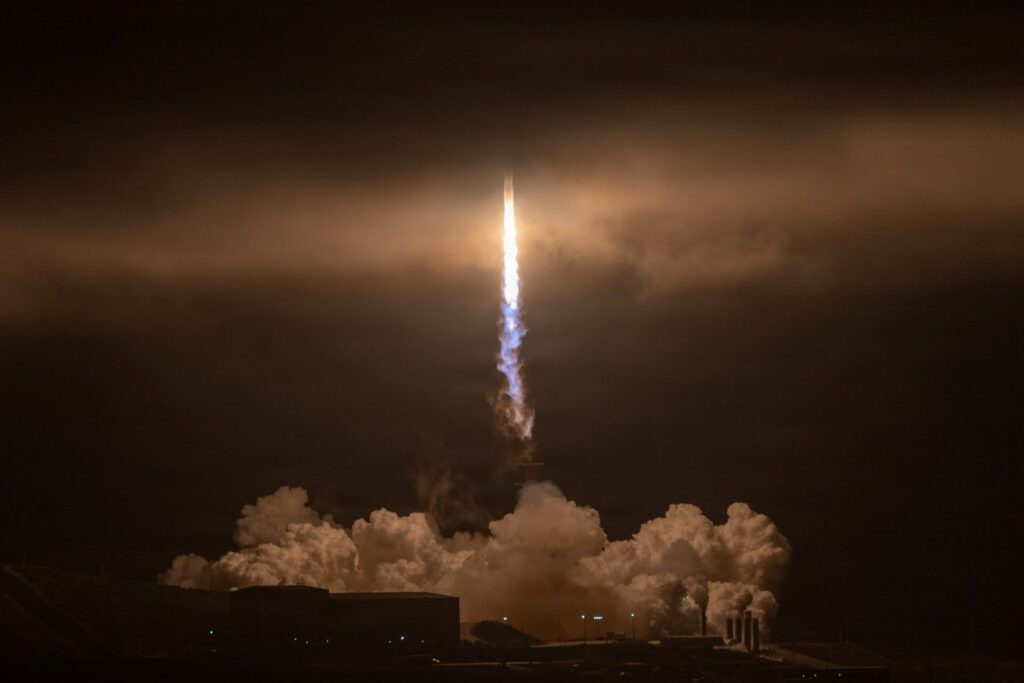 A SpaceX Falcon 9 rocket carries the Transporter-17 mission to low-Earth orbit from Vandenberg Space Force Base, California on July 7, 2026. Transporter-17 was a dedicated small satellite rideshare mission with 81 payloads, including City Labs' tritium-powered BOHR satellite—the first commercial nuclear-powered satellite to be cleared through the FAA's 2019 review pathway. (Photo by Enso Valle / US Space Force)
Listen to this article:
Listen to this article
--:--
This audio was generated using an automated voice. Learn more.
Earlier this month, a small satellite built by City Labs was launched to low Earth orbit aboard SpaceX’s Transporter-17 rideshare mission. The successful launch marked a milestone for commercial nuclear energy in space, potentially defining key safety and security norms and expectations for future nuclear-powered projects.
The BOHR satellite—short for Betavoltaic Orbital High-Reliability—was one of 81 payloads on the Falcon 9 mission from Vandenberg Space Force Base in California. BOHR is not carrying a reactor; its payload is a compact “nano-tritium” betavoltaic battery that converts beta particles (electrons or positrons) from the natural decay of tritium into electricity through a semiconductor. The nuclear battery is an experiment meant to demonstrate that small payloads can operate without sunlight. This capability could matter for deep-space missions, lunar night operations, and permanently shadowed regions of the Moon. For this flight, however, the satellite still relies on conventional solar panels to power its general operations.
Nuclear power itself has a long history in space. US radioisotope systems have powered missions since the Navy’s Transit 4A navigation satellite in 1961. And they later enabled many NASA missions to operate where solar power was limited or impractical. What makes the BOHR satellite different is that it comes from a small commercial operator, it is flying with a nuclear battery on board, it was launched as part of a routine rideshare mission, and it aims to demonstrate the safety and viability of commercial nuclear power in space.
Safety and transparency. As nuclear power becomes a more common part of commercial and governmental space missions, the safety and security frameworks established by City Labs may matter as much as the nuclear battery itself.
Like on Earth, nuclear systems in orbit carry certain risks.
In 1978, the Cosmos 954 satellite, carrying a small onboard nuclear reactor, crashed and spread radioactive debris across Northern Canada. The accident sparked significant debate about the use of nuclear power in Earth’s orbit. As new nuclear space systems reach the market, there will be questions about safety, reentry, debris generation, and mission transparency.
More concerning still is the potential use of nuclear weapons in space, which could disable or destroy orbiting satellites. Nuclear power may become a necessary part of long-term (and long-range) operations in outer space, but nuclear weapons in Earth’s orbit, or on celestial bodies, pose an indiscriminate threat to military and commercial capabilities. They would violate Article IV of the Outer Space Treaty outright. As commercial access to outer space continues to grow and more actors operate in the space domain, it becomes urgent to be able to distinguish peaceful nuclear power from potential nuclear weapons. With these threats looming as new space nuclear technologies emerge, it is critical to establish transparency frameworks and confidence-building measures to ensure they are safely and securely used.
Although the BOHR spacecraft carries very little radioactive material, the approval process CityLabs followed set a regulatory precedent. It is the first commercial mission to exercise the Federal Aviation Administration’s pathway for nuclear launch approval, laid out in 2019 in President Donald Trump’s Memorandum on “Launch of Spacecraft Containing Space Nuclear Systems,” and it is the first commercial nuclear satellite cleared to fly by the Federal Aviation Administration. City Labs conducted a launch safety analysis approved by Sandia National Laboratories. This close collaboration between a commercial operator and federal authorities offers a starting point for the transparency framework that the new space nuclear age will need.
Verification. But there is more that can be done. As recent academic work has shown, there are technical pathways for detecting and characterizing nuclear material aboard a satellite.
Until the last few years, the Outer Space Treaty had gone somnambulant, and the question of verifying the ban on bombs in orbit had been forgotten for decades. New work is waking it up, moving the question from a historical footnote to an active research problem.
Commercial operators and governments both have reason to support this effort. For operators, independent confirmation of peaceful use is a form of protection, both from liability and from governmental scrutiny. A single accident or unresolved ambiguity, like the Cosmos 954 crash, could set the industry back a generation. For governments, Article IV of the Outer Space Treaty is stronger with technical means of verification and monitoring.
As more satellites carry legitimate nuclear systems into orbit, two risks increase: A peaceful power source could be mistaken for a weapon, and a true weapon could hide behind a peaceful claim. Both risks demand the same solution: an independent, repeatable, and credible means of verifying the safety and security of a nuclear space system. Transparency measures and third-party characterization give regulators, treaty parties, and the public confidence that peaceful nuclear power in space stays peaceful.
BOHR is a small satellite carrying a small battery. But it marks the start of a much larger transition in which nuclear power becomes a more routine part of commercial space activity. Handled well—with real safety margins, trusted technical means of verification, and transparency—this transition can improve confidence and credibility in the space arena.
Together, we make the world safer.
The Bulletin elevates expert voices above the noise. But as an independent nonprofit organization, our operations depend on the support of readers like you. Help us continue to deliver quality journalism that holds leaders accountable. Your support of our work at any level is important. In return, we promise our coverage will be understandable, influential, vigilant, solution-oriented, and fair-minded. Together we can make a difference.

Isobel Porteous
Isobel Porteous is the founding Head of Business Development at EarthTraq Corporation and an Outer Space Visiting Fellow at the Council on Strategic ... Read More

Mallory Stewart
Mallory Stewart is the Chief Executive Officer of the Council on Strategic Risks and a former Assistant Secretary for the Bureau of Arms Control, ... Read More









The US public received zero advance notice of this radioactive launch and was provided no opportunity to provide public comment to the government on the risks or advisability of the payload. This breaks with decades of precedent in which such launches were subject to an EIS under NEPA, which provided the public advance notice and opportunity to provide public comment. Under this new FAA procedure, a private company could launch toxic plutonium or weapons-grade uranium without the public being notified or having an opportunity to try to block it. That is hardly “a starting point for the transparency framework that the… Read more »