‘Not the most cheerful thing I’ve ever done.’ Susan Solomon on the National Academies report on the effects of nuclear war
By François Diaz-Maurin | Interview | May 16, 2026
 Massive fires set off by the atomic bomb dropped on Hiroshima, Japan, on August 6, 1945 created this enormous cloud photographed a few hours after the explosion. The emissions and smoke from about a hundred such city firestorms would be enough to trigger nuclear winter effects and cause global food insecurity. (Credit: US Army)
Listen to this article:
Listen to this article
--:--
This audio was generated using an automated voice. Learn more.
Editor’s note: This is part of the “Nuclear winter: Why study it now?” series.
The scientific literature about the impacts of nuclear war on the environment has been fraught with many uncertainties and contradictions. In 2020, the US Congress called for a comprehensive review of the tools and knowledge base for evaluating potential environmental consequences of nuclear war. The bill mandating the review, which was part of the National Defense Authorization Act for Fiscal Year 2021, directed the Energy Department’s National Nuclear Security Administration to commission a study by the National Academies of Sciences, Engineering, and Medicine to reevaluate and update the body of scientific knowledge on this critical issue.
The study was long overdue. The last Academy study on the subject dated from 1985, and in the 40 years since, there have also been profound changes not only in nuclear capabilities and doctrines, but also in the scientific understanding and modeling capabilities of the changes happening to the atmosphere following a nuclear exchange. The study was supposed to be completed within 18 months. It took five years.
I recently sat down with Susan Solomon, a professor at the Massachusetts Institute of Technology with deep expertise in atmospheric chemistry and climate science, to discuss her role as one of the authors of the National Academies study, published last June. Solomon co-chaired the fourth climate science assessment report for the Intergovernmental Panel on Climate Change (IPCC), which was released in 2007, and is a former Bulletin Science and Security Board member.
During our conversation, Solomon emphasized the importance of plume rise and fuel loading, noting that urban areas burn hotter and produce more smoke than less dense locales. The study excluded radiation fallout effects, a limitation Solomon believes should be addressed in future assessments. She also highlighted the need for multi-model comparisons to better understand uncertainties, which is something the nuclear community could learn from the climate change community.
Our conversation has been edited for length and clarity.
François Diaz-Maurin: Could you explain your expertise and your role in that study?
Susan Solomon: I was one of the co-authors. I wrote more in the section on the stratosphere, and a little bit in the section on plume rise, because I’ve been doing work on wildfire smoke, and so that’s a subject that I know a fair amount about. Those were my main areas of focus.
It’s hard for people to really be as deep on every section. It’s a broad subject. I probably know about the ozone part much better than the ecosystem part, the human impacts part, and the war scenarios.
Diaz-Maurin: Why did the National Academies conduct an independent study on the potential environmental effects of nuclear war? Why now?
Solomon: The study, like almost all National Academies of Science studies, was done at the request of a sponsor. It is usually a US government agency or a group of agencies. In that case, it was the NNSA [National Nuclear Security Administration].
So, why now? I think it has to do with the fact that you have a period in which there has been a substantial drop in the number of nuclear weapons worldwide, and yet there are new players on the nuclear stage, like North Korea, for example. And there is obviously instability in the world, more so now, even than when we started the study. And of course, I don’t think we started this study imagining—and I’m sure we didn’t, because we were supposed to have finished it much sooner—that we would be releasing it a few days after the United States bombed nuclear facilities in Iran. [Editor’s note: The report was released on June 25, 2025, two days after the US military joined Israel in attacking Iran’s nuclear sites.] In the end, it was a very timely report. But certainly, there were reasons to be concerned even before that.

Diaz-Maurin: Obviously, a lot has changed in the 40 years since the last consensus study report by the Academy’s National Research Council on “The Effects on the Atmosphere of a Major Nuclear Exchange” in 1985. The congressional mandate in 2020 explicitly called on the Academy to reevaluate and update the body of scientific knowledge to evaluate the potential environmental consequences of nuclear war. What does it mean exactly?
Solomon: This study tried to review the information that’s available on all these new developments that I just mentioned and then discuss the environmental impacts of nuclear war. That was the focus.
We studied things like what happens if you have a [nuclear] exchange, even a very limited one, like a single bomb going off in an exchange that somehow managed to de-escalate quickly. You could imagine a nuclear mistake. We’ve come close to that for many, many years. You could have one bomb, and that would be it. If it was a mistake, and there was enough communication following the mistake, or there might be other reasons why just one bomb might explode.
The report discusses the range of possibilities and tries to comprehensively review the types of environmental impacts that would happen following such things, ranging all the way to what the climate effects would be. Because the arsenals have become so much smaller, the level of climate effect is not as severe as we once thought, but it’s not zero either.
If we were to have a regional exchange between, say, India and Pakistan, in which they burned large numbers of cities, which is what we discussed as a potential scenario for the moderate-scale regional exchange, that would still put enough material into the stratosphere to cause such significant climate effects. We talk about that in the report. And not only that. Ozone effects from such an exchange would also cause ozone depletion, and that’s significant, too. There is a good literature discussing that from different [research] groups.
Diaz-Maurin: And then there would be feedback effects, right? A nuclear exchange would have direct effects on the atmosphere. But then, in return, these changes in atmospheric conditions would have substantive effects on the ecosystems. Could we say that any nuclear weapon, even a small one, hitting a city would have a global impact?
Solomon: That’s a great question, and I don’t think anyone has quantified that. At least, I don’t think we have any quantitative discussion of that in the report.
My quick reaction to this would be that such an event probably would not put enough material into the stratosphere for the effect to become global. But the local and regional effects on ecosystems and human health could be quite significant. That’s only my assessment.
Diaz-Maurin: Now that we know more, does it mean the environmental effects of a nuclear exchange would probably not be as extensive as we once thought? Have you compared your results with early studies of nuclear winter?
Solomon: The effects would still be at the climate and global scale. Ozone depletion, for instance, is certainly expected to occur in the India-Pakistan scenario or other regional exchanges that we have considered. But the [nuclear] arsenals are so much smaller now than they once were that the level of global climate change [in a global nuclear war] would not be as severe as had been thought about when the nuclear winter theory was first developed. But other things have changed, too, in ways that I actually would love to see something do a really blow-by-blow comparison, and we don’t really have that in the report, because it will be quite difficult to do.
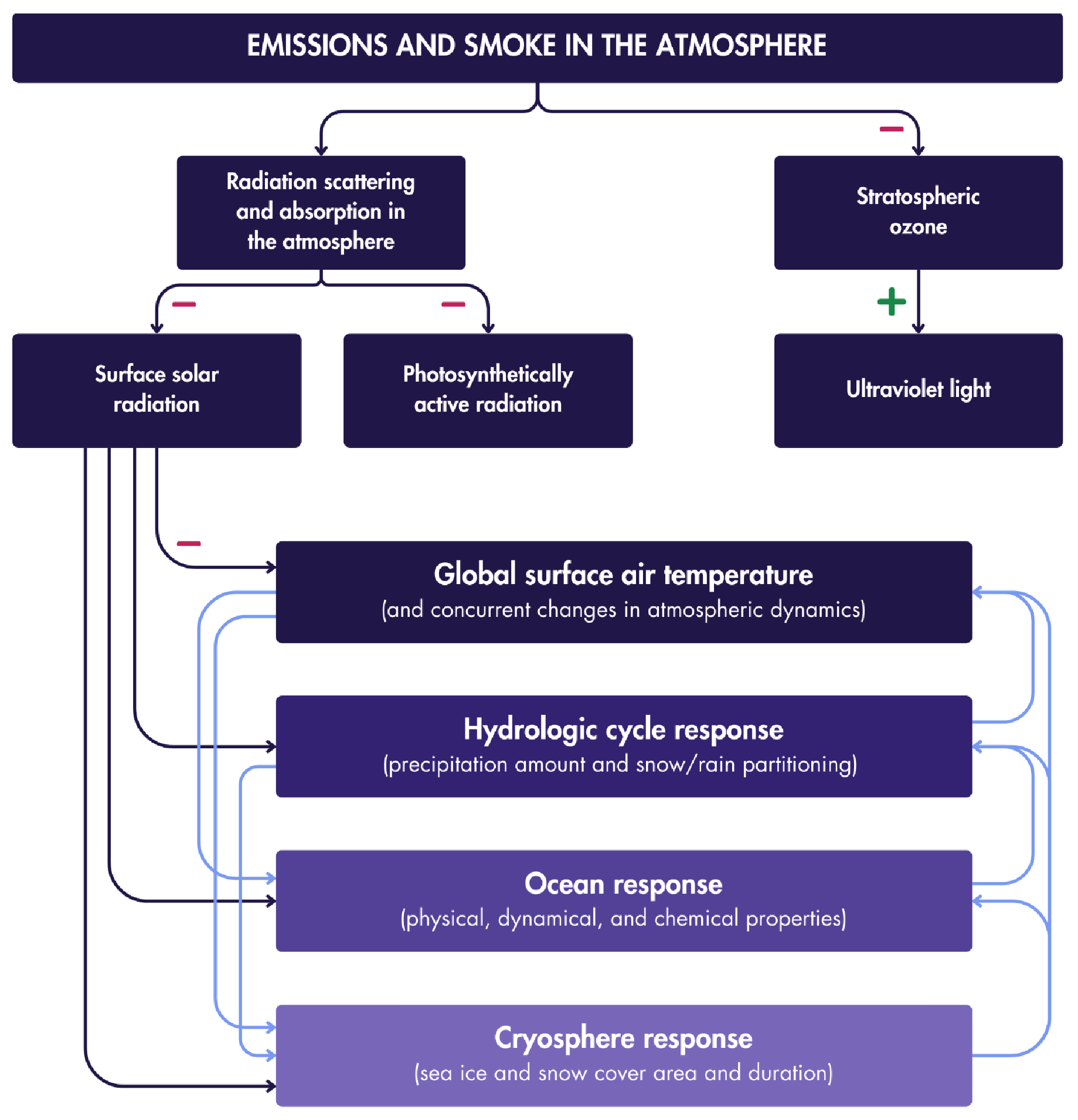
We know a lot more nowadays about black carbon and organic carbon, and how particles self-loft and how long they stay in the upper atmosphere once they get there, because the particles with black carbon in them heat, and therefore they literally rise, and that allows them to stay in the atmosphere for a very long time. We knew that before, but the calculations on that are more sophisticated these days.
The understanding of the ozone loss certainly has evolved substantially for various reasons. For example, we now know that wildfire smoke causes ozone loss. That’s in the report. And we know that, when it gets to the stratosphere, the chlorine can go into the particles which contain organic liquids, things like alcohols and organic acids, because chlorine is very soluble. And that enhances the ozone loss. So even if you had fewer bombs going off, you might have larger calculated ozone depletion than you had some 40 years ago, when we didn’t know about these effects. But again, I don’t think a one-to-one set of calculations has been done.
Diaz-Maurin: What have you learned that you did not know before joining the study group?
Solomon: I guess, from my own perspective, some of the things I learned in working on this had to do with the importance of the plume rise. It isn’t just the initial burst. It really does have to do with how the smoke is produced, the importance of fuel loading, and how different it is in an urban area compared to, say, a silo in Wyoming. Going into this, I naively thought that it didn’t matter as much as it does. The science of understanding how those plumes rise and the important roles black carbon plays in them has come a long way since earlier work.
Then there is the inter-comparison of different models. That’s the other thing. In the ozone assessment for the IPCC, several models can be good for this. You don’t just use one scientific model to look at a problem. You use a bunch of them, preferably six or eight or maybe even more. In the case of climate models, I think we have about 20 of them right now. And when you compare the results [across models], it gives you a much better understanding of the uncertainties. Not doing that is a limiting thing, and we do talk about that in this report. The need for multi-model comparisons is really important, and that hasn’t been done at all for nuclear war, to my knowledge.
Diaz-Maurin: Nuclear arsenals have decreased in terms of the number of nuclear warheads. What about the total explosive power of today’s nuclear arsenals compared to what it used to be in the 1980s? Would a potential all-out nuclear exchange be as devastating, given there are many fewer weapons?
Solomon: I don’t think that’s the case because they had more powerful weapons in the 1980s, in the megaton range. But this is definitely not my area. I tried to follow a little bit. But frankly, my eyes started to glaze over after a while, because it’s such depressing stuff. Working on this study was not the most cheerful thing I’ve ever done, and I had a hard time concentrating on it because it’s just so sad.
If you look at section 2.2 of the report [“Employment Scenarios”], they say the 1985 [National Research Council] study considered a hypothetical World War III-type Soviet-US exchange with 25,000 weapons of up to 8,500 megatons of total yield, and an earlier Academy study of 1975 even considered a worst-case scenario of 5,500 nuclear detonations of up to 10,000 megatons. In both studies, they considered a 50-percent usage factor, which they considered to be a plausible number. [Both 1975 and 1985 studies assumed “the use of one-half of the available weapons against a range of military, industrial, and civilian targets.”] We say in the report that there are now 90 percent fewer weapons. [Editor’s note: The Academy report states that “estimates of the total nuclear weapons have fallen dramatically (by approximately 90 percent) relative to estimated global stockpiles at the time of the earlier 1985 and 1975 studies. Based on the open literature, the report considers a total worldwide nuclear weapon inventory as of 2023 of 12,500 weapons, versus 48,000 and 65,000 weapons in 1975 and 1985, respectively.]
Diaz-Maurin: The largest scenario in the report talks about 2,000 nuclear detonations, and if you sum of the warheads per category, it gives a total explosive yield of 815 megatons. It’s an order of magnitude lower.
Solomon: Yes. And I know there’s been some debate about that. I’ve heard from a few people who think the numbers in this report might be a little low. But I can’t comment on that because, again, I’m not a nuclear war type person.
One of the issues I know they were concerned about is that, rather than hitting cities, if you had an exchange between Russia and the United States, it might well be that the military targets would be chosen instead, which are often not in cities in a lot of places. In that case, you might not have as extreme a fireball because there’s not as much material to burn.
The fuel loading is a big uncertainty. What kind of fuel loading are we talking about in different cities? There’s been a lot of debate about that in the literature. But in the case of a military target, say a silo in the middle of Wyoming, the fuel load is pretty small.
You should probably talk to Brian Toon, Rich Turco, or Alan Robock. They will give you the answers to these questions much better than me.
Diaz-Maurin: Well, I did talk to Toon and Robock. And they told me that Russia and the United States would most likely not limit themselves to striking missile silos in a nuclear war and that many military targets are actually based in urban areas, where the fuel load is much higher.
Solomon: See?
Diaz-Maurin: Let’s go back to your expertise, which is everything that happens in the stratosphere. Could you explain to our readers what happens after several nuclear detonations? You know, there is the blast, then fire happens, and then there is a huge injection of smoke into the stratosphere if the fire is big enough. But what happens next?
Solomon: It’s not just what gets pushed up to the stratosphere immediately in the initial blast. What’s also going to be quite important is what burns and how, how much smoke is produced, how much black carbon is produced in the burning, because that will also have a strong potential to get material right up to the stratosphere.
A city, for example, probably burns a lot hotter than a wildfire, because the fuel loading is so high that it’s going to produce plumes that will rise very high in the atmosphere. And once they get to the upper troposphere, most of them probably don’t go directly to the stratosphere. Probably very few of them can do that. But it doesn’t really matter. If they get to the upper troposphere, there’s already a very good chance that there will be enough heating due to the [soot and] sun that they’ll self-loft into the stratosphere. So, the more fires happen in urban areas, the better the chance of getting material high and making it “sooty,” so that it can continue rising as the sun hits. And that makes it for a large fraction that goes all the way up into the stratosphere.
Science has evolved since the early days. We did not have the same level of understanding of this [process] as we do now. As far as the plume rise, we certainly did not understand at all that the particles would not just be pure soot, but that there would be organic carbon as well in them, which changes their chemistry. [Editor’s note: The study defines soot as being “black particles of carbon produced in a flame.”]
Diaz-Maurin: Why does it matter whether smoke goes into the stratosphere?
Solomon: Because if it gets to the stratosphere, it’s there for years, especially if it’s got black carbon in it. It’s going to continue rising. It’s going to keep fighting with the circulation pattern that wants to bring it down, but it’s got enough oomph from the sun that it’s going to keep going up. Then it’ll stay around for a long time, 10 years or more easily. And then there are climate effects. How long they last might also depend on what changed. For instance, if ice caps change, then that takes longer to change back.
Diaz-Maurin: This Academy study was supposed to have been finished much sooner. Instead, it was released about three years after its original date. Why was that? Was it difficult to get a consensus on certain questions?
Solomon: Well, I’ve been an IPCC chairman. [The Intergovernmental Panel on Climate Change is the UN body in charge of assessing the science related to climate change.] So I’ve seen much worse [difficulty in reaching consensus]. [Laughter] But, no, I don’t think it was particularly that. The committee, once it got going, worked efficiently. Some of the delays were just, I think, staff changes, trivial things like that. I don’t really know because I was added to the committee late, too. They suddenly realized they didn’t have anybody on stratospheric ozone. And they thought, “Oh, gee, maybe that’s important,” which it is.
Diaz-Maurin: In the course of its work, the committee invited speakers to present their research related to the potential environmental effects of a nuclear weapons exchange. One speaker, Christopher Yeaw of the National Strategic Research Institute, said during his May 2023 presentation, “For nuclear deterrence, we wouldn’t want to give the impression to adversaries, like Russia and China, that we have so much concern over environmental prospects of nuclear weapons employment that we are self-deterred.” Then he added, “We would want to be careful not to come near to that line. If they feel that we are self-deterred because we don’t want to engage in any nuclear employment ever, regardless of their nuclear employment because of environmental effects, then deterrence would be undermined at that point, so there is a little bit of caution there.”
It’s worth noting that Yeaw is now the Assistant Secretary for the Bureau of Arms Control and Nonproliferation at the State Department. Is he right to be concerned that focusing too much on the environmental impact of nuclear weapons risks undermining nuclear deterrence?
Solomon: I think science has one job to do, and that is to tell it like it is. Science doesn’t filter its outcome and what it thinks the political result would be, one way or the other, for nuclear deterrence. That’s just not the way science can operate. We can try to provide some information on policy options. We do that in the IPCC too. But we don’t make a choice. We don’t sit on one side of the fence or the other. And I’m sure that every member of the committee would feel the same way I do on this question.
Diaz-Maurin: You mentioned the United Nations. The UN General Assembly voted last November to launch a two-year independent study on the effects of nuclear war. How different is this UN study going to be compared to that of the Academies? Aren’t there going to be overlaps?
Solomon: I don’t know exactly what the constraints are on the other UN study. One very limiting thing, at least for this Academy study, is that we were explicitly asked not to look at the influence of [radioactive] fallout. I think that’s missing a substantial piece. When you start thinking about the health of ecosystems and the health of human beings, and the health of animals for that matter, it’s a shame that it didn’t happen. So, I have not seen the scope statement for the other study, but I hope it doesn’t include a constraint not to do that.
Diaz-Maurin: In the Academy report, the NNSA’s statement of task specifies that “the study will consider non-fallout atmospheric, terrestrial, and marine effects and their consequences, including changes in climate and weather patterns, airborne particulate concentrations, stratospheric ozone, agriculture, and their impacts on ecosystems.” Why did the NNSA not want to know about fallout?
Solomon: See? It‘s right there, “non fallout.” I don’t know why. You’d have to ask the NNSA.
Diaz-Maurin: In their preface, the committee co-chairs, Antonio Busalacchi and Meng-Dawn Cheng, explain this decision by the fact that radiological effects on human species caused by radiation and the fallout of toxic metals and radioactive particulate materials have already been investigated extensively, and that a large volume of data on radiological effects is available in the open literature.
But coming back to the UN study. When the vote was on at the General Assembly, the United Kingdom, France, and Russia voted against the resolution, but they did not provide an official statement as to why they opposed it. But later, a UK Foreign Office spokesperson told The Guardian that “nuclear war would have devastating consequences for humanity. We don’t need an independent scientific panel to tell us that.” What do you make of this as a scientist working on these effects?
Solomon: Let me give you my perspective on international studies versus domestic studies. I come from the perspective of having been strongly involved in doing assessments of ozone depletion for both the parties of the Montreal Protocol and the IPCC. International assessments serve a very different purpose and reach both the scientific community and the policy community in a different way than a domestic assessment. If you do a study just within US authors and you’re responding to a specific agency’s request, then they are the primary customer. You are probably mostly looking at the American and English language literature. You are dealing with some level of an American lens on the concerns. That was true when we did ozone assessments for the National Academy of Sciences. But we stopped doing them when the international assessments began because an international assessment does something that’s at a much more important level.
If the thing is an international problem, they first bring scientists together from every country, so you don’t have a US version of the science of ozone depletion and a Russian version of the science of ozone depletion. It used to be that way when I was young. And then, we began doing these assessments. We talked to each other, shared data and information, and we reached consensus findings on what we could say across dozens of nations involved in those reports. And of course, the IPCC does it on an even larger scale, with a larger number of countries and dealing with a broader range of issues. It’s really quite incredible what the IPCC does, and it provides that information not to a domestic audience, but really to the United Nations. That’s the customer for this new UN report. So, I see them as two entirely different processes.
Ideally, a great UN report [on the effects of nuclear war] will mean that people won’t need to do national reports anymore, because once you’ve reached that level of science, and the audience spans all countries with nuclear weapons. They are the ones that really ought to be making decisions on this anyway, the difference being that we don’t even have the beginnings of an international treaty.
Diaz-Maurin: Well, there is the Treaty on the Prohibition of Nuclear Weapons (TPNW), which everyone calls the nuclear ban treaty.
Solomon: Right, but there is no nuclear-weapon state in it. It’s a basic gap here. We don’t have anything like the Montreal Protocol or the Paris Agreement for nuclear weapons. Even as toothless as it is, the Paris Agreement actually does a lot.
Diaz-Maurin: Are you saying that the international community working on nuclear policy has much to learn from the international efforts done through the IPCC?
Solomon: Yes, and not only the IPCC. Other entities do good assessments, too. The ozone assessments for the Montreal Protocol are fantastic. And there are other ways that the science community provides input, like to the Stockholm Convention on persistent pollutants. They also do assessments. So I don’t think there’s one model to hold up as the best way of international scientific assessment. You really have to have something that’s fit for purpose. In scientific assessment, the most important thing is that it reaches the policy community that is asking for it. Of course, there are some basic ideas about how an international assessment can borrow some models, like having an open review process, making sure that the authors respond to all the comments, and having a final summary that is clear and high-level on the issue. All those things.
A weeklong look at nuclear winter
Come back every two days from May 12 to May 18 for the next piece in the Bulletin's series on nuclear winter.
Together, we make the world safer.
The Bulletin elevates expert voices above the noise. But as an independent nonprofit organization, our operations depend on the support of readers like you. Help us continue to deliver quality journalism that holds leaders accountable. Your support of our work at any level is important. In return, we promise our coverage will be understandable, influential, vigilant, solution-oriented, and fair-minded. Together we can make a difference.
Keywords: atmospheric science, nuclear war, nuclear winter, nuclear winter series
Topics: Interviews, Nuclear Weapons

François Diaz-Maurin
François Diaz-Maurin is the editor for nuclear affairs at the Bulletin of the Atomic Scientists. Previously, Diaz-Maurin was a MacArthur ... Read More





819 megatons is 160 times the yield of all the explosives used by all sides in World War II