Nonproliferation and strategic stability as US extended nuclear deterrence erodes
By Paul van Hooft | Analysis | June 3, 2026
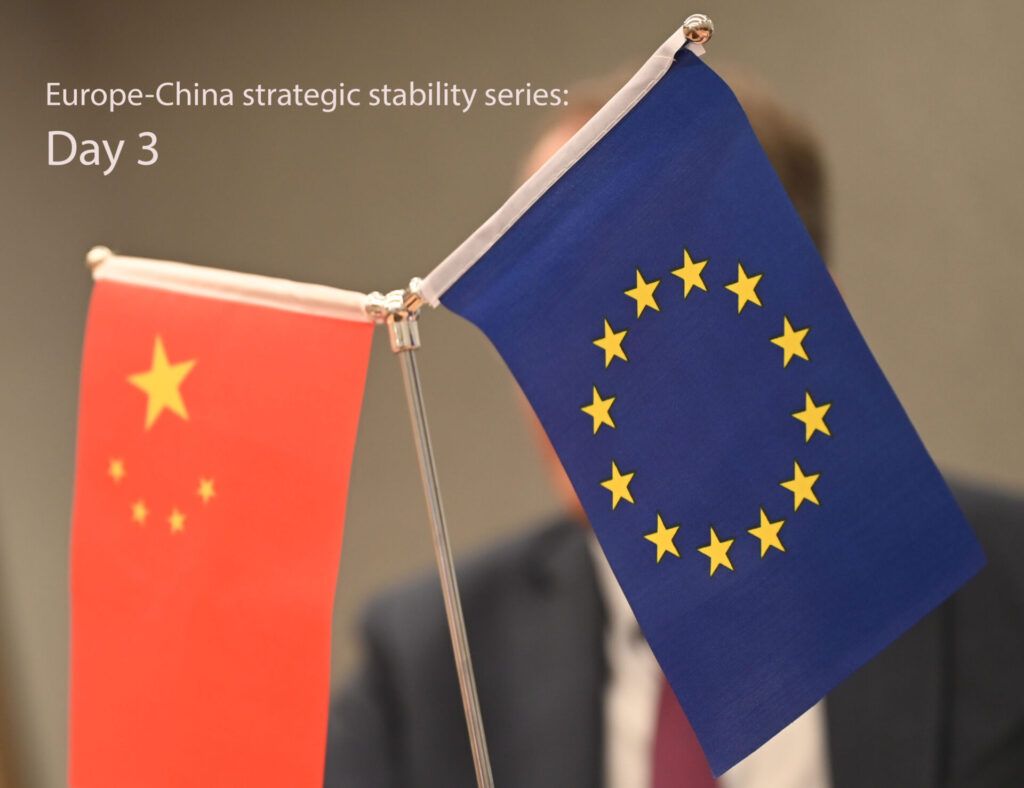 26 May 2026, China, Peking: A Chinese and a European flag stand on a table. Photo: Johannes Neudecker/dpa (Photo by Johannes Neudecker/picture alliance via Getty Images)
Listen to this article:
Listen to this article
--:--
This audio was generated using an automated voice. Learn more.
Editor’s note: This article is is intended to be read alongside “US nuclear sharing in Asia and its implications for regional security.”
China, Russia, and countries in the Global South have criticized US extended-nuclear-deterrence guarantees to its allies as undermining the nuclear non-proliferation regime and strategic stability.[1] Critics argue that NATO’s nuclear sharing arrangements are a form of covert proliferation that goes against the obligations under the Non-Proliferation Treaty (NPT). Also, extended-nuclear-deterrence guarantees have undermined strategic stability by driving the US interest in a counterforce nuclear doctrine and ballistic missile defense and making a no-first-use guarantee unacceptable to US allies.
At the same time, US extended-deterrence guarantees enabled and reinforced regional and global non-proliferation efforts. During the Cold War, extended-deterrence guarantees, including nuclear sharing, were crucial in dissuading allies from pursuing their own nuclear programs. They thereby enabled support for the NPT in Cold War Europe and informed the agreement between the United States and the Soviet Union that underpinned it.
Now, extended-deterrence arrangements face structural pressures, not only from US rivals but from the rhetoric, policies, and actions of the United States itself. Reinforcing US capabilities in the Indo-Pacific has long been on the US national security agenda,[2] but that focus also signaled that the United States has a diminished stake in European security. The second Trump administration’s 2026 National Defense Strategy (NDS) noted that the United States would still provide extended nuclear deterrence to NATO and Europe, but its allies would be expected to bear the weight for conventional deterrence.[3] The administration’s rhetorical attacks on the European Union and individual NATO allies, before and after the US-Israeli war against Iran, have further undermined confidence in US extended deterrence guarantees. Moreover, the administration’s threat to annex Greenland, a territory of NATO member state Denmark, has done damage to US credibility.
Ironically, China and Russia may find themselves unpleasantly surprised if US extended nuclear deterrence comes to an end. States that feel threatened by China and Russia are exploring options to compensate for deterrence shortfalls: either to reconsider their non-nuclear stances, as is the case for South Korea; reconfigure their deterrence around a smaller regional nuclear state like France; or rely on conventional deterrence, specifically through a buildup of mass precision strike capabilities.
While they may strengthen deterrence, these three kinds of proliferation—new nuclear states, nuclear states with new responsibilities, and conventional assets with strategic effects—also increase unpredictability and undermine strategic stability. In short, US extended nuclear deterrence is inherently both stabilizing—through its non-proliferation outcomes—and destabilizing. But its absence could also be destabilizing, and the United States, its allies, and its rivals will need to come to terms if this profound change in the international system indeed takes place.
Extended nuclear deterrence for nonproliferation. In the 1950s, ‘60s, and ‘70s, a long list of countries considered or initiated indigenous nuclear weapons programs, including West Germany, Italy, Norway, Australia, Japan, South Korea, and Taiwan. US leaders were disturbed by the prospect of a growing number of nuclear weapon states.[4] They looked to inhibit proliferation, with most of the effort taking the form of security assurances.[5]
Ensuring the credibility of extended-nuclear-deterrence guarantees, however, is inherently difficult. Direct nuclear deterrence in defense of one’s own vital interests is already challenging. A deterrer must find ways to communicate their resolve to use nuclear weapons even at stages of conflict when threats are not yet existential. Communicating such resolve on behalf of others is manifestly more difficult.[6] What is at stake for the states protected by the guarantees will be existential to them, as it likely also is for the aggressor, but not for the guarantor.
Even though the United States has provided multiple extended nuclear deterrence guarantees, its geographic insularity in the Western Hemisphere ensures it is far removed from the adversaries it deters and the allies it reassures, whether in Europe, Asia, and the Middle East.[7] Should it want to avoid nuclear retaliation, the United States is well-positioned to decouple from its allies. While the United States had an overwhelming strategic interest during the Cold War to keep Western Europe’s society and industrial potential out of the Soviet sphere of influence, Europeans had good reasons to doubt whether U.S. leaders were willing to risk their own survival. Fears of decoupling grew after the Soviet Union’s 1957 Sputnik launch, when the Soviet Union demonstrated it could directly threaten the survival of the US homeland with intercontinental ballistic missiles.
European states looked towards developing national nuclear programs, while US administrations were initially unsure about the desirability of such a development. Selective proliferation of nuclear weapons to allies could allow the United States to withdraw forces from Europe and cut the costs of near-permanent military commitments.[8] The Eisenhower, Kennedy, and Johnson administrations considered providing European allies with nuclear weapons through various arrangements.[9] However, for European allies as well as the Soviet Union, the memory of World War II was still vivid, and a (West) German nuclear was unacceptable. In turn, the Federal Republic of Germany could not accept complete dependence on the United States for its deterrence, especially as any escalation would certainly destroy German territory.[10] US leaders concluded a world with multiple smaller nuclear powers was risky. Extended nuclear deterrence was arguably the least bad among a set of poor options.[11]
The United States broadly pursued three sets of solutions to make extended nuclear deterrence guarantees credible. First, the United States underlined its stake through the presence of thousands of US military personnel on allied territories. This ensured that the United States had “skin in the game,” and it would be inextricably involved in any large-scale Soviet and Warsaw Pact aggression.[12] Nuclear sharing arrangements addressed the concerns of the non-nuclear states. NATO’s Nuclear Planning Group gives European allies insight into the US nuclear planning process and targeting and consultation ability. Second, the United States ensured it had multiple means at its disposal, including qualitatively superior conventional forces and non-strategic nuclear weapons, to escalate and deny adversaries the benefits of aggression. These escalatory means gave the United States options beyond “surrender or suicide,” the choice inherent in use of strategic nuclear weapons. Third, the United States looked for ways to diminish its vulnerability to nuclear attack. Mutual vulnerability has never been acceptable to the United States because the interests at stake are not its own.[13] US leaders pursued policies, such as command, control, and communications disruption and destruction, counterforce targeting strategies, and ballistic missile defenses, to limit the damage that nuclear weapons could inflict on the United States itself.[14]
Extended deterrence underwrote the non-proliferation regime. Soviet leaders sought to cooperate with their US counterparts to keep the nuclear club as limited as possible. With assurances in hand, European NATO members were willing to forego the acquisition of nuclear weapons. The United States then gave assurances to East Asian states that were tempted to acquire nuclear weapons. These agreements allowed the United States and the Soviet Union to come to an agreement that led to the Non-Proliferation Treaty.[15] But the policies underwriting extended nuclear deterrence and thus non-proliferation were not without costs and risks.
Extended deterrence and strategic stability. The benefits of non-proliferation through extended nuclear deterrence come at cost to strategic stability, however, due to the US policies necessary to make them credible. The US pursuit of nuclear superiority and damage limitation undermines its adversaries’ confidence in their assured second strike capabilities.[16] Ballistic missile defenses have been a problem for China and Russia, in particular the placement of systems close to their borders (respectively the Terminal High Altitude Area Defense system in the Republic of Korea and the Aegis system in Poland and Romania). One consequence is the Chinese and Russian pursuit of new or improved delivery systems to overcome defenses.[17] US policymakers may gamble that they can outspend Russia as they did the Soviet Union in the late Cold War, but it is not clear if the same approach could work with an economy the size of China’s.
Policies more directly related to extended deterrence have also been criticized. China and Russia have attacked NATO’s nuclear sharing arrangements as a threat to the non-proliferation regime.[18] They argue that at the time of war when operational control of US nuclear weapons is released to allies, nuclear sharing would create multiple nuclear-armed states. Even though neither Japan nor South Korea participate in nuclear sharing, China fears that the United States will deploy non-strategic US systems to the Indo-Pacific. One fear is the US plan for a submarine-launched cruise missile that carries a non-strategic nuclear weapon (SLCM-N).[19] Chinese officials have repeatedly insisted that the United States should commit to a no first use policy that precludes using nuclear weapons unless first attacked.[20] China’s and Russia’s concerns have merit on the surface. They are asked to accept an unequal relation between themselves and the United States where the latter has permanent nuclear superiority, as well as the deployment or employment of US nuclear assets close to their territories, undermining their ability to launch a second strike.
But the Chinese and Russian concerns are obviously also self-serving. NATO’s nuclear-sharing states do not have operational control over the US nuclear weapons during peacetime.[21] The permission required—from both the US president and European leaders—makes them less likely to be used. Moreover, the military utility of B-61 gravity bombs is unclear, given the expected difficulty in penetrating Russia’s integrated air defense systems. The transition among allies to the stealthy F-35 as the primary delivery system may offset those limits to an extent.[22]
More important, in the states that are most exposed to threat, interest in nuclear sharing has only increased. In the past, fears that the presence of US nuclear weapons on their territories made them targets for Russia led to calls for their removal in NATO member states.[23] The opposition to nuclear sharing in Europe largely dissipated after the 2022 Russian invasion of Ukraine. Meanwhile, South Korean leaders have asked the United States to explore nuclear-sharing arrangements and inquired in NATO states about their current procedures.[24] Poland has repeatedly signaled its desire to participate in NATO’s nuclear-sharing arrangements.[25]
In any case, strategic instability (of some kind) may be an unavoidable trade-off for deterrence, without which it would be difficult for US leaders to accept the costs and risks of extended nuclear deterrence and thus ensure nuclear non-proliferation.[26] Strategic instability is, in fact, increasing simply as a consequence of the structural shift that has occurred as China has more than doubled its strategic arsenal in recent years and improved its delivery systems.[27] Doubts about the sufficiency of the US nuclear arsenal have grown over the last decade because the United States now faces two (near) peer nuclear powers, Russia and China.[28] The US response to the perceived shortfalls may further undermine stability. As noted, the United States will also rely on SLCM-N to bypass land-based weapons.[29] Other options for escalation or under consideration as well. For allies, however, it is not primarily the balance of nuclear capabilities, whether warheads or delivery systems, but US political commitments that underscore the credibility of extended nuclear deterrence.
Asia and Europe: uncertainty about US commitments. Among allies, uncertainty about the long-term credibility of US political commitments has grown over the past decade. Much of this is a consequence of China’s economic rise and its investments in its conventional military power. Successive US administrations have signaled a regional reorientation; Europe and the Middle East were to be deprioritized in favor of the Indo-Pacific. The Biden administration’s 2022 National Defense Strategy (NDS), despite being published a month after Russia’s invasion of Ukraine began the largest land war in Europe since the end of World War II, underlined that China remained the “pacing challenge” for the Department of Defense.[30] More explicitly, the Trump administration’s 2026 NDS underlined that European NATO member states should shoulder the burden for the continent’s conventional defense and deterrence and reduced Europe to the third priority after the Western Hemisphere and the Indo-Pacific. The NDS noted that the United States would still provide extended nuclear deterrence.[31]
A diminishing US role in Europe’s conventional defense, however, also signals a declining political commitment as US exposure and “skin in the game” decreases. Moreover, if the United States looks to compensate for possible deterrence gaps through SLCM-N, Europeans may again, like they did during the Cold War, oscillate between fears that the United States would either abandon them or have a nuclear exchange contained to Europe.
Even with careful planning, US reprioritization between regions was bound to unsettle European allies. However, unpredictable statements and actions by the US administration have further rattled their confidence. In 2025, the administration ended its aid to Ukraine and criticized the European Union and seemed to signal it wanted to break it up,[32] instituting tariffs against allies and rivals. In the first months of 2026, the administration announced its intention to acquire Greenland by any means necessary and initiated war, together with Israel, against Iran without notification to allies.[33] Subsequently, it admonished allies for not sending their navies to the Persian Gulf and threatened withdrawal from NATO. These actions not only triggered short-term anger among allies in Europe, but also in East Asia and the Gulf States, and deeply rattled them about the long-term credibility of US commitments.[34]
Over the past decade, as concerns about Russian belligerence, Chinese assertiveness, North Korean recklessness, and uncertainty about the US commitment accumulated, non-nuclear European and Asian allies had already been reconsidering their policies, beyond joining the US nuclear sharing arrangements if they were not already members. Three broad non-exclusive approaches emerged: They reconsidered their commitment to the non-proliferation regime; looked to build alternative arrangements around other nuclear-armed allies; and acquired conventional precision-strike weapons for deterrence.
South Korea and Japan are latent nuclear powers, and members of both the elite and the general public are in favor of acquiring nuclear weapons.[35] In Europe, some have also hinted at this possibility.[36] A manifestation of the growing doubts about US extended nuclear deterrence is the European move towards alternative deterrence arrangements, centered on France and the UK.[37] In March 2026 French President Emmanuel Macron announced the evolution of French nuclear doctrine towards “forward deterrence”, with major shifts that include an expansion of the French nuclear arsenal, the integration with conventional precision strike, and, crucially, the coordination with multiple allies through exercises.[38] France, the UK, and Germany are now each coordinating bilaterally on deterrence.[39]
However, the most concrete consequence of the doubts about the credibility of the US extended-nuclear-deterrence guarantees is the rapid vertical and horizontal proliferation of advanced conventional weapons or precision-strike weapons among European and Asian non-nuclear armed and nuclear-armed states alike. In part, these are intended to address gaps in escalation options against the Russian, Chinese, and North Korean threats. [40] These are intended for deterrence by denial, deterrence by punishment, and, in some cases, even for counterforce objectives.[41] Precision weapons and asymmetric means have shown to be highly effective in Ukraine and the Persian Gulf.
This proliferation of advanced conventional weapons may dampen the desire to acquire nuclear weapons but undermines strategic stability—at least while states adapt to the new status quo. Current developments will lead to multiple states possessing conventional weapons that can accomplish strategic effects, including limited counterforce capabilities. This makes it more difficult to assess intentions, specifically if coalitions or alliances have multiple members that have both conventional and nuclear weapons. With the growing role of advanced conventional weapons, which are often dual-capable and rely on the same command, control, communications, and reconnaissance infrastructure, the risks of inadvertent escalation rise, because conventional actions are likelier to be misinterpreted.[42]
The greater incentives to pursue nuclear weapons as extended nuclear deterrence deteriorates are unlikely to translate into multiple states sprinting towards the bomb. Doing so undetected would be difficult. However, a greater number of states should be expected to hedge and make specific technical preparations. The proliferation of conventional precision weapons could ease constraints on breakout, as they would likely already be close to possessing the necessary delivery systems and supporting infrastructure.
Speed of developments and instability. The accelerating rate of developments triggered by the inward turn of the United States and the rise of China has created a highly unpredictable environment. As the credibility of the US extended-nuclear- deterrence guarantees erodes both from within and without, China and Russia may face a much less predictable environment with potential new nuclear states in their region and less predictable regional coalitions around new nuclear states, and they certainly will face the proliferation of conventional weapons that could achieve strategic effects. They are also likely to face a United States that is likely to invest in more technological capabilities to offset its perceived deterrence shortfalls. These developments would undermine strategic stability and leave not only states facing China and Russia with more uncertainty about their security, but possibly also China and Russia themselves.
Notes
[1] China’s Arms Control, Disarmament, and Nonproliferation in the New Era (The State Council Information Office of the People’s Republic of China, 2025); Max Seddon and Kathrin Hille, “China Pushes Nuclear ‘No First Use’ While Expanding Its Atomic Arsenal,” Nuclear Proliferation, Financial Times, August 2, 2024, https://www.ft.com/content/c23e896d-8fbd-4a9d-a7a3-ea0973d838cf.
[2] National Defense Strategy (Department of Defense, 2022); “Hillary Clinton: America’s Pacific Century and the Pivot to Asia,” accessed March 3, 2026, https://foreignpolicy.com/2011/10/11/americas-pacific-century/.
[3] National Defense Strategy: Restoring Peace through Strength for a New Golden Age of American (Department of Defense, 2026); “Remarks by Under Secretary of War for Policy Elbridge Colby at the NATO Defense Ministerial,” U.S. Department of War, accessed April 9, 2026, https://www.war.gov/News/Speeches/Speech/Article/4404801/remarks-by-under-secretary-of-war-for-policy-elbridge-colby-at-the-nato-defense/. See also Elbridge A. Colby, The Strategy of Denial: American Defense in an Age of Great Power Conflict (Yale University Press, 2021).
[4] U.S. leaders had multiple concerns about proliferation, including: the so-called N-country problem where every additional proliferation would further a nuclear cascade; blackmail against U.S. interests; a loss of U.S. influence; and accidental usage. It looked to inhibit proliferation to these European and Asian states, as well as others. Vipin Narang, Seeking the Bomb: Strategies of Nuclear Proliferation (Princeton University Press, 2022); Francis J. Gavin, “Strategies of Inhibition: US Grand Strategy, the Nuclear Revolution, and Nonproliferation,” International Security 40, no. 1 (2015): 9–46; Albert Wohlstetter, “IX. Nuclear Sharing: NATO and the N+1 Country,” in The Dispersion Of Nuclear Weapons, ed. R. N. Rosecrance (Columbia University Press, 1964), https://doi.org/10.7312/rose93320-011.
[5] Beyond security assurances, U.S. policies included assistance for civil nuclear programs, as well as coercion. Gavin, “Strategies of Inhibition”; Gene Gerzhoy, “Alliance Coercion and Nuclear Restraint: How the United States Thwarted West Germany’s Nuclear Ambitions,” International Security 39, no. 4 (2015): 91–129; Alexander Lanoszka, Atomic Assurance: The Alliance Politics of Nuclear Proliferation (Cornell University Press, 2018).
[6] As Richard Betts notes, “once basic deterrence becomes mutual, it negates extended deterrence by definition, since the latter requires the willingness to initiate nuclear attack”. Richard K. Betts, Nuclear Blackmail and Nuclear Balance (Brookings Institution Press, 2010), 10. See also: Lawrence Freedman, The Evolution of Nuclear Strategy, Third edition, 2003 (Palgrave Macmillan, 1981), 276.
[7] Paul van Hooft, “All-In or All-Out: Why Insularity Pushes and Pulls American Grand Strategy to Extremes,” Security Studies 29, no. 4 (2020): 701–29, https://doi.org/10.1080/09636412.2020.1811461.
[8] President Eisenhower saw selective proliferation as both just and an effective means to diminish the U.S. conventional military presence in Europe. Marc Trachtenberg, A Constructed Peace: The Making of the European Settlement, 1945-1963 (Princeton University Press, 1999), chap. 5.
[9] The submarine-based Multilateral Force (MLF) would have had shared controls and a dual-key arrangement.
[10] Trachtenberg, A Constructed Peace, chaps. 4, 6, 9.
[11] Robert S. McNamara, “Speech to NATO Council, Athens 5 May 1962,” in US Nuclear Strategy: A Reader, ed. Philip Bobbitt et al. (Palgrave Macmillan UK, 1989), https://doi.org/10.1007/978-1-349-19791-0_15.
[12] Arguably, the signal worked too well: allies were sensitive enough to consider any redistribution of U.S. forces between theaters a signal of imminent decoupling and to then reconsider their nuclear abstention. Lanoszka, Atomic Assurance.
[13] “Why We Extend Deterrence – by Pranay Vaddi and Vipin Narang,” accessed April 23, 2026, https://strategicsimplicity.substack.com/p/why-we-extend-deterrence.
[14] Austin Long and Brendan Rittenhouse Green, “Stalking the Secure Second Strike: Intelligence, Counterforce, and Nuclear Strategy,” Journal of Strategic Studies 38, nos. 1–2 (2015): 38–73; Matthew Kroenig, The Logic of American Nuclear Strategy: Why Strategic Superiority Matters (Oxford University Press, 2018); Brendan Rittenhouse Green, The Revolution That Failed: Nuclear Competition, Arms Control, and the Cold War (Cambridge University Press, 2020); Keir A. Lieber and Daryl G. Press, The Myth of the Nuclear Revolution: Power Politics in the Atomic Age (Cornell University Press, 2020).
[15] William Alberque, The NPT and the Origins of NATO’s Nuclear Sharing Arrangements, with Institut français des relations internationales, Proliferation Papers 57 (Ifri – Institut Français des Relations Internationales, 2017).
[16] Charles L. Glaser and Steve Fetter, “Should the United States Reject MAD? Damage Limitation and U.S. Nuclear Strategy toward China,” International Security 41, no. 1 (2016): 49–98, https://doi.org/10.1162/ISEC_a_00248.
[17] Dawn Stover, “Orbital Hypersonic Delivery Systems Threaten Strategic Stability,” Bulletin of the Atomic Scientists, June 13, 2023, https://thebulletin.org/2023/06/orbital-hypersonic-delivery-systems-threaten-strategic-stability/; “China’s Orbital Bombardment System Is Big, Bad News—but Not a Breakthrough,” Carnegie Endowment for International Peace, October 19, 2021, https://carnegieendowment.org/programs/nuclear-policy/proliferation-news/chinas-orbital-bombardment-system-is-big-bad-newsbut-not-a-breakthrough; Patrycja Bazylczyk and Hannah Freeman, Russia’s Nuclear-Powered Burevestnik Missile: Implications for Missile Defense, April 11, 2025, https://www.csis.org/analysis/russias-nuclear-powered-burevestnik-missile-implications-missile-defense; Guy Faulconbridge et al., “Russia Tests Nuclear-Capable Poseidon Super Torpedo, Putin Says,” China, Reuters, October 29, 2025, https://www.reuters.com/world/china/putin-says-russia-tested-poseidon-nuclear-capable-super-torpedo-2025-10-29/.
[18] China’s Arms Control, Disarmament, and Nonproliferation in the New Era.
[19] Anya L. Fink, Nuclear-Armed Sea-Launched Cruise Missile (SLCM-N) (Congressional Research Service, 2025). Gabriel Honrada, “US Navy Wants Sea-Launched Nuke Missiles to Hold China at Bay,” Asia Times, May 13, 2025, https://asiatimes.com/2025/05/us-navy-wants-sea-launched-nuke-missiles-to-hold-china-at-bay/.
[20] Benjamin Hautecouverture, Chinese No-First-Use: A Strategic Signaling Device, Diplomatic Tool, and Dogmatic Reality (Fondation Recherche Strategique, 2025), https://www.frstrategie.org/en/publications/notes/chinese-no-first-use-strategic-signaling-device-diplomatic-tool-and-dogmatic-reality-2025.
[21] The Permissive Action Links on U.S. B-61 gravity bombs make them useless to the sharing states without the approval of the U.S. president and delegation to U.S. military commanders in the early stages of a crisis.
[22] Aaron Mehta, “US Completes $9B B61-12 Nuclear Warhead Upgrade,” Breaking Defense, January 7, 2025, https://breakingdefense.com/2025/01/us-completes-9b-b61-12-nuclear-warhead-upgrade/; Michael Marrow, “EXCLUSIVE: F-35A Officially Certified to Carry Nuclear Bomb,” Breaking Defense, March 8, 2024, https://breakingdefense.com/2024/03/exclusive-f-35a-officially-certified-to-carry-nuclear-bomb/.
[23] For example, Michal Smetana et al., “Do Germany and the Netherlands Want to Say Goodbye to US Nuclear Weapons?,” Bulletin of the Atomic Scientists 77, no. 4 (2021): 215–21.
[24] Se Young Jang, “The Evolution of US Extended Deterrence and South Korea’s Nuclear Ambitions,” Journal of Strategic Studies 39, no. 4 (2016): 502–20; Sang-Hun Choe, “The Evolution of South Korea’s Nuclear Weapons Policy Debate | Council on Foreign Relations,” The New York Times, January 12, 2023, https://www.cfr.org/blog/evolution-south-koreas-nuclear-weapons-policy-debate; “In a First, South Korea Declares Nuclear Weapons a Policy Option – The New York Times,” accessed October 25, 2024, https://www.nytimes.com/2023/01/12/world/asia/south-korea-nuclear-weapons.html.
[25] “Poland’s Leader Says His Country Is Ready to Host NATO Members’ Nuclear Weapons to Counter Russia | AP News,” accessed July 9, 2024, https://apnews.com/article/poland-nuclear-weapons-nato-russia-ukraine-d92c508d6ff53683a25f1bc62d256f86.
[26] Brad Roberts, Counterforce in Contemporary U.S. Nuclear Strategy (Center for Global Security Research Lawrence Livermore National Laboratory, 2025), Austin Long, Damage Limitation in the 21st Century, https://cgsr.llnl.gov/sites/cgsr/files/2025-05/2025-0529-CGSR-Occasional-Paper-Counterforce-In-Contemporary-US-Nuclear-Strategy.pdf. Kroenig, The Logic of American Nuclear Strategy.
[27] Hans M. Kristensen et al., “Chinese Nuclear Weapons, 2025,” Bulletin of the Atomic Scientists 81, no. 2 (2025): 135–60, https://doi.org/10.1080/00963402.2025.2467011.
[28] Madeleine Creedon, ed., Congressional Commission on the Strategic Posture of the United States (Department of Defense (DOD); the Department of Energy National Nuclear Security Administration (NNSA), 2023).
[29] U. S. Naval Institute, “Report to Congress on Nuclear Sea-Launched Cruise Missile,” USNI News, 2025, https://news.usni.org/2025/09/24/report-to-congress-on-nuclear-sea-launched-cruise-missile-2.
[30] National Defense Strategy.
[31] National Defense Strategy: Restoring Peace through Strength for a New Golden Age of American.
[32] “US Military Aid to Ukraine Dropped 99% in 2025, Report Finds,” The Kyiv Independent, February 11, 2026, https://kyivindependent.com/us-military-aid-to-ukraine-dropped-99-in-2025-report-finds/; “Ukraine Support Tracker – Kiel Institute,” accessed April 23, 2026, https://www.kielinstitut.de/topics/war-against-ukraine/ukraine-support-tracker/. National Security Strategy of the United States of America (White House, 2025); “Remarks by the Vice President at the Munich Security Conference | The American Presidency Project,” accessed April 24, 2026, https://www.presidency.ucsb.edu/documents/remarks-the-vice-president-the-munich-security-conference-0.
[33] John Curtis and Stefano Fella, President Trump and Greenland: Frequently Asked Questions, March 2, 2026, https://commonslibrary.parliament.uk/research-briefings/cbp-10472/; Pete McKenzie et al., “MAGA Figures Are Pushing Trump’s Campaign to Grab Greenland. But It’s Tough Sledding,” Investigations, Reuters, April 17, 2026, https://www.reuters.com/investigations/maga-figures-are-pushing-trumps-campaign-grab-greenland-its-tough-sledding-2026-04-17/; Eric Schmitt and Jonathan Swan, “Iran War Has Drained U.S. Supplies of Critical, Costly Weapons,” New York Times (New York), April 23, 2026, https://www.nytimes.com/2026/04/23/us/politics/iran-war-cost-military.html.
[34] “Iran War Accelerates America’s Breakup with the World,” POLITICO, April 20, 2026, https://www.politico.com/news/2026/04/20/iran-war-us-world-influence-00882028.
[35] Chul Min Kim et al., “Nuclear Latency, Nuclear Power, and Nuclear Proliferation,” The Nonproliferation Review, February 5, 2025, 1–34, https://doi.org/10.1080/10736700.2024.2406590; Kyung Suk Lee, “South Korean Cost Sensitivity and Support for Nuclear Weapons,” International Interactions 50, no. 3 (2024): 506–36, https://doi.org/10.1080/03050629.2024.2348063; Matthew Fuhrmann and Benjamin Tkach, “Almost Nuclear: Introducing the Nuclear Latency Dataset,” Conflict Management and Peace Science 32, no. 4 (2015): 443–61.
[36] “Poland Seeks Access to Nuclear Arms and Looks to Build Half-Million-Man Army,” POLITICO, March 7, 2025, https://www.politico.eu/article/donald-tusk-plan-train-poland-men-military-service-russia/; POLITICO, “Poland Seeks Access to Nuclear Arms and Looks to Build Half-Million-Man Army.”
[37] Héloïse Fayet et al., “Forum: European Nuclear Deterrence and Donald Trump,” Survival 67, no. 1 (2025): 123–42, https://doi.org/10.1080/00396338.2025.2459011; Ulrich Kühn, Germany and Nuclear Weapons in the 21st Century: Atomic Zeitenwende? (Taylor & Francis, 2024), https://library.oapen.org/handle/20.500.12657/88129; Héloïse Fayet et al., “Towards a European Nuclear Deterrent,” in Survival: October–November 2024 (Routledge, 2024), https://www.taylorfrancis.com/chapters/edit/10.4324/9781003498018-7/forum-towards-european-nuclear-deterrent-h%C3%A9lo%C3%AFse-fayet-andrew-futter-ulrich-k%C3%BChn; Astrid Chevreuil, France’s Nuclear Offer to Europe, October 23, 2024, https://www.csis.org/analysis/frances-nuclear-offer-europe.
[38] “President Delivers Speech on France’s Nuclear Deterrence | France in the United Kingdom,” accessed April 9, 2026, https://uk.diplomatie.gouv.fr/en/president-delivers-speech-frances-nuclear-deterrence.
[39] “Northwood Declaration: 10 July 2025 (UK-France Joint Nuclear Statement),” GOV.UK, accessed March 2, 2026, https://www.gov.uk/government/news/northwood-declaration-10-july-2025-uk-france-joint-nuclear-statement; Euractiv, “France, Germany Say Establishing ‘Nuclear Steering Group,’” Euractiv, March 2, 2026, https://www.euractiv.com/news/france-germany-say-establishing-nuclear-steering-group/; Auswärtiges Amt, “For Security and Prosperity in Europe: Germany and the United Kingdom of Great Britain and Northern Ireland Conclude a Treaty on Friendship and Bilateral Cooperation,” German Federal Foreign Office, accessed April 24, 2026, https://www.auswaertiges-amt.de/en/aussenpolitik/laenderinformationen/grossbritannien-node/2727346-2727346.
[40] Russia retains distinct advantages over NATO in terms of the number of non-strategic weapons with which it could escalate against NATO military (or city) targets. The NATO European nuclear sharing states have approximately 100 non-strategic nuclear weapons distributed between them, which are stored on their territories but remain under joint custody of U.S. armed forces and those of the host country. If the U.S. security guarantees erode further and France and the UK would take on a greater role in European deterrence, the escalation management problem worsens as neither has non-strategic weapons. William Alberque, Russian Military Thought and Doctrine Related to Non-Strategic Nuclear Weapons: Change and Continuity, 2024, https://policycommons.net/artifacts/11314275/russian-military-thought-and-doctrine-related-to-non-strategic-nuclear-weapons/12199777/. The UK has announced it will acquire the F35-A to join the NATO DCA tasks, which may be a first cautious step towards reacquiring an air leg for its deterrent.
[41] Ian Bowers and Henrik Stålhane Hiim, “Conventional Counterforce Dilemmas: South Korea’s Deterrence Strategy and Stability on the Korean Peninsula,” International Security 45, no. 3 (2020): 7–39; Sungmin Cho, South Korea’s Offensive Military Strategy and Its Dilemma, February 29, 2024, https://www.csis.org/analysis/south-koreas-offensive-military-strategy-and-its-dilemma; Roberts, “Counterforce in Contemporary US Nuclear Strategy | Center for Global Security Research,” Jacek Durkalec, Counterforce at the Regional Level of War: A European Perspective; Douglas Barrie et al., “Deep Precision Strike: Europe’s Quest for Long-Range Missile Capabilities,” IISS, November 13, 2025, https://www.iiss.org/research-paper/2025/11/deep-precision-strike-europes-quest-for-long-range-missile-capabilities/.
[42] Andrew Futter and Benjamin Zala, “Strategic Non-Nuclear Weapons and the Onset of a Third Nuclear Age,” European Journal of International Security 6, no. 3 (2021): 257–77; David Blagden, “Strategic Stability and the Proliferation of Conventional Precision Strike: A (Bounded) Case for Optimism?,” The Nonproliferation Review 27, nos. 1–3 (2020): 123–36, https://doi.org/10.1080/10736700.2020.1799569.
Europe, China, and strategic stability
A series that brings together European and Chinese experts in parallel and co-drafted articles examining key dimensions of contemporary strategic stability.
Together, we make the world safer.
The Bulletin elevates expert voices above the noise. But as an independent nonprofit organization, our operations depend on the support of readers like you. Help us continue to deliver quality journalism that holds leaders accountable. Your support of our work at any level is important. In return, we promise our coverage will be understandable, influential, vigilant, solution-oriented, and fair-minded. Together we can make a difference.
Keywords: China, Europe, series, strategic stability
Topics: Analysis, Nuclear Risk
Get alerts about this thread
0 Comments
Oldest

Paul van Hooft
Paul van Hooft is the head of the RAND Europe Deterrence Initiative (REDI) and a research leader at RAND Europe (Netherlands office). ... Read More