China-Europe cooperation on arms control, disarmament, and non-proliferation: options and opportunities
By Sibylle Bauer, Wu Chunsi | Analysis | June 1, 2026
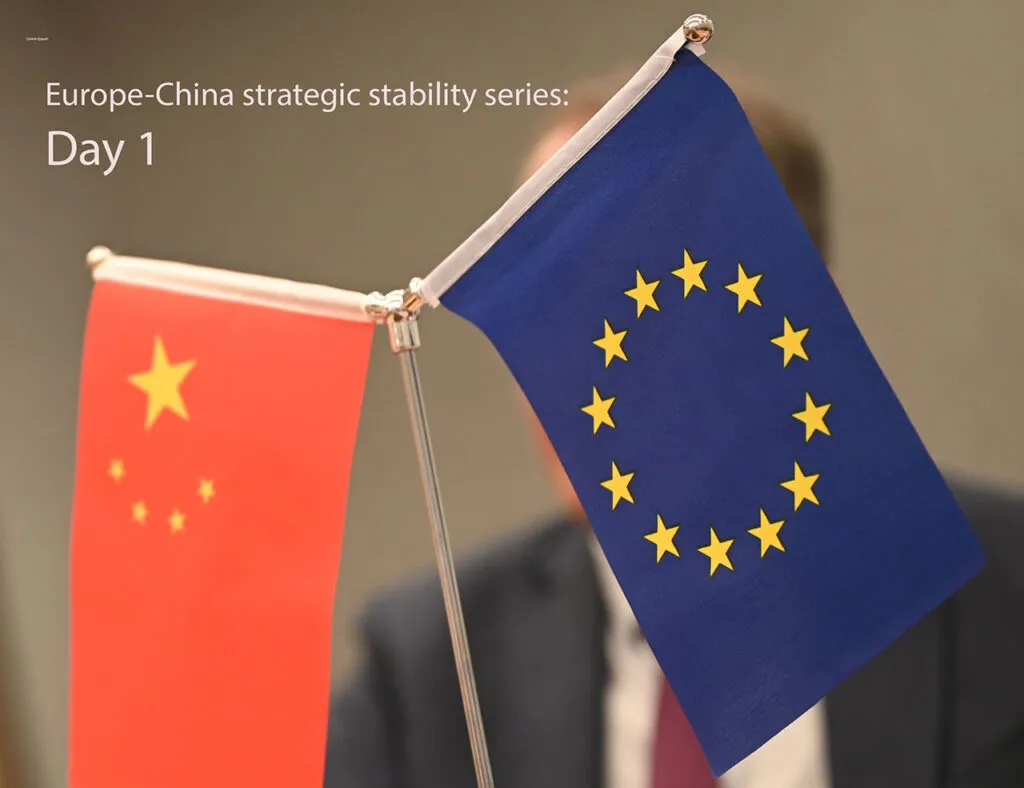 26 May 2026, China, Peking: A Chinese and a European flag stand on a table. Photo: Johannes Neudecker/dpa (Photo by Johannes Neudecker/picture alliance via Getty Images)
Listen to this article:
Listen to this article
--:--
This audio was generated using an automated voice. Learn more.
China and the European Union (EU) signed the Joint Declaration of the People’s Republic of China and the European Union on Non-proliferation and Arms Control in 2004 in The Hague, the Netherlands, illustrating the common ground between China and the EU on international arms control and non-proliferation processes. The current international environment—which features the abandonment of most Russia-US arms control agreements, nuclear modernization programs around the world, and increasing indications that more countries have interest in joining the nuclear weapons club—makes a renewal of EU-China nuclear talks more urgent than the talks were two decades ago.
To actively support multilateralism and uphold international law in the fields of arms control, disarmament and non-proliferation, China and the EU should work together directly in a variety of relevant areas, including maintaining the norm against nuclear use, proliferation and testing; upholding international humanitarian law and the wider framework of international law beyond nuclear weapons related issues; and to enhance crisis communication, among others.
The current problem. The international arms control and non-proliferation architecture is undoubtedly under very serious strain. To start with, most nuclear arms control and disarmament treaties between the two nuclear superpowers, namely Russia and the United States, were abandoned. In 2002, the US withdrew from the 1972 Anti-Ballistic Missile Treaty, which limited strategic missile defense systems and prevented space-based missile defenses, and in 2019 both the US and Russia withdrew from the 1987 Intermediate Nuclear Forces Treaty, which banned land-based intermediate-range missiles. With the expiry of New START in February 2026, all limits on the size and composition of US and Russian nuclear arsenals were lost.
Moreover, nuclear weapon modernization has become the preferred policy option of all nine nuclear weapon possessing states, with several of them also increasing their arsenals, or planning to do so. And in several non-nuclear weapon states, voices expressing an interest in attaining nuclear weapons are gaining traction, putting pressure on the non-proliferation norm that that been one of the core pillars of the Nuclear Non-Proliferation Treaty (NPT) and a relatively stable and uncontested feature of multilateral discussion.
On the positive side, the global norm against nuclear testing is still holding, with a functioning global monitoring system, even though the Comprehensive Test Ban Treaty has not entered into force. Similarly, the global norms against chemical and biological weapons are firmly in place. While the international community had to address recurrence of the use of chemical weapons in recent years, the Chemical Weapons Convention and the Organisation for the Prohibition of Chemical Weapons remain solid pillars weathering the storm of global geopolitics. And while the global record on arms control measures to limit the uncontrolled spread of conventional arms is mixed, the Arms Trade Treaty and Firearms Protocol received tailwind through a permanent member of the UN Security Council—China—having joined. Also on the positive side, International Humanitarian Law continues to constitute the key legal reference framework for all weapons, as well as for new means and methods of warfare.
In the current volatile landscape of international arms control and non-proliferation, many wonder whether there is still a chance to control, limit, or eliminate vertical and horizontal nuclear proliferation, whether the norm against nuclear testing will hold, and, even, if the use of nuclear weapons can ultimately be prevented. Among risks considered in this context are varied pathways towards escalation, intentional or unintended, as well as their second-order effects. In addition, the combination of existing weapons with new technologies such as artificial intelligence and the increased salience of other warfare domains such as cyberspace and outer space are complicating prospects and processes of arms control and non-proliferation more broadly.
While the current geopolitical context makes it challenging to achieve a broad global consensus in multilateral institutions, it also reinforces the need both to preserve what remains of the international arms control and nonproliferation architecture and to explore new ways to address emerging security challenges. At this important juncture for international peace and security, we see an opportunity for China and Europe to intensify and upgrade their cooperation and invest in joint efforts to strengthen the overall system of arms control and nonproliferation, in particular the nuclear dimension. Given the risks of entanglement and multi-domain warfare, any war involving nuclear-weapon-possessing countries could take escalation routes that are in no country’s self-interest.
Why the EU and China should engage now. In the current multipolar era, three factors could give new momentum to international nuclear arms control and nonproliferation:
The first is the strong demand from the international community. In most other countries, nuclear weapon states are seen as not having fulfilled their commitments on nuclear disarmament, arms control, and nonproliferation, most notably the disarmament commitment contained in the NPT. The five permanent members of UN Security Council (P5) in particular are expected to assume their responsibility on world peace and security. In January 2022, the P5 issued a joint statement on preventing nuclear war and avoiding an arms race. This was an important step, but far from sufficient.
The second factor is the self-interest of the major powers. The intensified competition among China and the United States and Russia and the United States has disrupted cooperation, consultation, and even communication on arms control and nonproliferation. All three countries need to find ways to re-balance geopolitical competition in the interest of strategic stability, preventing escalation and promoting survival.
Third, responsibly developing and using artificial intelligence (AI) and other emerging technologies could give new impetus to major power cooperation. While AI and other emerging technologies have become an area of intensified competition among major powers, these powers also share some common interests regarding the application of new technologies, such as preventing them from undermining the safety and security of nuclear weapons and contributing to increased strategic instability.
China and Europe are influential actors in international affairs. While their positions on international arms control and nonproliferation do not fully overlap, there is agreement on a wide range of issues, such as the crucial importance of the rule of law and of international institutions such as the United Nations; the indispensable nature of the international arms control and disarmament treaties and of international humanitarian law; and the urgency of avoiding the use of nuclear weapons. More important, the China-Europe relationship has not been trapped by geopolitical competition and perceived direct threat in the way the US-China and Europe-Russia relationships have been. Now is a critical moment for the two sides to strengthen their mutual trust by working together on the topics relevant to international order and a better future of humanity.
The 2004 Joint Declaration of the People’s Republic of China and the European Union on Non-proliferation and Arms Control was signed in The Hague, the Netherlands, illustrating the mutual support of, and common ground between, China and the EU on international arms control and non-proliferation processes. Two decades on, the international environment makes such efforts even more urgent. Building on previous dialogues on arms control and nonproliferation, China and Europe could exchange views on the overall functional of international arms control and nonproliferation system and explore ways to strengthen it. Beyond the nuclear field, they could coordinate their policies and actions to support the international community’s efforts on disarmament, arms control, and nonproliferation, including in the areas of conventional weapons; the prohibition of biological and chemical weapons; the taboo on nuclear use and nuclear testing; and new risks arising through interactions with and between emerging technologies. The achievements that have been reached should not be marginalized, undermined, or wasted because of diminished attention from major powers. China and the EU could also work together to reduce the tension of geopolitical competition and to encourage other powers to cooperate, thus making a much needed contribution to international peace and security in a time of tremendous risk for mankind.
In the context of strategic competition and low strategic trust, major powers might find it difficult to rebuild bilateral or multilateral consultations on nuclear arms control and nonproliferation, but they can nevertheless take unilateral actions to decrease the role of nuclear weapons in national strategies, reduce regional tensions and escalation risks.
To actively support multilateralism and uphold international law in the fields of arms control, disarmament, and non-proliferation, China and the EU could work together to promote actions in the following 10 areas:
- Upholding the existing international nuclear arms control and nonproliferation regime, including the norms against the threat of nuclear weapons use, proliferation, and testing.
- Strengthening the existing international nuclear arms control and nonproliferation regime through initiatives such as better cooperation and crisis communication for the purpose of global strategic stability and risk reduction.
- Strengthening academic, expert, and next-generation exchanges.
- Keeping self-restraint and promoting the reduction of the role of nuclear weapons in national and regional security strategies, while urging other major powers to do so.
- Calling on nuclear-weapon-possessing states to achieve an agreement on providing security assurances against the use or threat of use of nuclear weapons to non-nuclear weapon states.
- Promoting nuclear safety and security, including the protection of civilian nuclear power plants in armed conflict.
- Promoting consultations to better understand both the risks and opportunities of new technologies for international peace and security.
- Upholding multilateralism and the value and continued relevance of the UN, including sufficient funding for its work.
- Upholding international humanitarian law and the wider framework of international law and multilateralism beyond nuclear weapons related issues, including the Chemical Weapons Convention, the Biological and Toxin Weapons Convention, the Arms Trade Treaty and the Firearms
- Supporting the application of new technologies for the purposes of disarmament, arms control, and nonproliferation verification.
Some of these steps may have been seen as rather modest or conservative only a few years ago, but in the current context they are essential to prevent backsliding and the risk of nuclear war. It is high time for both governments and scholars to engage and invest more actively in international arms control and nonproliferation in the face of serious challenges. In this process, China and Europe could be more proactive and join forces to play more important roles.
Europe, China, and strategic stability
A series that brings together European and Chinese experts in parallel and co-drafted articles examining key dimensions of contemporary strategic stability.
Together, we make the world safer.
The Bulletin elevates expert voices above the noise. But as an independent nonprofit organization, our operations depend on the support of readers like you. Help us continue to deliver quality journalism that holds leaders accountable. Your support of our work at any level is important. In return, we promise our coverage will be understandable, influential, vigilant, solution-oriented, and fair-minded. Together we can make a difference.
Keywords: China, Europe, series, strategic stability
Topics: Analysis, Nuclear Risk
Get alerts about this thread
0 Comments
Oldest

Sibylle Bauer
Sibylle Bauer is Director of Studies, Armament and Disarmament, at the Stockholm International Peace Research Institute, with responsibility for ... Read More