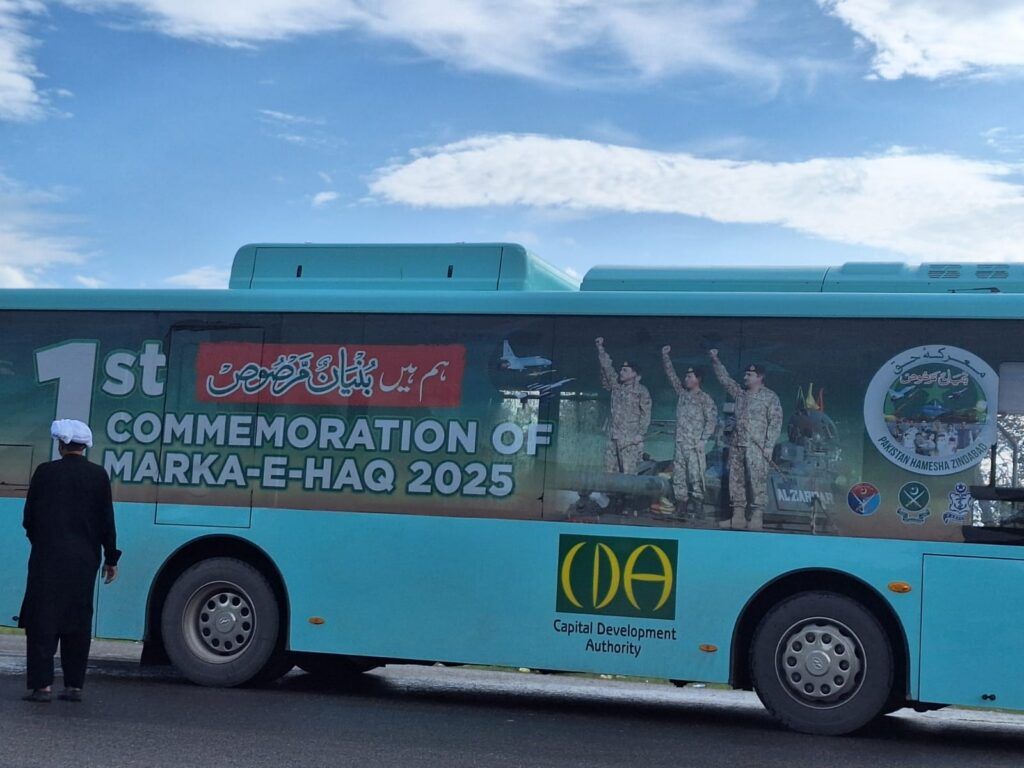
 (Photo by Sadia Tasleem)
Listen to this article:
Listen to this article
--:--
This audio was generated using an automated voice. Learn more.
The world is witnessing a renewed interest in nuclear weapons. From nuclear modernization plans in the United States, to growing anxieties in Europe and East Asia about the reliability of the US security umbrella, to discussions in South Korea, Canada, and elsewhere about acquiring nuclear weapons, the thinking about nuclear weapons appears to be shifting.
But Pakistan shows something different and unexpected.
In the aftermath of a short but limited three-day war with India in May 2025, Pakistan’s strategic elite had to face a hard truth: Nuclear weapons have limits. They do not prevent every crisis or escalation of military conflict, and they do not deter coercion. This is a reality that nuclear weapon states like the United States, Russia, and the United Kingdom have also experienced but rarely acknowledged publicly.
Evidence for this realization comes from how Pakistan commemorated the first anniversary of the military confrontation this May (the Marka-e-Haq) and the anniversary of the day in May 1998 when Pakistan conducted its first nuclear tests (the Youm-e-Takbeer). Those commemorations played down the importance of nuclear weapons, in part because the May 2025 conflict highlighted the limitations of Pakistan’s nuclear arsenal and the risks it can impose during a crisis.
Little fanfare. Marka-e-Haq has been elevated into a visible state narrative since May 2025. The first major indication of this came in July 2025, when the government announced that Pakistan’s Independence Day would be celebrated under the theme of Marka-e-Haq, encouraging participation from state institutions and organizations across the country, including educational institutions.
By the first anniversary in May 2026, the commemoration had become even more visible. Coordinated celebrations were organized across government departments, provincial governments, cultural institutions, public universities, diplomatic missions, and the armed forces. It clearly reflected the importance attached to the event by the state.
By comparison, Youm-e-Takbeer passed with remarkably little fanfare. There were no large-scale celebrations, and no sustained media attention. Senior civilian and military officials issued brief statements on social media, but the day lacked the symbolic prominence that had accompanied it during previous periods of center-right Pakistan Muslim League rule. This was particularly striking given that the party, which currently heads the civilian government, has long taken pride in its decision to conduct Pakistan’s nuclear tests in May 1998.
Even more telling were the visual cues.
Islamabad witnessed massive public displays of conventional military achievement, portraits of military leaders and narratives of battlefield success. From public transport emblazoned with images and slogans of victory, to posters lining major roads, to the naming of a public square, the message was impossible to miss. Notably, however, nuclear weapons and nuclear-capable missiles were conspicuously absent from these images of militarization. This was not because the state lacked the opportunity to showcase them. It was a deliberate effort to communicate a different message.
When the bomb loses relevance. The reason has to do with the dominance of the military in all aspects of Pakistan. The political interests of the military and its institutions are better served by conventional military success than nuclear weapons. The bomb’s destructive power appears largely self-contained; its existence does not easily translate into visible demonstrations of military competence or leadership. Moreover, Pakistan’s nuclear program was not solely the achievement of military institutions. The program was populated largely by scientists and engineers, and the decision to test nuclear weapons in 1998 was ultimately taken by a civilian government.
Even though the bomb has served the military’s political objectives in many ways in the roughly three decades since those tests, by reinforcing its claim to be the indispensable guardian of national security, legitimizing its dominant role in strategic decision-making, and enhancing its institutional authority at home and abroad, its ability to stoke pro-military sentiment among the masses remains limited. For a military establishment emerging from one of the most serious legitimacy crises in Pakistan’s history, highlighting conventional military achievements therefore has much more political value than celebrating the bomb. The former reinforces the image of the armed forces as the nation’s active guardian. The latter does not.
This shift also reflects a deeper problem. For a long time, Pakistan’s strategic elite has projected nuclear deterrence as a nearly absolute guarantee of national security and territorial sovereignty. The promise, which goes by the name full-spectrum deterrence, was huge but false: Nuclear weapons would prevent aggression at all levels of conflict spectrum.
But recent events have exposed the limitations of those claims. Nuclear deterrence did not prevent the May 2025 crisis. The fear of escalation did not keep India from striking deep in Pakistan’s heartland. Nor did it provide a decisive solution to the challenges Pakistan confronted.
Unlike previous episodes, these limitations have become increasingly difficult to obscure. The gap between the promises associated with nuclear deterrence and the realities of strategic competition has become too visible to ignore.
What we see today is the replacement of nuclear weapons at the apex of military strategy with a greater emphasis on conventional militarism; this is precisely the reason why Pakistan sees a spike in its defense spending coupled with the establishment of a new Army Rocket Force Command. The visibility of the senior leadership of the Rocket Force in international defense forums such as the Shangri-La Dialogue can be interpreted as signaling Pakistan’s conventional military preparedness. Nuclear weapons seem to have been displaced from the center stage.
Limited utility, profound risks. The May 2025 crisis exposed another serious challenge. Nuclear weapons were not merely absent as a solution; instead, they emerged as part of the problem. Nuclear weapons did not deter the crisis from unfolding, nor did they offer policymakers a way out once hostilities escalated. Instead, the presence of nuclear weapons constrained Pakistan’s response options by introducing constant risk of misperception and inadvertent escalation. For example, Pakistan’s response to India’s missile strikes had to account not only for military effectiveness but also for how its actions might be interpreted by New Delhi. Any missile launch carried the possibility that India could mistake a conventionally armed strike for the opening phase of a nuclear attack, increasing the dangers of rapid escalation. The challenge was not simply how to respond, but how to respond without triggering catastrophic miscalculation.
The risks were further exacerbated by the reports during the final stages of the confrontation that Pakistan had convened—or was preparing to convene—its National Command Authority, shortly before the United States announced a ceasefire. Whether the meeting actually happened or not is less important than what its likelihood revealed: The crisis had reached a point when nuclear command and control entered the public discourse, narrowing the margin for error and increasing the urgency of de-escalation. International diplomatic intervention helped bring about a ceasefire before these risks increased. Had the fighting continued, the possibility of an unintended or uncontrolled escalation could not have been dismissed.
If anything, this experience reveals that the utility of nuclear weapons is narrower than many of their advocates claim. Pakistan’s experience is worth studying not because it explicitly disproves deterrence, but because it demonstrates the dangers of treating nuclear weapons as a universal solution to security problems.
Countries debating whether to acquire nuclear weapons often ask what the bomb can do for them. Pakistan’s recent experience suggests they should also ask what military constraints and risks the bomb introduces.
Together, we make the world safer.
The Bulletin elevates expert voices above the noise. But as an independent nonprofit organization, our operations depend on the support of readers like you. Help us continue to deliver quality journalism that holds leaders accountable. Your support of our work at any level is important. In return, we promise our coverage will be understandable, influential, vigilant, solution-oriented, and fair-minded. Together we can make a difference.
Keywords: India-Pakistan relations, India-Pakistan war, Pakistan, nuclear escalation
Topics: Analysis, Nuclear Weapons

Sadia Tasleem
Sadia Tasleem is a lecturer with the Department of Defense and Strategic Studies at Quaid-i-Azam University, Pakistan. ... Read More












“Nuclear weapons have limits?” That statement infers that nuclear weapons are acceptable to maintain for specific purposes or under certain conditions. They are not….
The author provided example after example on why nuclear weapons were a hinderence, then relented by that statement.
Do read my article of Jan 04, 2017 in the EurasiaReview:
https://www.eurasiareview.com/04012017-evolution-of-pakistans-nuclear-doctrine-analysis/