It seems Washington needs to be reminded of the Nuclear Non-Proliferation Treaty
By Olamide Samuel | Analysis | April 16, 2026
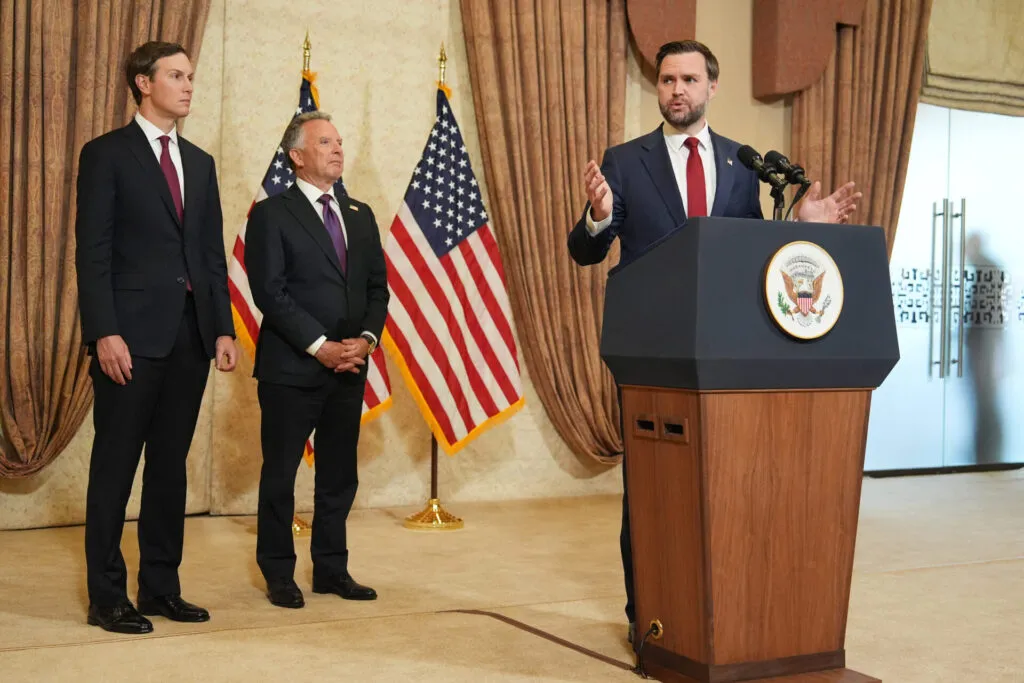 US Vice President JD Vance (right) speaks during a news conference after meeting with representatives from Pakistan and Iran, as US President Donald Trump's son-in-law Jared Kushner (left) and US Special Envoy to the Middle East Steve Witkoff (center) watch, in Islamabad on April 12, 2026. Iran and the United States failed to reach an agreement to end the war in the Middle East, US Vice President JD Vance said after marathon talks in Islamabad, adding that he was leaving negotiations after giving Tehran the United States' "final and best offer." (Credit: Photo by Jacquelyn Martin / AFP via Getty Images)
Listen to this article:
Listen to this article
--:--
This audio was generated using an automated voice. Learn more.
After more than 40 days of US-Israeli strikes on Iran and Iranian retaliation across the Middle East, Pakistan helped broker a fragile two-week ceasefire announced on April 7, alongside a temporary re-opening of the Strait of Hormuz and a promise of direct talks in Pakistan the following week. The ceasefire created just enough diplomatic space for the highest-level direct negotiations between the United States and Iran in recent memory.
But when the Islamabad talks collapsed after 21 hours of diplomacy on April 12, Washington almost immediately went back to coercion, with President Donald Trump threatening a blockade of Iranian ports and more strikes.
The fact that both sides agreed to talk, even momentarily, demonstrates their recognition that military escalation and economic coercion could very well spiral out of control and result in severe and unforeseen consequences.
After the talks, Vice President J.D. Vance said the United States’ core demand was an “affirmative commitment [that Iran] will not seek a nuclear weapon [and] will not seek the tools that would enable them to quickly achieve a nuclear weapon.” President Trump also clarified his anxiety, stating that “Iran is unwilling to give up its nuclear ambitions [and] they want to have nuclear weapons. It’s not going to happen.”
It is quite perplexing that a significant part of what Washington demands of Tehran has already been written into a treaty Iran signed a long time ago—the Nuclear Non-Proliferation Treaty (NPT), to which Iran is a non-nuclear-weapon state party since 1970. Although Tehran is to blame for Washington’s undermined confidence in the NPT, bombing Iran and issuing blockade threats won’t lead to a better non-proliferation arrangement. As state parties to the NPT will convene this month in New York for the treaty’s review conference, it’s about time to remind the Trump administration of the non-proliferation obligations Tehran already agreed to.
Existing obligations. The NPT strictly constrains Iran’s nuclear activities: Article II bars the acquisition of nuclear weapons, and Article III requires safeguards, limiting a state’s ability to “quickly achieve a nuclear weapon.” And even if Article IV affirms the rights of states to pursue the peaceful use of nuclear energy, it allows so only if that activity remains within the treaty’s non-proliferation obligations.
Of course, Washington has other demands that go beyond the NPT’s obligations. Although the US administration has not yet released its full 15-point list of demands, Washington has reportedly been asking for a package that includes missiles, regional proxy support, and freedom of navigation in the Strait of Hormuz. On the nuclear file, Washington demanded an end to uranium enrichment on Iranian soil, the dismantling of key sites such as Natanz, Isfahan, and Fordow, the handover of enriched-uranium stockpiles, and intrusive monitoring of Iran’s remaining nuclear facilities and material. Leaving aside Washington’s newer demands for zero enrichment and the elimination of Iran’s threshold capabilities, Washington is essentially asking for something remarkably similar to the 2015 Joint Comprehensive Plan of Action (JCPOA), which the first Trump administration walked away from in 2018.
Judging what both the president and vice president chose to articulate as their core demands in recent interviews, an affirmative commitment that Iran will not seek a nuclear weapon appears to be the ultimate red line for them.
But instead of pursuing those assurances through diplomacy, Washington has spent much of the past year bombing, hurrying its way through negotiations, and, at one especially reckless moment, threatening to end an entire civilization. That is a peculiar way to handle a problem whose legal baseline already exists in an existing treaty, even if the negotiations now turn on demands that go well beyond that baseline. It suggests that the US leadership has either forgotten about the existence of this treaty or that it does not believe the NPT and the safeguards system, meant to cement these assurances, can be trusted in practice.
A strained NPT. Later this month, diplomats will gather in New York City for the 11th Review Conference of the NPT, which opens on April 27. They will say, as they always do, that the treaty remains indispensable, that a rules-based non-proliferation order must be defended, and that confidence in the regime must be restored more urgently now than ever. And diplomats will be correct about all of that. But these declarations will still stop short of the heart of the matter.
The NPT regime is under strain because some of the states with the greatest stake in preserving it now behave as though they no longer trust the bargain on which it rests. There is also bitter irony in the fact that Pakistan, a nuclear-armed state outside the treaty, achieved what some of the treaty’s most powerful parties could not: It brought the United States (a depositary of the NPT) and Iran into the same room for nearly 24 hours of direct, high-level talks. That was no small diplomatic achievement, given that it had not happened for decades.
The opening Pakistan created proved to be painfully brief, and only points to the need for more systematic dialogue. But it is quite telling that even as the talks have collapsed, neither side has at least suggested that the upcoming month-long NPT Review Conference could serve as the backdrop for further talks between Washington and Tehran. How is it that this indispensable non-proliferation treaty is not even considered when the convenience it offers is so obvious?
Self-defeating strategy. To be fair, Iran has done much to undermine US confidence in the NPT. The International Atomic Energy Agency (IAEA) says Tehran stopped provisionally applying the NPT’s Additional Protocol (AP) in February 2021. The AP is an agreement that grants the IAEA expanded rights of access to information and sites to detect clandestine nuclear activities. It complements the standard NPT Safeguards Agreement by moving beyond verifying only declared nuclear material to ensure that there are no “undeclared” materials or facilities in a country. Since February 2021, Iran has not engaged the agency on unresolved safeguards issues as a way to pressure Washington to lift economic sanctions. And during the current reporting period, Iran did not provide access to any of Iran’s four declared enrichment facilities. Unless and until Iran implements the Additional Protocol, the agency says it cannot provide credible assurance about the absence of undeclared nuclear material and activities in Iran. More troubling still, because IAEA inspectors have not had access to those enrichment facilities, the agency says it cannot provide information on the current size, composition, or whereabouts of Iran’s enriched-uranium stockpile. And Iran has, recently and in the past, threatened to withdraw from the NPT altogether. These are serious failures, and they go to the heart of any workable non-proliferation US-Iranian arrangement.
Still, that is precisely why Washington’s present approach is so self-defeating.
If Washington’s goal is a credible assurance of Tehran’s permanent restraint, then bombing Iran and issuing blockade threats are remarkably strange ways to pursue it. Attacking nuclear facilities will not repair a damaged verification picture. It will only deepen the uncertainties around Iran’s nuclear activities. Likewise, threatening to block the Strait of Hormuz, which Iran already said it would respond to by blocking Bab al-Mandeb, the gateway into the Red Sea, would serve no nuclear non-proliferation objective and only result in Trump gambling with the global economy as collateral for not getting his way.
Washington’s actions have consistently narrowed the already fragile space for Iranian cooperation with IAEA inspections at the very moment when more visibility and more access are needed. But when Vance now says Iran must renounce not only the bomb but also the “tools” that would allow it to move quickly towards one—tools that reportedly include enrichment capacity, major nuclear facilities, and highly enriched uranium stockpiles—he is in effect describing the function the JCPOA once served, albeit in more maximalist form. That 2015 agreement was designed to lengthen breakout time, constrain enrichment, and make the restraint verifiable. The UN Security Council had endorsed that agreement, and Iran was complying with it until the first Trump administration unilaterally walked away from it in 2018.
The Trump administration’s Iran policy since June teaches a terrible lesson about nuclear proliferation: If Iran-style threshold nuclear latency does not protect against attack, if international safeguards do not shield declared nuclear facilities, and if coercion remains the answer even when diplomacy is attempted, some states may begin to conclude that only actual weaponization, not restraint, is what purchases security. That would be disastrous for the NPT system, but it is precisely the conclusion the present approach risks encouraging among some non-nuclear-weapon states.
Meeting the moment. No one should expect miracles at the next NPT Review Conference in New York. A tidy consensus final document may well prove beyond reach, as it has in recent review cycles. Still, the Review Conference remains one of the few places where the nuclear-weapon states and the non-nuclear majority are obliged to confront the same nuclear dangers under the same rules.
If governments use that setting seriously, rather than treating it as another pageant of set-piece statements, the conference can become the moment during which some of the slow work of repair begins. Such a work can start with a principle that has suddenly become brutally relevant: States parties should rally around the view that attacks on nuclear facilities under safeguards are unacceptable. IAEA Director General Rafael Grossi has repeatedly said that armed attacks on nuclear facilities “should never take place” because of the risk of grave consequences within and beyond the attacked state. What once felt like a recurring talking point now sits close to the center of the non-proliferation regime’s credibility.
A second task for the review conference is to bring the non-proliferation debate back within the bounds of treaty reality. Washington’s reported demand for zero enrichment may be the administration’s political preference—and even possibly its opening bid—but it is not an NPT requirement. The treaty prohibits the acquisition of nuclear weapons and requires safeguards compliance. That is why the argument over enrichment is so contentious: It sits at the intersection of Tehran’s claim to an Article IV right and Washington’s insistence that, under present conditions, no Iranian enrichment capacity is compatible with durable non-proliferation. The question before states parties is therefore a practical one: What kind of verification and restraint package could again make peaceful nuclear activity believable, enforceable, and politically sustainable?
A third task is to make better use of the conference’s margins, within which diplomacy is often more productive than on the main stage. Contact groups, structured side-processes, and interactive reporting mechanisms can create room for the kind of detailed discussion that plenary sessions often crowd out. The UN Institute for Disarmament Research has already laid out concrete options for interactive dialogue and reporting within the NPT process.
In a review cycle that too often slips into ritualized statements and familiar grievances, those mechanisms would offer something more valuable: They provide a way to test, in practical terms, what a post-war verification package might require. Washington is right to want strong non-proliferation guarantees from Iran. Many other states want the same. But for such guarantees to endure, Washington will have to treat the institutions and bargains that make them credible as something more than disposable tools. The NPT will still be there on paper when diplomats arrive in New York. Whether it can still function as a living bargain is the harder question, and one that states parties cannot afford to answer too late in a world increasingly tempted to seek assurance through military force rather than through rules and diplomacy.
Together, we make the world safer.
The Bulletin elevates expert voices above the noise. But as an independent nonprofit organization, our operations depend on the support of readers like you. Help us continue to deliver quality journalism that holds leaders accountable. Your support of our work at any level is important. In return, we promise our coverage will be understandable, influential, vigilant, solution-oriented, and fair-minded. Together we can make a difference.
Keywords: Additional Protocol, IAEA, Iran, Iran nuclear deal, Iran war, J.D. Vance, JCPOA, Joint Comprehensive Plan of Action (JCPOA), NPT, NPT Review Conference, NPT withdrawal, Nuclear Non-Proliferation Treaty, Pakistan, Trump administration, diplomacy, nuclear proliferation
Topics: Analysis, Nuclear Weapons

Olamide Samuel
Olamide Samuel leads network and engagement initiatives at Open Nuclear Network, a program of nonprofit organization PAX sapiens. He ... Read More








And when is Washington going to double-down on West Asia’s #1 nuclear proliferator?
That being the illegal and clandestine nuclear weapons program of the State of Israel.
That program has already produced deliverable nuclear weapons and posses a far more significant threat to world peace than any program Iran currently has.