Rethinking nuclear transparency: a European model for engaging China
By Francesca Giovannini | Analysis | June 4, 2026
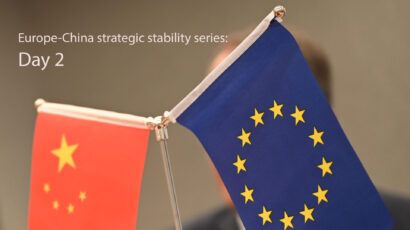
 26 May 2026, China, Peking: A Chinese and a European flag stand on a table. Photo: Johannes Neudecker/dpa (Photo by Johannes Neudecker/picture alliance via Getty Images)
Editor’s note: This article is is intended to be read alongside “Some thoughts on the issue of transparency in building trust between China and Europe.”
For decades, the United States and many of its Western and Asian allies have pressed Beijing to embrace greater transparency across multiple domains, including military modernization, strategic doctrine, and nuclear capabilities. Concerns regarding Chinese opacity long predate Xi Jinping’s rise to power and were already present in post–Cold War strategic dialogues and U.S. defense assessments during the 1990s and 2000s. However, these concerns intensified considerably under Xi Jinping as China accelerated the modernization and expansion of its military and nuclear forces while adopting a more assertive regional and global posture.
These anxieties have become especially acute in the nuclear domain, where the pace and scale of China’s modernization have fueled growing uncertainty regarding Beijing’s long-term strategic intentions. American diplomats, military officials, and nuclear experts have repeatedly asked their Chinese counterparts to clarify the drivers behind this buildup and to provide at least a broad sense of direction in China’s nuclear planning. Increasingly, Chinese official statements increasingly frame nuclear policy in terms of maintaining forces at the “minimum level required for national security,” rather than adhering to a fixed notion of “minimum credible deterrence.” This shift is consequential. By tying force requirements to an undefined and evolving assessment of national security needs, the concept of “minimum” becomes inherently elastic. Such elasticity permits both quantitative and qualitative expansion without requiring an explicit doctrinal revision, but at the cost of increased ambiguity for external observers.
What ought to be done?
The article argues that the road toward transparency—both within the Western political tradition and during the Cold War rivalry with the Soviet Union—was long, gradual, and deeply contingent. It further suggests that the tools developed during the US-Soviet experience cannot simply be replicated in the Chinese context. Instead, a different strategy may be required: one less centered on bilateral great-power bargaining and more focused on normative, procedural, and multilateral approaches capable of gradually opening limited but meaningful avenues for dialogue, risk reduction, and strategic reassurance. In this regard, the European experience may serve not only as a historical example of how transparency and confidence-building mechanisms evolved over time, but also as a potential catalyst for developing new frameworks of strategic engagement with China.
The evolution of transparency in the Western tradition: A complex and contingent process. In Western political thought, transparency emerged not only as a procedural mechanism but also as a moral and political aspiration—an antidote to tyranny, corruption, and unaccountable power. Enlightenment thinkers such as Immanuel Kant and Jean-Jacques Rousseau linked public reason, lawful conduct, and mutual consent to political legitimacy within societies and states. Their writings were primarily concerned with the relationship between rulers and citizens rather than with transparency between rival states in the modern strategic sense. Kant, in particular, argued that republican governance and the “publicity” of political conduct could contribute to more peaceful international relations by making state behavior more predictable and accountable, while Rousseau emphasized that legitimate political order depends upon forms of collective understanding and intelligibility within the political community.
Yet the relationship between liberal democratic thought and international transparency should not be overstated. While transparency gradually became associated within liberal democracies with accountability, public oversight, and constraints on arbitrary power, these principles did not translate straightforwardly into openness in foreign and security policy. Democratic states have historically maintained extensive systems of secrecy, often justified by the imperatives of national security and strategic competition. Even today, highly developed democracies such as the United States sustain vast classification systems that significantly limit public visibility into state conduct.
Nor did Enlightenment ideals immediately produce norms of interstate transparency. Nineteenth- and early twentieth-century diplomacy remained deeply rooted in secrecy, with alliances, military planning, and strategic commitments often deliberately concealed. There were, for example, no transparency or verification provisions in one of the first modern arms control agreements—the Rush-Bagot Treaty of 1817 between the United Kingdom and the United States following the War of 1812. In this sense, transparency is not as deeply rooted in the Western strategic tradition as is often assumed; rather, it is a comparatively recent and historically contingent development associated with the gradual consolidation of liberal democratic governance after 1945.
It was only after the catastrophic consequences of secret diplomacy—most notably in the lead-up to World War I—that transparency began to acquire a more central role in Western political and diplomatic thinking. The backlash against secrecy was captured in Woodrow Wilson’s call for “open covenants of peace, openly arrived at,” reflecting a growing belief that opacity had contributed to miscalculation and uncontrolled escalation. Over the course of the twentieth century, this impulse was progressively institutionalized within Western political systems through parliamentary oversight, a free press, and disclosure norms, embedding the principle that power must be visible in order to be constrained and held accountable.
The emergence of transparency as a principle of strategic stability, however, was not simply the direct extension of liberal political theory into international relations. Rather, it developed gradually and pragmatically in response to the dangers posed by industrialized warfare, great-power rivalry, and eventually the nuclear age. From this historically contingent evolution emerged the contemporary Western conviction that transparency can serve not only domestic governance but also international stability—however imperfect, partial, and conditional that transparency may be.
Particularly in the nuclear age, transparency came to be understood less as a universal moral good than as a practical mechanism for managing risk in an anarchic system. Information sharing—through notifications, official statements, or agreed reporting practices—can reduce uncertainty about others’ intentions and capabilities. While it does not eliminate rivalry, it can mitigate the risk that decisions are driven by worst-case assumptions. At the same time, transparency must remain calibrated: too little fuels fear and preemption, while too much risks exposing vulnerabilities. The challenge, therefore, lies not in maximizing transparency, but in defining forms of limited and purposeful disclosure that enhance credibility without undermining security.
Transparency is thus not only practical but also performative. By choosing to be seen, states signal alignment with openness, predictability, and rules-based conduct, distinguishing themselves from more opaque actors while reinforcing shared norms of responsible behavior. At the same time, transparency is relational and dynamic, unfolding as a gradual and reciprocal process in which each step builds upon the last. It often begins with relatively low-cost signals—public commitments, doctrinal statements, or declaratory policies—that clarify intent and make behavior more predictable. From there, modest forms of cooperation such as sharing standards, coordinating safety practices, or jointly responding to common challenges can build familiarity and routine interaction. Over time, transparency may evolve into more structured practices, including advance notifications, codes of conduct, regularized forums for dialogue, and institutionalized confidence-building measures, often reinforced by informal academic, professional, and cultural exchanges.
Adversarial transparency: How the Cold War operationalized transparency in strategic relations. While the Western political tradition had long treated transparency as a moral and political virtue, the nuclear age transformed certain forms of transparency into a strategic necessity. Yet this transformation did not produce a simple triumph of openness over secrecy. Instead, the Cold War generated two competing imperatives. On one hand, nonproliferation depended upon secrecy, restriction, and the tight control of sensitive nuclear knowledge. On the other hand, strategic stability between nuclear rivals increasingly depended upon selective transparency, predictability, and communication.
At the dawn of the nuclear era, secrecy remained the dominant instinct, even in democratic states. The United States codified this posture through the McMahon Atomic Energy Act of 1946, which sharply restricted the sharing of atomic-related information abroad. This framework reflected the belief that secrecy was essential both to preventing proliferation and to preserving strategic advantage. In this respect, opacity remained a foundational principle of the nuclear order, and many aspects of nuclear weapons design, operations, and intelligence continue to remain highly classified today.
Yet as the Cold War matured, policymakers in both Washington and Moscow gradually concluded that secrecy alone could not safely manage a rivalry defined by existential risks. Preventing deliberate or accidental nuclear war required a degree of mutual predictability. Selective forms of transparency—including hotline communications, launch notifications, arms control verification, and data exchanges—therefore emerged not as expressions of idealism, but as pragmatic instruments for reducing uncertainty, avoiding miscalculation, and stabilizing deterrence relationships.
Transparency between democratic allies differs fundamentally from transparency between geopolitical rivals. Within alliances, transparency may emerge from shared institutions, common political values, and expectations of mutual trust. Between adversaries, however, transparency has historically been driven less by liberal norms than by strategic necessity. Adversarial transparency refers to limited, selective, and often reciprocal forms of disclosure between geopolitical rivals intended not to eliminate competition, but to reduce uncertainty, manage escalation risks, and preserve strategic stability under conditions of enduring rivalry.
The first stabilizing measures of the Cold War did not primarily involve deep transparency regarding nuclear capabilities. Rather, they focused on crisis management and behavioral regulation. Mechanisms such as the Washington–Moscow hotline established after the Cuban Missile Crisis and the 1972 Incidents at Sea Agreement (INCSEA) sought to reduce the risks of accidental escalation by facilitating communication and establishing operational norms for military encounters. These arrangements did not require extensive disclosure of sensitive force structures or operational capabilities. Instead, they created procedural safeguards and predictable channels of interaction that helped manage confrontation without undermining deterrence.
More explicit forms of strategic transparency emerged only gradually. Beginning in the 1970s, measures such as advance notification of military exercises, data exchanges, and eventually verification mechanisms introduced more systematic forms of information sharing intended to reduce uncertainty regarding military activities and strategic intentions. These measures remained limited and carefully calibrated, reflecting the persistent tension between the stabilizing benefits of transparency and the enduring strategic value of secrecy. Crucially, they became politically sustainable because they were reciprocal, relatively low-cost, and reversible.
Technology opened a second pathway toward strategic stability. National technical means (NTM)—including satellites, radar systems, and signals intelligence—provided both superpowers with independent observation of nuclear activities. For the United States and its allies, NTM demonstrated that stability did not depend entirely on trust or intrusive access; visibility could also be technologically generated and independently verified. While imperfect, these monitoring capabilities established a baseline level of awareness that reduced uncertainty and mitigated worst-case assumptions.
At the same time, it is important to distinguish between transparency and surveillance. Much of the stability generated by national technical means during the Cold War did not result from voluntary disclosure, but rather from the growing ability of states to observe one another through technological surveillance. This was not transparency in the normative sense associated with openness or deliberate confidence-building. Rather, it reflected a form of enforced visibility produced by advances in intelligence collection. Strategic stability during the Cold War therefore emerged through a combination of intentional transparency measures and involuntary observation, with both contributing—through different mechanisms—to reducing the risks of surprise and miscalculation. This experience reinforced the Western conviction that transparency was stabilizing only if information could be independently verified.
Over time, procedural and observational tools laid the groundwork for more institutionalized forms of cooperative transparency. Arms control agreements incorporated these practices only gradually. Early agreements such as SALT I and SALT II relied primarily on national technical means of verification rather than on extensive voluntary disclosure. Crucially, however, they formally recognized the legitimacy of mutual observation by prohibiting interference with national technical means—a major step toward stabilizing strategic competition through predictable monitoring.
More intrusive and institutionalized forms of transparency emerged later. The 1987 INF Treaty introduced unprecedented on-site inspections and detailed data exchanges, while START I further expanded transparency through telemetry sharing, declarations, and verification procedures. Over time, these mechanisms normalized the idea that carefully calibrated transparency could strengthen deterrence stability by reducing uncertainty without eliminating strategic competition.
Political leadership also mattered. Figures such as Ronald Reagan and Mikhail Gorbachev accelerated acceptance of deeper transparency commitments once basic trust and technical verification mechanisms had been established. At the same time, international organizations, academic forums, and scientific exchanges helped lower political friction and sustain dialogue across ideological divides. By the late Cold War, transparency had come to be viewed not as a concession to adversaries, but as a stabilizing practice capable of serving both strategic and political ends.
Contemporary Western approaches to strategic transparency should therefore be understood less as the straightforward externalization of liberal democratic principles than as historically contingent responses to the dangers of nuclear competition. Strategic transparency emerged not from trust, but from the recognition that unmanaged opacity between nuclear adversaries could itself become destabilizing. This distinction is particularly important in understanding why non-Western states, including China, may not necessarily interpret transparency through the same normative lens often assumed in Western strategic discourse.
Asymmetric transparency: China and the limits of the Cold War model. The lessons Western strategists drew from the Cold War regarding transparency have found only limited traction in China. Despite decades of dialogue with the United States and its allies, much of Beijing’s nuclear posture remains deliberately opaque. Its force structure, doctrine, and command-and-control arrangements are tightly concealed, while official statements reveal only carefully curated aspects of Chinese nuclear policy. Strategic ambiguity is therefore not incidental but a central—though not exclusive—feature of Beijing’s deterrence strategy. By maintaining uncertainty regarding capabilities, thresholds, and operational practices, China seeks to offset perceived technological inferiority, complicate adversary planning, preserve survivability, and retain flexibility during crises.
Unlike the Soviet Union during the later Cold War, China has generated relatively few public doctrinal debates, semi-authoritative disclosures, or institutionalized transparency initiatives that might allow external observers to infer the evolution of its nuclear thinking. As Beijing expands its arsenal and deploys new delivery systems, international concern has grown. Yet Cold War–style calls for numerical disclosures, formal arms-control negotiations, or extensive data exchanges have gained little traction.
One reason is that China’s current posture resembles earlier phases of Soviet practice more than the later Cold War experience often invoked in Western debates. Before the institutionalization of arms control, the Soviet Union also relied heavily on opacity, controlled signaling, and carefully managed communication with external audiences. It was only after decades of rivalry, repeated crises, and the gradual maturation of strategic parity that Moscow increasingly accepted reciprocal inspections, verification regimes, and structured data exchanges as tools for stabilizing competition with Washington.
China today appears closer to this earlier phase. It relies heavily on what might be described as performative communication: white papers, official speeches, military parades, and declaratory policies that project images of strength and restraint while revealing relatively little about operational realities. Such ambiguity may serve important short-term strategic purposes. Yet as capabilities expand and interactions intensify, persistent opacity can also heighten the risk of miscalculation, particularly during crises where uncertainty tends to harden into worst-case assumptions and accelerate escalation dynamics.
At the same time, China’s approach to transparency reflects not only strategic calculation but also deeper institutional and ideological traditions. The Chinese Communist Party remains profoundly shaped by Leninist political logic, in which information is treated instrumentally rather than normatively. Within this framework, transparency and opacity are not moral categories but strategic tools to be deployed selectively in pursuit of political objectives. A Leninist system, built upon assumptions of enduring competition and zero-sum struggle, tends naturally toward caution regarding disclosure and external scrutiny. In this sense, opacity is not merely a feature of Chinese nuclear strategy but part of a broader conception of political control and governance.
Strategic thinking within the People’s Liberation Army has also been influenced by the concept of “asymmetric transparency” (不对称的透明度). According to this logic, weaker powers benefit from remaining less transparent because uncertainty encourages stronger adversaries to exercise caution and potentially overestimate hidden capabilities. From Beijing’s perspective, ambiguity may therefore enhance deterrence by complicating adversary planning and reinforcing survivability under conditions of asymmetry vis-à-vis the United States.
This logic helps explain China’s longstanding reluctance toward extensive disclosure and formalized transparency arrangements. Chinese officials frequently emphasize that China’s nuclear forces remain at the “minimum level required for national security” and argue that Beijing neither seeks parity with the United States nor intends to participate in a nuclear arms race. From this perspective, demands for trilateral arms-control negotiations or Cold War–style transparency measures appear unfair and strategically asymmetrical, particularly given the much larger U.S. and Russian arsenals.
At the same time, the logic of asymmetric transparency contains important limitations. Efforts to preserve ambiguity may induce caution in the short term, but they can also intensify security dilemma dynamics by encouraging adversaries to assume worst-case scenarios and expand their own capabilities accordingly. Persistent opacity may therefore produce the opposite of restraint, accelerating arms competition rather than moderating it. Moreover, the concept assumes a relatively static hierarchy of power, even though China simultaneously occupies positions of both relative weakness and growing strength across different strategic relationships.
Importantly, opacity should not be equated with invisibility. Historically, China’s smaller and more mobile nuclear arsenal facilitated concealment and survivability. Yet advances in satellite surveillance, remote sensing, commercial imagery, cyber capabilities, and open-source intelligence have dramatically increased external visibility into Chinese nuclear developments, even in the absence of voluntary disclosure. As China’s arsenal expands in size, diversity, and infrastructural footprint, maintaining traditional forms of opacity may become progressively more difficult and potentially less advantageous.
Institutional pathways also differ from the late Soviet experience. Although the Soviet military-industrial complex remained highly secretive, arms-control diplomacy gradually socialized Soviet negotiators, scientists, and officials into repeated interaction with Western counterparts and verification practices. China has engaged selectively in international agreements containing transparency elements—including the Comprehensive Nuclear-Test-Ban Treaty and confidence-building arrangements such as the Code for Unplanned Encounters at Sea—but these engagements have not generated the same degree of routinized interaction or institutionalized verification culture.
The People’s Liberation Army remains firmly embedded within Communist Party structures, with limited civilian oversight and relatively constrained engagement with external interlocutors on nuclear matters. Academic and scientific work related to nuclear strategy is also subject to extensive political oversight and censorship. In this respect, China is not unique; similar dynamics characterized the Soviet Union for much of the Cold War. Yet in the Chinese case these institutional patterns continue to coexist with strong perceptions of strategic vulnerability, reinforcing caution toward deeper transparency commitments.
The broader international environment further complicates matters. The Soviet Union operated within a largely bipolar system in which strategic negotiation with Washington became unavoidable. China, by contrast, functions within a more diffuse and increasingly multipolar environment involving simultaneous relationships with the United States, Russia, India, and regional actors across the Indo-Pacific. Under these conditions, bilateral transparency with Washington may appear to Beijing as strategically risky, potentially exposing vulnerabilities across multiple fronts and altering other regional balances.
For these reasons, contemporary Chinese opacity should not simply be interpreted as evidence of cultural exceptionalism or irrational resistance to transparency. Rather, it reflects a historically and strategically specific combination of Leninist political traditions, institutional incentives, perceptions of asymmetry, technological vulnerability, and evolving great-power competition. Whereas Cold War transparency emerged gradually from conditions of mutual vulnerability and strategic parity, the contemporary U.S.-China relationship remains at a much earlier and more asymmetrical stage of development. The result is not the absence of transparency altogether, but rather a different and more uneven model: one shaped by selective disclosure, strategic ambiguity, technological surveillance, and competing understandings of what stability itself requires.
Embedded transparency: Europe’s experiment in transparency at the regional level
Europe is undeniably the junior partner in the broader US–China relationship, and whether it can genuinely serve as a bridge builder remains uncertain. Internal divisions among European states regarding how best to engage China complicate any unified strategic approach. Yet in the specific domain of transparency and risk reduction, Europe possesses a long and distinctive historical experience that may still offer relevant lessons. Europe cannot compel China to become more transparent, nor can it replicate the Cold War arms-control model in Asia. It may, however, help shape conditions under which limited forms of transparency become less politically threatening and more strategically acceptable.
Europe and China, despite their significant differences, also share several interests that create space for pragmatic engagement. Both favor a relatively stable international order with predictable rules governing trade, finance, and diplomacy. Both maintain strong traditions of educational, scientific, and cultural exchange that sustain long-term channels of interaction beyond immediate geopolitical competition. In addition, both increasingly compete for influence across the Global South through infrastructure investment, development assistance, climate cooperation, and public-health initiatives. These overlapping interests do not eliminate strategic rivalry, but they create areas where dialogue and confidence-building may remain politically feasible.
Europe also brings a distinctive institutional experience regarding transparency as a mechanism of governance and stability. Following World War II, the European Coal and Steel Community pioneered a deliberately transparent model of integration by pooling oversight of strategic industries in ways designed to make national intentions visible and mutually accountable. Yet Europe’s most important lessons regarding strategic transparency emerged from its long and often fraught relationship with the Soviet Union and later Russia.
During the Cold War, European states recognized that they occupied the front line of superpower confrontation, where even limited misunderstandings risked catastrophic escalation. Out of this vulnerability emerged sustained support for structured forms of openness intended to reduce uncertainty and create greater predictability in military affairs. The Conference on Security and Cooperation in Europe (CSCE) represented an important turning point. Its Helsinki Final Act of 1975 introduced confidence- and security-building measures that later evolved into the 1990 Vienna Document, still one of the most important frameworks for conventional military transparency.
The Vienna framework institutionalized advance notification of major military exercises, annual exchanges of military information, and on-site inspections. These measures did not eliminate rivalry or mistrust, but they made military behavior more legible and helped reduce the risks of surprise, accidental escalation, and worst-case assumptions. Importantly, many of these arrangements emerged not because adversaries trusted one another, but precisely because they did not.
The broader European security environment also helped reinforce the political importance of verification practices associated with U.S.–Soviet arms control. Although major nuclear agreements were negotiated primarily between Washington and Moscow, alliance cohesion and European security concerns strengthened support for effective monitoring and confidence-building mechanisms. European NATO members became active participants in verification regimes, ranging from short-notice inspections under the INF Treaty to cooperative aerial observation under the Open Skies Treaty.
These experiences demonstrated that intrusive verification and structured transparency could become politically sustainable even between adversaries characterized by deep mistrust. They also showed that institutionalized transparency mechanisms can survive periods of significant political deterioration. Although many Cold War arms-control arrangements have weakened or collapsed in recent years, some narrowly focused measures—such as ballistic missile launch notification agreements and military communication channels—continue to function despite broader geopolitical breakdowns.
For Europe, the experience of managing relations with Russia generated two enduring lessons. First, modest but regularized measures—notifications, inspections, data exchanges, and military communication procedures—can meaningfully reduce uncertainty even in the absence of political trust. Second, once institutionalized, certain transparency and confidence-building arrangements can preserve limited channels of communication during periods of intense confrontation.
These lessons increasingly shape European discussions regarding whether similar approaches might eventually be adapted to the challenge of engaging China. Such adaptation, however, would require substantial modification. The Indo-Pacific differs fundamentally from Cold War Europe: the regional balance is more multipolar, China’s nuclear posture remains smaller and more opaque, and strategic competition extends across conventional, nuclear, technological, cyber, maritime, and economic domains simultaneously.
For this reason, Europe’s role is unlikely to center on promoting large-scale arms-control agreements or demanding extensive disclosure of Chinese capabilities. A more realistic approach would focus on narrower forms of cooperative risk reduction and procedural transparency. These could include regional launch-notification arrangements, military crisis-communication protocols, air and maritime incident-management procedures, or Track 1.5 dialogues on nuclear doctrine, escalation management, artificial intelligence, and strategic stability.
Europe may also possess a comparative advantage as a convener rather than as a principal strategic actor. France in particular—and, to a lesser extent, the United Kingdom—maintains direct strategic and territorial interests in the Indo-Pacific, while the European Union has increasingly emphasized de-risking, multilateral governance, and institutional engagement rather than overt military balancing. This positioning may allow European actors to support conversations that appear less directly tied to coercive competition between Washington and Beijing.
None of this guarantees success. China may continue to view many transparency initiatives with suspicion, particularly if they appear embedded within broader U.S.-led balancing strategies. Moreover, Europe itself lacks strategic unity regarding China policy. Nonetheless, the European experience demonstrates that transparency does not emerge suddenly through trust or moral convergence. Rather, it develops gradually, selectively, and often under conditions of deep rivalry. In this sense, Europe’s greatest contribution may not lie in exporting a ready-made model, but in demonstrating that even limited, procedural, and carefully calibrated forms of transparency can help manage competition before crises become unmanageable.
Building Transparency: What role can Europe play with China? Europe is uniquely positioned to think about transparency through a regional rather than purely bilateral lens. Unlike the United States, which often approaches transparency primarily through the framework of strategic competition with China, Europe’s security order evolved through multilateral mechanisms designed to manage rivalry. From postwar integration and the European Coal and Steel Community to the CSCE process, the Vienna Document, and NATO–Russia confidence-building measures, European security developed through efforts to institutionalize predictability among competitors. This experience gives Europe a comparative advantage: it can frame transparency not as a unilateral concession, but as a shared tool for managing risk under conditions of enduring competition.
A regional approach also reflects the realities of China’s security environment. Beijing’s nuclear posture is shaped not only by competition with the United States, but also by dynamics in its immediate neighborhood. US alliances in East Asia, Taiwan, regional missile deployments, and India’s nuclear capabilities all influence Chinese threat perceptions and force planning. At the same time, concerns about U.S. counterforce capabilities, missile defense, and long-range conventional strike remain central to Chinese assessments of strategic vulnerability. Situating transparency within this broader regional context therefore makes it more concrete and more directly connected to immediate escalation risks.
Europe’s relative distance from Pacific alliance structures may further strengthen its position. Although France and, to a lesser extent, the United Kingdom possess important Indo-Pacific interests, Europe is generally not viewed in Beijing as a primary military rival in the same way as the United States. This creates space for European actors to function less as coercive balancers and more as conveners able to share institutional lessons on confidence-building and crisis management.
Any European effort would nonetheless face important constraints. China remains wary of initiatives that appear embedded within U.S.-led balancing coalitions or designed to constrain Chinese capabilities. From Beijing’s perspective, regional transparency frameworks can easily resemble instruments of strategic encirclement. Yet China’s record on multilateral engagement is more nuanced than outright rejection. Although Beijing has resisted bilateral arms-control negotiations modeled on U.S.-Soviet parity, it has participated—sometimes reluctantly—in mechanisms such as the P5 process, the Comprehensive Nuclear-Test-Ban Treaty framework, and regional confidence-building arrangements.
There are also precedents for China engaging with European-style confidence-building measures. During the 1990s, Beijing negotiated military confidence-building agreements with Russia and several Central Asian states, drawing in part on concepts adapted from earlier NATO–Soviet arrangements. Chinese officials themselves acknowledged the need to translate and internalize these concepts within both the PLA and the Foreign Ministry. This history suggests that China is not categorically opposed to transparency mechanisms. Rather, it is selective about the political conditions under which they are introduced.
One major obstacle remains China’s enduring embrace of “asymmetric transparency.” Many Chinese strategists argue that opacity benefits weaker powers because uncertainty encourages stronger adversaries to act cautiously and potentially overestimate hidden capabilities. Yet this logic often assumes a single strategic relationship centered on the United States. It pays less attention to the fact that China itself occupies different positions of strength and vulnerability vis-à-vis neighboring states. Encouraging forms of “strategic empathy”—recognition that opacity can also generate insecurity and worst-case assumptions among others—may therefore provide a useful starting point for regional dialogue.
In this context, Europe’s role may be less about promoting formal arms control than about reframing transparency as a process of regional learning and practical risk reduction. European initiatives could emphasize gradual confidence-building, inclusive participation, and operational safety rather than intrusive verification or numerical disclosure requirements. This matters because China has historically responded more positively to ideas advanced by actors perceived as relatively neutral, or by broader coalitions that include Global South states. Europe could therefore contribute not only by engaging China directly, but also by facilitating wider Indo-Pacific discussions on strategic stability and crisis management.
A practical agenda would likely focus on procedural rather than quantitative transparency. Notification regimes for missile tests and major military exercises—loosely modeled on the Vienna Document or the Hague Code of Conduct—could provide advance warning without requiring disclosure of sensitive capabilities. Additional measures might include regional incidents-at-sea agreements, air and space safety protocols, standardized communication procedures, and multilateralized hotlines designed to reduce escalation risks during military encounters.
Track 1.5 and Track 2 dialogues could reinforce these efforts by developing common terminology, crisis lexicons, and scenario-based exercises focused on escalation management. Rather than seeking doctrinal convergence, such dialogues would aim to normalize habits of communication and strategic reassurance. Discussions on early warning systems, ISR practices, missile defense, and escalation risks could help clarify intentions while preserving the degree of ambiguity states continue to view as necessary.
Emerging technologies may provide particularly promising areas for cooperation. Debates over lethal autonomous weapons systems have often stalled because states perceive AI-enabled conventional capabilities as strategically advantageous. The nuclear domain introduces a different logic. AI integration into nuclear command-and-control systems, escalation assessment, and launch decision-making creates shared risks of false positives, automation bias, compressed decision timelines, and inadvertent escalation. These dangers are potentially mutual and catastrophic.
For this reason, AI and nuclear decision-making may offer a comparatively more productive entry point for limited transparency and risk-reduction measures. Both Washington and Beijing share a strong interest in preventing accidental nuclear escalation despite broader geopolitical rivalry. Discussions on maintaining meaningful human control over nuclear launch decisions, the role of AI in early warning systems, and the risks associated with automated escalation could therefore provide politically feasible avenues for dialogue.
Several prototype initiatives could operationalize these ideas. A “Western Pacific Launch and Exercise Notification Compact” could establish voluntary advance notification procedures for missile tests and large-scale military exercises. An “Indo-Pacific Incidents-at-Sea and Air Safety Protocol” could standardize operational phraseology, intercept procedures, and post-incident communication mechanisms. A “Regional Crisis Communications Network and Lexicon” could improve the usability of hotlines by harmonizing terminology and escalation-management procedures across regional actors. Similarly, an “AI-in-Warning Safety Pledge” could create a nonintrusive framework for discussing the role of AI in nuclear warning and launch systems while encouraging technical exchanges among experts.
Such proposals would not emerge in an institutional vacuum. Existing U.S.-China arrangements on maritime and air safety already provide limited precedents for operational risk reduction, even if implementation remains uneven. Europe’s contribution would therefore not be to invent transparency from scratch, but to adapt lessons drawn from its own experience of managing rivalry, institutionalizing predictability, and reducing risks without requiring deep political trust.
Ultimately, Europe’s role is likely to remain limited but still meaningful. Transparency in the Indo-Pacific will not emerge through moral appeals or assumptions of political convergence. As Europe’s own history demonstrates, transparency develops gradually, selectively, and often under conditions of deep mistrust. Europe cannot eliminate U.S.-China rivalry, nor can it recreate the Cold War arms-control architecture in Asia. What it may be able to do, however, is encourage limited, regional, and functionally oriented forms of cooperative risk reduction before competition hardens into unmanaged confrontation.
Transparency reimagined. Transparency between China and the West will not emerge from Cold War formulas of parity and counting warheads. It is constrained by China’s strategic culture, asymmetries of power, and deep political mistrust. Yet this does not mean transparency is impossible—it means it must be reimagined. Europe, with its history of regional confidence-building and its relative distance from Pacific rivalries, is uniquely positioned to pioneer this rethinking.
By promoting flexible, inclusive, and regionally grounded mechanisms, Europe can turn transparency from a zero-sum demand into a shared tool of crisis management. The task is not to force China into premature disclosures, but to create habits of communication and predictability that make escalation less likely. If pursued with patience and creativity, a European-led approach could help reshape global nuclear norms and quietly reduce the risks of catastrophe in the 21st century.
Together, we make the world safer.
The Bulletin elevates expert voices above the noise. But as an independent nonprofit organization, our operations depend on the support of readers like you. Help us continue to deliver quality journalism that holds leaders accountable. Your support of our work at any level is important. In return, we promise our coverage will be understandable, influential, vigilant, solution-oriented, and fair-minded. Together we can make a difference.
Keywords: China, Europe, series, strategic stability
Topics: Analysis, Nuclear Risk
Get alerts about this thread
0 Comments
Oldest

Francesca Giovannini
Francesca Giovannini is the executive director of the Project on Managing the Atom at the Harvard Kennedy School's Belfer Center for Science & ... Read More