The church steps into the AI debate: What the Pope’s first encyclical means
By Sara Goudarzi | Interview | June 2, 2026
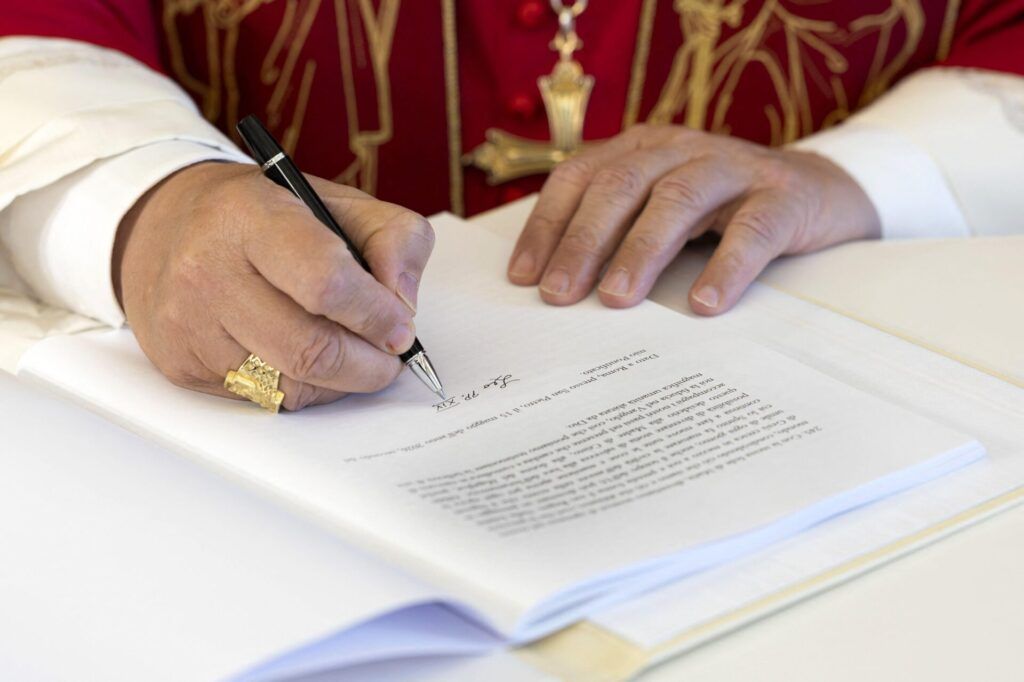 The Pope signed Magnifica Humanitas on May 15th, the anniversary of the landmark Rerum Novarum encyclical by his namesake Pope Leo XIII 135 years earlier. Photo: Alamy / Abaca Press
On May 25, Pope Leo XIV publicly presented his first encyclical, or official letter used to impart papal messages, titled Magnifica Humanitas (or Magnificent Humanity). The nearly 42,000-word document focused on the challenges posed by artificial intelligence, a transforming technology that, in the Pope’s view, needs to be “disarmed.” In the document, the Pope called for regulation of AI, which is currently benefiting a small elite while exposing the public to its risks. “In a world where data, computational resources, and regulatory influence remain in the hands of a few, to speak of the common good means exposing this new form of epistemic, economic, and political asymmetry and naming the new monopolies of AI.”
The Pope signed Magnifica Humanitas on May 15th, the anniversary of the landmark Rerum Novarum encyclical by his namesake Pope Leo XIII, 135 years earlier, which was a response to the Industrial Revolution. The timing of the current Pope’s encyclical echoes the moral urgency expressed by his predecessor, who “addressed the needs of the working class and helped kindle a social justice movement.”
To better understand the significance of Magnifica Humanitas, I spoke to Ilia Delio, a Franciscan Sister of Washington, D.C., and the Josephine C. Connelly Endowed Chair in Theology at Villanova University.
The resulting discussion has been edited and condensed for length and clarity.
Sara Goudarzi: Can you talk about the timing and significance of Pope Leo’s first encyclical, in which he has chosen AI governance as the subject? Is that a sign of where the church thinks power resides and that it needs challenging?
Ilia Delio: The Pope has been very concerned at the way artificial intelligence has invaded every aspect of our lives and may be distorting human values and changing our sense of human identity. So, for the church to respond to AI is very appropriate since the incarnation is central to what we’re about. The human person holds a special dignity within this theology, and I think it’s good timing. AI has been developing at a very rapid pace, and we don’t know why we’re doing what we’re doing, and where we’re going with it.
Goudarzi: What are some of the key takeaways from the document?
Delio: I think the Pope is stating that technology is never neutral, that those who design, finance, and use it are bringing a set of values or desires with that. And it’s always been a question: Who’s shaping our lives? Because it seems the coders are. So, I think Pope realizes that AI has encoded in it a vision for humanity, and the question is: Is this the vision we want, one that’s best for the flourishing of humanity, or for the good of the Earth?
AI holds tremendous power today, and this is a deep concern, not only for the Pope, but for many people. A few years ago, Sigal Samuel at Vox wrote an article, The case for slowing down AI. I teach in this area, so I use that article for my class, and it’s interesting to see how young people are deeply concerned with the rapid interjection of AI into every aspect of our lives. I’m not sure we can slow it down, but I do think his concern is a good one, it’s a genuine one. I’m not sure his solution is the right one. I would differ with the Pope on how we understand the human-AI relationship today, but that it is as much a theological concern as an anthropological one.
Goudarzi: How does your view and solution differ from the Pope?
Delio: His emphasis is on—as the title [of the encyclical] suggests—the magnificent human. I take issue with the title, quite honestly, because we’re not really magnificent. We can be magnificent, but we’re not always magnificent.
I think the human person is a very ambivalent creature, and the one thing that the Pope does not recognize is that technology and evolution always belong together. Nature by itself is creative, it’s tool making. We have this idea that we’ve made these incredible computers, and it seems to be something very distinctive of the human. Well, not really. Technology has always been what nature does in the face of limits, when the environment seems to be breaking down.
If you look at AI, it emerged during the 20th century, a very violent century, right on the heels of the Korean War and World War II. So, built into AI is more than just tool-making for our use. There’s a deep philosophical concern that we humans need to find a way to think in a different way, to extend our minds, to see from a different—a higher and maybe wider—vantage point. So, I think the interpretation of transhumanism and posthumanism is too narrow.
He’s right that these are philosophical movements that, taken in the extreme, can place us in [a position where] we’re just sort of a thing in the making. But the human person is never finished: That’s what evolution tells us. We’re always creating ourselves. So, transhumanism wants to surpass the human limits, of the biological limits of death and suffering. In the extreme, that can seem radical, but in another way, that’s exactly what we do. That drive for perfectibility is sort of written into human evolution.
The other thing is that posthumanism, we’re already cyborgs. So, is trying to remain human possible? Because we’re already past the individual human we knew 100 years ago. Since the ‘60s, we have become increasingly cyborgized, not only the extended self into our devices, but everything from eyeglasses to hearing aids to pacemakers are all hybrids of mechanical biological life. And posthuman life is about thinking of that cyborgian life or machinic interaction as a new matrix for human becoming. It resituates the individual within this web of relationships, including machine relationships. That is part of the next wave of human evolution.
The reading on those two movements is too narrow in the encyclical. I agree with the Pope about not using AI in an immoral way, like the use of drone warfare to kill innocent lives. Surveillance can also have deep-seated issues to it. And whenever we’re using AI for the benefit of financial gain or power—two things that are associated with AI—we’re on a slippery slope. We’re misusing the very tools we’ve created to enhance our lives.
Goudarzi: The pope signed the document on May 15, the 135th anniversary of Rerum Novarum, Pope Leo XIII’s landmark response to the Industrial Revolution. The timing and parallel seem deliberate. Why do you think the Pope did this, meaning how does he want the document to be read?
Delio: It goes back to safeguarding human dignity and the right to work. He’s acknowledging that every single person has a right to basic human needs, to work, to earn a living, and that these rights are being displaced by AI. Today, anyone going into the workforce is competing with artificial intelligence and robots. We know that the human workforce is changing and will significantly change within the next five to 10 years, that jobs will be eliminated, that they will be increasingly mechanized. That is a huge concern, because the question is: Are we creating a greater wealth gap? Because those who own the companies that make those machines will become increasingly rich, while those who cannot get work will become increasingly poor. So, is AI really leveling out the playing field for humans, or is it widening the gap between the rich and the poor, between the haves and the have-nots, where again the human is considered collateral damage?
So, to answer your question: Yes, he did do that deliberately, because I think he’s deeply concerned that the value of human life, human dignity, and human worth will be completely flattened out or just annihilated with AI.
Goudarzi: The pope chose to present the Magnifica Humanitas alongside Christopher Olah, billionaire co-founder of Anthropic. What do you think of this choice? Does it risk giving the industry moral legitimacy? And how does that square with the warning in the document about concentrating power in the hands of a few?
Delio: Honestly, that move made me suspect. First of all, Olah considers himself an atheist. The Pope’s concerns come out of a deep Christian theology. I did find Anthropic is concerned about moral and philosophical values and questions: They built a whole team of philosophers and ethicists for building their AI. But on the other hand, they just signed a multibillion-dollar contract with Google. So, I wondered, did Anthropic do this because it could boost their sales? Do they see something in it for themselves?
Goudarzi: I guess my question is: What did the Pope see in having Olah there?
Delio: I think for the Pope, [it was a way of implying] “look, everything I’m saying here is now being vindicated by this major AI company and needs to be taken seriously.”
Anthropic is the only company [that’s seemingly concerned]. I haven’t seen anything from Nvidia or any of the chip makers or Google or even Microsoft. So, I would imagine that not every major company shares these concerns. But I too am concerned by their incredible wealth. These are trillion-dollar companies. That kind of excess wealth—when a third of the planet lacks water and necessities—is really questionable. And the fact is every single person condones this wealth, because we’re all buying into it, we’re making this wealth possible for these companies, is something that’s not being addressed. That may be the bigger issue that the Pope really doesn’t get at in his encyclical.
Goudarzi: How effective do you think the encyclical will be?
Delio: Not a single thing will change. The train left the station quite a while ago now and it’s quickly speeding ahead into the future. Ray Kurtzweil posited the singularity, or complete merger between technology and machine, will arrive around 2045. Well, that’s less than 20 years away. So, thinking that we’re going to slow down AI and level out the playing field for humans is a little bit idealistic for me.
We have to deal with the concrete reality of where we are with it today, and the better questions to ask is: How are we here; why are we here; what drove us to be here? Technology and ecology were two movements that basically emerged in the ‘60s, but technology has taken off like a gazelle, and ecology is like a slow turtle. So, there’s something about technology that just sweeps us in its midst, whereas ecology is very nice, we’re concerned, but we’re not driven by it.
I don’t think [AI] will slow down. In fact, if anything, it’s speeding up. Technology advances at an exponential rate, basically every two years. Chip power doubles or triples and probably will quadruple with quantum computing. So, I don’t think this encyclical is really going to be helpful to us. Actually, what it’s going to do is create more confusion, especially for the faithful, because now everyone’s going to be like the Pope said we need to slow down. So, people are going to have a hard time making decisions: “Do I advance with AI, or do I oppose it?”
The Pope’s concerns are right, but I don’t think the solution is right, so we have to find a better way to figure out what distinguishes the human person, what’s worth preserving, and what part of us creatively seeks to advance, and how best to do so.
Goudarzi: Pope Leo has a degree in mathematics. Do you think that background gives him a different grasp of this technology compared to the lawmakers and regulators who seem to struggle to get their heads around it, and if so, does that make the church a more credible voice on the specifics of regulation, instead of just making a moral case for it?
Delio: I think having a degree in mathematics allows the Pope to be more sympathetic to structures of relationship. I do not see AI as a mathematical question, it’s an information question. So, I don’t know if having a degree in mathematics makes a significant difference here. For example, if one studied information theory, one would know that the types of relationships with AI today are cybernetic. I don’t see any kind of inkling that his background in mathematics plays out in understanding the types of relationships that are being formed through AI.
Goudarzi: I meant that more in terms of critical thinking skills and understanding of the sciences.
Delio: That the encyclical doesn’t really favor that is the downfall of it. It doesn’t attend to the sciences at all. In fact, if you look at the references, there’s not a single reference to any contemporary writer in technology, basic physics, or mathematics. The references are to Augustine, Thomas Aquinas, and Saint de Bérulle—all classic. And I’m thinking to myself, what sources did you use here to gain insight into these matters? There’s a wide, wide scope of literature in this area that’s been going on for 40 years or more. So, not to take note of that is a little bit concerning.
Is he a critical thinker? I can’t say based on this encyclical. The encyclical is largely about Catholic social teaching, highlighting the kind of the principles of Catholic social justice, which are the seven principles of dignity and right to work. But I don’t see significant signs of someone who has a clear understanding of the science, of what’s going on here, and kind of the way science itself calls us into new ways of thinking about who and what we are and therefore making and building. One of the principles of evolution is creativity and novelty.
It’s a deeply thoughtful document. I think he spent a lot of time talking to people and reflecting on these matters, so I see a genuine concern for the human person and human welfare today, and deep concern about the future of the human person.
Goudarzi: Is there anything that you’d like to add?
Delio: There’s a lot in this document—it’s very long for an encyclical, but I think the basic line to remain is asking: How can we remain human in an AI world? And the question, if we take evolution seriously, must be: How can we become human in an AI world?
Together, we make the world safer.
The Bulletin elevates expert voices above the noise. But as an independent nonprofit organization, our operations depend on the support of readers like you. Help us continue to deliver quality journalism that holds leaders accountable. Your support of our work at any level is important. In return, we promise our coverage will be understandable, influential, vigilant, solution-oriented, and fair-minded. Together we can make a difference.
Keywords: AI, Anthropic, Church, Industrial Revolution, Microsoft, NVIDIA, OpenAI, Pope Leo, The Pope, Vatican, artificial intelligence, encyclical
Topics: Artificial Intelligence, Disruptive Technologies

Sara Goudarzi
Sara Goudarzi is an associate editor at the Bulletin of the Atomic Scientists. Her work has appeared in Scientific American, The New York Times, ... Read More











” Technology has always been what nature does in the face of limits, when the environment seems to be breaking down.”
I’ve read that a dozen times and can make no sense of it. What is she presupposing?
I’d love to talk with her about that.
Fascinating piece, but I don’t think either she or her pope really get it. She does get points for her interest and reading in the topic.