AI is changing biological and nuclear risks; governance must change accordingly
By Stephen Herzog, Allison Berke, Yanliang Pan, William C. Potter, Douglas B. Shaw | Analysis | June 18, 2026
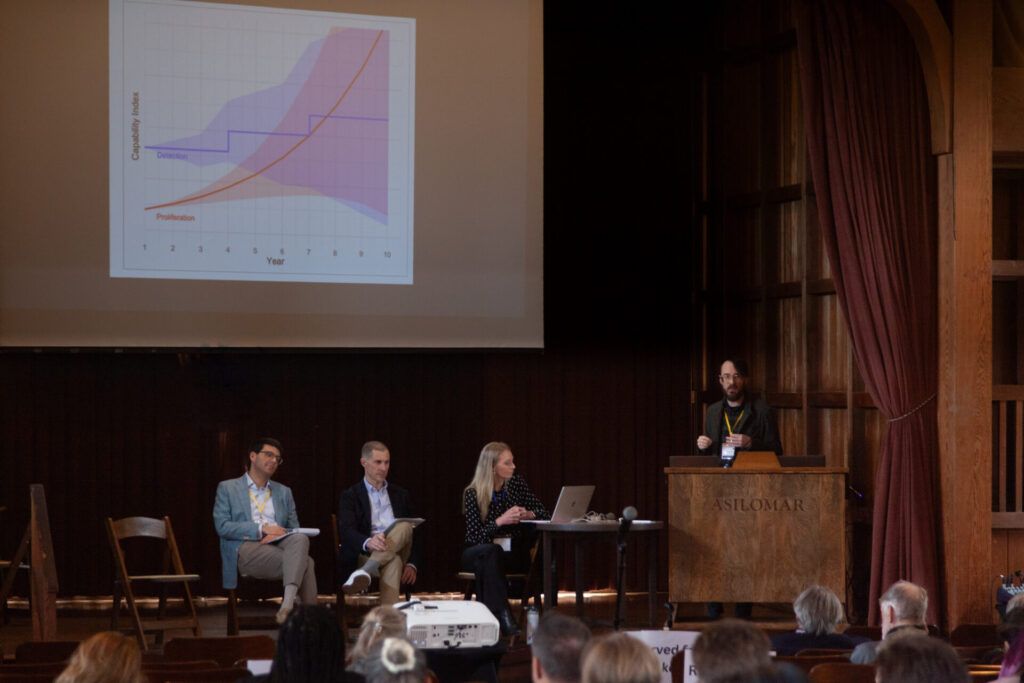 In April, more than 100 experts gathered at California’s Asilomar Conference Grounds to discuss how AI may affect nuclear and biological weapons. Image: Eduardo Fujii
On April 7th, Anthropic announced that it was restricting public access to its most advanced artificial intelligence (AI) model, Claude Mythos Preview, because the system could discover and exploit unknown security vulnerabilities in software. The developer is far from alone in these concerns; such risks extend well beyond hacking and digital security.
A major industry safety report from 2026 found that several frontier AI labs have recently added restrictions to their systems since they could not rule out that their models might assist novices in developing chemical or biological weapons. AI companies usually become aware of serious risks long before governments and international organizations can respond, making their involvement in shaping oversight rules critical from the start. But when it comes to restricting their own commercially valuable AI models, the industry has often stopped short. Moving beyond ad hoc restraint requires a standing forum where AI developers and outside security experts can jointly determine which emerging capabilities warrant closer scrutiny or limits.
Against that backdrop, the James Martin Center for Nonproliferation Studies convened a host of experts on April 8 and 9 at California’s Asilomar Conference Grounds. The setting was fitting, as Asilomar has long been associated with landmark efforts to govern transformative technologies. More than 100 experts gathered to discuss how AI may affect nuclear and biological weapons. Participants included representatives from universities, think tanks, research institutions, the national laboratories, governments, and crucially, the AI industry. The meeting launched a new Asilomar Process to develop practical safeguards for AI-related nuclear and biological risks as the technology continues to advance.
AI will affect nuclear and biological threats in different ways, but those ways connect to common governance problems. Relevant private sector AI models are developing much faster than the institutions tasked with preventing nuclear war and catastrophic biological events. AI companies may be the first to recognize new capabilities, but weapons and conflict experts are needed to judge when those capabilities create concrete security risks. As such, seven principles arose from the recent Asilomar conference intended to address this challenge. Each of these principles can be translated into new practices by AI labs, governments, and international organizations.
When AI meets synthetic biology and nuclear weapons. COVID-19 demonstrated the scale of damage that a pandemic can inflict worldwide, even without the added threat of a deliberately engineered pathogen. It also showed how manipulated information can shape public behavior on a vast scale during a biological emergency.
Those lessons are becoming more urgent because advanced AI systems could lower barriers to creating harmful biological agents by providing guidance to users with limited expertise. This type of danger is likely to grow as cloud laboratories make sophisticated biotechnology experiments remotely accessible, potentially straining safeguards designed around physical facility access. Companies controlling advanced biological design models and automated laboratories will therefore be making decisions with significant security implications, whether or not they are subject to established rules. It would be a grave mistake to wait for a pandemic that is far worse than COVID-19 to clarify these responsibilities.
AI raises a different set of concerns in the nuclear weapons domain, where governance gaps are already visible and the consequences of integration could be existential. Artificial intelligence use in early-warning and crisis-decision support could compress decision time and increase pressure on leaders to launch nuclear weapons in response to false or manipulated information.
Governments have begun to acknowledge these nuclear dangers. In December 2025, the UN General Assembly adopted a resolution on risks from AI in nuclear command, control, and communications. Likewise, while AI may improve monitoring and verification, recent research also warns that it may eventually help potential proliferators overcome bottlenecks to building the bomb. AI could also expose nuclear personnel and facilities to combined cyber, physical, and information attacks. Yet, at the 2026 Nuclear Non-Proliferation Treaty Review Conference, specific language on AI-related nuclear risks was removed from the final draft outcome document.
Taken together, the nuclear and biological cases reveal a fundamental gap in international AI governance. The same rapidly advancing technology is beginning to reshape both fields through very different routes. But they present a common governance challenge. Private developers may be the first to identify dangerous model capabilities, but they cannot evaluate those threats on their own. Nuclear and biological security experts can help determine what capabilities should be tested and when model advances raise the risk of nuclear war or an engineered pandemic. Pivotally, neither side can adequately address the concerns raised by AI without the other.
Following the Asilomar meeting and subsequent deliberations, the conference Secretariat adopted seven principles for governing AI applications in nuclear and biological security. The novelty of these principles lies in trying to build a bridge between the AI industry, which may encounter new capabilities first, and the experts and regimes trying to prevent the spread of nuclear and biological weapons. As the first public statement of the new Asilomar Process, they are reproduced below in full.
The Asilomar principles for governing AI applications in nuclear and biological security. These principles are intended to recognize AI’s potential contributions to human safety, as well as its capacity to create or amplify global catastrophic risks. As the first statement of an ongoing Asilomar Process, the principles aim to set an agenda for further research and implementation work, while remaining open to refinement as experience and capabilities evolve.
AI must protect human survival. AI systems must reinforce—and never erode—barriers against the use of nuclear and biological weapons. These armaments pose extinction risks to humanity that predate the development of AI. Such risks must not be accelerated or exacerbated by AI systems. The protection of human survival should therefore be the first priority in the deployment of AI tools affecting these domains.
Nuclear weapons use decisions must remain under meaningful human control. AI systems must not initiate, authorize, or otherwise cause the use of nuclear weapons. Human decision-makers must retain the ability to review and override AI outputs, even under severe time pressure and in circumstances where automation bias may distort judgment. Any AI system involved in nuclear-decision support must accordingly be auditable in both data and logic—by civilian and military authorities—in peacetime and in crises. New intelligence, surveillance, and reconnaissance (ISR) systems and nuclear command, control, and communications (NC3) architectures should be deployed only when they are shown to decrease the risk of nuclear weapons use.
AI governance must strengthen nonproliferation and strategic stability. Nuclear and biological research activities must be made safer, more secure, and more proliferation-resistant in light of AI’s disruptive potential. Existing practices of restraint must evolve to address new risks introduced by AI, including through commitments that reduce the dangers of AI-enabled escalation, miscalculation, or proliferation. Behavioral arms control and confidence-building measures should be pursued alongside the responsible use of AI tools to improve crisis communication.
AI developers must contribute to anticipatory risk governance. Frontier AI developers bear a special responsibility for helping anticipate and govern the nuclear and biological risks that may arise from rapid commercial innovation. Advances in AI may introduce technological shocks into these domains before governments or international institutions are prepared to manage them. Developers should therefore assess emerging capabilities before their release, recognize how they may alter incentives or lower practical barriers to weapons use or proliferation, and support stronger oversight as risks increase. AI companies are geopolitical actors whose choices can affect global security. Their legal, financial, and institutional obligations should reflect the overriding priority of preventing extinction risks.
AI-enhanced monitoring and verification must be responsible and ethical. AI systems may significantly improve the monitoring and verification of peaceful nuclear and biological activities, as well as efforts to detect diversion in support of weapons of mass destruction programs. Because these judgments carry high stakes, the use of AI must not weaken established standards for explainability, objectivity, validity, data provenance, and ultimate human accountability. AI should be used in ways that protect privacy and personal safety, while also guarding against the disclosure of sensitive nuclear or biological information that could aid malicious actors or undermine strategic stability. AI models used for monitoring and verification must themselves be protected, so that they do not become tools for helping proliferators evade detection.
AI governance must be globally inclusive. International collaboration—aligned with frameworks such as the Treaty on the Non-Proliferation of Nuclear Weapons (NPT) and the Biological Weapons Convention (BWC)—should ensure that the benefits of AI accrue to all humanity without deepening security or development divides. This work should cultivate shared strategic understanding, reducing rather than compounding the risks of nuclear proliferation, nuclear escalation, war, and catastrophic biological events. Measures that restrict access to dangerous capabilities should therefore be paired with efforts to reduce the incentives that drive states or other actors to acquire them.
AI must not enable disinformation or attacks on nuclear and biological facilities. False or manipulated information concerning the use or development of nuclear and biological weapons can be highly damaging. Safeguards should be established to prevent actors from using AI to create or disseminate highly realistic falsehoods in these domains. Active resilience must also be developed against AI-enhanced physical and cyberattacks on nuclear and biological facilities, including attacks intended to enable material theft or sabotage. These measures should address both crisis decision-making and public perceptions of nuclear and biological threats. The societal, economic, and psychological effects of information warfare may be difficult to reverse.
From principles to practice. Moving forward, the Asilomar Process should create a collaborative environment for developing thresholds about when emerging AI capabilities present serious concerns. In nuclear security, this means asking whether an AI system changes crisis stability dynamics or proliferation risks. In biological security, this means assessing whether a model materially shortens the path to producing a pathogen capable of causing an outbreak. Such judgments cannot remain informal or hidden behind commercial secrecy. Clearer evaluation protocols should guide risk mitigation measures so that developers and governments can act before dangerous capabilities spread.
Ultimately, this work should inform national authorities and the international institutions charged with reducing nuclear and biological threats to humanity. The Nuclear Non-Proliferation Treaty and the Biological Weapons Convention are at the heart of this governance architecture. But neither was designed for a world in which commercial AI capabilities may reshape security risks faster than multilateral processes can respond. The Asilomar Process is intended to connect technical evaluations of emerging AI capabilities to the policy choices that governments make under these regimes. Without that bridge, states may confront AI-enabled nuclear or biological catastrophe only after the most important decisions have already been made.
Together, we make the world safer.
The Bulletin elevates expert voices above the noise. But as an independent nonprofit organization, our operations depend on the support of readers like you. Help us continue to deliver quality journalism that holds leaders accountable. Your support of our work at any level is important. In return, we promise our coverage will be understandable, influential, vigilant, solution-oriented, and fair-minded. Together we can make a difference.
Keywords: AI, Anthropic, Asilomar Process, Claude, artificial intelligence, biological, mythos, nuclear, risks
Topics: Analysis
Get alerts about this thread
0 Comments
Oldest

Stephen Herzog
Stephen Herzog is Professor of the Practice at the James Martin Center for Nonproliferation Studies, based on the Vermont campus of Middlebury ... Read More

Allison Berke
Allison Berke is a senior engineer at RAND's Center for AI, Security, and Technology, where she works on biosecurity and AI security research and ... Read More

Yanliang Pan
Yanliang Pan is a research associate at the James Martin Center for Nonproliferation Studies, where his research has focused on nuclear supply and ... Read More

William C. Potter
William C. Potter is the director of the James Martin Center for Nonproliferation Studies and co-author of Death Dust: The Rise, Decline, and Future of Radiological Weapons Programs ... Read More

Douglas B. Shaw
Douglas B. Shaw is a Non-Resident Scholar at the James Martin Center for Nonproliferation Studies at the Middlebury Institute of International ... Read More