Data centers powered by next-gen nuclear? Don’t fall for Big Tech’s PR hype
By Molly Langabeer, M.V. Ramana | Analysis | July 20, 2026
 An Amazon Web Services data center. (Photo: Tedder/Wikipedia, CC BY-SA 4.0)
Nuclear energy recently crossed a global milestone. In 2025, the share of all electrical energy flowing in the world’s grids coming from nuclear power plants was just 8.8 percent, roughly half of what it was 30 years ago. In contrast, 19.5 percent of the electrical energy came from fast- growing renewables such as solar and wind power. Large hydropower plants provided an additional 13.9 percent.
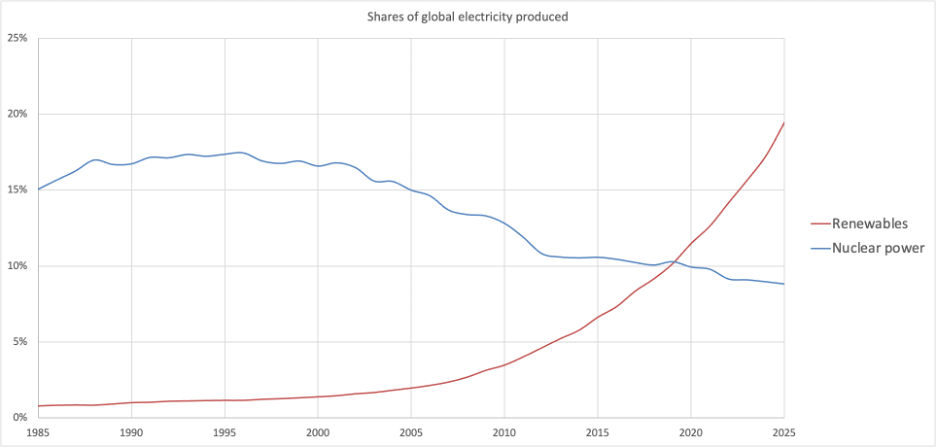
This decline may come as a surprise, given the ongoing parade of announcements about the bright future of nuclear power, featuring oft-repeated terms like “renaissance” and “revival.” In recent years, two elements have featured prominently in these announcements: The demand from Big Tech companies for nuclear power, and their investment in so-called next-generation or small modular nuclear reactors.
In October 2024, a company called Kairos Power and Google announced that they had signed a “Master Plant Development Agreement, creating a path to deploy a U.S. fleet of advanced nuclear power projects totalling 500 megawatts by 2035.” Two days later, the utility company Energy Northwest and Amazon announced “an agreement to fund efforts to move toward the development and deployment of small modular reactor (SMR) technology in Washington state.” The Amazon version of this announcement also contained the expectation that these reactors “will help meet the forecasted energy needs of the Pacific Northwest beginning in the early 2030s.”
Peer under the hood however, and it becomes evident that these press releases are all show, with little substance.
To start, the actual announcements were far more circumspect than some media coverage would suggest. Amazon, for example, only promised to “fund the initial feasibility phase of an SMR project” in exchange for “the right to purchase electricity from the first project (4 modules), which is expected to generate 320 megawatts of energy capacity.” Having the right, presumably, doesn’t force Amazon to purchase the electricity—and Amazon could decide not to purchase any electricity should generating it from these SMRs turn out to be too expensive. Likewise, the agreement between Kairos Power and Google talks about selling “energy, ancillary services, and environmental attributes to Google under Power Purchase Agreements.” The announcements said nothing about the terms of the power purchase.
There are good reasons for companies to be circumspect about investing in nuclear power plants. In the United States, each unit of electrical energy from a new nuclear reactor costs about three times the corresponding energy from a solar or wind power plant. Furthermore, the diverging long-term trends for nuclear power (becoming more expensive over time) and renewables (becoming cheaper with time) suggest that the cost divergence will only increase. Estimates of electricity costs from SMRs show that each unit of electrical energy from SMRs would be far more expensive than a corresponding unit from solar and wind power plants, even when the cost of storage technologies and other means of accounting for the variability are included. For Big Tech companies already struggling with input costs, buying power from expensive nuclear reactors would only make their business less likely to be financially viable.
Then there is uncertainty. Nuclear power projects have historically been delayed and have cost more than initially anticipated. One study examined 180 nuclear power projects and found that 175 had exceeded their initial budgets and timelines. This is particularly likely with so-called advanced reactor designs and small modular reactors, because there is little or no experience with building such plants. The only recent experience with small modular reactors is in Russia, where the KLT-40S design was based on the design of reactors used in the nuclear-powered icebreakers operated by the country for decades. But building the first power plant based on the KLT-40S design took 13 years from the start of construction to generating electricity, instead of the expected 3 years. In China, the twin High Temperature Gas Cooled Reactor units (Shidao Bay 1-1 and 1-2), took more than twice the promised “50 months.”
To be clear: There are no small modular reactor projects currently under construction in the United States. Their estimated times of arrival have already been significantly pushed back. For example, in 2020, the Energy Department declared a goal of having the Natrium reactor and the Xe-100 reactors be operational “within 5-7 years.” But in November 2025, an executive working for Natrium promised “commercial operation delivery date, power on the grid” by “2031.”
When these reactors might actually produce any electricity is also dependent on how much assured funding there is behind each project. Many announcements are ambiguous; of the ones that do specify an amount, the largest investments have been in the hundreds of millions of dollars. In October 2024, a consortium involving “Amazon’s Climate Pledge Fund, Citadel Founder and CEO Ken Griffin, affiliates of Ares Management Corporation, NGP, and the University of Michigan” announced that they were investing “approximately $500 million” in X-energy, the designer of a high-temperature gas-cooled reactor. The following June, Terrapower, the nuclear company started by Bill Gates, announced that it had raised $650 million from a group that included “NVentures, the venture capital arm of NVIDIA, and current investors”; the latter included, not surprisingly, Bill Gates and the South Korean company, Hyundai.
To put these figures in context, one estimate of TerraPower’s proposed Natrium nuclear plant is $9.4 billion for 345 megawatts of electrical power. This puts it at roughly the same total cost as a project in Idaho involving six NuScale SMRs that would have generated 462 megawatts of power. The NuScale project was cancelled in 2023 because the $9.3 billion cost estimate was too high for potential purchasers of electricity from this project. Cost estimates for high-temperature gas-cooled reactors like Xe-100, supported by the Amazon consortium, are even higher; if actually built, both Natrium and Xe-100 would produce electricity at costs per unit that are double or more of the cost of producing electricity from large nuclear plants. And, as mentioned earlier, the cost of electricity from large nuclear plants is three times or more the cost of electricity from solar and wind power plants.
Even the largest investment announced so far, $650 million, would not suffice to fund the construction of a single Natrium reactor, or even the much lower power output NuScale SMR. In short, AI companies are not spending anywhere near the amounts needed to bring new nuclear power, especially from small modular reactors, online.
The AI industry certainly has the capital to do so. During their February 2026 earnings calls, Amazon and Google said that they were expecting to spend up to $200 billion and $185 billion, respectively, during the upcoming year on data centers. Their nuclear commitments are just a fraction of one percent of their annual expenditures earmarked for building data centers. This suggests that their announcements of nuclear power investments—typically containing the self-promoting, if questionable, adjectives “safe,” “reliable,” “clean,” and “affordable”—are primarily meant as greenwashing, in order to divert attention from the negative environmental impacts of data center operations. Such investments are more likely to come from the portions of their budgets dedicated to public relations than operational expenses.
In addition to being too expensive, the potential contribution from new nuclear projects will be too meagre. One report estimated that currently 10 percent of data centers require more than 1 gigawatt of power; but projected a doubling of this fraction, to 20 percent, by 2030. Stargate’s Abilene data center project in Texas wants up to 5 gigawatts of power. Meta is planning a 5 gigawatt data center in Louisiana. In January 2026, Pacifico Energy announced that its GW Ranch project received a Texas Commission on Environmental Quality air permit for 7.65 gigawatts of gas-fired power generation, the largest permit granted in the United States.
A single small modular reactor—defined as having the capacity to produce less than 300 megawatts of electricity, or less than a third of a gigawatt—would not go very far in meeting the voracious energy demands of AI data centers. Large reactors would be more helpful in meeting these enormous demands, but they are also far more expensive. The last large reactors built in the United States were the Vogtle project in Georgia, which ended up costing over $36 billion—more than double the $14 billion estimated when construction of those reactors started.
The sizeable gap in investment will, at least in part, be filled by public money, either from US citizens or citizens of other countries. In September 2024, when Constellation Energy and Microsoft announced an agreement to restart the Three Mile Island reactor—the twin unit to the reactor that melted down in 1979—they claimed that it was “entirely…a private agreement” and that it “involves no public funds.” The following month, the Washington Post revealed that Constellation had applied to the Energy Department for a $1.6 billion federal loan guarantee. In November 2025, the Energy Department loaned $1 billion to Constellation, and in June 2026, it announced a “$17.5 billion American Nuclear Supply Chain Loans… to accelerate the deployment of 10 large-scale commercial nuclear reactors.”
Loan guarantees were a key mechanism used by the Energy Policy Act of 2005 to incentivize what was described as a so-called “nuclear renaissance. (That renaissance fizzled!) What such guarantees do is transfer the financial “risk to the public,” as a 2008 Congressional Budget Office (“CBO”) report explained. The CBO went on to caution: “economic theory suggests that such incentives cause recipients to invest in excessively risky projects because they do not bear all the cost of a project’s failure.”
Which is what happened. US utility companies proposed constructing more than 30 reactors, but just four proceeded to construction, of which two were abandoned mid-project after over $9 billion was spent. Consumers in South Carolina are still paying every month for that project, although they never benefited from any electricity. Duke Energy also wasted billions of dollars on nuclear projects that were never built. The only two completed reactors were the ones at the Vogtle power plant in Georgia that cost close to $37 billion.
The Trump Administration has also used the threat of tariffs to twist the arms of other countries. Earlier this year, the government of Japan promised to invest $40 billion in two SMR projects in Tennessee and Alabama, and $33 billion in natural gas facilities in Pennsylvania and Texas; some of the power generated is to feed “co-located data centers.” If these investments move forward, then it would presumably be Japanese taxpayers who would be shouldering a significant part of the financial burden.
The backdrop to these announcements is the tremendous growth of data centers, which are being built at a rapid pace. As of July 2026, the website Data Center Map lists 11,826 data centers around the world, 4,467 of which were located in the United States. According to a report funded by many AI companies, private investment in artificial intelligence in the United States reached $285.9 billion in 2025, and AI data center power capacity “reached approximately 29.6 gigawatts by Q4 2025, enough to power all of New York state at peak demand.” The scale of the power demand from data centers has resulted in huge increases in consumer electricity bills—a Bloomberg article cited one case in which a blind man living on disability payments in Baltimore was contending with an 80 percent increase in his energy bills over three years. (He lives an hour’s drive from a part of northern Virginia known as ‘Data Center Alley.’) And he had it better than some consumers; the article found that “electricity now costs as much as 267 percent more for a single month than it did five years ago in areas located near significant data center activity.”
The trend is recent and has happened quickly. In the United States, since 2020, according to the Energy Institute’s “Statistical Review of World Energy 2026,” energy demand for these facilities has grown at a rate of 12.6 percent per annum, from 172.8 terawatthours (TWh) in 2020 to 312.6 TWh in 2025. (To put those numbers into context, a small modular reactor designed to generate 300 megawatts can produce just 2.6 terawatthours annually if it operated 24 hours a day, 365 days a year.) This demand is expected to rise substantially over the next few years, as more data centers are built.
The only source of energy that has been growing faster than the demand from data centers is renewable energy. Within the United States, output from renewable energy sources, such as solar and wind power but excluding large hydro plants, has grown from 547.7 TWh in 2020 to 926.9 TWh in 2025. In other words, the increase in renewable energy generation has outpaced—so far—the growth in demand from data centers.
Nuclear energy, however, declined marginally from 831.5 TWh in 2020 to 826.1 TWh in 2025. We can conclude that nuclear power has played no role in fulfilling the increased demand for energy from data centers. If the output from any nuclear reactors were being directed towards data centers, then this electricity would have to have been diverted from the general public or other traditional consumers.
What else is increasing alongside demand from data centers is national carbon dioxide emissions, which increased by 147 million metric tons in the last year. The increase is in part because electricity produced by burning coal went up by about 13 percent. Underlying this increase is utility companies’ reliance on increased use of coal to provide electricity to data centers.
Not so long ago, most Big Tech companies, including Google, Meta, Amazon and Microsoft, made commitments to reduce greenhouse gas emissions from their operations. Microsoft pledged to achieve net negative emissions by 2030, Google and Meta committed to achieving net zero emissions by 2030, and Amazon committed to net zero emissions by 2040.
Google is singing a very different tune these days and is evidently interested in being seen as supporting the Trump administration. At the 2025 Hill & Valley Forum, an annual meeting featuring prominent tech executives, venture capitalists, and federal policymakers, Interior Secretary Doug Burgum called for “accelerating production of American oil, gas, coal, and potentially some nuclear would be key to realizing Silicon Valley’s AI agenda.” Ruth Porat, president and chief investment officer of Google and Alphabet, told conference attendees: “I thought Secretary Burgum’s comments were fantastic… [B]ecause I think it is very clear that to realize the potential of AI, you have to have the power.”
Between 2019 and 2023, the indirect greenhouse gas emissions caused by the generation of energy purchased by an organization (technically known as “Scope 2” emissions) from Amazon, Google, Meta, and Microsoft increased substantially, with emissions from data centers nearly doubling during that period. There are reports that the “real emissions” from company-owned data centers are over seven times higher than officially reported. Rather than scaling back growth to remain aligned with their climate targets, these companies continue to accelerate investments in AI infrastructure, increasing energy consumption and emissions, and mostly ignoring their own former goals.
This is perhaps why Big Tech firms and their supporters have emphatically described nuclear power as “carbon-free” when announcing any agreements with nuclear companies. For example, when the agreement between Microsoft and Constellation Energy to reopen the Three Mile Island nuclear reactor was announced, multiple officials used the term “carbon-free” while talking about nuclear power. The October 2024 news release by Amazon had the sub-headline: “New Small Modular Reactor agreements are part of Amazon’s plan to transition to carbon-free energy.”
Other than building small modular reactors, one way nuclear power could help meet the energy demand from data centers is by restarting reactors that have been shut down—if the companies running these plants could get the public to look the other way when it comes to concerns about the cost of running these plants and the risk of accidents.
There are a handful of reactors that were closed in the recent past, usually because they were uneconomical. First on this list is Three-Mile Island Unit 1, which was designed to generate 819 megawatts, for which Constellation received a $1 billion loan from the DOE. The 2017 decision to shut down this reactor, according to its then-owner, Exelon Corporation, resulted from “more than five years of losses… and its recent failure in an auction to sell Three Mile Island’s power into the regional grid.” The even more dangerous possibility is the reopening of the 805 megawatt Palisades nuclear reactor in Michigan, aided in part by a $1.5 billion loan from the Department of Energy. The dangers stem from problems discovered in the reactor and from the checkered history of the company that is to oversee repairs and operate the reactor. Finally, there is the 601 megawatt Duane Arnold reactor in Iowa, which was shut down in 2020 because a derecho (moving windstorm) caused extensive damage to the reactor’s cooling towers, reinforcing an earlier decision by the owner to shut down the plant because it had calculated that replacing nuclear energy with wind energy would “save customers nearly $300 million in energy costs, on a net present value basis.”
Even if these three reactors were to come online, they would only contribute 2.225 gigawatts of power, at best. Under the extremely optimistic assumption that these decades-old reactors work as anticipated without shutdowns or other problems, and operate at their historical load factors, they would together generate only about 15 TWh of energy every year—a tiny fraction of the Energy Institute’s demand estimate from US data centers of 312.6 TWh in 2025. The demand is expected to only increase.
Projections of future demand, however, have become far more uncertain in light of public opposition to data centers. Data Center Watch reports that between March and June 2025, twenty “projects were blocked or delayed amid local opposition, affecting $98 billion in potential investment—more than all disruptions tracked since 2023.” In July 2026, New York state banned the construction of data centers for a year.
A recent IPSOS poll, for example, found that when asked whether they support or oppose the construction of new data centers in the United States, 44 percent of those polled would oppose it, more than double the percentage of people who support the project (21 percent). When the question was modified to support or opposition to “a data center being built within your community,” support dropped to 14 percent, whereas opposition jumped to 57 percent. And 61 percent of those polled did not agree that rapid growth in the use of artificial intelligence was “mainly a good thing for the country.”
Opposition to data centers springs from multiple concerns. A Gallup survey from March 2026 found that people opposed data centers because of their effects on resources, such as energy consumption and water usage; the effects on costs, especially utility bills; noise pollution; and concerns about quality of life and economic effects from loss of jobs. Some of these concerns would be accentuated if these data centers are powered by nuclear reactors, which could drive up the costs of electricity because of how expensive it is to build new nuclear plants. Using reactors will also increase the water demand. Nuclear reactors that operate on a once-through water cycle withdraw, on average, 44,350 gallons of water for each megawatt-hour of electricity generated, roughly four times the corresponding figure for a combined cycle natural gas plant. It is possible to reduce these water requirements through by essentially recirculating the water used to absorb the plant’s waste heat, or what is known as “closed-cycle cooling,” but that would drive up the energy requirement—a loss either way. In contrast, renewables require little water because there is no heat production.
Finally, there are also reasons to question whether this demand for energy will diminish because the AI industry might be, as some analysts characterize it, a bubble. The main reason to expect this bubble to burst is the absence of a viable business model to pay for the immense expenses of building and operating the immense infrastructure needed. Some investors are even betting on this market collapsing. If that happens, then that would also remove the ostensible motive to build nuclear reactors.
Looking to the future, nuclear power and small modular reactors will be unable to provide any significant boost to the electricity consumption of data centers anytime soon—especially within the next several years, when AI-related energy demand is expected to increase most rapidly. The potential increase of nuclear output from restarting old reactors that were shut down because of age and poor economics is a small fraction of the demand—current and anticipated—from data centers. New nuclear reactors are at least a decade away from being started, and the scale of investment from tech companies in small modular or advanced reactors is completely mismatched to the actual cost of building even a single nuclear reactor, let alone the dozens that would have to be built for nuclear power to contribute a sizeable fraction of the demand from data centers.
Together, we make the world safer.
The Bulletin elevates expert voices above the noise. But as an independent nonprofit organization, our operations depend on the support of readers like you. Help us continue to deliver quality journalism that holds leaders accountable. Your support of our work at any level is important. In return, we promise our coverage will be understandable, influential, vigilant, solution-oriented, and fair-minded. Together we can make a difference.

Molly Langabeer
Molly Langabeer is a Master of Public Policy and Global Affairs student specializing in Resource, Energy, and Sustainability at the University of ... Read More

M.V. Ramana
M.V. Ramana is the Simons Chair in Disarmament, Global and Human Security and a professor at the School of Public Policy and Global Affairs, ... Read More










Massive data centers that create so much heat in need of cooling the electronics to function. At least radiant heat released to our already warming environment. Then we add more nuclear heat release from cooling towers? And more spent fuel to deal with? Sounds like data centers are just a fast track to more global warming to me.
Good article. I found particularly interesting the suggestion that all the noise about these new reactors amounts to greenwashing to allow business as usual to continue.
Greatly appreciate the article, especially the part about certain advanced reactor projects which tout cost and schedule data that is not even close to being real. I do believe, however, that nuclear will be needed to meet climate goals and personal energy needs. The article does not appear to differentiate between the “paper reactors” (courtesy of Admiral Rickover) and those which have a solid engineering and cost basis. For example, the TerraPower reactor uses a storage system to accommodate increased peak loading (above 345MW) as well as air cooling, reducing the water usage. The cost you provided appears to include… Read more »
Big tech needs to make more efficient computers not more powerplants.