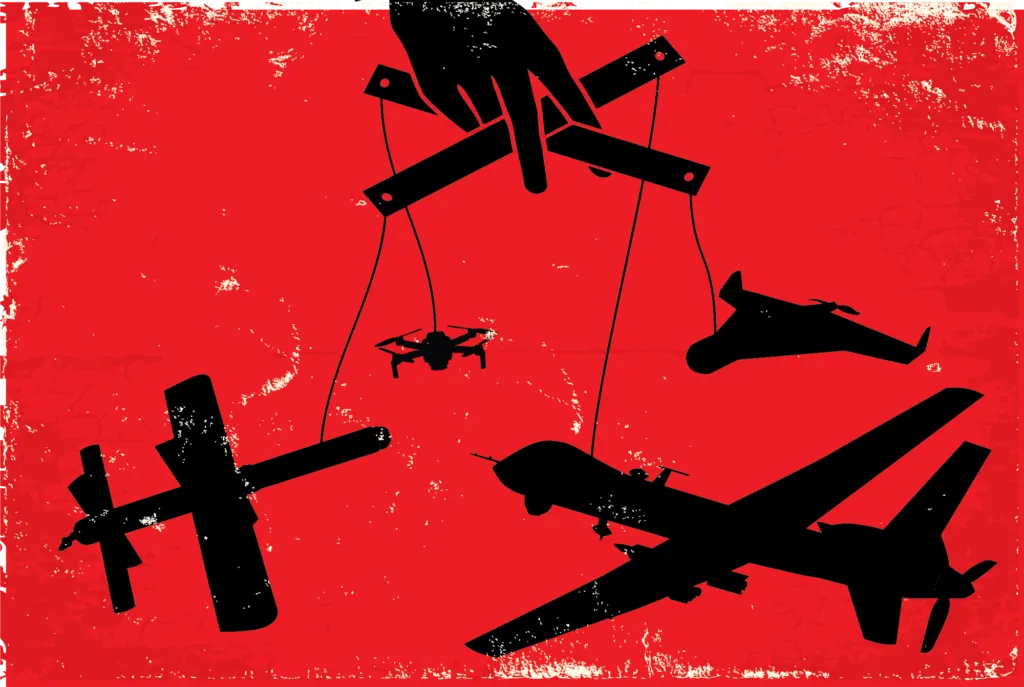
 Drone technology has spread from great powers to smaller states and non-state actors, changing the character of war. Illustration by Thomas Gaulkin; images via depositphotos.com
Editor’s note: The following is an excerpt from Steven Feldstein’s forthcoming book, Bytes and Bullets: Global Rivalries, Big Tech, and the New Shape of Modern Warfare, to be published on September 8, 2026, by St. Martin’s Press. Used with permission.
In the northwest province of Idlib, Syrian rebel groups were quietly readying a campaign to topple the government. For nearly a quarter century, Bashar al-Assad had ruled over Syria with an iron fist. Since 2011, he had prosecuted a grinding civil war, which arose out of Arab Spring anti-government protests. In November 2024, under the leadership of the Islamist group Hayat Tahrir al-Sham, the rebels struck back against government forces. In just 11 days, Hayat Tahrir al-Sham executed a lightning offensive that swept through Syria’s largest city, Aleppo, and continued past Hama, Daraa, and Homs. By December 7, Hayat Tahrir al-Sham’s forces were perched outside the gates of Damascus. The surviving government units were prepared to make a last stand backed by the powerful Fourth Armored Division, led by Assad’s brother, Maher al-Assad. But Bashar al-Assad saw the writing on the wall and decided to flee. Under the cover of night, without disclosing his decision to any of his aides or even Maher, he slipped into a private plane, turned off the aircraft’s transponder, and flew to the safety of a nearby Russian air base. Once his aides realized their president had escaped, they too fled in a panic, leaving the gates wide open for rebel forces to storm the compound a few hours later.
It was a stunning victory. How did a loosely constituted group of insurgents who had battled unsuccessfully against Assad’s forces for over a decade manage to break through his defenses in a matter of days? The rebel triumph defied an easy answer, but one advantage was drones. Government forces faced relentless bombardment from drone attacks spread across the country. Reports emerged about a special drone unit orchestrating the chaos: the Al-Shaheen (Falcon) Brigade. Al-Shaheen had a large budget and was overseen by an engineer who worked directly under Hayat Tahrir al-Sham’s top leader, Abu Mohammed al-Jolani. Over time, its operations became quite sophisticated. “The Falcon Brigade has been using and developing drones for the past 10 years,” said Cihat Arpacik, editor in chief of Intelligence Report magazine and a longtime Syria watcher. “They can import spare parts from China and other areas, and now use turbojet drones.”
 Al-Shaheen played a key role in the campaign, leading a multilayered attack against regime installations, tank hideouts, armored vehicles, troop gatherings, and frontline lookout points. It launched swarms of suicide drones against regime targets. A fleet of reconnaissance drones provided guidance for those strikes. Behind them, small munitions were directed at the targets by “teams of drone operators who had been trained intensively in secret over the past year.” Artillery and mortar shelling provided yet an-other layer of firepower against the Syrian army. The effect was devastating. The regime front lines collapsed one after the other across the battlefield, allowing Hayat Tahrir al-Sham’s coalition to rapidly push its way toward Aleppo city and then beyond.
Drone technology, once confined to great powers like the United States and China, has irrevocably spread to smaller states and non-state actors. In the early 2000s, it would have been unthinkable for small insurgent groups to develop sophisticated drone-building programs and deploy unmanned aircraft against their opponents. A generation later, this technology has become cheaper and far more accessible. Syria’s civil war demonstrates how local initiative combined with inexpensive drones imported from second-tier producers can bring game-changing results.
Hayat Tahrir al-Sham’s drone-making effort took years to develop and reflected strategies employed by several other groups, including the Islamic State. (Historically, it is the norm for guerilla or insurgent groups to piggyback off each other’s innovations and adopt and refine them across successive conflicts.) Over a 10-year period, the group invested heavily in drone infrastructure, building a small network of workshops based in garages, converted schools, warehouses, and private homes. They made use of 3D printing technology to customize weapons and manufacture components that weren’t readily available on the commercial market. (Other actors have also taken advantage of 3D printing to augment their drone-making efforts, including groups in Ukraine, Myanmar, and Yemen.) The Falcon Brigade primarily worked off two drone models: shorter-range quadcopters and longer- range fixed- wing drones. Quadcopters were deployed as “bomb couriers,” releasing improvised explosive devices onto targets from above— similar to the Islamic State’s tactics. The group also experimented with more complex single- use drones, which they reportedly reverse engineered from captured Iranian Shahed UAVs and Russian drone units. They carried up to 100 kilograms’ worth of explosives and exploded upon impact. In due course, Hayat Tahrir al-Sham built a fleet of longer-range “Shaheen” drones that incorporated first-person view (FPV) technology for remote navigation.
While the bulk of these efforts reflected homegrown initiative, undoubtedly Hayat Tahrir al-Sham also benefited from external support. Türkiye was an important partner. Turkish smugglers brought in first-person view drones to supplement Hayat Tahrir al-Sham’s arsenal, and analysts even suggested that Ankara provided critical input in the planning stages of the rebel campaign.
A particularly surprising entrant was Ukraine; in 2024, reports circulated that the embattled country was quietly providing drones and technical assistance to Hayat Tahrir al-Sham. That June, the Kyiv Post quoted a source from Ukraine’s military intelligence service who claimed that “since the beginning of the year, the [Syrian] rebels, supported by Ukrainian operatives, have inflicted numerous strikes on Russian military facilities represented in the region.” About a month before the offensive, David Ignatius reported in The Washington Post that a special Ukrainian intelligence unit, known as Khimik, had sent around 20 experienced drone pilots along with 150 first-person view drones to rebel headquarters. While Kyiv’s aid likely played only a small role in the campaign, its involvement was still notable, exemplifying its larger ambition to covertly “bloody Russia’s nose and undermine its clients” in other regions, and demonstrating the global character of military diffusion.
Hayat Tahrir al-Sham provides a glimpse into the future. The group leveraged a powerful combination of instruments: it took lessons from the Islamic State’s drone program, relied on off-the-shelf consumer technologies like 3D printing, and benefited from the expertise of middle- power states like Türkiye and Ukraine to successfully prosecute its campaign against Assad. The result was a stunning military victory and a reshaping of geopolitical lines in the Middle East.
Data collected by the Armed Conflict Location and Event Data (ACLED) initiative illustrates just how much drone use has proliferated in the last five years. The number of air/drone events surged from 6,380 incidents in 2020 to 58,272 in 2025. Fatalities from these operations climbed as well, increasing from 11,379 deaths in 2020 to 32,769 in 2025.
Drone events aren’t evenly distributed. Most of the drone strikes and associated casualties are concentrated in a handful of wars. As figure 1 shows, more drone events were linked to the Ukraine war than any other conflict, with nearly 55,000 recorded incidents taking place between 2020 and 2025.

When it came to drone casualties, the Gaza war displayed the highest number of fatalities by a huge margin; from 2020 to 2025, over 53,400 people were reported killed due to air/drone strikes.
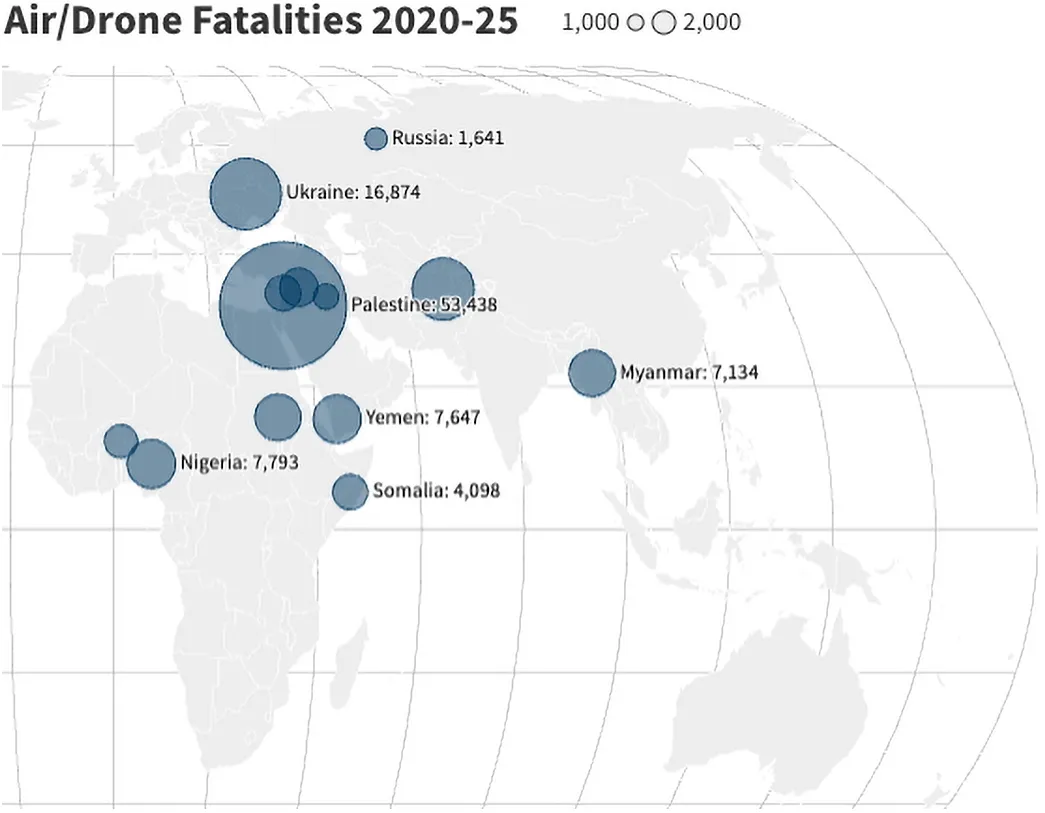
These wars represented 97 percent of all drone events occurring between 2020 and 2025 and 95 percent of all drone-related fatalities, bringing a crucial insight: any major armed conflict fought today will almost certainly involve drone technology. Consequently, UAVs are changing the character of war and challenging assumptions about how military victory is achieved.
As UAVs become cheaper and more accessible, the time investment required will contract. Emerging technologies reinforce one another, bringing new innovations and unexpected advantages. The combination of 3D printing (an additive manufacturing process) with advances in robotics and the availability of off-the-shelf quadcopters is already transforming the drone landscape. Today, Ukraine and Syria demonstrate the accelerated pace of innovation, from concept to implementation to large-scale production of first-person view drones. In the coming years, the diffusion of mass-market drones as well as the availability of high-tech components will only grow.
Together, we make the world safer.
The Bulletin elevates expert voices above the noise. But as an independent nonprofit organization, our operations depend on the support of readers like you. Help us continue to deliver quality journalism that holds leaders accountable. Your support of our work at any level is important. In return, we promise our coverage will be understandable, influential, vigilant, solution-oriented, and fair-minded. Together we can make a difference.
Keywords: China, FPV, Syria, UAV, book excerpt, drones, proxy wars
Topics: Disruptive Technologies

Steven Feldstein
Steven Feldstein is a senior fellow at the Carnegie Endowment for International Peace in the Democracy, Conflict, and Governance Program where he ... Read More











Leave a Reply