Strathmore and the Bulletin present Kronos Quartet’s A Hard Rain
By John Pope | What's New at the Bulletin | September 10, 2026
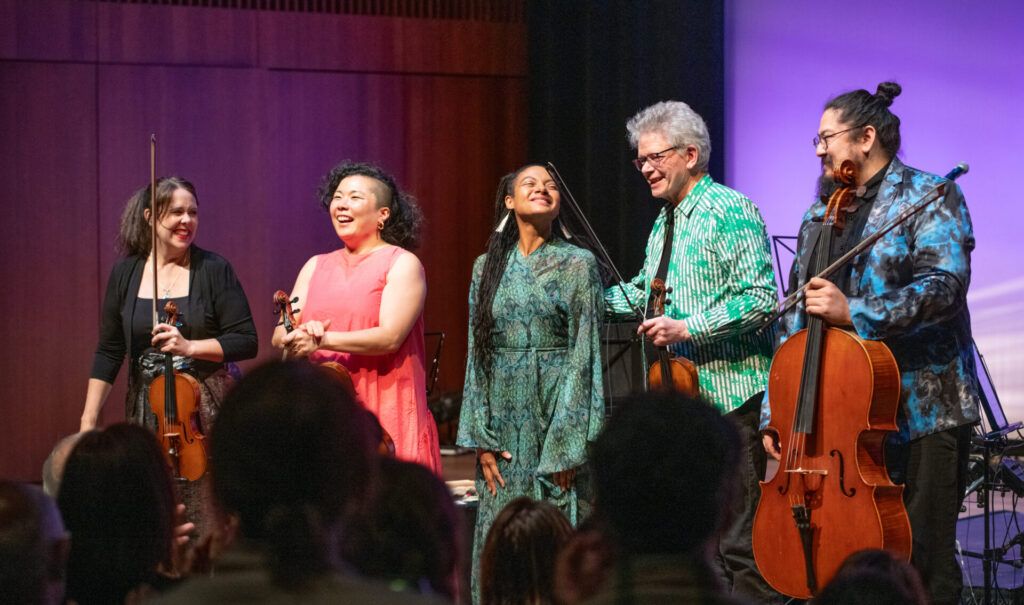 Members of the Kronos Quartet stand with Allison Russel (center) following their performance at the Nobel Laureate Assembly for the Prevention of Nuclear War on July 16, 2025.
Immersive Performance Marks 80th Anniversary of Iconic Doomsday Clock; Celebrating Collaboration and Hope in the Face of Humanity’s Greatest Threats
NORTH BETHESDA, MD. – Sept. 10, 2026 – On the very day the world learns the latest setting of the iconic Doomsday Clock, the Grammy-winning Kronos Quartet will take the stage at the Music Center at Strathmore for A Hard Rain, a landmark national event. Strathmore and the Bulletin of the Atomic Scientists will co-present the 8 p.m. ET concert on Tuesday, Jan. 26, 2027, aligning the performance with a monumental milestone: the 80th anniversary of the Clock’s 1947 creation by artist Martyl Langsdorf.
Currently closer to midnight than at any point in its history, the Doomsday Clock remains an iconic global symbol of existential risk. As the Bulletin of Atomic Scientists’inaugural Doomsday Clock Artist-in-Residence, Kronos Quartet carries forward a long tradition of uniting art and science. By bringing music, testimony and historical accounts of narrow escapes into an examination of civilization’s fragility, A Hard Rain gives audiences a common vocabulary for shared global dangers. Illuminating these risks creates a foundation for people to stand together and build a better world.
“Strathmore has long believed that the arts help us to understand and process complex issues,” said Monica Jeffries Hazangeles, president and CEO of Strathmore. “Partnering with the Bulletin to host Kronos Quartet on the anniversary of the Doomsday Clock invites our community to a shared space for reflection and dialogue so that we might infuse this moment of great uncertainty with hope.”
Taking its title and spirit from Bob Dylan’s timeless 1962 song, “A Hard Rain’s a-Gonna Fall,” Kronos Quartet’s A Hard Rain was conceived in Chicago, where violinists David Harrington and Gabriela Díaz, violist Ayane Kozasa, and cellist Paul Wiancko performed for Nobel Laureates gathered on July 16, 2025 – the 80th anniversary of the first nuclear test. That initial pairing of music with historical readings from Hiroshima survivors sparked the vision for an expanded program, honoring the scientists working to safeguard humanity while translating their vital warnings for the public stage.
“Einstein once said that science created many of the dangers we are facing, but that the real problem was in the hearts and minds of men. So, what does it mean to change hearts and minds in this contentious era?” said Alexandra Bell, president and CEO of the Bulletin of the Atomic Scientists. “It starts with building empathy and a collective acknowledgement that existential threats affect us all regardless of geography, faith, relative wealth, or political views. Art, including the creative and beautiful work of the Kronos Quartet, enables such efforts and helps us to better connect communities as we try to turn back the Clock.”
Known worldwide for using string music to explore critical global issues, Kronos Quartet brings this extraordinary production to the Music Center’s state-of-the-artConcert Hall alongside special guest artists. The concert interweaves live chamber music with readings from firsthand historical accounts, such as testimony from Hiroshima survivors, Mikhail Gorbachev’s private reflections on nuclear negotiations, and John F. Kennedy’s “Strategy for Peace” speech.
“For over five decades, Kronos Quartet has used music to confront the defining issues of our era, and today the stakes couldn’t be higher,” said David Harrington, founder and lead violinist of Kronos Quartet. “A Hard Rain is more than a concert. It is a shared space where art meets the truth. We hope this performance gives audiences both the space to process these existential risks and the courage to act.”
Prior to the main concert, Strathmore and the Bulletin of Atomic Scientists will host a free Windows Series pre-concert discussion, Hard Rain: Music Against Midnight: Art and the Doomsday Clock (6:30-7:30 p.m. ET) in the Music Center Lobby. Featuring Harrington and Bell, the panel will explore how people process large-scale global threats and how music and art strengthen our capacity to face real-world challenges.
Tickets for Kronos Quartet: A Hard Rain will go on sale Monday, Sept. 23 at 10 a.m. ET. For more information or to purchase tickets, visit www.strathmore.org or call 301-581-5100. To ensure Strathmore’s 2026-2027 Season is accessible to all, tickets under $30 are available for Strathmore Presents performances at the Music Center.
For over 50 years, San Francisco’s Grammy-winning Kronos Quartet and its nonprofit Kronos Performing Arts Association have reimagined the string quartet experience through thousands of concerts, more than 70 recordings, collaborations with performers across myriad genres, and more than 1,100 commissioned works from composers worldwide, including as part of the monumental Kronos Fifty for the Future, an online library of 50 compositions offered for free to musicians everywhere. Most recently, Kronos Quartet has been selected as the Doomsday Clock Artists in Residence for the Bulletin of Atomic Scientists. Follow the Kronos Quartet on Facebook, Instagram,Spotify and YouTube.
ABOUT THE BULLETIN OF ATOMIC SCIENTISTS
The Bulletin of the Atomic Scientists began as an emergency action in 1945, created by Manhattan Project scientists who saw an immediate need for a public reckoning in the aftermath of the atomic bombings of Hiroshima and Nagasaki. These scientists anticipated that nuclear weapons would be “only the first of many dangerous presents from the Pandora’s Box of modern science.” Their goal was to use the media to equip the public, policymakers, and scientists with the information needed to reduce human-made threats to our existence. Today, the Bulletin focuses on three main areas: nuclear risk, climate change, and disruptive technologies. It uses its website, premium magazine, videos, iconic Doomsday Clock, and regular events to help advance actionable ideas to reduce existential threats. Follow the Bulletin of the Atomic Scientists on Facebook, Instagram, BlueSky, YouTube, and Linkedin.
Since 1983, Strathmore has enriched lives through transformative artistic experiences and meaningful community connections. Based in North Bethesda, Md., this nonprofit cultural institution showcases world-class talent, supports emerging artists, and offers diverse programs at its Music Center and Mansion, as well as across Montgomery County. Strathmore fosters creativity and community through performance, educational initiatives, and accessible arts programming. Experience the magic of Strathmore, where the arts are everywhere. Follow Strathmore on Instagram, Facebook, YouTube, and LinkedIn.
Media Note: For interviews, press tickets, and assets, please email Strathmore’s media contact.
# # #
MEDIA CONTACTS:
Brandii Toby-Leon (she/her), Strathmore, [email protected]
John Pope (he/him), Bulletin of Atomic Scientists, [email protected]
Together, we make the world safer.
The Bulletin elevates expert voices above the noise. But as an independent nonprofit organization, our operations depend on the support of readers like you. Help us continue to deliver quality journalism that holds leaders accountable. Your support of our work at any level is important. In return, we promise our coverage will be understandable, influential, vigilant, solution-oriented, and fair-minded. Together we can make a difference.
Topics: What’s New at the Bulletin
Get alerts about this thread
0 Comments
Oldest