How dehumanizing language, video images, and human oversight affect public opinion on drone warfare
By Paul Lushenko, Srinjoy Bose | Analysis | February 3, 2026
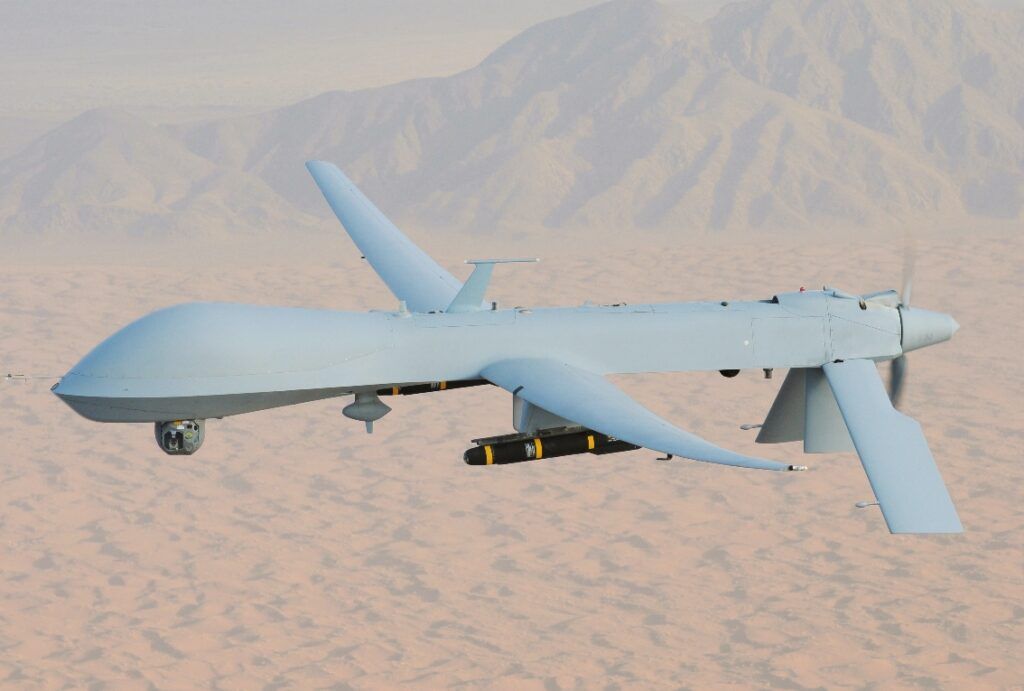 Public support for strikes is highest when animalistic dehumanization is paired with a semi-autonomous drone over which a human retains oversight. Image: Lt. Col. Leslie Pratt, via Wikimedia Commons
Since the terrorist attacks of September 11, 2001, drones have promised a way to reconcile military effectiveness with unintended consequences. These unmanned aircraft help keep soldiers safer and through their surveillance enable surgical strikes that potentially reduce civilian casualties. Despite these advantages, critics claim that drones impose a key risk: Killing at a distance makes it easier—politically and psychologically—to see targets as less human.
Human rights advocates, international lawyers, and war ethicists argue that drones render humans as little more than abstract or anonymous objects. Modern warfare is mediated through screens, sensors, and algorithms that could erodeempathy, blur accountability, and routinize killing, all of which could affect societal perception.
But experts know surprisingly little about whether or to what degree dehumanization shapes public support for drone strikes. People’s views on the issue may be influenced by factors beyond presenting targets as pixelized images. These include describing targets with derogatory epithets.
To understand how dehumanization shapes public attitudes toward drone strikes, we conducted a survey on a representative sample of 1,500 Americans in November 2025. Our results show a complicated relationship between dehumanization and public support for drone strikes. Although dehumanization does shape support for drones, the public also cares about how targets are framed, with words or pictures, and favors human oversight of strikes. When strikes are conducted by fully autonomous drones or “killer robots,” which use artificial intelligence (AI) to identify, track, and target without human oversight, the public begins to question the merits of operations. While countries are promoting the use of fully autonomous drones that reduce targets to data points, Americans do not fully endorse them. Therefore, the story about drones’ dehumanizing potential is not simply one of ensuring that humans remain morally responsible and accountable for strikes. The pairing of fully autonomous drone strikes and dehumanizing imagery could undermine public support for military action, even in cases when action is needed.
Dehumanization. Analysts often treat dehumanization as a single phenomenon. But it operates along two lines: animalistic (likening humans to animals) and mechanistic (treating humans as objects).
Animalistic dehumanization relies on rhetoric to depict targets as savage, irrational, or morally inferior. Historically, policymakers rely on animalistic language to justify the use of force, ranging from colonial warfare to counterterrorism operations. Such language is emotionally charged and designed to evoke fear, anger, or disgust. Former President Barack Obama, for instance, referred to the Islamic State as “barbarians,” a caricatural appeal that helped sustain high domestic support for drone strikes against terrorists.
Mechanistic dehumanization strips individuals of human features altogether, reducing them to data points or heat signatures. This type of dehumanization is much subtler than the animalistic variety. It does not rely on slurs or epithets but draws on pictures and symbols to obscure targets’ individuality. For example, the infrared optical signal drones often transmit renders targets as black and white images, contributing to what some critics claim is the public’s “cold indifference” toward strikes.
So, while these two mechanisms both deny targets’ humanity, they work through unique psychological mechanisms: Animalistic dehumanization denies empathy through emotion; mechanistic dehumanization denies emotion altogether by reducing targets to blips on a screen.
What public opinion reveals. To conduct our survey, we randomly assigned respondents to treatment groups that varied the rhetorical or graphical framing of a target as well as the type of semi-autonomous or fully autonomous drone that engaged the target. We asked respondents to gauge their support for a drone operation using a 5-point scale, on which 1 corresponds to “strongly oppose” and 5 corresponds to “strongly support.”
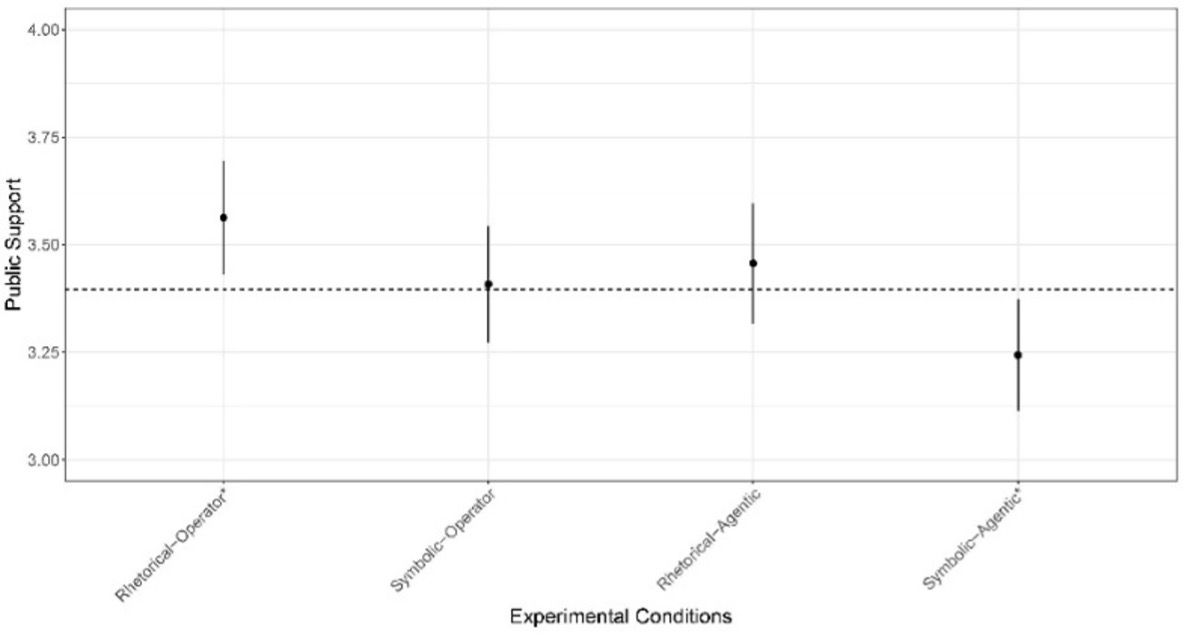
Our analysis points to several key takeaways: First, dehumanization does shape public support for drone strikes. But the framing of a target and the type of drone used to strike it moderate the effect.
Second, public support for a strike is highest when animalistic dehumanization is paired with a semi-autonomous drone over which a human retains oversight. This result echoes existing research for public and military attitudes toward drone strikes. It also reinforces the logic of the Department of Defense’s Directive 3000.09, which requires that fully autonomous drones be designed to allow commanders and operators to exercise “appropriate levels of human judgment” over the use of force.
But there are other advantages of pairing dehumanized rhetoric with semi-autonomous drones where humans remain “in the loop,” meaning they have ultimate oversight of drone strike. Politically, it is potent. This approach mirrors how political and defense officials normally justify drone strikes in practice. Targets are often graphically displayed or mechanistically dehumanized for the public after drone strikes take place. Officials share short video clips of drone operations on social media, as was the case following the Trump administration’s strikes against narcotraffickers in the Caribbean.
Also, dehumanizing rhetoric mobilizes emotion that is useful to further justify drones strikes, especially those conducted by semi-autonomous drones that preserve a sense of human agency. In our survey we found that emotion, especially anger, played a statistically significant role in shaping higher public support for a drone strike.
Third, mechanistic dehumanization paired with a fully autonomous drone results in the lowest level of public support for the strike. Respondents’ support for a strike dropped when they viewed an infrared image of a target and were told that AI controlled the drone. More than 10 percent of respondents expressed discomfort with machines making life-and-death decisions based on the target’s abstract representation and opaque approval process. One respondent noted, “I was thinking of supporting this until I realized it was fully automated.” Another respondent cautioned, “letting a machine make the ultimate decision … seems cowardly and irresponsible.”
Managing psychological distance. These findings highlight a key but under-analyzed challenge of modern warfare: managing psychological distance. Drones re-spatialize conflict, creating physical distance between combatants. Dehumanization extends this distance psychologically. We show that such psychological distance can cut in opposed directions in terms of public opinion.
Animalistic dehumanization shortens psychological distance by intensifying emotional engagement, particularly anger, even as it denies targets’ humanity. Mechanistic dehumanization lengthens distance by abstracting targets altogether. When combined with fully autonomous drones, this abstraction can feel unsettling rather than reassuring. This helps explain why fully autonomous drones, despite their hype in some military circles, generate controversy, especially given the potential for AI hallucinations to cause targeting errors that result in civilian casualties. The objection is not only that machines might make mistakes. It is that fully autonomous drones threaten to sever the moral link between decision-makers and outcomes. Drone strikes therefore appear illegitimate, even when they don’t violate international humanitarian law on, for example, the purposeful targeting of civilians.
Our results have important implications for policies governing drone warfare. First, public support for drone warfare rests on a narrow and unstable equilibrium. Push too far toward automation and abstraction, and that balance begins to collapse. Indeed, our findings suggest that human control over drones is not just an ethical safeguard. It also offers political dividends. The credibility of the Defense Department’s Directive 3000.09, which emphasizes appropriate levels of human judgment over drones, therefore relies on its implementation. As the US military experiments with AI-enabled drones, such as the U.S. Air Force’s “loyal wingman,” the challenge will be to preserve visible and credible forms of human judgment—not merely formulaic approval steps deeply buried in the “kill chain,” which describes the decision-making process for drone strikes.
Second, public support depends on how targets of drone strikes are framed. Dehumanizing rhetoric may enhance public support for drone strikes in the short term. But it does so by exacerbating emotions, especially anger. This emotive response can superficially enhance public support, granting broad license to officials to kill with drones while circumventing public accountability and oversight of strikes—the hallmarks of democracy. Over time, however, such framing risks expanding who is seen as a legitimate target and dulling sensitivity to error, miscalculation, and escalation.
Finally, our findings caution against assuming that fully autonomous drones will increase public acceptance by reducing human bias or error. This concern is echoed by the Responsible AI in the Military or REAIM initiative, which is designed to promote the ethical, transparent, and accountable use of military AI. At the very least, this suggests that policymakers should invest in the Responsible AI in the Military initiative to legitimate novel AI-enabled capabilities. Even in the absence of a binding international treaty, countries that deploy fully autonomous drones in ways perceived as dehumanizing may face political backlash that constrains their freedom-of-action as well as the perceived legal—and moral—legitimacy of strikes.
Together, we make the world safer.
The Bulletin elevates expert voices above the noise. But as an independent nonprofit organization, our operations depend on the support of readers like you. Help us continue to deliver quality journalism that holds leaders accountable. Your support of our work at any level is important. In return, we promise our coverage will be understandable, influential, vigilant, solution-oriented, and fair-minded. Together we can make a difference.
Keywords: AI, drones, fully autonomous, killer robots, military, strikes, war
Topics: Disruptive Technologies

Paul Lushenko
Paul Lushenko is a senior fellow at Cornell University’s Tech Policy Institute and Institute of Politics and Global Affairs. His work lies at the ... Read More

Srinjoy Bose
Srinjoy Bose is an associate professor of international relations at UNSW Sydney. He researches topics in critical peace/security studies including, ... Read More













Leave a Reply