A new boost-phase missile defense system—and its diplomatic uses in the North Korea dispute
By James E. Goodby, Theodore A. Postol | Issue Article | June 28, 2018
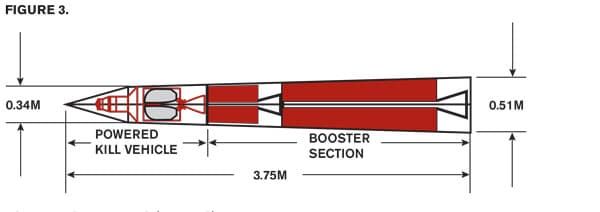 A diagram of an interceptor that might be used in a proposed boost-phase missile defense system for use against North Korea.
The defense system the authors sketch in this article – the Airborne Patrol System – would make it possible to destroy North Korean ICBMs with fast-accelerating, high-speed interceptors before the targeted missile could deploy countermeasures that can defeat the US ground-based missile defense system. The Airborne Patrol System would be based on the well-tested, long-endurance MQ-9 Reaper remotely piloted drone. The big-wing version of the MQ-9 can loiter at an altitude of 50,000 feet for well in excess of 24 hours while carrying a 3,000-pound payload. Drones in the Airborne Patrol System would fly over the Sea of Japan or Yellow Sea, well outside the airspace of North Korea. Each Predator-B would carry two anti-ICBM interceptors. US-led diplomacy will need to carefully set objectives for different political contingencies, so this new defense system could be adaptively used as a lever to persuade and deter North Korea within a wide range of political situations. To be effective in increasing world security, such diplomatic efforts would also need to be closely coordinated, via consultations and agreed understandings, with South Korea, Japan, and probably China and Russia. In principle, the system concept is very simple. Its successful implementation would, however, require an extremely careful and well thought-out integration of technologies.
Together, we make the world safer.
The Bulletin elevates expert voices above the noise. But as an independent nonprofit organization, our operations depend on the support of readers like you. Help us continue to deliver quality journalism that holds leaders accountable. Your support of our work at any level is important. In return, we promise our coverage will be understandable, influential, vigilant, solution-oriented, and fair-minded. Together we can make a difference.
Get alerts about this thread
0 Comments
Oldest

James E. Goodby
James E. Goodby has been a fellow at Stanford University’s Hoover Institution since 2007. He works with former Secretary of State George P. Shultz ... Read More
Theodore A. Postol
A physicist, Theodore A. Postol is professor emeritus of science, technology, and national security policy at MIT. His expertise is in nuclear weapon ... Read More