Why ‘mowing the grass’ won’t work to curtail the Iranian nuclear program
By Matt Field | Analysis | June 26, 2025
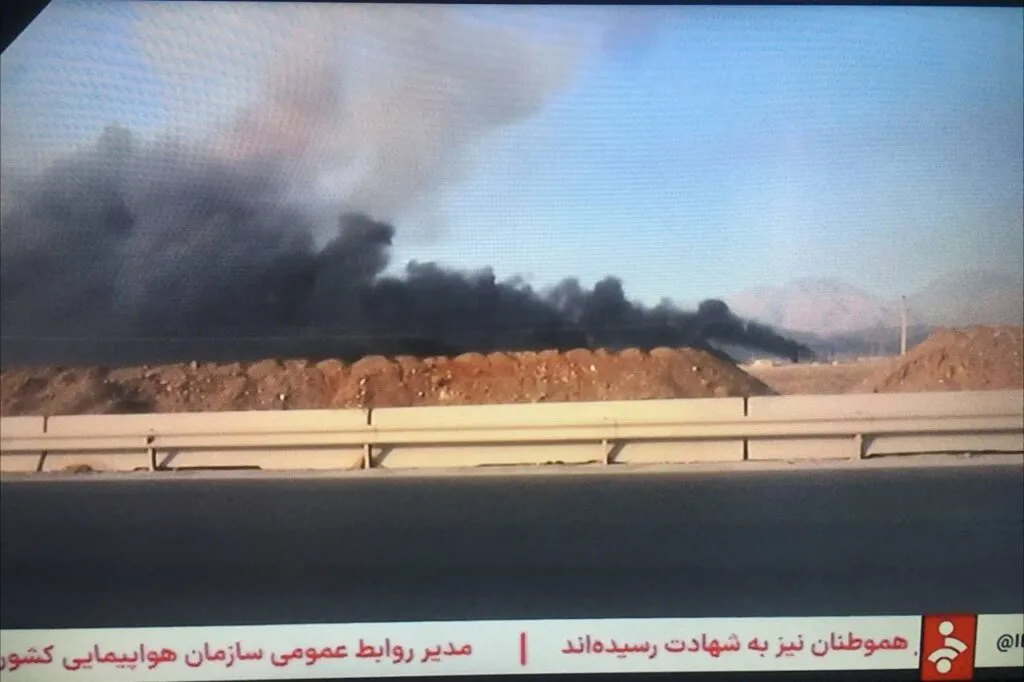 Iranian state-run media reported seeing explosions outside of the Natanz nuclear facility in central Iran, confirming the facility had been targeted by Israel's strikes on early Friday. (source: Telegram)
After US strikes on three Iranian nuclear facilities and a muted Iranian response, President Donald Trump appeared satisfied Monday that the eruption of violence in the Middle East had finally come to an end. He congratulated Israel and Iran for their “Stamina, Courage, and Intelligence.” The war “should be called ‘THE 12 DAY WAR,’” Trump added in a post on Truth Social, after making the optimistic assessment that Iran’s key nuclear facilities had been “totally obliterated.” Leaked US intelligence, however, quickly cast doubt on his rosy projections. The powerful US “bunker buster” bombs had maybe set Iran’s ambitions back only a few months, unnamed analysts told CNN, and Iran’s stockpile of near-bomb-grade uranium remained intact.
The Trump administration disputed the leaked intelligence, and the head of the International Atomic Energy Agency (IAEA), Rafael Grossi, said Iran’s fortified Fordow facility, one of the three enrichment sites the US attacked Saturday, was no longer operational. It couldn’t be said, however, that Iran’s program had been “wiped out,” Grossi told the media.
Destroying Iran’s program completely may be exceedingly difficult, experts say. The Iranian regime appears to have survived this conflict intact and now has perhaps a different nuclear calculus than it had at the beginning of the month. Given this, Israel or the United States may once again face questions about whether to attack a resurgent Iranian nuclear program, a variation on the theme of Israel’s longtime “mowing the grass” strategy of attacking geographically close hostile groups. Indeed, Israeli Prime Minister Benjamin Netanyahu has already pledged to “act with the same determination, the same power” to halt anyone trying to restore Iran’s program.
University of Illinois Urbana-Champaign political scientist Nicholas Grossman told me that from a security perspective, the strategy might work with a group like Hamas on Israel’s border, but “there’s no way it can work with a sizable country like Iran that’s 1,000 miles away.” A real solution to the Iran nuclear dilemma can’t be delivered by air.
In an interview conducted before the ceasefire between Iran and Israel was announced Monday, I spoke with Grossman about the pressures on Iran’s regime, the future of its nuclear program, and the ways the United States or Israel might deal with it in the future.
The interview has been edited for length and clarity.
Matt Field: Could the pressure of the current situation cause the Iranian government to collapse?
Nicholas Grossman: We have quite a bit of evidence that aerial bombardment alone does not make governments collapse. There have been a number of different efforts, especially post-World War II, to just say, “Oh, if we just fire some air strikes, that will solve the issue,” and it pretty much never does. The people who are on the ground usually are able to keep control of the ground. Also, Iran’s government, one thing that they’ve proven good at is repressing their population, repressing any sort of pro-democracy sentiment.
People usually don’t blame their own government, even if they don’t like their government, when foreigners are bombing them. They tend to blame the foreigners who are bombing them.
There will likely be some sort of rally around the flag effect in Iran, but maybe not that strong, probably one that is temporary, but nevertheless makes it that some Iranians who were speaking out against their government, or at least were inclined to join anything against the government, some of them are going to keep quiet because they don’t want to be seen as siding with Israel.
Field: If the government holds on, will that lead to consideration of further attacks to end the nuclear program?
Grossman: Yes, and that’s one of the reasons I suspected from the beginning that either this is intended as a regime change war or, if that’s not what they intend, that it could spiral into one, because the Iranians learned from other attacks on nuclear programs. In particular, the Israelis destroyed an Iraqi nuclear reactor that was under construction in 1981. They destroyed a Syrian reactor that was under construction in 2007. The Iranians learned from all this. They dispersed their nuclear program and put in a lot of hardened locations.
The Iranian nuclear program can be set back, but probably can’t be destroyed from the air. They can always move stuff. They can hide stuff. They can build new facilities that they don’t tell people about. And importantly, you can’t bomb knowledge. The Iranians don’t need an Oppenheimer to invent this stuff. They’ve already proven they know how to do it, and the technology isn’t new. They just need engineers who can repeat already accomplished tasks, and so they should be able to reconstitute it.
As long as this government is in power or another Iranian government that wants nuclear weapons or at least sees potential value in becoming a nuclear threshold state at the cusp of building a bomb—all the ingredients in place, but not actually doing it—they now have also a greater incentive to do that.
Field: What happens in Iran?
Grossman: If the regime survives, and if it does in fact push harder for nuclear weapons, or even just more advanced missiles, then the United States and Israel will again face this same type of situation that they face now, which is: Do you let Iran have those capabilities? If Iran really looks like they’re about to build a bomb, then they would have to attack again.
And what this reminds me of is an Israeli strategy against terrorist groups right near them, for which they use a very crude metaphor called “mowing the lawn” or “cutting the grass.”
Before the big current war in Gaza that killed tens of thousands of people there, Israel had multiple back-and-forths with Hamas, multiple exchanges, and a few of them were air-only exchanges. Often, the Israelis would talk about how, you know, they’re going to destroy Hamas’s ability, and they’re going to wipe them out. And it never ever worked.
Hamas would build its capabilities back up, the Israeli military would go in and destroy a bunch of it, and then Hamas would build up again. Then Israel would have to do it again.
Without considering very important humanitarian considerations—without even factoring those in, just from a security perspective—that strategy could potentially work, temporarily, maybe, with a non-state actor like Hamas that is right on their border. There’s no way it can work with a sizable country like Iran that’s 1,000 miles away.
Field: Why is that? Why can’t they just keep lobbing missiles at Iran and picking off sites?
Grossman: Because the Iranians will put the program even deeper underground, even deeper in a mountain. And remember, even this time the Israelis couldn’t do it on their own; they needed US help. Something like what they’re doing now would probably be militarily feasible to do again in, say, five years, or three years, or I don’t know. But at best, that strategic approach has no endgame. There’s no end to it. It’s just “I kind of hope they stop at some point” while we’re giving them reasons not to stop.
Field: And at the same time, the mowing-the-grass approach with Iran dissuades any sort of diplomatic solution to this?
Grossman: It’s important to point out that the October 7th attack and the Gaza war are both examples of why the mowing-the-grass strategy, at absolute best, is a costly holding pattern that, in this case, failed in this really brutal, spectacular fashion.
Together, we make the world safer.
The Bulletin elevates expert voices above the noise. But as an independent nonprofit organization, our operations depend on the support of readers like you. Help us continue to deliver quality journalism that holds leaders accountable. Your support of our work at any level is important. In return, we promise our coverage will be understandable, influential, vigilant, solution-oriented, and fair-minded. Together we can make a difference.
Keywords: Iran
Topics: Nuclear Risk

Matt Field
Matt Field is the biosecurity editor at the Bulletin of the Atomic Scientists. Before joining the Bulletin, he covered the White ... Read More













So, what does Grossman suggest to deal with the Iranian problem? As I see it, Regime Change is the only possible solution hoping that whatever replaces the Islamic theocracy (& it can hardly be worse) is something more inclined towards a democratic answer.
There will be chaos initially but hopefully the Iranian people will be able to bring order.
Forcible ‘Regime Change’ has been US strategy since about 1953 or -54 with the US overthrow of Iran’s elected leader whom the US decided not to support. (Think of all the countries worldwide since 1945 that would have liked to do the same with some US governments!! No chance for any of them, of course…Until 2016 and now, with Russia successfully manoeuvring the US pu blic and the Trump regime, to the point that the US has just lifted all sanctions on Russian banks involved in backing Putin’s invasion of Ukraine!). After asassinating Iran’s elected leader, the US installed a… Read more »
Just like order has been achieved in Iraq, Libya, and Afghanistan after regime change by the US? The ARROGANCE of Americans to believe that they can just go in and topple governments at a whim or for their own interests and not have global consequences is breathtaking!