“Let Them Eat Beef Tallow!” MAHA’s answer to expiring health insurance subsidies
By Matt Motta | Opinion | November 26, 2025
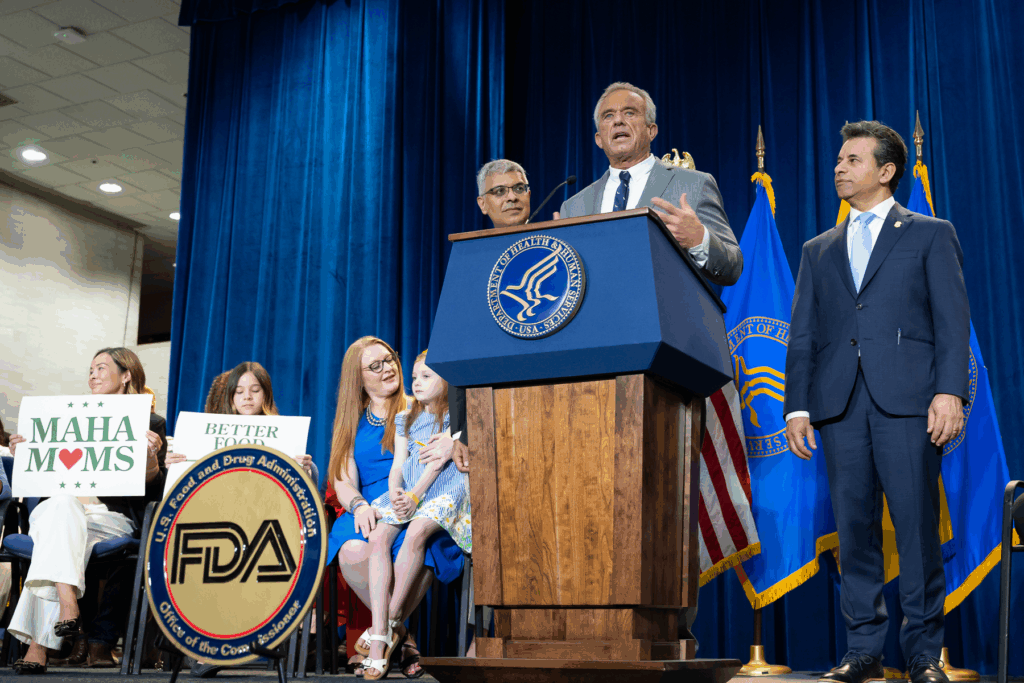 Robert F. Kennedy Jr. at a press conference in April. Credit: US Department of Health and Human Services.
Millions of Americans could see the price of their health insurance increase in 2026—a potential crisis that’s been brewing since the summer, when Congress opted against extending certain enhanced “Obamacare” subsidies. Another presidential administration might have spent these past few months trying to enact a policy to address this looming health insurance cliff. Instead, the Trump team’s health focus has been decidedly elsewhere—on Tylenol, on food dyes, on vaccines, on beef tallow, and on the often head-scratching goals of the “Make America Healthy Again” (MAHA) agenda.
Though the prospect of swelling ranks of people without insurance would ordinarily seem a daunting political problem, the once fringe concerns of MAHA and Health Secretary Robert F. Kennedy, Jr., who embodies the movement, have, in the Trump administration, largely crowded out the traditional focus of health policy debates. Unfortunately, the public might let the administration get away with it.
The insurance crisis. Nearly all Americans who get health insurance through state Affordable Care Act exchanges benefit from financial assistance from the federal government. These subsidies were implemented as part of the nation’s response to the COVID-19 pandemic and helped people afford Obamacare. Of the 24.3 million Americans enrolled in marketplace plans in 2024, 92 percent received government-subsidized health insurance. But the Republican-controlled Congress failed to extend the extra subsidies, on average, health care plan costs will more than double for most marketplace enrollees if the subsidies expire in January 2026, as currently scheduled. Adults making $65,000 per year could see their annual premiums increase by $2,400 per year.
At best, those who choose to remain insured could take a massive financial hit once the enhanced subsidies expire. At worst, rising health insurance premiums could force Americans to forego insuring themselves altogether.
While the Trump administration has expressed support for proposals to provide some marketplace enrollees with health Savings Accounts that could be used to partially offset premium hikes, those temporary funds could not be used to pay for insurance directly. In the 11th hour, the administration is now scrambling to find a “fix” for the expiring subsidies, with President Donald Trump floating the possibility of temporary subsidy extensions for at least some of those who originally benefited. As millions of Americans face premium hikes and lapses in coverage, the Trump White House’s health messaging, has often focused elsewhere–for example, on beef tallow, aluminum, and Tylenol.
“Let them eat beef tallow!” In November, as some members of Congress sought to address the health insurance issue, Kennedy appeared to focus on another battle, promising to end America’s “War on Saturated Fat.” Kennedy has for years asserted that Americans are being “unknowingly poisoned” by seed oils (like canola and sunflower seed oils) used in place of animal oils (like beef tallow) with comparatively higher levels of saturated fat. This is a dubious claim, as higher levels of saturated fat consumption can have adverse health outcomes. Kennedy notably praised the fast food chain Steak n’ Shake for taking action earlier this year for “RFK-ing its fries” by frying them in beef tallow rather than vegetable oil.
Over the past few weeks, Kennedy and the administration have promised to investigate the possibility that aluminum additives in vaccines may be responsible for asthma, autism, food allergies, and more—all claims at odds with the best available medical science. They have also drawn headlines for inaccurately suggesting that Tylenol (acetaminophen) use in pregnancy can cause children to develop neurological issues later in life and for replacing the deputy director of the Centers for Disease Control and Prevention (CDC) with the surgeon general of Louisiana, Ralph Aberham. Aberham has touted ivermectin as a potential cure for COVID-19, which it is not, and has called pandemic mitigation measures “tyrannical.”
In this way, Kennedy poses a contrast from Tom Price; Trump’s health secretary during his first term, when Republicans attempted to repeal the Affordable Care Act. Price was a fierce critic of Obamacare but ultimately kept in his lane when it came to health policy. Kennedy’s apparent lack of interest in health insurance may stem from the fact that—as an environmental lawyer—he doesn’t seem to know much about it. Kennedy notably had difficulty explaining the differences between Medicare and Medicaid under oath during his Senate confirmation hearings.
Of course, Kennedy’s focus on all things other than health insurance may be a feature, not a bug, of his administration. As I detail in my book Anti-Scientific Americans, American attitudes toward the scientific community have grown deeply personal, negative, and politically polarized in recent years. Kennedy’s policies—including his attacks on vaccine safety and embrace of raw (unpasteurized) milk—tend to be quite popular with those who harbor suspicions toward the scientific community. Perhaps unsurprisingly, Kennedy’s MAHA coalition has amassed a fairly “broad tent” of support among Republicans (and even some Democrats) in the public.
Do Americans care about health insurance policy? The administration’s lack of interest in extending health insurance subsidies and its ardent pursuit of MAHA policy goals raise an important question. Will the public hold the Trump administration accountable for its unscientific actions?
The answer, unfortunately, may be “no.” In theory, public outrage about the rising costs of health care could constrain policymakers’ actions. Fearing the possibility of retribution at the polls, politicians have an electoral incentive to cater to public opinion.
Americans, however, are paying little attention to expiring subsidies. This is true even of those who would be directly impacted by their expiration.
For example, a recent Kaiser Family Foundation (KFF) poll conducted on the eve of an October government shutdown (September 23-29, 2025) found that over 60 percent of Americans had heard a little or nothing at all about the expiring subsidies. Worse, a majority (58 percent) of those Americans who purchased their own health insurance—and could therefore be directly impacted by subsidy expiration—said the same.
Although it’s true that the same KFF poll found that a large majority (84 percent) of self-insured opposed allowing the subsidies to expire, there was a catch. Survey respondents were told about the possibility that cuts might expire by the end of this calendar year, before answering that question. Taken together, these numbers means that while the idea of subsidy cuts is clearly unpopular, many Americans are simply not following the issue closely enough to send unambiguously supportive signals to their elected officials.
Of course, the public is not fully to blame here. Low public attention to subsidy debates may be perfectly reasonable for at least two reasons.
The first has to do with the design of the Affordable Care Act itself. People are more likely to fight to protect policies they like when they know that they benefit from them. This is what social scientists call a “policy feedback effect.”
The problem with Affordable Care Act subsidies is that many Americans may not know that they directly benefit from government support. They are what scholars refer to as a “submerged” benefits. Even if Americans are aware of the amount they pay for health insurance, the costs they could pay for those benefits—without government support—is less obvious. Unearthing those submerged benefits requires action by state governments to advertise what health care costs could be in the absence of subsidized premiums, which may not be revealed in insurance sticker prices.
Americans who receive health insurance subsidies may have a more difficult time tracing that benefit back to government actions. That’s important, because low benefit traceability could decrease the likelihood that people will take political action to defend those policies at the ballot box.
The second reason for low public attention to the insurance-subsidy issue has to do with our political environment. The Trump administration has taken many controversial policy actions that command public attention: on-again, off-again tariffs, immigration enforcement and military presences in major US cities; and even the president’s call for the death of sitting elected officials who hold policy views at odds with the president. People can lend their attention to only so many issues, and technical debates about health policy may fail to rise to the top.
The fact remains that many Americans seem to be unaware of the subsidy fight. And while there is no guarantee that policymakers will listen to the public’s demands for affordable health insurance—even in a world where voters sent a much clearer signal than they have so far—public inattentiveness to the issue makes it all the more likely that policymakers will not feel pressed to act.
The public could pressure the Trump administration to save expiring health insurance subsidies. But, that would require widespread outrage. And the outrage would need to come fast.
Together, we make the world safer.
The Bulletin elevates expert voices above the noise. But as an independent nonprofit organization, our operations depend on the support of readers like you. Help us continue to deliver quality journalism that holds leaders accountable. Your support of our work at any level is important. In return, we promise our coverage will be understandable, influential, vigilant, solution-oriented, and fair-minded. Together we can make a difference.
Keywords: Robert F. Kennedy Jr.
Topics: Biosecurity
Get alerts about this thread
0 Comments
Oldest

Matt Motta
Matt Motta, PhD is an associate professor in the Department of Health Law, Policy, & Management at the Boston University School of Public ... Read More