Is it a chemical? Is it alive? Oversight in the coming era of synthetic cells could be complicated
By David Gillum, Peter A. Carr | Opinion | July 31, 2026
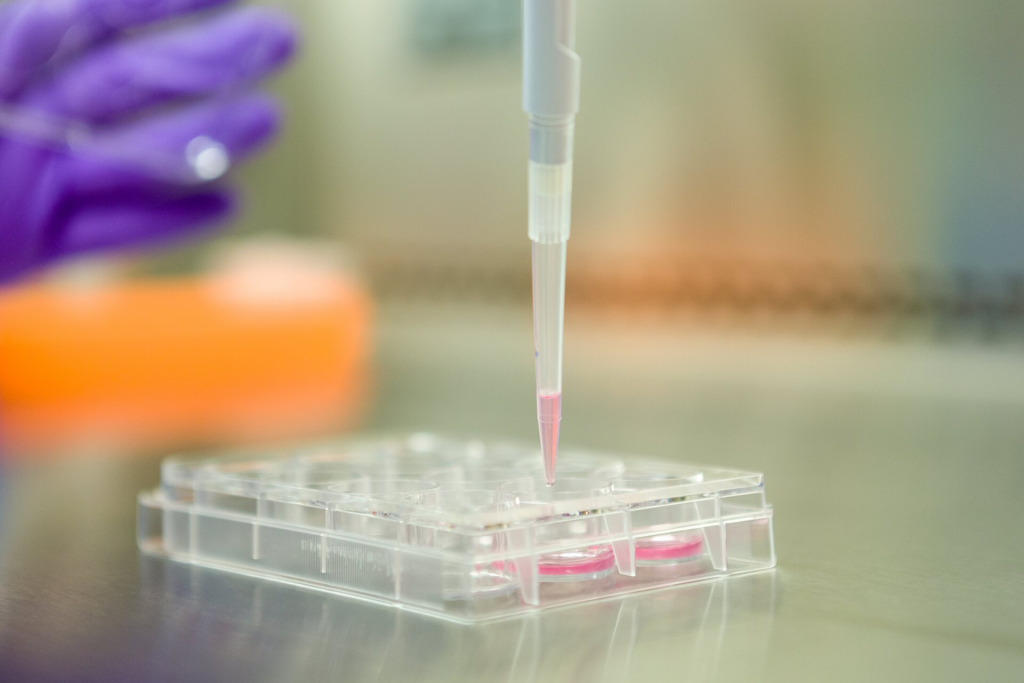 A cell culture plate. Credit: National Center for Advancing Translational Sciences via Wikimedia.
From the smallest bacteria to blue whales and redwood trees, all life on Earth is composed of cells. Until now, evolution has shaped all cellular life through adaptation under selective pressures. This is about to change.
In labs today, scientists are building life-like systems from scratch. These synthetic cells could someday be used in medicine, environmental cleanup, or manufacturing. Imagine spraying biosensing cells on a wall to test for hidden mold or swallowing a pill full of dehydrated cells that blossom into an antibiotic treatment in the gut. Some synthetic cells will be designed to reproduce, others will not. Some may function more like a chemical than a typical organism.
These potential developments are yet to come; the field of synthetic cell biology is still young. In July, however, scientists at the University of Minnesota reported that they had produced functioning cells built from the ground up. The team reported that the cells reproduced for several generations, though they lacked some standard components of natural cells.
The advent of synthetic cells has promoted speculative concern about future risks—cells that can outcompete natural life, say—but, for now, the technology raises more immediate questions: How long can such cells persist in the environment? Will they affect ecosystems or the human microbiome? Although the US government is engaged in the process of modernizing biosafety policies, current oversight practices remain ill-suited to regulating the production of synthetic cells. The technology will straddle scientific areas like chemistry and biology and regulatory domains such as environmental protection and human health.
We are co-authors of a recent report from the National Academies of Sciences, Engineering, and Medicine that analyzes where this technology may be headed, especially as regards its safety, security, and environmental implications. And as the Minnesota announcement makes clear, it’s time for scientists and policymakers to get serious about answering the questions synthetic cell biology raises.
Why current rules don’t fit. Biosafety oversight in the United States has been shaped by decades of experience with genetically engineered organisms and recombinant DNA. The rules in use today lay out a system for assessing risk, assigning laboratory containment levels, and reviewing experiments involving recombinant and synthetic DNA. At the core of that system is an approach that considers the source of genetic material, the characteristics of the organisms involved, and the risks associated with the proposed research.
Synthetic cells challenge this approach. They can be built using DNA sequences that do not exist anywhere in nature, meaning there may be no natural source or behavior with which to compare a new cell.
More broadly, whether a product contains DNA or not may not represent the biggest question mark when it comes to a proper risk assessment of synthetic cell technology.
For example, though a hypothetical spray-on biosensor that detects mold might contain genetic material, it could be designed to not replicate or spread. Yet, under National Institutes of Health (NIH) guidelines and institutional biosafety review processes at universities and other facilities, the presence of recombinant or synthetic nucleic acids and the potential for replication are important considerations when determining the appropriate level of laboratory review and containment.
Putting aside the NIH’s regulatory perspective, if that same biosensor were developed for use outside the laboratory, it would also raise environmental and public health questions that fall under other authorities.
Could a synthetic cell system persist longer than intended? Could it spread beyond a target site? Might it produce unexpected byproducts or affect surrounding ecological processes? These are the questions that may matter more than slotting a synthetic cell system into an established regulatory category.
Oversight needs to follow function. Recognizing the challenges with regulating synthetic cell technology, the National Academies report recommends that the NIH, working with the Environmental Protection Agency (EPA) and other federal agencies update and, where necessary, replace existing guidance, so oversight can better address rapidly advancing engineering biology and emerging technologies such as synthetic cells. An interagency working group should develop and apply such oversight tools consistently across agencies and stages of research and development.
Existing rules were developed at a time when chemicals and engineered organisms could be treated as separate categories. Core guidance like the NIH’s Guidelines for Research with Recombinant and Synthetic Nucleic Acid Molecules was developed for an earlier generation of research practices, when most engineered biological systems fit more neatly into established categories. Synthetic cells, of course, can blur these lines.
This creates challenges because different agencies evaluate different aspects of a technology at different points in its research and development lifecycle.
The NIH’s current guidelines only govern research involving recombinant and synthetic nucleic acids in contained settings. Outside the laboratory, however, the Department of Agriculture (USDA), the EPA, and the Food and Drug Administration (FDA) oversee genetically modified products according to their intended use and each agency’s authority. Genetically modified crops provide an example of engineered biological products used outside containment, but synthetic cells may not fit neatly within existing regulatory pathways because they may not look anything like a conventional organism.
A more practical approach to safety oversight of synthetic cells would start with how a system behaves, rather than how it fits into regulatory buckets. It would focus on a shared set of questions. How long does a system remain active? Can it spread? What environments will it encounter? What is it designed to do? An interagency working group could look at those issues uniformly and across applications and development processes making it easier to evaluate both risks and benefits.
Consider a non-replicating synthetic cell designed to decontaminate soil. Regulators should ask if its genetic material could persist or transfer to soil microbes, whether degradation produces harmful byproducts, how far the cells could move through soil or runoff, and whether they could be detected after release. A risk-benefit assessment could then link those findings to a specific decision: contained testing; a limited field trial with monitoring; or redesign, if persistence or spread cannot be adequately controlled.
The NIH’s guidelines provide an important framework for evaluating laboratory research involving recombinant and synthetic nucleic acids, but synthetic cells may raise questions that extend beyond laboratory biosafety. The goal should not be to create an entirely new regulatory system, but to harmonize existing environmental and biological oversight and make it more adaptive as synthetic cell technology evolves.
Time to act. Looking further ahead, some researchers are beginning to explore concepts involving non-traditional biochemistries and mirror-image biological systems, sometimes referred to as mirror life. A synthetic mirror bacterium, built with forms of DNA and proteins not found on Earth—should it escape containment—theoretically might evade some human and animal immune defenses and interact with natural ecosystems in unfamiliar ways. It might proliferate uncontrollably, consuming resources and outcompeting other life forms. While this is speculation, this example illustrates why governance discussions cannot wait until products hit the market.
Bioengineering is increasingly reaching beyond the modification of existing organisms. Scientists will soon be building new systems with defined behaviors, programmable functions, and in some cases, built-in limits on how long they can persist or where they can operate.
As with many technologies, in the field of synthetic cell research, the tools are advancing quickly, while many of the systems used to evaluate them were built for a different era. The time to catch up is now.
Together, we make the world safer.
The Bulletin elevates expert voices above the noise. But as an independent nonprofit organization, our operations depend on the support of readers like you. Help us continue to deliver quality journalism that holds leaders accountable. Your support of our work at any level is important. In return, we promise our coverage will be understandable, influential, vigilant, solution-oriented, and fair-minded. Together we can make a difference.
Keywords: mirror life, synthetic biology
Topics: Biosecurity
Get alerts about this thread
0 Comments
Oldest

David Gillum
David Gillum is associate vice president of compliance and research administration and adjunct faculty in the School of Public Health at the ... Read More

Peter A. Carr
Peter A. Carr is a senior principal engineer at RTX BBN Technologies, where he leads research and development at the intersection of synthetic ... Read More