Congress and Trump’s policies on research risks wouldn’t have prevented recent lab incidents. Here’s what to do
By Sumnima Singh, Anemone Franz | Opinion | June 29, 2026
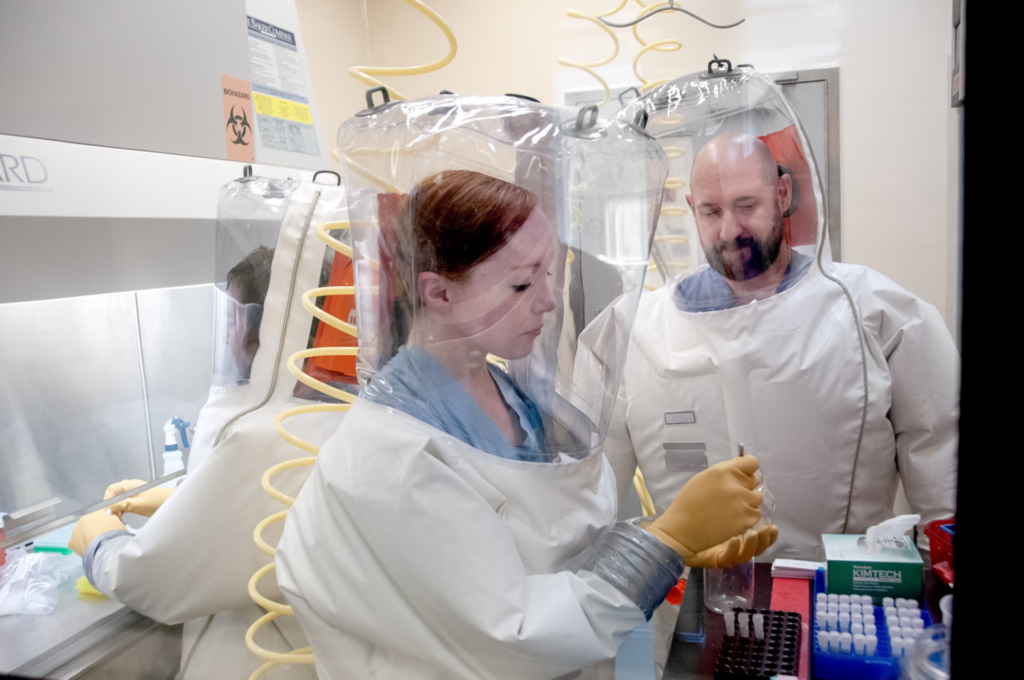 Researchers at the Integrated Research Facility, a government biological laboratory at Fort Detrick. Credit: National Institute of Allergy and Infectious Diseases via Wikimedia Commons.
In March 2025, a researcher at one of the several government biological research labs at Fort Detrick in Maryland found a large hole in their Biosafety Level (BSL) 4 containment suit. The Integrated Research Facility (IRF) operated by the National Institutes of Health (NIH) was the sort of place where scientists studied Ebola and other deadly viruses. Not something one would want to do without protective gear. Researchers wore pressurized containment suits to keep themselves safe from the pathogens they studied. But someone, it seems, had deliberately ripped a hole in one of them.
The Frederick News-Post, a Fort Detrick-area paper reported that an investigation found that parts of the hole’s opening looked cleanly cut whereas others looked “forcefully separated.” To make matters worse, the lab’s safety problems didn’t stop with the hole. Staff had been knowingly entering inaccurate information on suit test logs. Damage was going unreported and unrepaired. For an unknown period, all the people who entered the maximum containment facility relied on these false records for their safety.
By April 2025, the facility had been ordered to cease research and was being restructured. NIH Director Jay Bhattacharya later wrote on X that a personal dispute had led someone to rip a hole in the containment suit. A “lover’s spat,” Fox News reported an anonymous official as saying, had caused work at the critical facility to grind to a halt.
The problems at the Integrated Research Facility weren’t the first to afflict the US biodefense enterprise. Six years earlier, at the US Army Medical Research Institute of Infectious Diseases (USAMRIID), another Fort Detrick-based biological lab, flooding had damaged the steam sterilization plant. The facility had shifted to a complex chemical decontamination process, and workers didn’t follow the new procedures consistently; certifications lapsed, and equipment leaked. Despite the accruing breakdowns in biosafety at the facility, the problems persisted for more than a year until a routine Centers for Disease Control and Prevention (CDC) inspection in June 2019. A subsequent research registration suspension disrupted the Defense Department’s countermeasure pipeline for months.
The COVID pandemic and the persistent debate over whether it began in a laboratory in China have driven a recent push to reform US biosafety policy. Congress is considering at least two bills on the subject, and President Trump signed an executive order related to pathogen research early in his term. But there is one problem with these proposals: None would have caught the problems at the Fort Detrick labs, lapses that under different circumstances might have caused outbreaks.
US high-containment labs. The United States built its high-containment laboratories over decades, each lab answering a different gap in the country’s ability to detect, study, or respond to biological threats.
When letters stuffed with anthrax spores were sent to political and media figures in 2001, investigators on the so-called “Amerithrax” case faced significant gaps in their ability to attribute the attacks to a suspect. The field of microbial forensics was new, and no dedicated facility existed to integrate bio-forensic analysis with the evidentiary standards required for criminal prosecution. Authorities sent samples from the letters to multiple laboratories. The investigation took years, and the results were contested. In part for those reasons, the Department of Homeland Security established the National Biodefense Analysis and Countermeasures Center (NBACC) to support a forensic mission. It has since provided bio-forensic analysis for federal law enforcement investigations across a wide range of cases.
The US Army research lab at Fort Detrick addresses an equally consequential requirement. As the only Defense Department facility operating at the highest biosafety level, BSL-4, USAMRIID develops the medical countermeasures that protect US soldiers from biological attack, including research that contributed to the development of BioThrax, the anthrax vaccine given to hundreds of thousands of service members, raxibacumab, an antitoxin used to treat inhalation anthrax, and an Ebola virus vaccine. Replacing such a facility would take years and cost billions of dollars, before a single researcher returned to work.
The NIH’s Integrated Research Facility, whose research operations are now suspended, has MRI and PET-CT scanners in its maximum containment environment, enabling researchers to observe what pathogens do inside a living body without removing animals from containment. These data can be used by the Food and Drug Administration (FDA) under its Animal Rule for approving drugs when human trials are not ethically feasible. Very few labs worldwide can do what’s done at the facility. The ongoing Ebola outbreak in the Democratic Republic of the Congo and Uganda, which the World Health Organization (WHO) declared a public health emergency of international concern, illustrates what is at stake. The outbreak of Bundibugyo, an orthoebolavirus for which no approved vaccine or treatment exists, is exactly the kind of threat US government high-containment labs were built to address.
Beyond their individual research contributions, these three facilities together cover capabilities central to US biological security: the capacity to detect a biological attack, develop countermeasures against it, prosecute those responsible, and protect the forces deployed in response. Visible investment in that infrastructure also signals to allies and adversaries alike a level of biodefense commitment for which no policy statement can substitute.
Flawed reforms. Political consideration of biosafety reforms has generally proceeded along two lines in recent years. Some legislators have argued that the risks of the research at high-containment labs outweigh the benefits and that the facilities should either be closed or severely restricted. Others have focused on strengthening research oversight through three major proposals: the Risky Research Review Act, which would create an independent board to review and approve high-risk federally funded research; the Preventing Illegal Laboratories and Protecting Public Health Act, which requires pathogen transfer logbooks and mandates a strategic evaluation of these facilities; and Executive Order 14292, signed in May 2025, which paused federally funded gain-of-function research and directed development of a new pre-grant-award review framework. All three focus their attention on the authorization stage, on what research should be permitted and funded, rather than on how already-authorized facilities are operated day-to-day.
The difficulty is that neither the compromised suit at the Integrated Research Facility nor the decontamination failures at the US Army lab were caused by an inadequately reviewed research proposal. A board that scrutinizes research proposals before funding is awarded would not have detected falsified inspection logs, noticed equipment leaking in a containment room, or identified the gradual procedural drift that accumulated inside an institution with every incentive to manage problems quietly. Pre-award review closes a real gap, but authorization-stage controls cannot substitute for ongoing operational accountability.
These are structural conditions, not failures of individual judgment. Recent empirical work on biosafety governance finds that underreporting and procedural drift are often linked not simply to negligence but to institutional pressures involving staffing constraints, operational continuity, funding limitations, workforce capacity, and uncertainty about how regulators will interpret disclosed incidents. Implementation failures emerge less from the absence of rules than from gaps in operational oversight capacity, workforce support, institutional learning systems, and day-to-day accountability mechanisms.
The safety literature contains a concept called normalization of deviance: a pattern in which small departures from protocol accumulate gradually in high-reliability organizations until what was once exceptional becomes routine. Near-misses go unreported because reporting them creates reputational risk, and institutions develop increasingly sophisticated compliance documentation while losing the ability to recognize that actual practice has diverged from it. The sociologist Diane Vaughan documented the same dynamic in her study of the Space Shuttle Challenger disaster, and it is precisely the failure mode that no proposal-stage review board will ever be positioned to catch.
Potential models. Aviation and nuclear regulation have addressed structurally analogous problems, imperfectly but demonstrably.
The Nuclear Regulatory Commission (NRC) does not simply approve reactor designs and trust operators to run them safely. It conducts unannounced inspections and has the authority to require corrective action and suspend operations. The Federal Aviation Agency (FAA) created a non-punitive reporting system that allows pilots and crew to disclose near-misses without fear of punishment, generating a continuous flow of operational data. Regulators can spot systematic problems before they become disasters. The Chemical Safety and Hazard Investigation Board, which investigates industrial chemical accidents, separates investigation from enforcement entirely, so that honest accounts of an accident can be gathered without the distortion that comes from an assessment of liability. Biosafety lacks these features. There is no mandatory independent inspection program, no non-punitive reporting system, and no single body accountable for biosafety, a mission which is instead divided across at least eight programs in four federal agencies. A 2023 analysis found that 17 of 33 expert biosafety recommendations made in 2014 and 2015 remained unimplemented eight years later, a record that reflects a governance system structurally unable to act on what it already knows.
What should change. The failures documented in both the Integrated Research Facility and the US Army lab incidents carry costs beyond immediate questions of safety–from delayed forensic investigations to suspended vaccine development. Yet political pressure to do something about the problems that surfaced in the incidents may not automatically produce better safety. Under political pressure, institutions tend to prioritize what is visible over what is effective, narrowing their research toward routine, less innovative work and their safety practices toward documentation that satisfies oversight on paper. Facilities optimized this way risk becoming less capable of responding to novel biological threats over time.
What is needed is governance designed to change institutional behavior rather than institutional appearances. That means independent inspectors who can show up unannounced at US high- and maximum-containment facilities and gain access to camera footage and logs as needed. Labs need consistent good laboratory practice (GLP)-style documentation for every sample and experiment. They need to eliminate unmonitored spaces where unsafe behavior can go undetected. A reporting system should reward disclosure rather than suppress it. Binding safety standards should apply regardless of who funds research. These are the features that distinguish effective operational oversight in nuclear and aviation safety from the self-policing model of biosafety governance.
The window for reform is open, but not indefinite. Public attention fades, and if current proposals pass as written—a big if, granted—the problem will look solved while the operational gaps that produced both incidents remain open. Independent oversight, applied at the operational stage, is the reform that evidence supports.
The log said “inspected,” but the suit was not. That gap is what independent oversight should exist to close.
Together, we make the world safer.
The Bulletin elevates expert voices above the noise. But as an independent nonprofit organization, our operations depend on the support of readers like you. Help us continue to deliver quality journalism that holds leaders accountable. Your support of our work at any level is important. In return, we promise our coverage will be understandable, influential, vigilant, solution-oriented, and fair-minded. Together we can make a difference.
Keywords: pandemic prevention
Topics: Biosecurity

Sumnima Singh
Sumnima Singh is a senior AI x biosecurity fellow at the Cambridge Boston Alignment Initiative, where she focuses on AI-enabled biological risk. She ... Read More

Anemone Franz
Anemone Franz is a visiting research fellow at the American Enterprise Institute, where she focuses on biosafety and biosecurity. Previously, she ... Read More









As a Laboratory Director for ove 40 years I can validate everything highlighted in this article. Accredited Laboratory Scientists have so little time to achieve many tasks outside just testing that they fear repercussions for any documented errors. Less focus on blame and more on GLP along with stronger oversight organizations would be a great first step. Unfortunately with the current Administrations focus less on efficiency and more on personal agendes I do not envision this will occur.