Why Trump’s nuclear blackmail of Iran failed spectacularly
By Jack Kennedy | Analysis | July 7, 2026
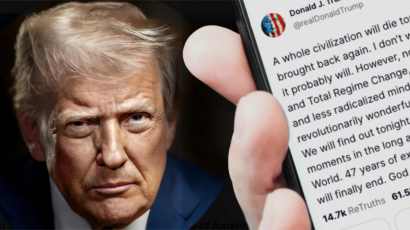
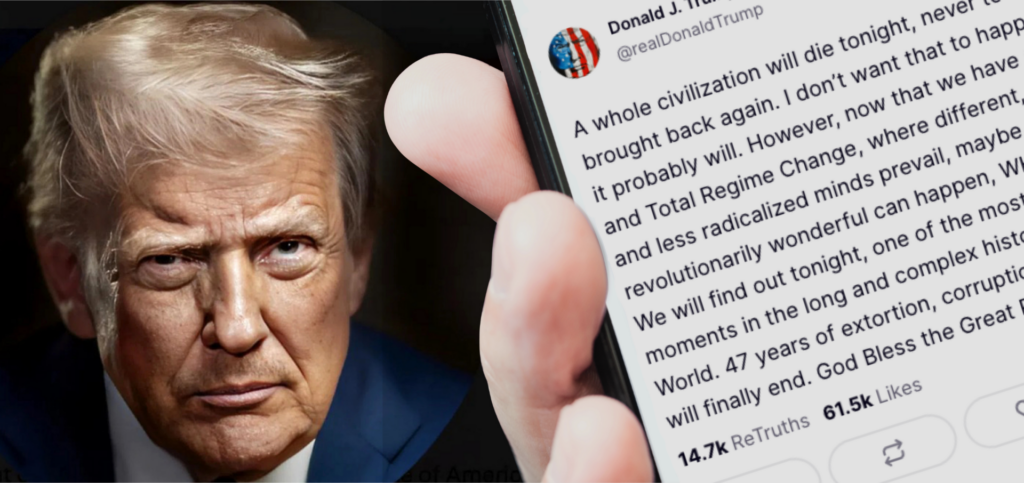 On April 7, President Trump posted a message on his Truth Social platform asking Tehran to agree to a ceasefire or face severe consequences, in what many considered as being an implicit nuclear threat. (Illustration by François Diaz-Maurin; original photo by KLYONA / depositphotos.com)
Listen to this article:
Listen to this article
--:--
This audio was generated using an automated voice. Learn more.
On the morning of Tuesday, April 7—38 days into the US-Israeli war on Iran—President Donald Trump posted on his social media platform, Truth Social, that “a whole civilization will die tonight, never to be brought back again.” He added that the promised destruction could be averted—“maybe something revolutionarily wonderful can happen”—if, he implied, the Iranian government made a deal with him.
The post capped off a series of escalating threats the US president had made towards Iran. He had set a deadline—first April 7, then moved to April 8—for Tehran to agree to a ceasefire and threatened increasingly severe consequences as it approached. Among them, Trump threatened to destroy civilian infrastructure on what he called “Power Plant Day and Bridge Day.”
The statements were condemned around the world, from the UN Secretary General to the Pope. Deliberate targeting of civilian infrastructure is a war crime; eradicating an entire nation or culture would be genocide, and threatening to commit genocide is itself a crime.
But many people read the threat with an additional layer: Trump was threatening to use nuclear weapons.
The logic is simple enough: Destruction on the scale the president promised would be essentially impossible to achieve using conventional munitions, making a nuclear strike the obvious implication of Trump’s threat.
Interpreted that way, Trump would enter a small club of leaders who, finding themselves locked in apparently unwinnable wars, have reached for the threat of nuclear escalation to try to secure a favorable outcome on their own terms. Richard Nixon tried it in 1969, putting US nuclear forces on alert across the globe to scare the Soviet Union and North Vietnam into coming to the table to end the Vietnam War, then about five years in. Most familiar to everyone today is Russian President Vladimir Putin’s repeated nuclear threats during his full-scale invasion of Ukraine, which reached its peak in October 2022 when the Russian army appeared to be wavering.
There’s every reason to believe the US president was doing exactly this, invoking the nuclear specter to try to scare Tehran into surrender after conventional bombing failed to do so. About 11 hours after Trump’s Tuesday morning post, the parties did indeed agree to a ceasefire. But that ceasefire saw Tehran give up nothing, and when a more lasting peace was agreed two months later, it was largely on Iran’s terms.
In other words, Trump’s threat failed. It was probably always going to.
Diagnosing the threat. President Trump did not make an explicit nuclear threat, in that he didn’t use the word “nuclear.” But many nuclear threats don’t. One prominent threat from Vladimir Putin in the early days of the Ukraine War was similarly euphemistic, promising “consequences will be such as you have never seen in your entire history” to any state opposing Russia.
Later on April 7, after Trump’s “civilization” post, Vice President JD Vance said that the United States might employ capabilities they “so far haven’t decided to use” in the war. After some commentators noted this could imply nuclear weapons, an official White House X account shot back that “literally nothing [Vance] said here ‘implies’ this, you absolute buffoons.” However, it’s difficult to imagine what else it could have meant; the US military has used an exceptionally wide range of platforms and weapons against Iran, including its largest single conventional munition.
The White House denial itself means little: Denials often are thrown in alongside nuclear threats. In March 2022, a Kremlin spokesperson insisted that “no one is thinking about using, about—even about [the] idea of using a nuclear weapon.” Threats, both implicit and explicit, continued unabated. Moreover, the denial extended only to Vance; asked if Trump’s original post meant he was considering nuclear use, the White House Press Office declined to definitively say he wasn’t and added that “only the President knows where things stand and what he will do.”
The core issue is that it can be difficult to define when a nuclear threat has been made because in almost every case—even when the nuclear dimension is explicit—the threatening party purposefully maintains some ambiguity. In theory, this gives the threatener room to maneuver; by not clearly committing to nuclear use under a given condition, it can back down without damaging its reputation and credibility. And since nuclear weapons are so frightening, even an ambiguous threat may have coercive value.
According to White House sources, Trump believes “seeming unstable could help spur the Iranians to negotiate.” This follows in the footsteps of Nixon’s infamous “madman theory,” which held that if he appeared unconstrained and capable of unlimited escalation—including past the nuclear threshold—this could be a powerful coercive tactic.
Ultimately, the most obvious and compelling reason to call it a nuclear threat is that it was widely interpreted as one.
Those who interpreted Trump’s post as a nuclear or potentially nuclear threat include former Vice President and Democratic presidential nominee Kamala Harris and other US Democratic politicians; former Trump allies Anthony Scaramucci and Tucker Carlson; reporters for outlets like The Atlantic, The New Republic, AFP, and the Associated Press; retired US Army General Shawn Harris; Pervez Hoodbhoy writing in the Bulletin, and many more.
Apply the duck test: If it sounds like a nuclear threat, is treated by a great many people as such, and the threatener doesn’t definitively deny it is a nuclear threat, then it is probably a nuclear threat. Whether Trump ever seriously considered using nuclear weapons against Iran is immaterial: A bluffing threat is still a threat.
The results. After the April 8 ceasefire was announced, Washington and Tehran both claimed victory. Trump said it had been agreed because “we have already met and exceeded all Military [sic] objectives,” while the Iranian government portrayed it as a “victory against the United States and Israel.” There was nothing to show for Trump’s last-minute threats. The ceasefire was mostly just that: a cessation of active combat. This overwhelmingly benefited Iran, which, despite occasionally destructive retaliation across the region, was still being bombed much more than it was bombing. The sides agreed to negotiations—from very different starting points—which quickly fell apart.
Most crucially, Iran maintained its blockade of the Strait of Hormuz. The United States protested that this was “not the agreement we have” and imposed a counter-blockade on Iranian ports, but the waterway remained closed. Clearly, the ceasefire was not a matter of Tehran being intimidated into capitulation but primarily a climbdown by Washington.
Over the subsequent two months, the truce largely held, despite numerous violations. And on June 17, Washington and Tehran signed a memorandum of understanding (MOU), solidifying the ceasefire pending a subsequent, final agreement due by mid-August. The immediate consensus was (with some exceptions) that the MOU represents a US defeat, and a large one. Trump himself said that the deal had been signed to prevent a “worldwide depression” caused by the Hormuz blockade.
Iran has conceded nothing from the pre-war status quo, and both parties have lifted their respective naval blockades. In return, Tehran has been promised relief from pre-war sanctions and hundreds of billions of dollars for reconstruction and economic development.
The United States, by contrast, has conceded on all of its war goals. Initially aiming for regime change, Trump now says of Iranian leaders that they are “nice to deal with … strong people, smart people … not radicalized.” Having been adamant that Iran should have no ballistic missiles and no nuclear program of any kind, Trump now says it would be “unfair” for Tehran not to have both.
Trump’s blackmail failed in the proximate sense, with Tehran making no concessions and remaining in control of the Strait. In the broader sense, it failed catastrophically: Ultimately, the United States was the party forced to make concessions to end the war, buckling under the cumulative economic pressure of the Hormuz blockade.
Why nuclear blackmail fails. Fundamentally, nuclear coercion lacks credibility. As international relations scholars Todd Sechser and Matthew Fuhrmann conclude, “it is exceedingly difficult to make coercive nuclear threats believable.”
Blackmail features an imbalance of stakes that deterrence does not. The use of nuclear weapons, even against an enemy that cannot retaliate, would likely come with huge political costs and unpredictable ripple effects. It’s one thing to convince your adversaries you’ll accept these costs if your country is being invaded, when the alternative is mass death, domination by a foreign power, and so on. It’s another thing entirely to insist you’ll do so to avoid making political concessions in a war of choice.
However, Trump got closer than most leaders have, historically. His rhetoric was treated by many as somewhat credible and therefore alarming. US politicians who demanded that Trump clarify he was not threatening nuclear use would not have done so if that threat were obviously implausible. “Will Trump nuke Iran” was, for a time, a question worth considering seriously.
How did he manage to convince so many that his threat was real? Reputation.
By starting the Iran war, Trump has made clear he is not overly bothered by legality, ethical norms, or domestic or international disapproval. His other actions in office—from the capture of Venezuelan President Nicolas Maduro to his attacks on US democracy—have also helped build his reputation as a president constrained only by his “own morality.”
This has parallels to Putin’s threats to use nuclear weapons in support of his invasion of Ukraine. These threats were treated as potentially plausible precisely because his decision to invade Ukraine in the first place was so shocking and laid waste to so many assumptions about his limits.
Nixon may have craved a “madman” reputation, but there’s no evidence he ever had it. According to longtime Soviet Ambassador Anatoly Dobrynin, while Moscow was initially wary of Nixon given his anti-Soviet rhetoric, they came to see him as “more pragmatic and realistic than other Cold Warriors,” using anticommunist zeal as “just a convenient means to climb the political ladder.” Nixon failed to establish himself as a “madman” because he never did anything to earn that reputation. Trump and Putin, by contrast, have real track records of extreme behavior.
Still, Putin mostly failed, and Trump failed completely. In the latter case, the likely reason was the imbalance of stakes: For Washington, this was a war of choice; for Tehran, it was existential.
One notable difference between Trump’s nuclear blackmail and that of Putin and Nixon was that the latter two channeled their threats through third parties: Putin’s coercion initially focused mostly on NATO states whose material support was (and is) essential to Kyiv’s resistance. Equally, Nixon’s threat was calculated to be picked up by the Soviet Union, whose support kept North Vietnam afloat and fighting. By contrast, Trump has only threatened Iran directly, not least because the country has essentially been fighting alone. This third-party approach has a strategic logic: NATO and the Soviet Union had much less at stake than their respective allies and much less to lose if they backed down.
Nixon’s attempt still failed, largely because the signaling was too opaque and Moscow wasn’t sure what was being threatened or why. On the other hand, Putin’s nuclear threats in Ukraine achieved limited success: Western aid to Kyiv was initially constrained for fear of provoking escalation, only ramping up slowly over time.
In both cases, though, the primary target of those threats was particularly unmoved. Kyiv has consistently been less concerned about escalation than its allies, requesting a NATO-imposed no-fly zone early in the war even at the risk of direct combat between Russian and Western forces. In October 2022, when Moscow appeared to be threatening nuclear use against Ukraine itself, Kyiv did not slow or halt its ongoing offensive.
While we don’t know if North Vietnam even comprehended Nixon’s 1969 nuclear threat, a similar, more public attempt to threaten Hanoi in December 1972 also failed. After negotiations to end the war broke down in their final stages, Nixon issued North Vietnam with an ultimatum to immediately resume talks, “or else.” Hanoi ignored him.
In both cases, these states were fighting for stakes they considered existential: Ukraine for its territorial integrity and independence, North Vietnam to unite its country and drive out what it viewed as an ongoing colonial occupation by the United States. Both states had also already endured enormous destruction, stiffening their will to resist and making them harder to shock with threats of further attack.
It was the same in Iran. For the leaders of the Islamic Republic, losing this war would have meant losing everything. The original US-Israeli war goal was regime change. After they failed to secure a quick victory, Tehran could potentially have made peace based on less maximalist concessions. But capitulation to its two archenemies would have dealt a devastating, likely fatal blow to the regime’s legitimacy at home. The war has also radicalized the regime and its supporters and strengthened hardline factions, such as younger officers of the Revolutionary Guard.
For this new, more determined Iranian government, balancing the consequences of surrender against the probability that Trump was bluffing, holding firm was the obvious choice. Ultimately, Trump failed because he tried to shove someone whose back was against the wall.
Consequences of Trump’s failure. On April 23, two weeks after his threat, President Trump seemed to disavow his previous behavior: “No, I wouldn’t use it,” adding that “a nuclear weapon should never be allowed to be used by anybody.”
Despite Trump’s failure to coerce Tehran and his ultimate concession in the war, his attempt will have consequences—all of them negative. Following on from Putin, it will serve to further normalize overt nuclear saber-rattling. Even aside from the nuclear dimension, explicit threats to target civilians and civilian infrastructure are harmful to the international rule of law, which is already under strain.
Right from the start, the Iran war risked encouraging nuclear proliferation rather than halting it. Tehran’s attempt at nuclear hedging clearly failed. Other regimes in Iraq, Libya, and Syria that considered going nuclear but didn’t commit tell the same story. Meanwhile, nuclear-armed North Korea remains secure.
By raising the possibility that non-nuclear states are vulnerable not only to conventional attack by powerful rivals but possibly nuclear coercion or attack too, Trump has reinforced this lesson. Countries that have long considered going nuclear, like South Korea, will take note. Here, too, Trump is continuing the work that Putin started in Ukraine, and the world will be more dangerous for it.
Worse still, maybe, there is the risk of consequences to Trump himself.
Should the famously thin-skinned president feel humiliated by the loss of this war, Trump may become more belligerent and unpredictable as he attempts to save his credibility—or pride. On June 28, with the ceasefire under renewed strain, he threatened to “militarily complete the job,” adding, “the Islamic Republic of Iran will no longer exist.” Trump’s behavior is hard to predict: Most of his threats are empty, but occasionally he will follow through with shocking violence, as the Iran war has demonstrated. But the more the US president feels embarrassed and no longer taken seriously, the more likely that next time he threatens catastrophe—whether in Iran or elsewhere—he won’t be bluffing.
Together, we make the world safer.
The Bulletin elevates expert voices above the noise. But as an independent nonprofit organization, our operations depend on the support of readers like you. Help us continue to deliver quality journalism that holds leaders accountable. Your support of our work at any level is important. In return, we promise our coverage will be understandable, influential, vigilant, solution-oriented, and fair-minded. Together we can make a difference.
Keywords: Donald Trump, Iran, Iran war, Richard Nixon, Trump administration, madman theory, nuclear blackmail, nuclear threats
Topics: Analysis, Nuclear Weapons
Get alerts about this thread
0 Comments
Oldest

Jack Kennedy
Jack Kennedy is the Bulletin's nuclear risk editorial fellow. He is a doctoral candidate and research associate at the Centre for ... Read More