Give negotiations a chance: How to turn Iran’s claimed right to enrich uranium into a new deal—and avoid a war
By Mark Goodman | Analysis | February 26, 2026
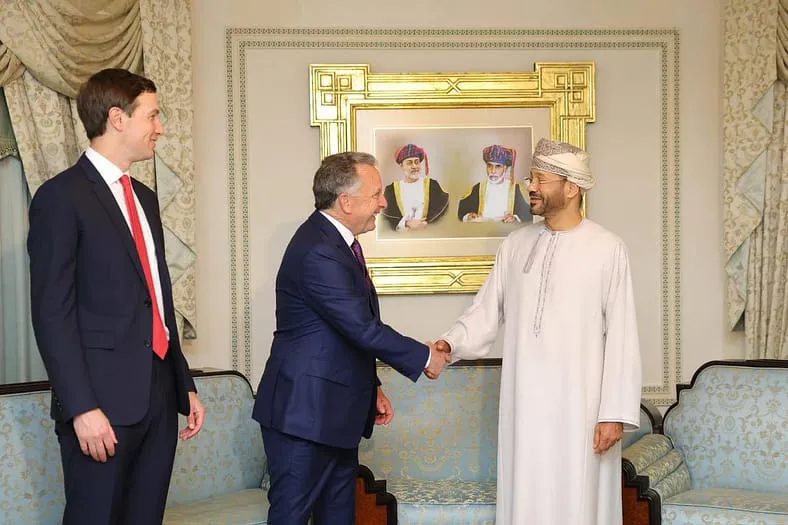 Oman will hold last-ditch talks about Iran's nuclear program to avert a military conflict between the United States and Iran on Thursday in Geneva. The International Atomic Energy Agency is said to join the talks as a technical observer of the negotiations. On Wednesday, Iran delivered a new draft proposal, which the United States reportedly said offers no flexibility on the central US demand for a complete halt to uranium enrichment on Iranian soil. (Credit: Foreign Ministry of Oman)
As the United States has assembled what President Donald Trump calls a “massive armada” of military forces around Iran, the two countries have held a series of negotiations over Iran’s nuclear program, mediated by Oman. A key question is whether Iran should be allowed to continue enriching uranium, and Iran’s assertion of a right to do so.
Iran says it is ready to scale back but not eliminate its enrichment program and its stockpile of highly enriched uranium if the United States recognizes that right. It is not clear whether the United States will accept this approach and whether a resolution to the nuclear issue will be sufficient to forestall a US military attack on Iran.
Although US negotiators have also raised the issues of Iran’s missile program, its support for proxy forces in the region, and its violent repression of citizens during anti-government protests, recent US statements have focused on Iran’s nuclear program.
What is the right to peaceful use?[1] The widespread peaceful uses of nuclear energy, science, and technology are rightly touted as a major benefit of the Nuclear Non-Proliferation Treaty (NPT) and the broader nuclear nonproliferation regime. These peaceful uses are surprisingly diverse and go far beyond nuclear power. They include using radiation to diagnose and treat cancer, or to control insect-borne infestations like screwworm and sleeping sickness, as well as the use of nuclear isotopes to monitor the environment and natural resources. The NPT and other nonproliferation agreements are designed to prevent the misuse of nuclear technologies and thereby provide confidence that fosters international cooperation in these areas.
But these peaceful uses of nuclear energy can also be a source of division when framed as a matter of rights.
Article IV of the NPT recognizes a general right to the peaceful use of nuclear energy, but this right is less than meets the eye. It is a sovereign right that is not granted by the NPT and does not entail a right to any specific technology. This article also expresses the right of parties “to participate in the fullest possible exchange” of nuclear technology for peaceful purposes. However, this does not entail a right to demand the transfer of technology from other countries or companies. Iran has long been a leader among developing countries in asserting these broader rights as an NPT party and has presented itself as a victim of discrimination and denial of those rights.
In fact, the requirements and prohibitions in the NPT do impose limits on the right to peaceful use in several important ways. Above all, the treaty bars its non-nuclear-weapon state parties from using nuclear technology to produce nuclear weapons under the pretext of peaceful use. Nuclear activities in those states must take place under International Atomic Energy Agency (IAEA) safeguards—a system of monitoring and inspections to verify that those activities remain peaceful and are not misused. Among the many nuclear technologies, uranium enrichment is particularly susceptible to misuse because it can produce weapon-usable highly enriched uranium.
Iran’s nuclear history. In 2002, the IAEA launched an investigation into Iran’s nuclear program, after public revelations that Tehran was pursuing undeclared nuclear activities. The IAEA investigation and inspections confirmed that Iran failed to declare its development of uranium enrichment technology and construction of a heavy water reactor suitable for plutonium production. The IAEA Board of Governors found Iran in non-compliance with its safeguards agreement, and the United States concluded that not only that Iran’s failure to declare those activities violated its safeguards obligations under Article III of the NPT, but also that Iran carried them out as part of a nuclear weapons program, and in so doing violated Iran’s NPT Article II obligation not to seek or receive assistance in the production of fissile material for weapons. In 2007, the United States said that Iran had halted its program to develop nuclear weapons in 2003, after its undeclared nuclear activities were exposed. And in 2011, the IAEA reported on the information it had acquired on the possible military dimensions of Iran’s nuclear program.
Despite a record of NPT violations, Iran has defended its nuclear activities as peaceful and legitimate, and Tehran has used claims about its nuclear rights to resist international pressure to limit them. Iranian leaders have also highlighted the development of nuclear technology in the face of international opposition as a symbol of national accomplishment and resistance to unfair discrimination and denial. When Iran speaks of its nuclear rights, it invokes concepts of fairness and national pride.
Minimum enrichment. Iran knows from experience that the United States has a different view and that Washington is unlikely to concede Tehran’s claimed right to enrich uranium. During President Barack Obama’s first term, Iran’s insistence on this right was an obstacle to negotiations, perhaps a deliberate one. Now, Iran’s assertion of its right is more likely a tactic to counter Washington’s insistence that Iran give up all uranium enrichment.
Iran has used its enrichment program for leverage in international negotiations. It did so by escalating the scale and level of its enrichment over the last several years to the point that, as of last June, it had over 400 kilograms of near-weapon-grade highly enriched uranium. (Uranium enriched to 60 percent uranium 235 is weapon usable, and 25 kilograms of this fissile material is considered by the IAEA to be a “significant quantity,” roughly enough for one nuclear weapon.) Tehran now says that it is willing to accept limits on its enrichment and to blend down or export its stockpiles of highly enriched uranium, but that it will not forgo enrichment altogether.
In turn for these concessions, Iran expects the United States to agree not just to forgo further military strikes but also to lift economic sanctions, both actions that will be tricky to negotiate.
The United States is reportedly considering whether to accept a “token” level of enrichment, in which Tehran would retain minimal enrichment capacity but with restrictions and safeguards to prevent diversion or misuse. This may be a small opening in otherwise stalled negotiations.
One potential compromise could be for Iran to agree to zero net enrichment, which means limited production of enriched uranium combined with steps to prevent the stockpile from growing. The previous Iran nuclear deal—formally known as the Joint Comprehensive Plan of Action (JCPOA), which President Trump abandoned during his first term—did something similar, requiring Iran to export any newly enriched uranium to Russia. But the scale of enrichment then was larger than the Trump administration would be likely to accept now, given how President Trump criticized the JCPOA for allowing Iran to maintain and even expand its enrichment capabilities.
A smaller-scale alternative would be for Iran to operate a few enrichment cascades but configure them to blend the enriched uranium product and the depleted uranium tails back to natural uranium, which effectively undoes the enrichment at the end of the process. This could be part of a research, development, testing, and demonstration program, both to show Iran’s technological prowess. If agreed upon, this process could also support a regional enrichment consortium—an idea that has been proposed in previous negotiations.
Iran already suggested that its enrichment program could form part of such a regional enrichment consortium meant to allow enrichment in the region in a way that limits the risk of nuclear proliferation. Each participating country (such as Iran, Oman, Saudi Arabia, and the United Arab Emirates) would have reliable access to reactor fuel, but without having its own enrichment facilities. Ideally, no single country would have sufficient control over the uranium enrichment process to appropriate the technology for a weapons program, and they would be deterred from trying by the fact that their regional rivals are watching. This is not a foolproof concept, but it is worth exploring as a way for Iran to retain some enrichment activities—albeit not large-scale—on its territory.
Finding common ground. The United States should be prepared to recognize a general right to peaceful use of nuclear energy, as expressed in the NPT. For example, the JCPOA stated explicitly that it would “enable Iran to fully enjoy its right to nuclear energy for peaceful purposes under the relevant articles of the [NPT] in line with its obligations therein.” But rather than get tied up in disagreements over whether Iran has a right to enrich, negotiators should focus on what practical steps Iran would take to limit enrichment and to provide the transparency needed to ensure its compliance with these commitments.
In such a deal, Iran could maintain that it preserved its rights while agreeing to limit the exercise of those rights in exchange for economic and security benefits. However, given the unilateral US withdrawal from the JCPOA, Iran would likely demand stronger assurances that those benefits would be realized. A mere recognition of its rights is unlikely to provide a meaningful assurance to Tehran.
The lead US negotiator, Steve Witkoff, said Iran was “probably a week away” from having enough weapons-grade uranium for a bomb, despite the US administration’s claim that the June 2025 US military strikes had obliterated Iran’s nuclear program. Although Iran retains much of the technical ability to weaponize, it is nowhere near possessing a nuclear weapon. Witkoff’s alarmist claim is therefore either mistaken or deliberately misleading. In any case, it seems aimed at pressuring Tehran even further and adding a sense of urgency to justify another possible US military attack. Either way, it is irresponsible rhetoric.
There is room for common ground to allow limited uranium enrichment in Iran, in which Tehran can claim it protected its right, while Washington avoids formally recognizing such a right. More important, successful negotiations would block Iran’s path to a nuclear weapon and remove Iran’s nuclear program as a justification for a US military strike against Iran.
But there is also a significant danger that each side will overestimate its own leverage, misjudge the other side’s redlines, and even escalate. With the massive—and still unexplained—US military buildup in the region and a famously impulsive president, such miscalculations could easily spark a war. Disputes over whether Iran has a right to enrich should not provide that spark.
Note
[1] For a more detailed analysis, see Mark Goodman, “The Right to Peaceful Nuclear Energy Use: A Disputed Matter,” Arms Control Today, Vol. 56, March 2026 (forthcoming).
Together, we make the world safer.
The Bulletin elevates expert voices above the noise. But as an independent nonprofit organization, our operations depend on the support of readers like you. Help us continue to deliver quality journalism that holds leaders accountable. Your support of our work at any level is important. In return, we promise our coverage will be understandable, influential, vigilant, solution-oriented, and fair-minded. Together we can make a difference.
Keywords: IAEA safeguards, Iran, Iran nuclear deal, Iran nuclear facilities, Iran nuclear program, JCPOA, Middle East, NPT, Oman, Trump administration, US military, United States, nuclear proliferation, nuclear reactors, nuclear regulation, reprocessing, uranium enrichment
Topics: Analysis, Nuclear Energy, Nuclear Risk, Nuclear Weapons

Mark Goodman
Mark Goodman is a former senior scientist at the US State Department who specialized in nuclear policy—nuclear energy, nuclear nonproliferation, ... Read More











The article in the footnote has now been published by Arms Control Today at https://www.armscontrol.org/act/2026-03/features/right-peaceful-use-nuclear-energy-disputed-matter It’s behind a paywall, so please subscribe or be patient. The paywall comes down after a month.