Is London shifting from nuclear deterrence to war-fighting?
By S.M. Amadae, Tom Stevenson | Analysis | July 10, 2026
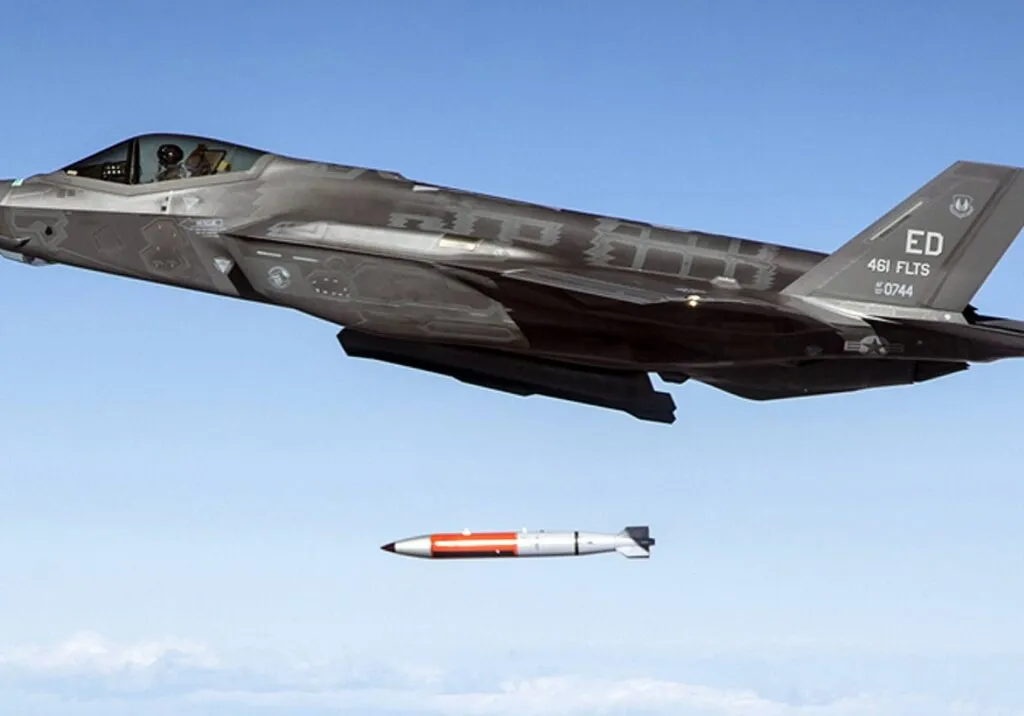 An F-35A fighter jet releases an inert B61-12 bomb during a dual capable aircraft (DCA) test flight in the skies above Edwards Air Force Base, California, on June 27, 2019. In June 2025, the United Kingdom announced plans to acquire 12 F-35As, and there are indications that in July 2025 the US Air Force may have moved B61-12 nuclear bombs to Royal Air Force Lakenheath air base, which has recently undergone a significant upgrade to reactivate a nuclear mission. (Los Alamos National Laboratory)
Listen to this article:
Listen to this article
--:--
This audio was generated using an automated voice. Learn more.
For most of the past three decades, one might almost have said the United Kingdom had a glowing record on nuclear non-proliferation: Britain was the only major nuclear power to operate a minimum deterrent based on a single delivery system; it supported international non-proliferation initiatives; and the UK government had spent 30 years reducing its nuclear stockpile. No more. Instead, London now builds momentum supporting a new wave of nuclear proliferation under the auspices of NATO’s nuclear sharing.
In the last five years, Britain has quietly moved to increase the maximum size of its nuclear stockpile and revise its nuclear doctrine, and it is now acquiring an additional nuclear capability. In concert with the United States, the UK government is expanding the deployment of non-strategic (tactical) nuclear weapons in a way that could destabilize the strategic balance in Europe.
In doing so, London is reversing decades of gradual progress on disarmament without serious analysis of the strategic implications or public consultation, and at a time when there is less support for nuclear diplomacy than at any point in recent history.
New systems and more weapons. In June 2025, the United Kingdom announced plans to acquire Lockheed Martin F-35As that are the first stealth fighter jets certified to carry variable-yield thermonuclear B61-12 gravity bombs. The 12 F-35As would be ordered in place of F-35B fighter jets, which are designed for use on aircraft carriers but are not nuclear-capable. At the Hague summit last year, the United Kingdom then announced it would be joining NATO’s air-launched nuclear mission and putting those planes to work carrying US nuclear bombs. Though it has still not been officially confirmed, US B61-12s were almost certainly moved to RAF Lakenheath in July 2025.[1] Media briefings at the time suggested the UK government was also in talks with Washington on acquiring non-strategic B61-12 bombs of its own, but no such agreement has publicly emerged yet.
On the surface, the United Kingdom’s decision to acquire tactical nuclear capability appeared to be part of a natural evolution in European strategic planning prompted by Russia’s invasion of Ukraine in 2022. But London’s acquisition of F-35As and the deployment of US B61-12s are just the latest examples of a longer trend in the United Kingdom’s nuclear posture. In 2022, RAF Lakenheath had already undergone infrastructure modernization necessary for the return of US nuclear weapons.
Before that, in 2021, the UK government decided to raise the maximum cap on the number of warheads in its arsenal by more than 40 percent. In 2010, the UK government stated that it would continue to reduce its warhead stockpile—at the time numbering 225 warheads—and cap its future arsenal at a maximum of 180 warheads. But in 2021, it suddenly raised the cap to 260 warheads. Despite being a reversal of decades of gradual reductions in the United Kingdom’s projected nuclear stockpile, that decision was slipped onto page 76 of the government’s Integrated Review of Security, Defence, Development, and Foreign Policy.
Policy implications. The United Kingdom has also made a quiet change to its nuclear doctrine, introducing a “right to review” the use of nuclear weapons against non-nuclear states under certain circumstances. Together with the decision to raise the warhead cap, this constituted a dramatic strategic change for which there was no discernible democratic mandate and no public discussion.
At the time, even the best-informed commentators on UK nuclear affairs were unaware of the motivation. One argument, put forward by nuclear historian Lawrence Freedman, was that a larger stockpile of 260 warheads might allow the United Kingdom to have two fully armed nuclear submarines (each potentially carrying a maximum of 128 warheads on 16 missiles) on patrol at once. That the increase in stockpile size was motivated by plans for the United Kingdom to have the option of acquiring a non-strategic nuclear capability only emerged later.
The decision to station B61-12s on UK soil amounts to a de facto settlement of the long‑running debate over adopting a doctrine of no‑first‑use or sole‑purpose, and over the future of tactical nuclear weapons in NATO. The deployment of high-precision, variable-yield counter-force weapons signals a willingness to carry out retaliatory or pre-emptive nuclear strikes on an adversary.
Due to their enhanced guidance systems, B61-12 bombs, coupled with the dual-capable stealth F-35A, also have the potential to alter the geopolitical balance in Europe. The UK B61-12 adoption paves the way for further proliferation of these weapons throughout Europe, cements the normalization of nuclear weapons, and challenges the guaranteed second-strike survivability of adversaries’ nuclear command and control and strategic weapons systems.
Since the end of the Cold War, the United States and, by extension, NATO have become, in the words of the now Under Secretary of Defense for Policy Elbridge Colby, “accustomed to escalation dominance,” the strategic objective of achieving battlefield superiority on all rungs of escalation. This aim relies on maintaining asymmetrical advantage, which is not a sound doctrine against a nuclear peer competitor: It is destabilizing and stokes further arms races.
The combination of F-35A fighter jets and B61-12 bombs gives NATO a stealth-enabled, precision counterforce tool designed to deter by denial by holding Russian nuclear and nuclear command and control assets at credible risk. In theory, they provide limited escalation-control options, such as pre-emptive or tit-for-tat strikes at tailored yield. These technological developments make Russian nuclear forces and command systems both more vulnerable in crisis and less certain for guaranteeing second-strike capability.
From arms control hero to nuclear war fighter. Until recently, UK efforts on exemplary disarmament were comparatively good. The United Kingdom was the only major nuclear state that had limited itself to a single deterrence system (the Trident submarine-launched ballistic missile). The UK government had made incremental reductions in its nuclear stockpile since 1980. With US B61s having returned to the United Kingdom, that record has now been overturned.
Given the lack of official transparency, it is worth revisiting the strategic rationale for increasing the deployment of B61-12 across NATO member states and the role non-strategic nuclear weapons are expected to play. During the Cold War, the Soviet Union overmatched the conventional military forces of Western Europe, particularly on land. To offset this conventional weakness, the United States deployed thousands of lower-yield tactical nuclear weapons throughout Western Europe and Turkey. The Soviet Union also maintained non-strategic nuclear options (though, unlike the United States, it formally adopted a ‘no-first-use’ nuclear doctrine).
But with the collapse of the Soviet Union, the strategic dynamic in Europe reversed.
Now Russia occupies the weaker position in the conventional military balance. The United States greatly reduced the number of non-strategic nuclear weapons deployed in Europe and eliminated its land- and sea-launched tactical nuclear weapons. Critically, however, it refused to change any aspect of NATO’s nuclear policy, which included the possibility of first use. Russia has since remedied some of its conventional arms deficit, and the current US government’s ambivalence about NATO does introduce some uncertainties. But Russian strategic documents consistently express concern about the conventional balance, something nuclear policy expert Kristin Ven Bruusgaard describes as “a sustained perception of conventional inferiority.” As the Centre for Strategic and International Studies noted in June 2024, “NATO’s cumulative capabilities far exceed Russia’s—even excluding the United States.”
American scholars of nuclear warfighting and counterforce strategy, Keir Lieber and Daryl Press, point out that now the military balance in conventional weapons favors the United States and NATO, the tide has turned. They observe that weaker states, like Russia in Europe, face large incentives to use nuclear weapons in a conventional war against a superior opponent, particularly if they fear battleground losses pose an existential threat to national sovereignty or regime stability.
Ukraine’s successful drone strikes against both Russia’s nuclear command and control early warning system and its strategic bomber fleet have been dramatic demonstrations of Russia’s limited capability to provide territorial security against homeland attacks. And the United States has launched two pre-emptive military operations crafted to initiate regime change in Venezuela and Iran. Russian leaders could perceive themselves as facing a greater existential threat now in a crisis with NATO.
US and allied defense planners should be especially focused on preventing escalation with Russia that might lead to a scenario in which nuclear use would be incentivized and seen as potentially beneficial. But instead, the United Kingdom and the United States are now expanding the deployment of tactical nuclear weapons that are designed for first use and honed for precision and pre-emptive attacks against hardened military targets.
No rationale, real danger. The strategic need for the United Kingdom to operate air-launched tactical nuclear weapons has not been clearly presented either by US officials or the UK government. In addition, these weapons arguably increase the United Kingdom’s reliance on US weapons platforms at a time of transatlantic political divergence.
The United Kingdom cancelled its domestic nuclear gravity bomb program nearly 30 years ago in response to the proliferation of ground-based anti-air systems. US nuclear bombs haven’t been deployed in Britain since 2008. The B61-12 program dates to the 2010 Nuclear Policy Review, which set out a full-scope life extension of the B61 gravity bombs deployed in Europe in the Cold War. A narrative can be presented that the F-35A and B61-12s are well-suited to make NATO’s nuclear sharing credible again, given the crisis of the Ukraine war, but the underlying planning dates to the early 2000s.
More seriously, the idea that any nuclear exchange with Russia could be limited to the sub-strategic level is dubious. There can be no guarantee that after initiating a nuclear war with tactical nuclear weapons, or even using them to retaliate against a nuclear strike, it would be possible to stop further moves up the escalatory ladder. Even the deployment of dual-capable F-35A fighter jets that also carry out conventional military missions raises the likelihood of accidental escalation into nuclear war: Adversaries have no way of differentiating whether in-flight F-35As are carrying conventional or nuclear warheads, and they may erroneously perceive an incoming nuclear strike.
The UK government and the United States should carefully revisit the assumptions that led to this point. There is no justifiable reason for the United Kingdom and NATO to expand non-strategic capabilities while also maintaining a no-first-use doctrine unless they are planning a pre-emptive nuclear strike deep into Russian territory, or the territory of another nuclear weapons state, or against a non-nuclear weapons state. NATO member states, like Finland and Poland, are promoting their participation in nuclear sharing and planning. Both understandably perceive an existential threat from Russia, and they are now also considering hosting US nuclear weapons and joining France’s forward deterrence initiative. But with the United Kingdom having already made that choice, it has the dubious distinction of leading the way in normalizing more first-use tactical nuclear capabilities in Europe without comprehensive analysis of the strategic implications. This nuclear brinkmanship, directly pertinent to the Ukraine war, offers the false promise of security for some at the cost of dooming security for all.
Note
[1] The piece does not argue that the United Kingdom already has its own F-35A fighter jets (which of course have not yet been delivered) “mated” to B61 bombs. But the movement of B61s to RAF Lakenheath is very definitely linked to the decision to purchase F-35As. The UK government formally announced as much last year at the Hague summit. The United States has already deployed B61s in the United Kingdom alongside its own air capability. But the meaning of the United Kingdom “joining NATO’s air-launched nuclear mission” is precisely that UK F-35As, once they arrive and the pilots are certified, would become what NATO calls “certified Allied aircraft” carrying US B61-12 bombs. There is no assumption here. More important, all these developments are very significant changes to the UK nuclear posture.
Together, we make the world safer.
The Bulletin elevates expert voices above the noise. But as an independent nonprofit organization, our operations depend on the support of readers like you. Help us continue to deliver quality journalism that holds leaders accountable. Your support of our work at any level is important. In return, we promise our coverage will be understandable, influential, vigilant, solution-oriented, and fair-minded. Together we can make a difference.
Keywords: B61, European security, F-35, NATO, Russia, United Kingdom, United States, first use, minimum deterrence, nuclear deterrence
Topics: Analysis, Nuclear Weapons
Get alerts about this thread
0 Comments
Oldest

S.M. Amadae
Sonja Amadae is the director of the Centre for the Study of Existential Risk at the University of Cambridge and a tenured political scientist at the ... Read More

Tom Stevenson
Tom Stevenson is a contributing editor at the London Review of Books. ... Read More