Russian nuclear weapons, 2026
By Hans M. Kristensen, Matt Korda, Eliana Johns, Mackenzie Knight-Boyle | May 14, 2026
On May 12, 2026, Russia announced the successful test launch of the Sarmat intercontinental ballistic missile in a video. The missile was fired from a test silo at the Plesetsk Cosmodrome in northern Russia, reportedly hitting its target at the Kura test range about 5,700 kilometers away. The RS-28 Sarmat is designed to replace the aging Soviet-era Voevoda (SS-18 Satan). The introduction of the Sarmat—initially scheduled for 2018—has been marked by years of manufacturing and technical delays, as well as numerous testing failures. It is the first known successful flight test since April 2022. (Credit: Russian Defence Ministry)
Russian nuclear weapons, 2026
By Hans M. Kristensen, Matt Korda, Eliana Johns, Mackenzie Knight-Boyle | May 14, 2026
Russia is in the late stages of a multi-decade-long modernization program to replace all of its Soviet-era nuclear-capable systems with newer versions. However, this program is facing significant challenges that will further delay the entry into force of these newer systems. In this issue of the Nuclear Notebook, we estimate that Russia now possesses approximately 4,400 nuclear warheads for its strategic and non-strategic nuclear forces—a slight increase from the previous year. The significant increase in non-strategic nuclear weapons that the Pentagon predicted five years ago has so far not materialized. A nuclear weapons storage site in Belarus appears to be nearing completion. The Nuclear Notebook is researched and written by the staff of the Federation of American Scientists’ Nuclear Information Project: director Hans M. Kristensen, associate director Matt Korda, and senior research associates Eliana Johns and Mackenzie Knight-Boyle.
This article is freely available in PDF format in the Bulletin of the Atomic Scientists’ digital magazine (published by Taylor & Francis) at this link. To cite this article, please use the following citation, adapted to the appropriate citation style: Hans M. Kristensen, Matt Korda, Eliana Johns, and Mackenzie Knight-Boyle, Russian Nuclear Weapons, 2026, Bulletin of the Atomic Scientists, 82:3, 221-254, DOI: https://doi.org/10.1080/00963402.2026.2659527
To see all previous Nuclear Notebook columns in the Bulletin of the Atomic Scientists dating back to 1987, go to https://thebulletin.org/nuclear-notebook/.
Russia is nearing the completion of a decades-long effort to replace most of its strategic and non-strategic nuclear-capable systems with newer versions. But despite Moscow’s continued rhetorical emphasis on its nuclear forces, commercial satellite imagery and other open sources indicate that elements of Russia’s nuclear modernization are proceeding much more slowly than planned: Upgrades to intercontinental ballistic missiles (ICBMs) and bombers face significant delays, and the “significant” increase of Russian non-strategic nuclear weapons that US Strategic Command (STRATCOM) predicted five years ago has so far not materialized (Richard 2020, 5).
As of March 2026, we estimate that Russia has a stockpile of approximately 4,400 nuclear warheads assigned for use by long-range strategic launchers and shorter-range tactical nuclear forces. This number is greater than last year, largely due to a change in our estimate of warheads assigned to non-strategic nuclear forces following STRATCOM’s publication of its estimate for the number of warheads in the Russian arsenal. The estimate, which is the first time in more than three decades that the US government has disclosed how many warheads it believes Russia possesses, stated that “Russia’s nuclear warhead arsenal consists of approximately 4,600 nuclear warheads; 2,600 are intended for its strategic triad and up to 2,000 are warheads intended for theater nuclear weapons” (Correll 2026). Given that the US Intelligence Community for several years has estimated Russia has 1,000–2,000 nonstrategic warheads (US Department of State 2025a), the “approximately” in the STRATCOM statement indicates the stockpile is less than 4,600 and the number of nonstrategic warheads is less than 2,000. We were able to match the estimate for strategic warheads, but the total stockpile number necessitated a revision of our estimate for nonstrategic warheads closer to the estimate we published in 2023 (Kristensen, Korda, and Reynolds 2023).
Of the estimated 4,400 stockpiled warheads, approximately 1,796 strategic warheads are deployed: about 892 on land-based ballistic missiles, about 704 on submarine-launched ballistic missiles, and about 200 at heavy bomber bases. Another approximately 810 strategic warheads are in storage, along with about 1,794 nonstrategic warheads. In addition to the military stockpile for operational forces, a large number—approximately 1,020—of retired but still largely intact warheads await dismantlement, for a total inventory of approximately 5,420 warheads[1] (see Table 1).

Russia’s nuclear modernization program appears motivated in part by the Kremlin’s strong desire to maintain quantitative and qualitative parity with the United States and to maintain national prestige. The program also seems to seek to compensate for Russia’s inferior conventional forces and the leadership’s long-held conviction that the US national ballistic missile defense system constitutes a real future risk to the credibility of Russia’s retaliatory capability. Throughout its war in Ukraine, Russia has conducted a series of missile strikes using dual-capable precision weapons, such as Kh-101 air-launched cruise missiles (the nuclear version is called Kh-102), sea-launched 3M-54 Kalibr cruise missiles, 9-A-7760 Kinzhal ballistic missiles, air-launched Kh-22 (AS-4 Kitchen) cruise missiles, and ground-launched Iskander missiles (Interfax 2022a, 2022b; Reuters 2023b). Additionally, the United Kingdom Ministry of Defense has released several intelligence reports identifying that Russia has used de-nuclearized Kh-55 (AS-15 Kent) cruise missiles in Ukraine (DefenceHQ 2022, 2023). However, the performance of Russian weapons and its military has been much less effective than what experts had assumed before the war. It is potentially possible that some of these factors could also affect the performance and readiness of Russia’s nuclear forces.
In early 2026, images of debris from Russian strikes in Ukraine confirmed that Moscow had also used the nuclear-capable 9M729 ground-launched cruise missile, corroborating earlier reported use from 2022 and 2025 (Balmforth 2026). In 2014, the Obama administration claimed that Moscow had developed and tested this missile in violation of the Intermediate-range Nuclear Forces Treaty—a claim the Kremlin denied—contributing to the Trump administration’s decision to withdraw from the treaty in 2019.
Russia’s nuclear modernization programs—combined with frequent explicit nuclear warnings and threats against other countries in the context of its large conventional war in Ukraine—contribute to uncertainty about the country’s long-term intentions and have generated a growing international debate about the nature of its nuclear strategy. These concerns, in turn, have led to increased defense spending, nuclear modernization programs, political opposition to further nuclear weapons reductions in Europe and the United States, and decisions in France, the United Kingdom, and the United States to increase their nuclear arsenals.
The New START treaty expired in early February 2026. If Russia decided to exceed the central limits of the treaty, it could theoretically upload hundreds of warheads onto its deployed delivery systems, potentially increasing its deployed nuclear arsenal by up to 60 percent (Korda and Kristensen 2023). How quickly this could be achieved depends largely upon the weapon system: Bombers could be armed in a matter of hours or days, whereas a complete warhead upload of the submarines could take months and changing the warhead configuration on each ICBM could take several years. For now, the Russian government has indicated it intends to adhere to the limits of the treaty.
Research methodology and confidence
The analyses and estimates made in the Nuclear Notebook are derived from a combination of open sources: (1) state-originating data (e.g. government statements, declassified documents, budgetary information, military parades, and treaty disclosure data); (2) non-state-originating data (e.g. media reports, think tank analysis, and industry publications); and (3) commercial satellite imagery. Because each one of these sources provides different and limited information that is subject to varying degrees of uncertainty, we crosscheck each data point by using multiple sources and supplementing them with private conversations with officials whenever possible.
Analyzing and estimating Russia’s nuclear forces is becoming an increasingly challenging endeavor, in part due to President Vladimir Putin’s decision in 2023 to suspend Russia’s participation in New START, the bilateral US-Russia treaty that requires both countries to exchange data about their respective numbers of deployed strategic warheads and launchers. New START was a critical node for transparency and allowed analysts to work backward from the aggregate numbers to estimate the breakdown of Russia’s deployed strategic forces. Following the expiration of the treaty in February 2026, there will be less confidence in open-source estimates of Russia’s nuclear forces until a new agreement is formed that allows for an exchange of data alongside publicly available reporting.
According to the last available New START data, as of September 1, 2022, Russia was listed as having 1,549 deployed warheads assigned to 540 strategic launchers (US Department of State 2022). Since then, Russia has not released any data but appears to remain below the limits. Our current estimates of strategic nuclear forces are relatively close to the 2022 data. However, the New START numbers differ from the estimates presented in this Nuclear Notebook because the treaty’s counting rules artificially attributed one warhead to each deployed bomber, even though Russian bombers do not carry nuclear weapons under normal circumstances. The treaty also did not count weapons stored at bomber bases as “deployed.” The Nuclear Notebook does count these weapons as deployed when they can quickly be loaded onto the aircraft because this represents a more realistic picture of the deployment status of weapons.
Given that Russia has not provided this data to the United States since September 2022, it is increasingly difficult to compile a comprehensive picture of Russia’s nuclear force structure. Although Putin has repeatedly stated that Russia would stay below the overall limits of New START, the January 2025 US State Department compliance report noted that “The United States is unable to make a determination that the Russian Federation remained in compliance throughout 2024 with its obligation to limit its deployed warheads on delivery vehicles subject to the New START Treaty to 1,550, due to Russia’s proximity to the limit as of its last update and failure to fulfill its obligations with respect to the Treaty’s verification regime” (US Department of State 2025b). The report also noted that “The United States assesses with high confidence that Russia did not engage in any large-scale activity above the Treaty limits in 2024,” but added that “Russia was probably close to the deployed warhead limit during much of the year and may have exceeded the deployed warhead limit by a small number during portions of 2024” (US Department of State 2025b).
In September 2025, Putin stated that Russia was prepared to uphold the central limits of New START for one year following its expiration and will consider whether to uphold the voluntary limitations in 2027 (Putin 2025). Following the treaty’s expiration in 2026, Assistant Secretary Christopher Yeaw released a statement saying the United States rejected the Kremlin’s offer to maintain central limits, describing New START as a “bad deal” (Yeaw 2026).
To maintain confidence in our estimates, we supplement this historical treaty data and recent official statements with Russian state and non-state media news releases, industry reports, translations of strategic documents, videos published by the Russian Ministry of Defense, and other materials. These types of secondary sources often contain valuable information about the progress of Russian weapons procurement programs, such as the schedule for the commission or decommission of various weapon systems, the number of units of each system expected to be procured, and the technical specifications of these systems. Yet, this public data is getting more difficult to access because the Russian state cut off internet access to several previously accessible websites after it invaded Ukraine.
In addition to these materials, high-ranking Russian military leaders typically provide end-of-year interviews to Russian state media about the current situation of their respective services. On some occasions, the interviewees disclose some specific details about the number of new units of each weapon system that were commissioned during the year, as well as other relevant annual updates. Military leaders also sometimes share their goals for the following year, which can then be used as a research guideline for analysts to measure the progress of Russia’s nuclear modernization programs.
To perform this analysis, we frequently use various sources of commercial satellite imagery to observe and document highly granular changes to Russia’s nuclear forces. Satellite imagery makes it possible to identify air, missile, and navy bases, as well as potential nuclear weapons storage facilities. Satellite imagery has been particularly instrumental in monitoring construction and updates at critical nuclear-related facilities, including ICBM silos, air and submarine bases, warhead storage areas, and others. By analyzing the observable strategic force structure, we can offer a well-reasoned estimate of Russia’s strategic nuclear forces. Without New START disclosures, however, the relative confidence in these estimates will decrease over time.
It is even more difficult to develop a comprehensive picture of Russia’s non-strategic nuclear weapons. Nearly every Russian non-strategic nuclear weapons delivery vehicle is dual-capable—that is, it can be used in both nuclear and conventional strike roles. This means that counting every Russian non-strategic delivery vehicle as being assigned a nuclear warhead would likely yield an inflated estimate. In addition, many of Russia’s non-strategic nuclear weapons are several decades old, and it is highly uncertain how many of these weapons remain active and how many are slated for retirement and will be replaced with newer versions. The already difficult picture is further complicated by the fact that Russia has significantly more non-strategic weapons than any other country, compounded by a lack of verifiable public information about these weapons. The US government has for several years estimated that Russia has between 1,000 and 2,000 non-strategic nuclear weapons, significantly fewer than the 2,000–4,000 a decade-and-a-half ago (US Department of State 2025a; Kristensen 2019); however, this still represents a sizable error margin. The announcement by STRATCOM in March 2026 that it estimates Russia has “up to 2,000” warheads for nonstrategic forces indicates that the number has not increased significantly and does not exceed 2,000 (Correll 2026). Our estimate of approximately 1,794 non-strategic nuclear weapons falls within this range and attempts to establish a more specific overview of Russia’s non-strategic and defensive forces (see Table 1). However, given that our efforts to analyze Russia’s non-strategic nuclear forces are limited to analysis of satellite imagery, current and historical government documents, news sources, and other non-governmental sources amid a lack of verifiable public data, this specific estimate does not come with a high degree of confidence.
In addition, it is important to view external assessments with a critical eye, particularly regarding the risk of citation and confirmation bias in which governmental or non-governmental reports continuously reference each other’s claims and estimates—sometimes without the reader knowing that this is occurring. This practice can inadvertently create a cyclical echo chamber effect, which may not necessarily match the reality on the ground and may lead to inflated estimates of numbers and capabilities. This is because the information used in the public debate about Russian weapons numbers mainly comes from the US military, which tends to favor higher worst-case estimates when making threat assessments to inform policy responses.
Despite these difficulties, we maintain a higher degree of confidence in our Russian nuclear force estimates compared with those of other nuclear-armed countries (China, Pakistan, India, Israel, and North Korea) for which official and unofficial information is either scarce, unreliable, or both. However, our estimates about Russian nuclear forces—particularly Russia’s non-strategic nuclear forces—come with a lower degree of confidence than those for countries with greater nuclear transparency (the United States, the United Kingdom, and France).
Russia’s nuclear strategy and its war in Ukraine
Russia last updated its public official deterrence policy in 2024 through an executive order that described explicit conditions under which it could potentially launch nuclear weapons (Ministry of Foreign Affairs of the Russian Federation 2024):
- Receipt of reliable data on the launch of ballistic missiles attacking the territories of the Russian Federation and (or) its allies;
- Employment of nuclear or other types of weapons of mass destruction by an adversary against the territories of the Russian Federation and (or) its allies, against facilities and (or) military formations of the Russian Federation located outside its territory;
- Actions by an adversary affecting elements of critically important state or military infrastructure of the Russian Federation, the disablement of which would disrupt response actions by nuclear forces;
- Aggression against the Russian Federation and (or) the Republic of Belarus as participants in the Union State with the employment of conventional weapons, which creates a critical threat to their sovereignty and (or) territorial integrity;
- Receipt of reliable data on the massive launch (take-off) of air and space attack means (strategic and tactical aircraft, cruise missiles, unmanned, hypersonic and other aerial vehicles) and their crossing of the state border of the Russian Federation.
These conditions were more expansive than those included in the 2020 iteration of the doctrine, which described that Russia could use nuclear weapons in response to an attack with weapons of mass destruction or when “the use of conventional weapons when the very existence of the state is in jeopardy” (Ministry of Foreign Affairs of the Russian Federation 2020). This new formulation could be interpreted to have lowered the threshold for the use of Russian nuclear weapons and is likely a result of the evolving East-West nuclear dynamics during the Russia-Ukraine war. Whether, or the extent to which, the Russian military has actually changed its plans for the potential use of nuclear weapons is unclear.
The nuclear signals issued by Putin and other Russian officials throughout the war in Ukraine have prompted questions about where, how, and when Russia might use a nuclear weapon. In particular, it is not clear how broad Russian leaders consider the “territories of the Russian Federation” in the country’s nuclear doctrine: Do “territories” extend to the newly illegally annexed portions of Ukraine? Or are they limited to the internationally recognized borders of the Russian Federation? In addition to Belarus—which is explicitly named as a participant in the Union State—which countries are included as Russia’s “allies” that would meet the conditions for a nuclear response? In response to the Western reactions to Russia’s doctrine change, Putin said: “Let me stress once again, so that no one accuses us of trying to scare everyone with nuclear weapons: This is a policy of nuclear deterrence” (Russian Federation 2024a).
Although many Russian officials regularly comment on Russia’s nuclear doctrine, it is believed that only three people—President Putin, Minister of Defence Andrey Belousov, and Chief of the General Staff Valery Gerasimov—possess so-called nuclear briefcases that can be used to authorize the employment of Russian nuclear weapons. Moreover, an order from Putin must be cosigned by one of these two officials before any nuclear weapons can be launched (Ven Bruusgaard 2023). It is possible that Putin himself sees strategic utility in remaining ambiguous about his own views—which, under the current Russian political regime, essentially form the state’s official posture—regarding the conditions under which Russia would use nuclear weapons. At the very least, Russia’s nuclear signaling appears primarily designed to deter the United States and NATO from interfering militarily in the ongoing conflict in Ukraine.
Russian strategic missiles in silos on land and on board submarines remain on alert with nuclear warheads and ready to launch within minutes. Warheads for non-strategic nuclear forces, in contrast, have been thought to be kept separated from their launchers in central storage depots. However, in a speech to the Defence Ministry Board in December 2024, Putin stated: “It is likewise important to keep non-strategic nuclear forces on constant alert and to continue holding exercises involving their potential use” (Russian Federation 2024a). It is unclear if he was referring to non-strategic launchers or their warheads. Keeping even a portion of Russia’s non-strategic nuclear forces on alert with nuclear warheads would constitute a significant change to the Russian nuclear alert strategy, but we have so far seen no indication that nuclear warheads are mated with non-strategic launchers under normal circumstances.
In February 2024, House Intelligence Committee Chairman Mike Turner requested the declassification of information concerning an unspecified “serious national security threat” (House Intelligence Committee 2024). The following day, National Security Council spokesperson John Kirby publicly confirmed the threat was related to a “troubling” anti-satellite weapon that Russia is developing (The White House 2024a). At a House Armed Services Committee hearing in May 2024, Assistant Secretary of Defense for Space Policy John F. Plumb said the Pentagon was concerned Russia is developing the ability to “fly a nuclear weapon in space,” which would put vulnerable satellites and other space-based infrastructure at risk (Harpley 2024). In April 2025, one of Russia’s satellites, believed to be connected to this mission, appeared to be “spinning uncontrollably” and may no longer be operational (Roulette 2025). If Russia were to place a nuclear weapon in orbit, it would not only violate the Outer Space Treaty of 1967, but it would also be a highly destabilizing and unprecedented act.
A possible return to nuclear testing?
In November 2023, Putin signed a bill into law officially withdrawing Russia’s ratification of the Comprehensive Nuclear Test Ban Treaty (CTBT), which bans all nuclear detonations (Federal Assembly of the Russian Federation 2023). Russia’s “de-ratification” followed reports that Russia could be preparing to resume nuclear explosive testing at its former test site in Novaya Zemlya. Recent satellite imagery indicates a higher level of activity at the site, including the presence of large trucks, construction cranes, shipping containers, and new construction at several on-site administrative and residential facilities (Lewis 2023). Rear Adm. Andrei Sinitsyn, the head of Russia’s nuclear test site in Novaya Zemlya, said in an interview in September 2024 with the state-run newspaper Rossiyskaya Gazeta that the site is “fully ready” for the resumption of “full-scale testing activities” (Rossiyskaya Gazeta 2024). Then, following President Trump’s confusing announcement that the United States would begin testing “on an equal basis” with Russia and China, Russia’s Defence Minister stated that it would be “advisable to begin preparations for full-scale nuclear testing immediately” (Russian Federation 2025a). However, this would conflict with previous Russian statements that Russia would not resume nuclear testing unless the United States does (Isachenkov 2023; Osborn 2023).
Russian nuclear sharing in Belarus
Between 2022 and 2024, President Putin and Belarusian President Alexander Lukashenko appear to have established the infrastructure to forward-deploy Russian non-strategic nuclear weapons on Belarusian territory. Whether the warheads for those weapons are currently in Belarus is unclear.
In a March 2023 announcement, Putin also specified that Russia had reequipped 10 Belarusian Su-25 aircraft with the ability to deliver nuclear weapons and had transferred dual-capable, road-mobile short-range Iskander (SS-26) launchers to Belarus (Smotrim 2023). The Belarusian brigade base for the Iskander launchers is thought to be in the southern outskirts of Asipovichy, roughly seven miles west of where satellite imagery has shown the construction of a double-fenced security perimeter around a weapons depot—a signature that can also typically be observed at Russia’s nuclear storage areas (Kristensen and Korda 2023). Several open-source clues suggest that Lida Air Base, located only 40 kilometers from the Lithuanian border and the only Belarusian Air Force wing equipped with Su-25 aircraft, is the most likely candidate for Russia’s new “nuclear sharing” mission in Belarus (Korda, Reynolds, and Kristensen 2023). Rather than storing nuclear weapons at the base, this arrangement would likely involve aircraft picking up their nuclear payloads in Russia before proceeding to their targets.
In late December 2023, Lukashenko stated that Russia had completed its shipments of nuclear weapons to Belarus, and in early January 2024, Belarus updated its military doctrine that reportedly described nuclear weapons “as an important component of preventive deterrence of a potential enemy from unleashing armed aggression” (Associated Press 2023; Belta 2024; Buzin 2024; Knight and Lau 2024).
Despite claims of completed nuclear shipments, construction appears to be ongoing at the most likely candidate location for Russian nuclear storage in Belarus. This location—an upgraded Cold War-era nuclear weapons storage depot at Asipovichy—has undergone a significant transformation in recent years. Since 2023, the depot has received a quadruple-layered security perimeter, extensive forest clearing, a new guarded access point, new communications facilities, air defense mounds, and a new rail line connecting the interior of the depot with the Belarusian rail system and Iskander deployment sites (Kristensen 2023b; Kristensen and Korda 2024; Shauliuha and Furlong 2025). As of March 2026, the rail line and a loading platform inside the depot were still under construction but appeared to be nearing completion. If Russia did decide to deploy nuclear warheads in Belarus, they would most likely be moved by rail. Moreover, new high-rise apartment buildings and other residential facilities that are specifically intended to house military personnel have been built nearby (Osipovichi District Executive Committee 2025). These buildings would likely house personnel from the 12th GUMO—the department within Russia’s Ministry of Defense responsible for maintaining and transporting Russia’s nuclear weapons.
Other signatures point to the existence of a nuclear-related mission at Asipovichy. Radiation indicators have been installed on nearby buildings and tenders for the nearby railway indicate the designation of an “iodine prophylaxis site” in a nearby village—a measure that is typically only associated with locations that are near nuclear-related infrastructure or could be affected by a release of radiation (Svaboda 2025).
In December 2024, Lukashenko stated that Belarus is currently hosting “dozens” of Russian nuclear warheads (Associated Press 2024b). However, there is no conclusive public evidence to indicate whether nuclear weapons had been stored there by March 2026.
Satellite imagery analysis and statements by the Ukrainian, Belarusian, and Russian leaders also indicate that Russia’s new dual-capable Oreshnik intermediate-range ballistic missile—used for the first time in operation in Ukraine in November 2024—have been deployed to Belarus (see section “Ground-based nonstrategic nuclear weapons”).
Intercontinental ballistic missiles
Russia’s Strategic Rocket Force currently deploys several variants of silo-based and mobile ICBMs. The silo-based ICBMs include the RS-20V Voevoda (also known by the NATO designation SS-18), the RS-12M2 Topol-M (SS-27 Mod 1), RS-24 Yars (SS-27 Mod 2), and the Avangard (SS-19 Mod 4), while the mobile ICBMs include the RS-12M1 Topol-M (SS-27 Mod 1) and RS-24 Yars (SS-27 Mod 2).
Cross-referencing our observation of satellite images with information from Russia’s official statements and New START’s previous data exchanges, we estimate that Russia may have approximately 324 nuclear-armed ICBMs, which we estimate can carry up to 1,092 warheads (see Table 1). Modernization of the ICBM force also involves equipping upgraded silos with new air- and perimeter-defense systems, and the new Peresvet laser has been deployed with at least five road-mobile ICBM divisions for the purpose of “covering up their maneuvering operations” (Hendrickx 2020; Russian Federation Defence Ministry 2019), possibly implying that one role of Peresvet is to blind spy satellites.
Russia’s ICBMs are organized under the Strategic Rocket Forces in three missile armies with a total of 12 divisions consisting of approximately 41 missile regiments (see Table 2). Of these, the regiment in the 8th missile division at Yurya operates the Sirena-M—a system based on the SS-27 Mod 2 ICBM—which is believed to serve as a backup launch code transmitter and, therefore, is not nuclear armed. The Sirena-M has recently replaced the older Sirena command module.

The Russian ICBM force has been reduced in size for three decades, and Russia claims to be approximately 90 percent of the way through a modernization program to replace all Soviet-era missiles with newer types on a less than one-for-one basis (Krasnaya Zvezda 2025). This publicly stated modernization rate has been unchanged since 2023, suggesting that ICBM modernization has slowed potentially as a result of prioritizing industrial capacity to support Russia’s ongoing war in Ukraine (Krasnaya Zvezda 2023).
To accommodate its ICBM modernization program, Russia appears to be expanding its solid-propellant motor production facilities (Hinz 2024). After the mobile RS-12M Topol (SS-25) ICBM was removed from active service in 2023, we assess that the last remaining active Soviet-era ICBMs in the Russian arsenal are the silo-based SS-18s and a small number of SS-19s that have been reconfigured to carry the Avangard hypersonic glide vehicle.
Unlike silo-based ICBMs, all of Russia’s mobile ICBM divisions have completed their upgrade from Soviet-era missiles. However, not all the upgraded garrisons have been expanded to accommodate all the vehicles required to support the new launchers. As a result, some support vehicles must be stored in the open under camouflage nets until the garrisons can host them. While several garrisons have completed conversion and expanded significantly in size, satellite images indicate that construction of others appears to have slowed or even stalled in recent years, forcing entire brigades to be temporarily stored on temporary concrete tarmacs.
Apart from the missiles and silos themselves, the upgrade of Russian ICBM forces also involves extensive modification of external security fences, internal roads, and support facilities. Each silo complex is also receiving a new “Dym-2” perimeter defense system, including automated grenade launchers, small arms fire, and remote-controlled machine gun installations (Krasnaya Zvezda 2021; Russia Insight 2018). Likewise, the Launch Control Centers that control each missile regiment are also receiving significant upgrades.
The RS-20V Voevoda (SS-18 Mod 5) is a silo-based, heavy ICBM first deployed in 1988. In 2022, Russian state media showed a video of the RS-20V bus indicating that it could carry up to 14 multiple independently targetable reentry vehicles (MIRVs) in two tiers of seven warheads (Kornev 2022); however, the operational configuration of the RS-20V Voevoda is thought to be up to 10 warheads—the number that Russia declared for the missile under the START treaty. It is believed that the remaining four bus slots would be used to carry decoys.
The RS-20V Voevoda is reaching the end of its service life, with approximately 40 SS-18 Mod 5s that can carry up to 400 warheads remaining in the 13th Missile Division at Dombarovsky and the 62nd Missile Division at Uzhur. We estimate that the number of warheads on each RS-20V has been reduced to meet the New START limit for deployed strategic warheads. The RS-20V formally began retiring in 2021 to prepare for the introduction of the RS-28 Sarmat (SS-29) ICBM at the Uzhur missile field, beginning with the 302nd Missile Regiment.
The silo-based, six-warhead UR-100NUTTKh (SS-19) ICBM, which entered service in 1980, was previously retired from combat duty but a small number of them have been converted and are being deployed with two regiments of the 13th Missile Division at Dombarovsky as the SS-19 Mod 4 with the new Avangard hypersonic glide vehicle. The first regiment—the 621st—completed its rearmament in December 2021 (Russian Federation 2021), and the second regiment—the 368th—reportedly completed its rearmament in December 2023 (Krasnaya Zvezda 2023). However, regiment-related construction—including the laying of new cable lines—was still ongoing as of March 2026, and the regiment may not have reached full operational capability yet. The UR-100N UTTKh ICBM continues to be life-extended and is eventually expected to be replaced by the SS-29 Sarmat (TASS 2025a).
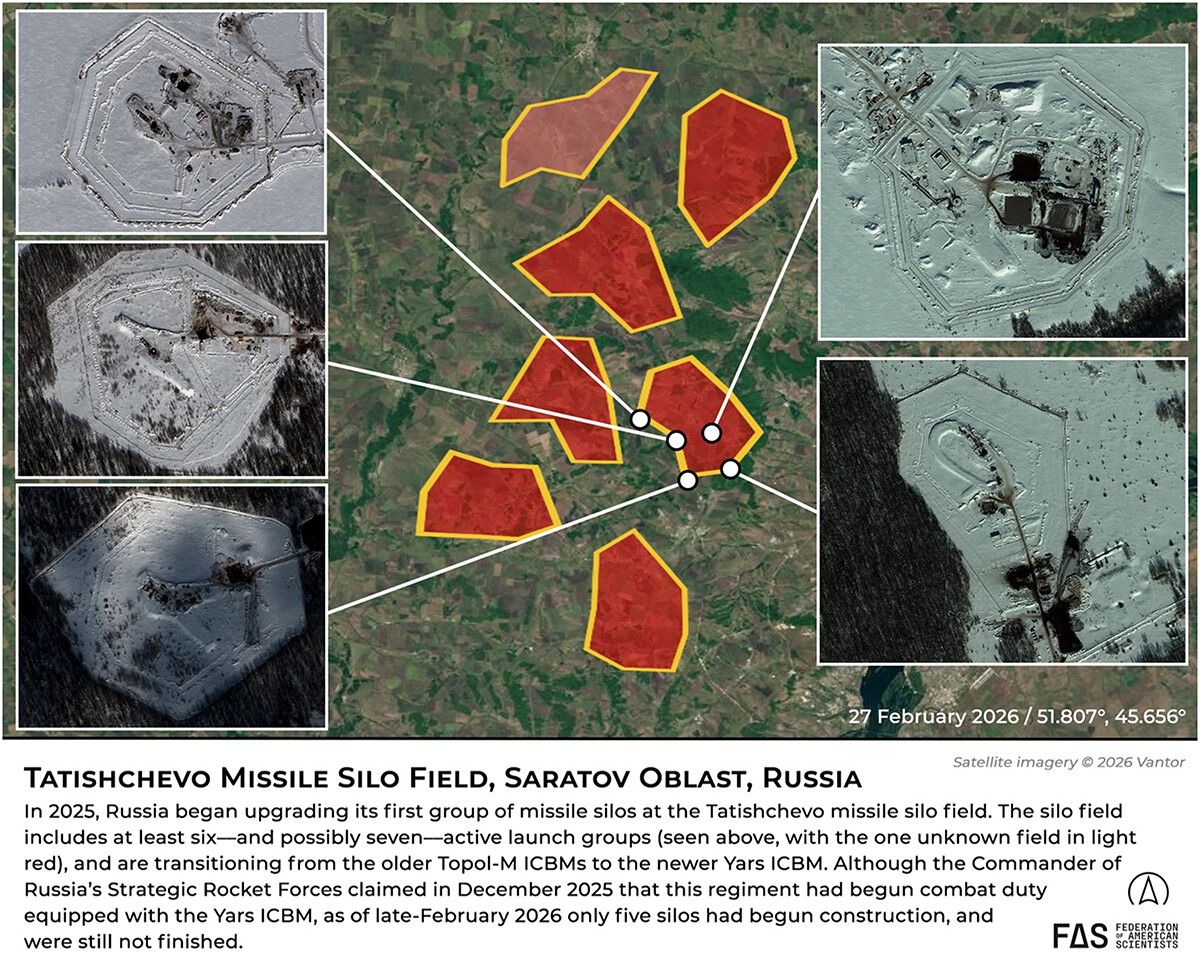
The RS-12M1 and RS-12M2 Topol-M (both of which are known by the NATO designation SS-27 Mod 1) are single-warhead ICBMs that come in either mobile (M1) or silo-based (M2) variants. Deployment of the SS-27 Mod 1 was completed in 2012 with a total of 78 missiles: 60 silo-based missiles with the 60th Missile Division in Tatishchevo, and 18 road-mobile missiles with the 54th Guards Missile Division at Teykovo. In December 2024, Commander of Russia’s Strategic Rocket Forces Col. Gen. Sergei Karakaev stated that his priority for 2025 was the commencement of the rearmament for one mobile regiment (at Teykovo) and one silo regiment (at Tatishchevo) with RS-24 Yars (SS-27 Mod 2) ICBMs (Krasnaya Zvezda 2024). The remaining Topol-M regiments will be upgraded to RS-24 Yars throughout the second half of the decade. In December 2025, Karakaev declared that “the first regiment of the Tatishchev formation went on combat duty, equipped with a silo-based Yars missile system” (Krasnaya Zvezda 2025). However, judging from the time it has taken to upgrade other ICBM divisions, completion of Teykovo and Tatishchevo might take longer. Satellite imagery from February 2026 shows construction has begun at five silos of the first regiment to upgrade and that completion is still several years away (see Figure 1). The eventual replacement of single-warhead Topol-M with Yars equipped with MIRVs could potentially add several hundred warheads to Russia’s ICBM force.
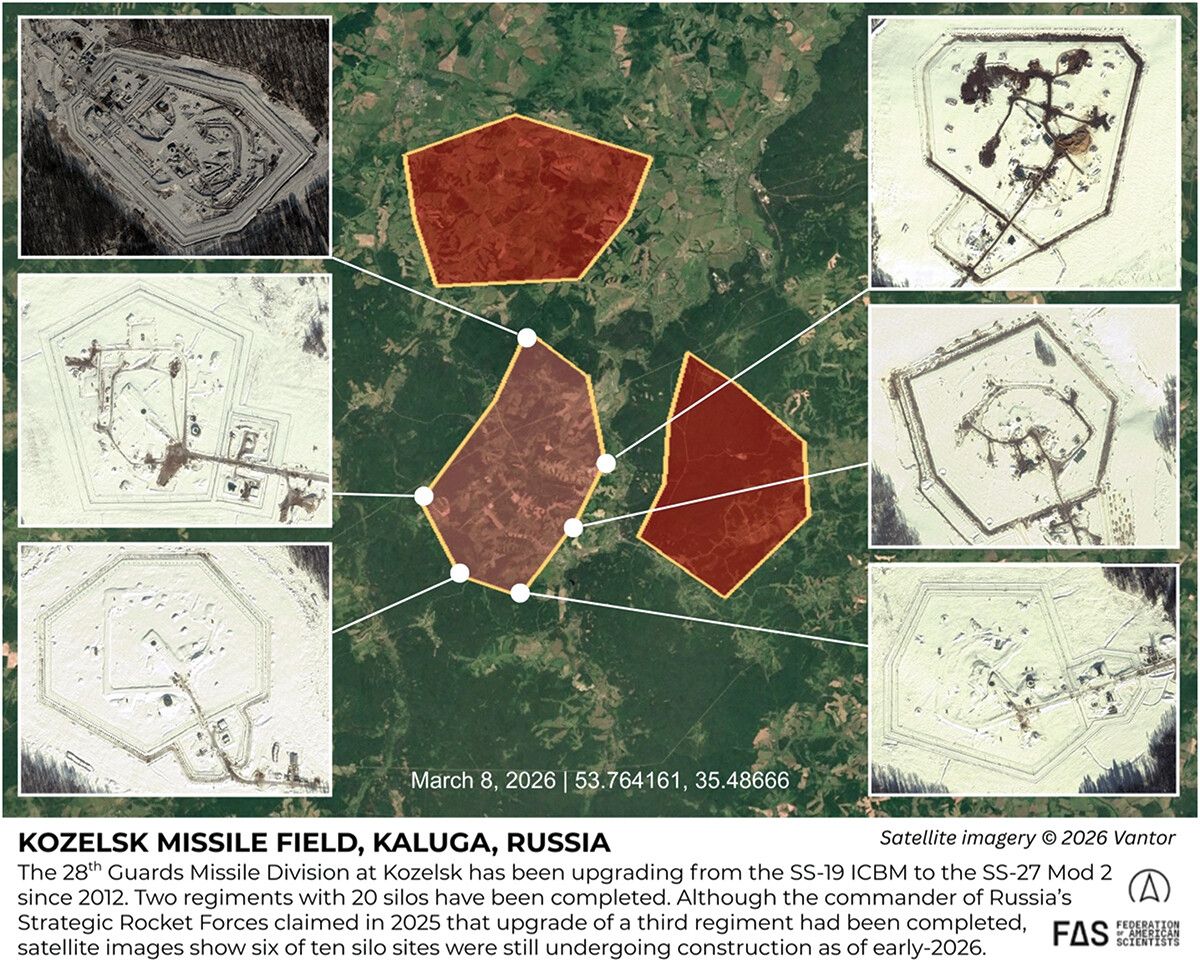
The RS-24 Yars (SS-27 Mod 2) is a modified SS-27 Mod 1 that can carry up to three MIRVs. It appears that there are currently several variants of the Yars system: One is reportedly equipped with “light warheads” and another (known as Yars-S) is reportedly equipped with more powerful, medium-yield warheads for use against hardened targets (Kornev and Ramm 2021). As of March 2026, Russia was in the last phase of upgrading the final regiment of the 28th Guards Missile Division at Kozelsk to the RS-24 Yars; missile loading appears to have been slow, with only about two ICBMs per year. In 2024, silo loadings at Kozelsk took place in November and December (Krasnaya Zvezda 2024; Ministry of Defence of the Russian Federation 2024a). In December 2025, Col. Gen. Karakaev claimed that “this week in the Kaluga region, the last Yars intercontinental ballistic missile was loaded into a silo, bringing this momentous event to a close” (Krasnaya Zvezda 2025). However, as of March 2026, satellite images showed that two silos had not yet begun construction, and minor construction appeared to still be ongoing at some of the other silos (see Figure 2).
During an interview with the Russian Ministry of Defense’s TV channel in December 2020, Karakaev declared that approximately 150 mobile and silo-based Yars had been deployed by the Strategic Rocket Force (Zvezda 2020). We estimate that, as of March 2026, this number had grown to approximately 207 mobile and silo-based Yars missiles.
The next major phase of Russia’s ICBM modernization will be the long-awaited replacement of the RS-20V Voevoda (SS-18) with the new RS-28 Sarmat (SS-29). Eventually, the Sarmat will probably also replace the SS-19 Mod 4. The introduction of the Sarmat—initially scheduled for 2018—has been marked by years of manufacturing and technical delays, as well as numerous testing failures. The delays have created political pressure on the defense establishment resulting in confusing and conflicting statements on the part of various Russian high-level officials about progress that contrast with observations on the ground through satellite imagery.
Except for Sarmat’s first flight test in April 2022—its only known successful flight test—the missile’s test record has been abysmal. According to US officials, a test in February 2023 likely ended in failure, and several others were canceled or postponed (Interfax 2022d; Kamchatka Info 2022; Liebermann and Bertrand 2023; TASS 2021b). In September 2024, a Sarmat flight test suffered another catastrophic failure, which significantly damaged its test silo at the Plesetsk Cosmodrome (Trevelyan 2024).
Despite insufficient numbers of successful tests, Russian officials have repeatedly claimed that the Sarmat is close to deployment. In November 2022, the General Director of the Makeyev Rocket Design Bureau—responsible for the design of Sarmat—claimed that the missile had already entered serial production (Emelyanenkov 2022). Moreover, in October 2023, the Russian Ministry of Defense noted on the Telegram messaging app that the “final stages” of construction and installation were underway at the first launch facilities and associated command post (Russian Federation Defence Ministry 2023). In November 2023, TASS—apparently incorrectly—reported that the first Sarmat regiment was already on “experimental combat duty” and that it would officially enter combat duty in December 2023 (TASS 2023a). In December 2023, Karakaev noted that work on the Sarmat had been “practically completed” (Krasnaya Zvezda 2023).
As of March 2026, satellite imagery indicated that the 302nd Missile Regiment at Uzhur had been disarmed to accommodate for Sarmat-related upgrades to the regiment’s silos and launch control center, and that all six of the regiment’s silos were at advanced stages of construction. Construction may have been completed at some of these silos, although we assess that, as of March 2026, no Sarmat missiles had been loaded and placed on combat duty yet. Notably, the Sarmat upgrade was not mentioned during the annual end-of-year interviews with Karakaev in December 2024 and 2025, suggesting that no significant milestones had been achieved in 2024 and 2025 that could be announced (Krasnaya Zvezda 2024, 2025).
If the Sarmat replaces all current SS-18s, it will be installed in up to 46 silos of the three regiments at the Dombarovsky missile field and four regiments at the Uzhur missile field (six regiments of six missiles and one regiment of 10 missiles).
Some media sources have dubbed the Sarmat missile the “Son of Satan” because it is a follow-on to the SS-18, which the United States and NATO designated “Satan”—presumably to reflect its extraordinary destructive capability. The operational configuration will likely be close to the payload on the SS-18 (up to 10 warheads) plus penetration aids. A small number of Sarmat ICBMs could probably be equipped to carry Avangard hypersonic glide vehicles, which are currently being installed on a limited number of SS-19 Mod 4 boosters at Dombarovsky. In December 2024, Karakaev noted that the Avangard command posts were named “Bugai” (Bull) (Krasnaya Zvezda 2024).
Sarmat is believed to have a significantly longer range than other Russian ICBMs. Col. Gen. Karakaev has stated that Sarmat can travel over both the North and South Poles (Lenta 2023), and in 2023 a Russian company involved with testing the Sarmat issued an environmental study indicating that Russia could plan to test the missile to a range of nearly 15,000 kilometers (Marcuz 2023a). The very long range may be more important for public relations than operational necessity, so to test the Sarmat and other ICBMs at shorter operational ranges, Russia is building a new testing ground at Severo-Yeniseysky—a decision announced in December 2020 (Marcuz 2023b; Ministry of Foreign Affairs of the Russian Federation 2020). Major construction at the test site may have been completed by the end of 2024, although it does not appear to have been used yet. It is possible that this new testing complex was also motivated by the fact that Kazakhstan—where Russia has historically test-flown its missiles into the Sary-Shagan site—is a state party to the Treaty on the Prohibition of Nuclear Weapons, which requires “the elimination or irreversible conversion of all nuclear-weapons-related facilities” (United Nations 2017).
Russia also appears to be in the early stages of development on at least two new ICBM programs, as well as on various hypersonic glide vehicles that could be fitted atop modified ICBMs. There is significant uncertainty, however, regarding the various designations and capabilities of these systems. In December 2021, Karakaev stated that “a new mobile ground-based missile system” is being developed and, in December 2022, noted that the system would have “greater mobility” than Yars and would officially begin development in 2023 (Krasnaya Zvezda 2021, 2022). In December 2023, Karakaev indicated that this system would have an emphasis on stealth and could eventually replace the RS-24 Yars in the longer term (Krasnaya Zvezda 2023). However, no mention of these systems was made in Karakaev’s end-of-year interviews in 2024 and 2025.
It is unclear which missile system Karakaev referred to in his annual remarks as there are several possible candidates. Russia is reportedly developing a new “Yars-M” ICBM that features multiple warheads with individual propulsion systems, known as independent post-boost vehicles (Kornev 2023a, 2023b; Kornev and Ramm 2021). (In this configuration, warhead separation would take place at an earlier stage in flight, thereby theoretically allowing for greater survivability against missile defenses.) Although the Yars-M will reportedly share a launcher and first stage with the Yars and Yars-S, the Yars-M missile complex represents a relatively novel delivery system, has a much higher GRAU index number than both the Yars and Yars-S missile complexes, and will likely still take years to develop (Kornev 2023a, 2023b). (The GRAU index is a naming system used by the Russian Ministry of Defence to catalog different weapons, equipment, and ammunition. The last numbers of each GRAU index indicate the specific model of the system; therefore, GRAU indices that are far apart from one another could indicate that they were developed independently from one another, rather than in tandem or right after each other.) The Yars-M fits a similar—and somewhat confusing—naming pattern for Russian ICBMs, in which certain ICBMs are given similar names (Yars and Yars-M, or Topol and Topol-M) despite not sharing very many technological similarities. It is believed that Russia has already tested the Yars-M.
The second ICBM in development is called “Osina-RV,” which can be launched from both mobile and silo launchers and is reportedly intended to be a modernized version of the Yars-M system (Marcuz 2023c; Ryabkov 2023; War Bolts Военно-болтовой 2021). Flight tests of the Osina-RV were supposed to take place throughout 2021 and 2022; however, it is unclear whether they took place (Marcuz 2023c).
Russia is also developing another ICBM system, called “Kedr,” to begin replacing the currently deployed Yars ICBMs in both mobile and silo configurations by 2030 (TASS 2021a). Kedr is the only Russian new ICBM system known to have been publicly mentioned by the Commander of US Strategic Command since 2022 (Richard 2022).
Russia appears to also be developing a series of hypersonic glide vehicles for deployment atop its newer ICBMs, similar to how the Avangard hypersonic glide vehicle is currently deployed with the legacy SS-19 Mod 4 ICBM. Although public Russian industry documents have revealed some of their names—including Gradient-RV and Anchar-RV—the programs remained highly secretive and their respective capabilities unclear. None of these programs, nor the new developmental ICBM programs, were mentioned by Karakaev in his end-of-year interviews in 2024 or 2025.
In addition to ballistic missiles, Russia is also developing a nuclear-powered, ground-launched, nuclear-armed cruise missile with intercontinental range, known as 9M730 Burevestnik (NATO’s designation is SSC-X-9 Skyfall). However, this missile has faced serious setbacks, including nearly a dozen failed tests-one of which resulted in the missile being lost at sea and necessitating a recovery effort that catastrophically failed, killing five scientists and two soldiers at Nenoksa (DiNanno 2019; Panda 2019). Following an October 2023 New York Times analysis of satellite imagery that indicated a test of the Burevestnik could be imminent, Putin subsequently claimed that a successful test of the system had been carried out, although he did not provide any further details (Mellen 2023; RIA Novosti 2023b).
In 2024, a potential deployment site for the Burevestnik was identified by Decker Eveleth of the CNA Corporation to be located immediately next to a known nuclear storage site (Landay 2024). The deployment site, next to the Vologda-20 national-level storage site near Cherepovets some 360 kilometers (230 miles) north of Moscow, features nine launch pads in three groups inside explosive berms, with roads connecting the site to support buildings and the nearby nuclear bunkers. This would be a highly unusual deployment site, given that Russia does not typically place its missile launchers right next to nuclear warhead storage sites. Satellite imagery indicates that construction at the site began in 2021 and, although many features had been completed by March 2026, only four of nine suspected launcher garages had been completed. It seems likely the base is working on the integration of the missile.
Submarines and submarine-launched ballistic missiles
The Russian Navy operates 13 nuclear-powered, nuclear-armed ballistic missile submarines (SSBNs) of two classes: five Delta IV-class SSBNs (Project 667BRDM Delfin) and eight Borei-class SSBNs (Project 955/A), five of which are improved Borei-A (Project 955A) submarines. Each submarine can carry 16 submarine-launched ballistic missiles (SLBMs), and each MIRVed SLBM can carry between four and six warheads, depending on the missile type (Table 1). However, not all these submarines are fully operational, and the warhead loading on some of the missiles may have been reduced for Russia to stay below the New START treaty limit on deployed warheads. We estimate that one SSBN of each type is typically undergoing maintenance, repair, or reactor refueling at any given time, and that Russia’s stockpile therefore only includes enough warheads to arm the remainder of the submarines. As a result, we estimate that Russia’s stockpile of SLBM warheads totals up to 928 warheads, with approximately 704 of those deployed.
Russia’s five legacy Delta IV SSBNs—all of which were built between 1985 and 1992—are part of the Northern Fleet and based at Yagelnaya Bay (Gadzhiyevo) on the Kola Peninsula. The Delta IVs carry 16 of either the Sineva (SS-N-23) SLBMs, each of which carries up to four warheads, or the modified version, known as Layner (or Liner) (Podvig 2021). The Layner can be equipped with the same warhead as the Bulava SLBM, and some believe it could potentially carry up to 10 low-yield warheads, but likely carries four (Podvig 2011). The SS-N-23 missiles and warheads are likely stored at the submarine bases. Normally, three or four of the five Delta IVs are operational at any given time, with the other one or two in various stages of maintenance. Russia previously possessed seven Delta IV SSBNs, but one of Russia’s submarines—Yekaterinburg (K-84)—was decommissioned in 2022 after 36 years of service, and another—Podmoskovye (formerly K-64, now BS-64)—was deactivated in 1999 for conversion to a “special purpose” submarine (TASS 2016, 2021c). In October 2025, one of the five active Delta IVs—the Bryansk (K-117)—participated in Russia’s annual nuclear training exercise by firing a Sineva SLBM from the Barents Sea (Russian Federation 2025b).
Each Borei (Project 955/A) SSBN is armed with 16 SS-N-32 (Bulava) SLBMs that can carry up to six warheads each. However, the missile’s payload may have been reduced to four warheads each to meet the New START limit on deployed strategic warheads. Eight Borei submarines are currently in service, of which one or two are in maintenance or overhaul at any given time, with another four in various stages of construction, for a total of 12 planned Borei SSBNs. Six Borei SSBNs are expected to be assigned to the Northern Fleet (in the Arctic Ocean), and six will be assigned to the Pacific Fleet, replacing all remaining Delta IV SSBNs (TASS 2024). The Borei-class Knyaz Oleg (K-552) also participated in Russia’s annual nuclear training exercise in October 2024 by firing a Bulava SLBM into the Barents Sea (Russian Federation 2024b).
It has typically taken an average of eight years between each new Borei keel being laid down and the boat’s delivery to the Russian Navy, although some ships have been delayed longer (see Figure 3). The newest Borei-class SSBN—Knyaz Pozharskiy—was launched in February 2024, began sea trials in July 2024, and was commissioned to the Navy’s Pacific Fleet a year later after a longer-than-normal testing period (Russian Federation 2025c). The next SSBN, Dmitry Donskoy, was supposed to be commissioned at the end of 2025 but has been delayed. TASS reported that the keels for the final two Borei submarines were planned to be laid in 2024 but have been further delayed (TASS 2024). It is possible that two additional Borei SSBNs will be ordered.
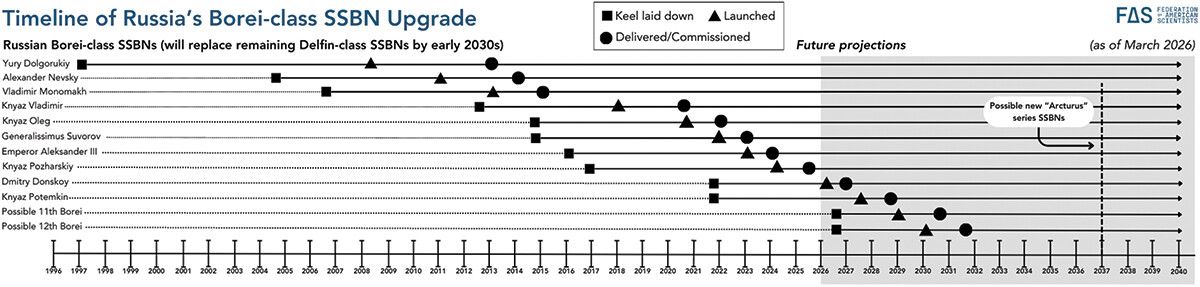
A possible concept for the next generation of Russian strategic nuclear submarines—known as “Arktur” or “Arcturus”—was unveiled at the Army 2022 International Military-Technical Forum and would potentially start replacing the Borei-class after around 2037 (RIA Novosti 2023a). The Arktur-class design is expected to be smaller than the current Borei-class and will have a reduced number of missiles (RIA Novosti 2022). It could also potentially function as a carrier for an unmanned underwater vehicle, or autonomous uninhabited underwater vehicle (ANPA) “Surrogates,” suggesting an expanded role relative to traditional SSBNs (Dempsey 2022; RIA Novosti 2024). In an interview with Russian news agency RIA Novosti, Igor Vilnit, the General Director of the Rubin Central Design Bureau that designs Russia’s nuclear and diesel-electric submarines, said the fifth-generation “Arcturus” will focus on “robotics” and will be distinguished by “even higher stealth, as well as the ability to disorient enemy assets” (RIA Novosti 2024). At this stage, it is unclear what this future submarine class will eventually look like.
In addition to ballistic missiles, the Russian Navy is also developing a nuclear-powered, intercontinental-range, nuclear-armed torpedo called Poseidon. Underwater trials for the Poseidon—which is rumored to have a large yield, possibly in the multi-megaton range—began in December 2018 (Hruby 2019; TASS 2019b). The weapon will be carried by specially configured submarines and is scheduled for delivery to the Navy in 2027 (TASS 2018a). The first of these special submarines—the Project 09852 Belgorod (K-329)—was launched in April 2019 and delivered to the Russian Navy in July 2022, and can reportedly carry up to six Poseidon torpedoes (Naval News 2022; Sutton 2021). Russian defense sources indicated that the “first batch” of Poseidon torpedoes had been produced and would soon be delivered to the Belgorod submarine, despite an apparent aborted test of the torpedo in November 2022 (TASS 2023b). The aborted test reportedly was followed by a throw test of a Poseidon mock-up using the Belgorod in January 2023, and additional reports suggested that another test might have happened in June 2023 (Cook 2023b; Sciutto 2022; Sutton 2023; TASS 2023c). The Poseidon was tested again in October 2025, but as of March 2026, it was not yet believed to be operational (Reuters 2025).
Subsequent Poseidon-capable submarines will be of a new class—the Project 09851 Khabarovsk—the first of which was expected to be delivered in the autumn of 2021, but it experienced delays and was only launched in November 2025 (Newdick 2025; Starchak 2023a; TASS 2021h, 2023d). The Khabarovsk can reportedly carry up to six Poseidon torpedoes (TASS 2020a). One more submarine, called Orenburg, is planned to be delivered to the Russian Navy by 2027, for a total of at least three, possibly four, Poseidon-capable submarines (TASS 2023b).
Both the Belgorod and Khabarovsk will homeport at the Pacific Fleet naval base in Kamchatka, which is undergoing upgrades, including to the warhead storage area (TASS 2023e). In 2025, Russia reportedly built its first Drone Control Center, including anti-drone nets at the Rybachy nuclear submarine base, to improve the operations of drones and protection of facilities (Izvestia 2025).
Over the years, there have been occasional reports of Russian submarine deployments off US and Mediterranean coasts (Brugen 2023). In September 2025, a Borei-class submarine was also spotted for the first time by the Japan Maritime Self-Defense Force in the La Perouse Strait near the Sea of Japan (Japan Ministry of Defence Joint Staff 2025; Mahadzir 2025). British Defense Secretary Ben Wallace stated in April 2023 that the United Kingdom was also tracking Russian submarines “in the North Atlantic and in the Irish Sea and in the North Sea doing some strange routes that they normally wouldn’t do” (Cook 2023a).
Strategic bombers
Russia operates two types of nuclear-capable heavy bombers: the Tu-160 (known to NATO as “Blackjack”) and the Tu-95MS (“Bear-H”). We estimate that there are roughly 60 bombers in the active inventory. This number was determined by cross-referencing satellite imagery of various strategic bomber locations and maintenance facilities during 2025.
Both bomber types can carry the nuclear AS-15 Kent (Kh-55) air-launched cruise missile and upgraded versions are being equipped to carry the new AS-23B (Kh-102) nuclear cruise missile. Several versions of the Tu-95 are thought to have been fielded over the years: the legacy Tu-95MS6 and Tu-95MS16 versions and the modernized Tu-95MSM version. The 1991 START Treaty distinguished between the two legacy variants given their different missile capacities: The Tu-95MS6 can carry up to six missiles internally, and the Tu-95MS16 can carry up to six missiles internally and up to 10 missiles on wing-mounted pylons for a total of 16 missiles. We estimate that the MS16 version at some point lost the external hardpoints, effectively turning it into the MS6 variant. Hardpoints are being restored as part of the Tu-95MSM modernization program that is equipping legacy Tu-95s to carry eight AS-23B missiles externally for a maximum of 14 missiles per aircraft, including the six AS-15 missiles stored internally. The Tu-160s are also being modernized to carry up to 12 AS-23B internally. The AS-23Bs being added during bomber modernization might eventually replace the AS-15.
During a visit by North Korean leader Kim Jong Un to Russia’s Knevichi airfield in September 2023, Russia’s Long-Range Aviation Commander revealed a Tu-160 aircraft reportedly equipped with “novel” Kh-BD cruise missiles, which could be based upon the existing AS-23B. The commander said the new missile has a range of over 6,500 kilometers—potentially indicating a nuclear role given that nuclear warheads weigh much less than heavy conventional munitions, therefore saving weight for fuel. Russia’s Defence Minister added that Tu-160s will be able to carry 12 missiles, though some experts are doubtful of this claim (Cook 2023c; TASS 2023f). Little information has emerged about the new missile, but Ukrainian military news website Militarnyi reported in October 2025 that it had obtained Russian procurement documents revealing that the Russian Ministry of Defense ordered 32 of the Kh-BD for delivery between 2024 and 2026 and that the missiles were ordered with both conventional and “special” warhead configurations (Yan 2025).
It is unknown how many nuclear weapons are assigned to the heavy bombers. Each Tu-160 aircraft can carry up to 40 metric tons of ordnance, including 12 air-launched cruise missiles, whereas the Tu-95MS can carry six to 16 cruise missiles, depending on configuration. Combined, the bombers could potentially carry over 650 weapons, but we estimate that weapons only exist for operationally deployed bombers for a total of approximately 586 bomber weapons (Table 1). However, not all bomber weapons are stored at bases: We estimate that roughly 200 bomber weapons might be stored at Engels Air Base in Saratov oblast and Ukrainka Air Base in Amur oblast (and therefore considered as “deployed” in Table 1), the rest being thought to be in central storage. Modernization of one of two nuclear weapons storage bunkers at Engels Air Base began in 2018 but appears to have stalled or been abandoned altogether. This suggests that Russia may intend to store fewer weapons at the base going forward, as strategic bombers have largely been moved from the base since 2022 because of long-range drone threats from Ukraine.[2]
STRATCOM Commander General Cotton stated recently that both the Tu-95 and Tu-160 bombers “are capable of carrying nuclear gravity bombs” (Cotton 2025, 5). But the older and slower Tu-95 bomber would not stand much of a chance against modern air defense systems, the Tu-160 is not a stealth bomber, and although both have been used to launch cruise missiles during the war in Ukraine, neither is believed to have carried out gravity bomb attacks that would require them to pass through air defenses. Consequently, although Tu-160 might potentially be assigned some bombs, we do not count gravity bombs as part of Russia’s strategic forces.
Russia carried out several exercises during 2025 that involved heavy bombers, including in October when some Tu-95MS bombers participated in a strategic nuclear forces exercise during which the aircraft fired “a volley” of air-launched cruise missiles, according to the Kremlin (Russian Federation 2025b). On December 9, 2025, two Tu-95 bombers conducted a joint strategic air patrol with Chinese H-6 bombers over the Sea of Japan and East China Sea—their 10th such exercise to “demonstrate both sides’ determination and capability to jointly address regional security challenges and maintain regional peace and stability,” according to Chinese military media (China Military Bugle 2025). In January 2025, the Russian Ministry of Defense reported that two Tu-160s conducted a scheduled flight over the Arctic Ocean that lasted over 11 hours (Ministry of Defence of the Russian Federation 2025).
Some of Russia’s bombers have been destroyed and others damaged by Ukrainian drone strikes. After a likely Ukrainian airstrike on Engels Air Base in December 2022, Russian officials reported that two planes were damaged, one of which was a Tu-95 bomber as visible on satellite imagery (Kramer, Schwirtz, and Santora 2022; Kristensen, Korda, and Reynolds 2023; Röpcke 2022). Then, on June 1, 2025, Ukraine carried out Operation Spiderweb, a large-scale drone attack on five Russian air bases. Satellite imagery revealed that seven Tu-95 bombers were destroyed in the attack-four at Olenegorsk Air Base and three at Belaya Air Base—and one additional Tu-95 was reportedly damaged (Janes 2025). (See Figure 4)
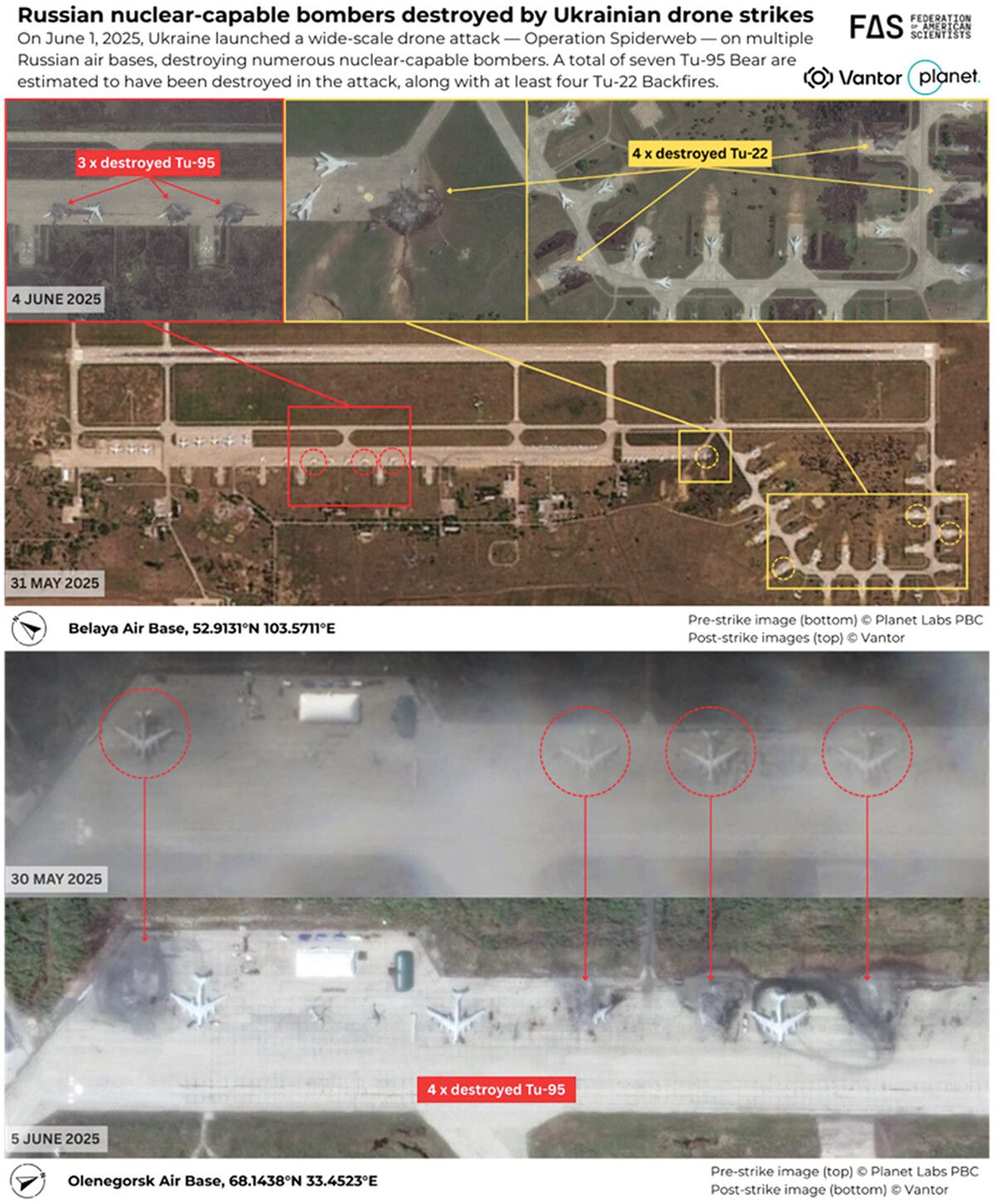
Satellite imagery since the June drone strikes shows a large majority of Tu-95s at Ukrainka Air Base, with just one or two each at Engels, Belaya, and Olenegorsk air bases. Similarly, imagery indicates that Russia has ceased deploying Tu-160s to Belaya Air Base entirely since the drone strikes. The Tu-160 fleet now appears largely scattered; for example, three to five Blackjacks can typically be seen at Ukrainka Air Base, one or two at Engels Air Base, and three occasionally at Ugolny Air Base near Anadyr for Arctic and Far East patrol missions.
In addition to modernizing its existing strategic bombers, Russia is also reproducing additional Tu-160 bombers and appears to plan as many as 50 new aircraft. There is considerable confusion about the Russian designations of the various upgraded models, which include the Tu-160M, Tu-160M1, and Tu-160M2 designations. Some sources suggest that all upgraded Tu-160s fall under the Tu-160M designation, with the M1 and M2 suffixes referring to successive modernization phases. The first phase reportedly includes a new engine—the NK-32–02—that is said to increase the aircraft’s range by approximately 1,000 kilometers (TASS 2017a), as well as a new autopilot system and the removal of obsolete components, whereas the second phase includes a new radar, cockpit, communications, and avionics equipment (TASS 2020b, 2020c). Other sources, however, indicate that the “M” designation refers to Tu-160s assembled through the “reproduction” program, meaning those built from Soviet-era airframes and scrap parts (Shcherbak 2025; Taylor 2026).
The first newly manufactured Tu-160M bomber conducted its maiden flight in January 2022 (United Aircraft Corporation 2022a). Russia’s state tech corporation, Rostec, announced in July 2023 that the aircraft had entered joint trials of the Ministry of Defense and the United Aircraft Corporation. In February 2024, President Putin visited the Gorbunov Kazan factory to inspect four Tu-160Ms and take an approximately 30-minute flight on one of the modernized bombers, the “Ilya Muromets” (Ministry of Defence of the Russian Federation 2024b). In an interview after the flight, Putin stated that the modernized Tu-160s “can be accepted into the Armed Forces” (Associated Press 2024a). According to Russian media, the Ministry of Defense is expected to receive 10 Tu-160Ms by 2027 (Redstar 2018). A 2025 investigation by private intelligence firm Dallas revealed through intercepted documents that, as of May 2025, five of Russia’s operational Tu-160s were undergoing repair and modernization at the Kazan factory, and two new Tu-160s were being reproduced (Dallas 2025). The Ministry of Defense was reportedly scheduled to receive four Tu-160Ms in 2025, but as of early January 2026, just two had been transferred to the Russian Armed Forces (Johnson 2026; Taylor 2026).
The delays associated with the Tu-160M program have been so severe that the Russian Ministry of Industry and Trade has filed a lawsuit against the aircraft manufacturer (Interfax 2022c). It is possible that the eventual target of 50 new Tu-160M bombers will not be reached, but if it does, it would probably result in the retirement of most, if not all, of the remaining Tu-95MSs, which are expected to be retired before 2035.
The Tu-160 modernization program, meanwhile, is only a temporary bridge to the next-generation bomber known as PAK DA, the development of which has been underway for several years. The subsonic aircraft will reportedly have a reduced radar signature and will be able to carry long-range cruise missiles and hypersonic missiles (Tsukanov 2023). The Russian government signed a contract with manufacturer Tupolev in 2013 to construct the PAK DA at the Kazan factory. The aircraft is expected to share many systems with the Tu-160M (TASS 2019a). State flight tests (which typically take place following flight tests by the aircraft’s manufacturer) of the PAK DA were scheduled for February 2026, with initial production expected to begin in 2027 and serial production in 2028 or 2029 (Izvestia 2020; TASS 2019c). However, internal Tupolev documents detailing the itinerary of a leadership tour of Kazan and inspection of the strategic bomber operations underway at the facility reveal that, as of March 2026, Kazan was still in the process of assembling the first prototype of the PAK DA for static ground testing (Dallas 2025). There remains no clear timeline for completion of the next-generation aircraft. Such significant delays for both the Tu-160 and PAK DA programs may indicate insufficient capacity by the Russian aviation industry to develop and produce two strategic bombers at the same time.
Nonstrategic nuclear weapons
Russia is modernizing many of its shorter-range, so-called “nonstrategic” dual-capable weapons and introducing new types. This effort is less clear and comprehensive than the strategic forces modernization plan, but it also involves phasing out Soviet-era weapons and replacing them with newer, but likely fewer, weapons overall. Although the number of non-strategic dual-capable launchers is increasing, that does not necessarily mean Russia is also increasing the number of nuclear warheads assigned to those launchers.
Although Trump administration officials in 2018 claimed that Russia had increased its nonstrategic nuclear weapons over the previous decade, the inventory in fact declined significantly—by about one-third—during that period (Kristensen 2019). The US Defense Intelligence Agency’s Worldwide Threat Assessment in 2021 and the State Department’s 2023 New START implementation report stated that Russia likely possesses “roughly 1,000 to 2,000 nonstrategic nuclear warheads”—the lowest number since the 1950s—and the State Department made the same estimate again in 2024 and 2025 (US Defense Intelligence Agency 2021; US Department of State 2023a, 2025a). The range reflects different estimates within the US intelligence community, with the military typically using the higher number for its threat assessments. STRATCOM predicted in 2020 that “Russia’s overall nuclear stockpile is likely to grow significantly over the next decade—growth driven primarily by a projected increase in Russia’s non-strategic nuclear weapons” (Richard 2020, 5). And rumors resurfaced in early 2022 that some in the Intelligence Community believe the number of Russian non-strategic nuclear weapons could increase significantly—potentially doubling—by 2030 (Bender 2022; Kristensen 2022).[3]
As of March 2026, the dramatic projected increase of Russia’s non-strategic nuclear weapons has not materialized. In its annual report to Congress on the status of nonstrategic nuclear weapons negotiations published in March 2026, the US State Department confirmed our assessment from last year that “there are as-yet no indications of a large-scale increase in the overall numbers of warheads assigned these roles” (US Department of State 2026). STRATCOM’s latest public estimate remains “up to 2,000” warheads, the same estimate used in the 2018 Nuclear Posture Review. We estimate nearly 1,800 nonstrategic nuclear warheads, a significant decrease from 15 years ago of nearly 2,000, although this estimate comes with a significant degree of uncertainty. These warheads are assigned for delivery by air, naval, ground, and various defensive forces. Although there are many rumors about greater inventories and additional nuclear systems, there is little authoritative public information available. This estimate—and the categories of Russian weapons that we have been describing in the Nuclear Notebook for years—accords with that of the 2024 State Department report to Congress, which states:
Russia has an estimated stockpile of 1,000–2,000 nonstrategic nuclear warheads, as of the latest unclassified assessment in 2023. This includes but is not limited to warheads for air-to-surface missiles, gravity bombs, depth charges, torpedoes, anti-aircraft, anti-ship, anti-submarine, anti-ballistic missile systems, and nuclear mines, as well as nuclear warheads for Russia’s dual-capable ground-launched missile systems. (US Department of State 2025a)
This assessment, however, raises questions about the US government’s assumptions and counting rules about Russia’s nonstrategic nuclear weapons. Most of these systems are dual-capable, which means not all platforms of a given type may be assigned nuclear missions and not all operations are nuclear. Moreover, even if Russia may increase a category of dual-capable launchers, it does not necessarily mean that the number of nuclear warheads assigned to that category also increases. Finally, many of the delivery platforms are in various stages of overhaul and would not be able to launch nuclear weapons at any given time.
Regardless of the uncertainty about the precise number, the Russian military continues to attribute a considerable importance to nonstrategic nuclear weapons for use by naval, tactical air, and air- and missile-defense forces, as well as on short-range ballistic missiles. Part of the rationale for the Russian military to rely on nonstrategic nuclear weapons is that many of the potential targets for Russian nuclear strike plans are in Russia’s periphery; they do not require weapons of intercontinental range but can be covered with shorter-range weapons. Moreover, Russia’s non-strategic nuclear weapons are intended to offset the superior conventional forces of NATO and the United States. After Russia’s significant conventional losses in the Ukraine war, the relative importance of non-strategic nuclear weapons will likely be reinforced or even increase. Russia also appears to be motivated by a desire to counter China’s large and increasingly capable regional conventional forces. Finally, having a sizable inventory of nonstrategic nuclear weapons helps Moscow keep overall nuclear parity with the combined nuclear forces of the United States, the United Kingdom, and France. Without the non-strategic nuclear forces, Russia’s nuclear warhead stockpile would be significantly smaller—about 40 percent smaller.
During the summer of 2024, Russia conducted a non-strategic nuclear weapons exercise comprised of three phases: (1) readiness and preparation; (2) joint exercises with Belarus; and (3) combat use and deployment, which included trainings conducted by Iskander (SS-26) missile groups (Ministry of Defence of the Russian Federation 2024c). In September 2025, Russia and Belarus conducted their first joint strategic command staff exercise, called Zapad-2025, since 2021 (Bowen and Fink 2025). Belarusian military officials stated that the exercise would include rehearsing joint nuclear weapons employment following the November 2024 revisions to Russia’s nuclear policy, but this was later walked back (Bowen and Fink 2025).
Sea-based nonstrategic nuclear weapons
As far as we can ascertain, the biggest user of nonstrategic nuclear weapons in the Russian military is the navy, which we estimate has roughly 767 warheads for use by land-attack cruise missiles, anti-ship cruise missiles, anti-submarine rockets, anti-aircraft missiles, torpedoes, and depth charges (see Table 1). These weapons may be used by submarines, aircraft carriers, cruisers, destroyers, frigates, corvettes, and naval aircraft. The actual number of sea-based nonstrategic nuclear weapons may be lower than our estimate because not all vessels with dual-capable weapon systems may be assigned nuclear warheads.
Major naval modernization programs focus on the next class of nuclear attack submarines, known in Russia as Project 885/M or Yasen-M. The program has been subject to years of delay, partially due to technical deficiencies with the vessels themselves. Russia currently operates six Yasen submarines—Severodvinsk, Kazan, Novosibirsk, Krasnoyarsk, Arkhangelsk, and Perm—after the sixth boat was commissioned in March 2025 (Russian Federation 2025d).
Four additional Yasen-M nuclear-powered nuclear-armed guided missile submarines (SSGNs)—named Ulyanovsk, Voronezh, Vladivostok, and Bratsk—are under various stages of construction. The next boat—Ulyanovsk—was laid down in July 2017 and was expected to launch in early 2026. The Voronezh and Vladivostok were laid down in July 2020 (TASS 2020d). Russia is planning to build at least one additional Yasen-M SSGNs, for a total of 10 (Russian Federation 2025e).
The first Yasen submarine was reportedly 10 to 12 meters longer than the improved Yasen-M submarine and can therefore accommodate 40 Kalibr missiles-eight more than its successors (Gady 2018). The Yasen-M boats reportedly also have improved reactors and sonar systems, which may enhance their ability to evade detection (Kaushal et al. 2021). The Yasen submarines will replace Soviet-era attack submarines.
In addition to dual-capable Kalibr land-attack cruise missiles, the Yasen-class submarines can deliver the SS-N-26 Strobile (3M-55 Oniks) anti-ship cruise missile, which the US Air Force’s National Air and Space Intelligence Center says is “nuclear possible,” and, beginning with the Perm, the SS-N-33 (3M-22 Tsirkon) hypersonic cruise missile (Ramm and Stepovoy 2020). In 2021 and 2022, the Severodvinsk successfully test-launched the Tsirkon from surface and sub-surface positions—the first tests of the new system from a submarine (TASS 2021g, 2023g). According to Russian military officials, the Yasen-M submarines can salvo-launch several different types of missiles using modernized UKSK-M “universal launchers” that can accommodate multiple systems (Interfax 2021; Ramm, Surkov, and Dmitriev 2017; TASS 2021d).
Other upgrades of naval nonstrategic nuclear-capable platforms include those planned for the Sierra class (Project 945), the Oscar II class (Project 949A), and the Akula class (Project 971). While the conventional version of the Kalibr is being fielded on a wide range of submarines and ships, the nuclear version has probably replaced the SS-N-21 (Sampson) nuclear land-attack cruise missile on select attack submarines. For over a decade, multiple types of naval dual-capable systems have been in the process of being phased out, with some being upgraded to new dual-capable systems and others being exchanged for conventional systems.
In addition to attack submarines, many surface ships and naval aircraft carry dual-capable weapon systems. The most important types are the 2,500 kilometer-range 3M-14 Kalibr (SS-N-30A) land-attack cruise missile and the 3M-55 Oniks (SS-N-26) anti-ship cruise missile, which are being added to many of Russia’s new surface ships and backfitted onto older ships, replacing older weapon types. The SS-N-33 (3M-22 Tsirkon) hypersonic cruise missile is being integrated on the Admiral Gorshkov class (Project 22350).
Air-based nonstrategic nuclear weapons
The Russian Air Force is estimated to be assigned roughly 488 nonstrategic weapons for delivery by the Tu-22M3 (Backfire) intermediate-range bombers, Su-24M (Fencer-D) fighter-bombers, the Su-34 (Fullback) fighter-bombers, the MiG-31K, as well as the new Su-57 aircraft. Other aircraft, such as the Su-30SM, might also be dual-capable, although this is unconfirmed.
The Tu-22M3 can deliver Kh-22 (AS-4 Kitchen) air-launched cruise missiles. The Tu-22M3 is being upgraded to the new Tu-22M3M, which reportedly contains 80 percent entirely new avionics and shares a communications suite with the new Su-57 fighter (TASS 2020e). The M3M standard is also reportedly fitted with the same new NK-32-02 engine as modernized Tu-160 heavy bombers, significantly increasing the aircraft’s range (TASS 2017b). The first Tu-22M3M conducted its maiden flight in December 2018 (United Aircraft Corporation 2018). The Tu-22M3M will be armed with an upgraded version of the Kh-22 known as the Kh-32 and might also be capable of carrying the new Kinzhal “Dagger” air-launched ballistic missiles (TASS 2018b). The Tu-22M3M—in addition to the Tu-160M and future PAK DA strategic bombers—will also eventually be equipped with a new Kh-95 hypersonic missile, a prototype of which has reportedly already been tested (RIA Novosti 2021).
The second prototype of the upgraded Tu-22M3M conducted its first flight in March 2020 and was reportedly delivered to Russian Aerospace Forces in 2023 (TASS 2020f; Kyrychevskyi 2026). According to a former Aerospace Force Commander, Russia planned to modernize 30 Tu-22M3s to the M3M standard (TASS 2018b). However, just two of the modernized aircraft have reportedly been delivered to Russian Aerospace Forces-one in 2018 and one in 2023—and leaked internal Tupolev documents obtained by private intelligence firm Dallas mention just two Tu-22M3Ms in progress at the Kazan plant in mid-2025 (Dallas 2025; Taylor 2026). Russia has carried out conventional attacks using Tu-22M3 intermediate-range bombers during its war with Ukraine. After an ostensibly Ukrainian drone strike on Soltsy air base in August 2023 that destroyed a Tu-22M3, Russia relocated the remaining Backfires at the base to Olenegorsk air base on the Kola Peninsula, which is notably forward-deployed and near NATO’s borders (Baker 2023; Nilsen 2023). Satellite imagery indicates that four Tu-22M3s were destroyed at Belaya air base by Ukraine’s Operation Spiderweb drone strikes on June 1, 2025 (see Figure 4 above).
The Su-34 has played an extensive combat role in the war in Ukraine, resulting in heavy losses to the fleet. Because of these losses, the total number of operational Su-34 has remained relatively unchanged since pre-war numbers despite increased production. The International Institute for Strategic Studies’ 2026 Military Balance report estimates that Russia possesses approximately 124 Su-34 fighters (International Institute for Strategic Studies 2025). Russia purchased an additional 76 upgraded units of the Su-34M with improved avionics and received several batches throughout 2025, most recently on December 10 (Global Arms Trade Analysis Center 2023; Lavrov and Krezul 2020; TASS 2025b). Following a visit to the manufacturing plant in October 2023 during which Defense Minister Shoigu requested that production and repairs of the Su-34 be ramped up, the scale of production has increased significantly to over 30 aircraft per year (Military Watch Magazine 2023, 2025).
Russia has also developed a new long-range, dual-capable, air-launched ballistic missile system known as the 9-A-7760 Kinzhal “Dagger.” The missile, which bears similarities to the ground-launched SS-26 short-range ballistic missile used on the Iskander system, allegedly has a range of up to 2,000 kilometers if launched from a specially modified MiG-31 (Foxhound) designated as MiG-31K, and up to 3,000 kilometers if launched from the Tu-22M3 bomber (the range is the combined combat range of the aircraft plus the missile). Russian state media earlier reported the Tu-22M3M would be able to carry up to four Kinzhals (RIA Novosti 2018), although that remains to be seen. The air-defense version of the MiG-31 is also thought to be nuclear-capable. During the nonstrategic nuclear weapons exercises in May-June 2024, a MiG-31 was shown being loaded with what appeared to be a nuclear air-to-air missile, possibly the R-37 M (AA-13). The DIA reported in 2025 that “Russia is expanding its nuclear forces by adding new capabilities, including nuclear air-to-air missiles” (US Defense Intelligence Agency 2025).
The MiG-31K cannot carry both the Kinzhal and its regular air-to-air missiles and must therefore be deployed alongside a protective air detail (TASS 2018c). In December 2021, Russian Defence Minister Sergei Shoigu announced that in 2021 “a separate aviation regiment was formed, armed with MiG-31K aircraft with the Dagger hypersonic missile” (Russian Federation 2021), apparently in the North Fleet area on the Kola Peninsula. Plans were reportedly underway to equip the Northern and Central Military Districts with Kinzhal missiles by 2024, and recently satellite imagery of MiG-31s at bases in the Kola Peninsula could suggest that the Kinzhal has been delivered to the region (Izvestia 2021; TASS 2021f). Indeed, during the joint Russia-Belarus Zapad strategic exercise in September 2025, two MiG-31K aircraft armed with one Kinzhal missile each were shown taking off from Severomorsk air base on the Kola Peninsula before conducting a flight over the Barents Sea (Nilsen 2025). The Kinzhal has been used several times in the war in Ukraine. In February 2023, President Putin announced that Russia would speed up mass production of Kinzhal (TASS 2023h).
Additionally, the Russian Aerospace Force reportedly received its first batch of Su-57 (PAK FA) fighter jets in late 2020, and deliveries continued through 2023 and “considerably increased” throughout 2024, according to the CEO of the United Aircraft Corporation (TASS 2020f; United Aircraft Corporation 2022b, TASS 2025c). The CEO also stated that the company would expand production capacity for the Su-57 during 2025, and that new batches will have new features and upgrades, including integration with unmanned aerial vehicles (TASS 2025c). The full contract is expected to comprise 76 planes for delivery by the end of 2028 for three regiments (Suciu 2021; TASS 2020g, 2020h). Russian Aerospace Forces officials reported throughout 2025 that the pace of Su-57 delivery to the Russian military was increasing (TASS 2025d, 2025e). The US Department of Defense says that the Su-57s are nuclear-capable (US Department of Defense 2018, 8). In addition to bombs and air-to-surface missiles, they will reportedly also be equipped with hypersonic “missiles with characteristics similar to that of the Kinzhal” (TASS 2018d). Rostec announced in December 2025 that a Su-57 equipped with a new “advanced fifth-generation engine” had begun flight tests (TASS 2025f). In February 2026, Rostec announced that upgrades were underway for the Su-57’s weapons and systems capabilities to broaden the range of weapons the aircraft can use (TASS 2026).
Russia apparently has equipped a smaller number of Belarusian Su-25 (Frogfoot) fighter-bombers with the capability to deliver nuclear bombs. The aircraft are located at an airbase near Lida and featured in Russia’s nonstrategic nuclear weapons exercise in May-June 2024.
Nonstrategic nuclear weapons for ballistic missile, air-, and coastal-defense forces
The stockpile estimate of warheads for Russian missile and air defense interceptors is highly uncertain.
Since 2018, US agencies have repeatedly stated that Russia continues to possess nuclear warheads for defensive weapons. A 2023 State Department assessment suggested that Russia uses nonstrategic nuclear warheads for “anti-aircraft” and “anti-ballistic missile systems” (US Department of State 2023b). Coastal defense systems using the 3M-55 (SS-N-26) anti-ship missile might also be dual-capable.
This includes the A-135 anti-ballistic missile defense system around Moscow that is equipped with 68 nuclear-tipped 53T6 Gazelle interceptors. The system is being upgraded to the A-235 with the Nudol anti-ballistic and anti-satellite interceptor. The new A-235 Nudol system was expected to enter service by the end of 2025, but there have been no indications or official confirmation that it has done so (TASS 2021e). It is possible that the A-235 system will rely less on nuclear warheads but rely more on conventional warheads or kinetic hit-to-kill technology (Krasnaya Zvezda 2017; Starchak 2023b). If so, that could potentially further reduce the number of nuclear warheads assigned to air-defense forces.
Dual-capable air-defense systems include the mobile S-300 (SA-20) and S-400 (SA-21), which are designed for theater air (and some missile) defense. US government sources privately indicate that Russia maintains nuclear warheads for both systems. Nuclear capability is probably focused on those units that are tasked with defending high-value facilities. The S-300 and S-400 systems have been used extensively in the war in Ukraine for both air-defense and offensive ground-strikes (TASS 2023i). It is possible, yet uncertain, that future and more advanced air-defense systems could eliminate the need for such a nuclear capability (Hendrickx 2021; TASS 2021e).
Given these developments, we estimate that nearly 200 nuclear warheads are available for air defense forces today, plus an estimated 107 additional warheads for the Moscow A-135 missile defense system and coastal defense units, making a total inventory of about 307 warheads (Table 1). However, it must be emphasized that this estimate, because of limited transparency and authoritative sources, comes with considerable uncertainty and low confidence about its accuracy.
Ground-based nonstrategic nuclear weapons
Ground-based systems with dual-capability include the 9K720 Iskander (SS-26) short-range ballistic missile, possibly the 9M728 (SSC-7 or R-500) short-range ground-launched cruise missile (the weapon was displayed in official videos from Russia’s nonstrategic nuclear weapons exercise in the summer of 2024), the 9M729 (SSC-8) ground-launched cruise missiles, and the new Oreshnik intermediate-range ballistic missile (IRBM).
The 350-kilometer range SS-26 (Iskander) has now completely replaced the SS-21 in approximately 13 brigades: four in the Western Military District; two in the Southern Military District; two in the Central Military District, and at least four in the Eastern Military District. Not all base upgrades are complete; construction continues at some bases, and not all have missile depots. Each brigade initially had 12 launchers with two missiles each for a total of 24 missiles (at least one reload is in storage), but Russia’s Defence Ministry sources have said that every brigade would receive an additional battalion so that each brigade in the future would have 16 launchers with 32 missiles (Izvestia 2019). We estimate that there are roughly 232 warheads for short-range and intermediate-range ballistic missiles (Table 1).
Russia has supplied Belarus with nuclear-capable Iskander launchers for the SS-26 and SSC-7 short-range missiles. In February 2023, Belarusian military officials claimed that they were autonomously operating Russian-supplied nuclear-capable SS-26 Iskander missile systems, and they were spotted training at a base near Asipovichy later that month (Kristensen 2023a; Reuters 2023a). (See “Russian nuclear sharing in Belarus” section above for further details.)
Two of Russia’s Iskander bases appear to have been hit in attacks by Ukraine in early 2025: the 448th Missile Brigade at Durnevo and the 112th Missile Brigade at Shuya. Satellite imagery shows holes in the roofs of three of four climate tents at Durnevo, holes in the roofs of two climate tents, as well as the destruction of a small perimeter building at Shuya (see Figure 5). The damage appears unfixed as of early 2026.

The United States and NATO have accused Russia of having developed, test-flown, and deployed a dual-capable ground-launched cruise missile—identified as the 9M729 (SSC-8) with a range of roughly 2,500 kilometers—in violation of the now-abandoned Intermediate-range Nuclear Forces Treaty (US Department of State 2019). The first two 9M729 battalions were deployed in late 2017 (Gordon 2017), and US intelligence sources indicated in December 2018 that Russia had deployed four battalions in the Western, Southern, Central, and Eastern Military Districts with nearly 100 missiles (including spares) (Gordon 2019). We estimate that these four battalions (each with four launchers) are co-located with the Iskander sites at Elanskiy, Kapustin Yar (possibly moved to a permanent base by now, possibly in the Far East), Mozdok, and Shuya.
It is unknown if Russia has added 9M729 battalions beyond the four reported in December 2018. There is no public confirmation that it has, but in February 2019, only a few weeks after Russia acknowledged the existence of the 9M729 but claimed its range was legal, the press service of Russia’s Western Military District reported it had carried out “electronic launches” of the 9M279 in the Leningrad region (RIA Novosti 2019). This could potentially indicate the 9M729 has been added to a fifth brigade (the 26th Missile Brigade outside Luga, about 125 kilometers south of St. Petersburg) or that launchers were sent there for training. In October 2025, Ukraine’s foreign minister reported that Russia had fired the 9M729 at Ukraine 23 times since August 2025, which is the first confirmation of the missile’s use in combat (Balmforth 2025).
Each Iskander brigade previously comprised three battalions, each of which was assumed to include four launchers; however, in 2019, Russian officials indicated that each Iskander brigade would be equipped with a fourth battalion, therefore increasing the number of launchers per brigade (Izvestia 2019). It is potentially possible that this fourth battalion at some brigades is the 9M729 (which would therefore be collocated with other Iskander variants). While this remains unconfirmed, our estimate assumes a total of four 9M729 battalions, each of which includes four launchers, in four brigades for a total of 16 launchers. Since each launcher appears to be equipped to carry four missiles, this would indicate a total of 64 missiles per battalion (possibly 128 if each launcher has one extra reload). We estimate approximately 30 warheads for the four battalions. Russia also appears to now be operating a small number of North Korean Hwasong-11 solid-fuel ballistic missiles, “several dozen” of which US officials claimed had been recently provided by North Korea (The White House 2024b). Russian forces launched a small number of these missiles into Ukraine on December 30, 2023, and January 2, 2024, and subsequent open-source analysis strongly indicated that the launched systems were either the Hwasong-11A (US designation KN23) or -11B (KN24) variants (Lewis 2024). While these systems very likely play a nuclear role in North Korea, we assess that Russia is using them exclusively in conventional strike roles, and therefore, they are not included in .
In November 2024, Russia used a new type of experimental IRBM—known as Oreshnik—in combat in Ukraine. The Oreshnik can carry at least six reentry vehicles; in the conventional configuration each reentry vehicle can carry multiple submunitions (Kullab and Morton 2024). President Putin said the weapon was “not nuclear” (Russia Federation 2024a), but the Pentagon claimed that the new missile was based on Russia’s RS-26 Rubezh IRBM and that “it could be refitted to certainly carry different types of … conventional or nuclear warheads” (US Department of Defense 2024). In December 2024, Putin announced that the Oreshnik system would be deployed in Belarus “as soon as the second half of 2025” (RFE/RL 2024). Approximately one year later, Ukrainian President Volodymyr Zelenskyy announced, “The relocation of the Oreshnik system to the territory of Belarus is nearing completion” (Zelenskyy 2025). Researchers affiliated with Middlebury College identified Krichev-6 aerodrome as the likely deployment site, and a video released by Russia’s Ministry of Defense on December 30 seems to confirm their analysis (Duitsman, Eveleth, and Lewis 2025; Osborn 2025). The site includes a new secure railhead and ongoing construction of garages.
Acknowledgments
This research was carried out with generous contributions from the Carnegie Corporation of New York, the New-Land Foundation, Ploughshares, the Prospect Hill Foundation, and individual donors.
Notes
[1] We estimate that Russia stores its nuclear weapons at approximately 40 permanent storage sites across the country, including about 10 national-level central storage sites (Kristensen and Norris 2014, 2–9; US Department of State 2022, 10).
[2] New storage facilities have been added to Russia’s bomber bases over the past few years that might be related to the introduction of conventional cruise missiles to the strategic bomber fleet.
[3] A US government telegram stated in September 2009 that Russia had “3,000–5,000 plus” nonstrategic nuclear weapons (Hedgehogs.net 2010), a number that comes close to our estimate at the time (Kristensen 2009). The US deputy undersecretary of defense for policy, James Miller, stated in 2011 that nongovernmental sources estimated Russia might have 2,000 to 4,000 nonstrategic nuclear weapons (Miller 2011). The US Department of State assessed in 2022 that Russia had an active stockpile of 1,000–2,000 nonstrategic nuclear warheads, including warheads awaiting dismantlement (US Department of State 2022, 11). For a more in-depth overview of Russian and US nonstrategic nuclear weapons, see Kristensen (2012). Some analysts estimated that Russia has significantly fewer warheads assigned to nonstrategic forces (Sutyagin et al. 2012).
Together, we make the world safer.
The Bulletin elevates expert voices above the noise. But as an independent nonprofit organization, our operations depend on the support of readers like you. Help us continue to deliver quality journalism that holds leaders accountable. Your support of our work at any level is important. In return, we promise our coverage will be understandable, influential, vigilant, solution-oriented, and fair-minded. Together we can make a difference.
Keywords: Nuclear Notebook, Russia, ballistic missiles, bombers, delivery systems, nuclear weapons
Topics: Analysis, Nuclear Notebook, Nuclear Weapons
Get alerts about this thread
0 Comments
Oldest

Hans M. Kristensen
Hans M. Kristensen is the director of the Nuclear Information Project with the Federation of American Scientists in Washington, DC. His work focuses ... Read More

Matt Korda
Matt Korda is the associate director of the Nuclear Information Project at the Federation of American Scientists, and an associate senior researcher ... Read More

Eliana Johns
Eliana Johns, née Reynolds, is a senior research associate for the Nuclear Information Project at the Federation of American Scientists, where she ... Read More

Mackenzie Knight-Boyle
Mackenzie Knight-Boyle is a senior research associate for the Nuclear Information Project at the Federation of American Scientists, where her work ... Read More

ALSO IN THIS ISSUE