Iran’s internet shutdown tells a larger story: Digital repression is on the rise

According to the organization NetBlocks, internet access was completely cut off in Iran on January 8, 2026, following protests that swept the country. Illustration by Samuel Boivin/NurPhoto via Getty Images
By Steven Feldstein, Shreya Joshi
January 22, 2026
On January 8, at around 8 p.m. in Tehran, Iran’s leadership pulled the plug on the country’s internet, shutting down online access for its 92 million citizens and effectively cutting its people off from the outside world. The move came as nationwide protests intensified, driven by mounting public anger over economic decline. What began as a series of demonstrations led by shopkeepers in Tehran’s Grand Bazaar over the rial’s collapse, which lost 40 percent of its value since last June, and high inflation rapidly spread nationwide, tapping into broader grievances about corruption and declining regime legitimacy.
The first reports about internet disruption occurred on December 29, when the internet monitoring service Filterwatch reported that a targeted suppression campaign affecting connectivity in certain regions across Iran was underway. In Tehran’s commercial district, including areas surrounding the Grand Bazaar, mobile network operators MCI (known as Hamrah-e Aval), IranCell, and Rightel were effectively unusable. Landline services also faced disruptions in the Baharestan and Amirkabir districts. Users reported that even VPNs—regularly used to get around blocked sites—had become unusable as traffic was not passing through. Multiple locations outside Tehran faced similar disruptions. The cities of Bushehr, Sanandaj, Ilam, Shiraz, Marvdasht, Fasa, and Mashhad—all of which were undergoing intense protest activity—experienced severe disruptions, especially for overseas connections.
On December 31, Cloudflare data showed a roughly 35 percent reduction in internet traffic in Iran, a direct result of network interference. Several days later, on January 2, the Open Observatory of Network Interference (OONI) reported “protocol-level anomalies” that were affecting users’ ability to send and receive data on the MCI and IranCell networks. These partial restrictions culminated in the nationwide shutdown on January 8, when internet traffic dropped to near zero as the regime ramped up violence against protesters. Alongside the communication blackout, Iranian authorities wielded a range of coercive measures to quell the unrest: Security forces deployed low-flying surveillance drones and signal jammers, authorities spread AI-manipulated propaganda to discredit the protestors, and state-backed militia fired automatic rifles against their fellow citizens, “aiming at their faces and genitals.” As of January 20, one report indicated that at least 5,000 citizens had been killed and over 24,000 people arrested. Another report that uses figures compiled by hospital staff and emergency departments indicates “that at least 16,500-18,000 people have been killed and 330,00 to 360,000 injured, including children and pregnant women.”
Iran isn’t the only country resorting to internet shutdowns to suppress its population. Governments worldwide continue to rely on shutdowns to rig elections, subdue demonstrations, and collectively punish their citizens. In 2025, an estimated 212 shutdowns occurred across 28 countries, resulting in 120,000 hours of internet disruption that affected 798.12 million people. While network disruptions can benefit governments, they can also backfire politically and economically. Increasingly, governments are turning to other digital tools to achieve their political aims, using AI surveillance networks and advanced censorship technologies to exert control over their people. But citizens aren’t standing still. In response, they are adopting innovative strategies to counter these measures and deny repressive states the upper hand.
Same playbook, different country. In Uganda, the incumbent government employed tricks similar to those used in Iran. Uganda is a semi-autocratic state that has been run by the same leader, Yoweri Museveni, since 1986. It periodically holds national elections, but in recent years Museveni’s popularity has waned, and his cohorts have resorted to dirty tactics to keep him in power. During the country’s last election, held in 2021, the government instituted a widespread campaign of harassment that included a violent crackdown on the opposition, allegations of vote rigging, and a four-day internet shutdown. Eventually, the election commission declared Museveni the winner and hounded the opposition into exile.
Five years later, Museveni returned to the same playbook in his bid for a seventh term. On January 13, two days before scheduled elections, the Uganda Communications Commission ordered mobile service providers to shut down public internet connections from 6:00 p.m. onwards. Internet monitoring group NetBlocks reported a roughly 80 percent drop in network connectivity in response to the directive. Ugandan officials claimed they wanted to head off “misinformation, disinformation, electoral fraud and related risks.” But the opposition offered a different explanation: Authorities wanted to stop people from taking to the streets to protest Museveni’s likely victory. The shutdown lasted five days, enough time for the authorities to declare Museveni the winner with 71.6 percent of the vote. One day after the election announcement on January 18, the government partially restored internet services to the country.
While internet shutdowns dominate current news coverage, their actual effectiveness is mixed. In many cases, shutdowns reflect regime desperation, deployed when other measures have failed and protests or unrest swell. Sometimes network disruptions work, but the cost is high. Researcher Simon Migliano studies the economic impact of internet and social media shutdowns globally. In 2025, he found that internet outages resulted in $19.7 billion in lost economic activity. For specific countries, the effect can be devastating. Take Iran, for example. Using the Netblocks Cost of Shutdown Tool, a full internet blackout lasting one day is estimated to drain more than $37.3 million from its economy. For a country already struggling with an economic crisis, these losses are simply unsustainable. It’s unclear when the Iranian government plans to end the digital blackout, but state-affiliated media have reported plans “for a gradual return of internet services.”
Aside from their economic downsides, internet shutdowns can also backfire politically. During the onset of the Arab Spring protests in 2011, former Egyptian President Hosni Mubarak directed telecom companies to shut down the internet to subdue growing demonstrations. Rather than stop the protestors, the cut-off had the opposite effect: It inflamed the street and caused people to head outside to find out what was happening. The communications blackout created an additional disadvantage: It blinded the regime about protestors’ plans and prospective gatherings. Ultimately, the shutdown not only failed to contain the demonstrations but also precipitated the regime’s collapse.
Beyond shutdowns: New forms of intimidation and control. In contrast to digital blackouts, other digital tools have proven far more effective for coercion. Authoritarian regimes routinely deploy facial recognition surveillance, automated censorship, sophisticated spyware, and synthetic AI propaganda to target their opponents, silence journalists, and persecute ordinary citizens. As political instability, demonstrations, and armed conflict roil the world, governments have dialed up their strategies. According to Freedom on the Net’s latest report, released in November 2025, global internet freedom witnessed its 15th consecutive year of decline. Authoritarian stalwarts like China, Egypt, Pakistan, and Russia continued to consolidate control over their information environments.
Myanmar, whose military junta has been engaged in a vicious civil war that has spanned five years, rolled out a range of digital strategies to solidify its power. Initially, the regime launched a nationwide shutdown to subdue opponents. But over time—and with support from China, Russia, and India—the junta instituted “systematic, highly technical and targeted digital censorship and oppression.” Today, the military uses advanced surveillance technologies, digital IDs, biometric databases, and facial recognition systems to rein in challengers.
Democracies haven’t been immune to these trends either. In the country of Georgia, faced with escalating demonstrationsin the early months of 2025, the ruling party banned media coverage of court trials, arrested opposition leaders, and censored outside access to information. Meanwhile in Kenya, youthful activists took to the streets amid several waves of protests in 2024 and 2025, demanding government accountability and an end to corruption. They were met with online threats, harassment, and intimidation. According to Amnesty International, digital smear campaigns became “core state tools to undermine the credibility and reach of government critics.” Those tactics were supplemented with enforced disappearances, extra-judicial killings, and mass arrests.
These events are not outliers; they constitute a global trend extending over the past two decades. As our research shows, the world has experienced a surge in digital repression. In 2004, things looked very different: Countries with above-average levels of digital repression were clustered in a belt extending from North Africa and the Middle East through Central Asia and China. Technological repression was largely absent from other regions.
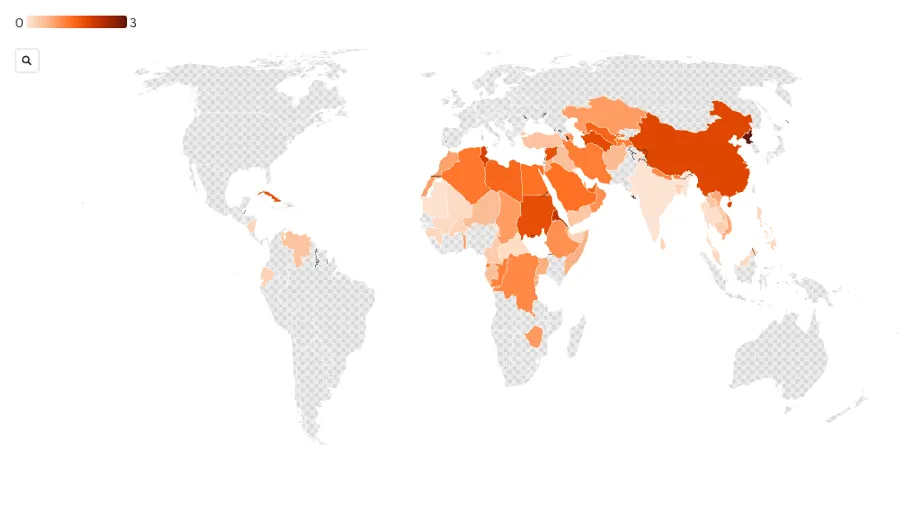
By 2024 (the most recent year of available data), the landscape had changed dramatically. Russia, India, parts of Europe, as well as Africa and Southeast Asia had moved in a sharply repressive direction. Countries like China, Saudi Arabia, and Turkey had become even more digitally repressive, adopting innovative techniques, from biometric surveillance and spyware to algorithmic censorship.

Fighting back against the digital repression tide. While governments continue to innovate their digital repression strategies, civic activists have not stayed put. A growing array of “Freedom Tech” tools are giving advocates and opposition members the means to resist government surveillance, internet controls, and financial repression. One such example is the mesh network Bitchat. This messaging app was launched by Twitter co-founder Jack Dorsey in 2025 after “a week of coding” in July. The app features a simple interface and requires no login. Crucially, it functions without cellular service or internet access. Instead, it uses Bluetooth mesh technology to create a decentralized, offline network where a message is passed from device to device, hopping through intermediaries, until it reaches the intended recipient. It has been a lifeline for citizens in Iran and Uganda.
Ahead of Uganda’s elections, Bobi Wine urged his followers to download Bitchat, warning that Museveni was planning an internet shutdown to steal the election and that the app would help people stay connected. His efforts appeared to bear fruit. According to one of Bitchat’s developers (known online as “Calle”), over 400,000 Ugandans had downloaded the app. Bitchat’s success isn’t surprising. Prior events, such as the 2019 Hong Kong protests, saw scores of people download a similar technology—Bridgefy’s mesh network—to circumvent internet shutdowns (reportedly 500,000 Hong Kong residents downloaded Bridgefy to organize marches and evade police forces). Especially in densely packed areas where scaling is easier, Bluetooth networks can attain a “percolation threshold” forming clusters of connected nodes that allow for continuous communication in a defined area. The limitation of these networks is that while they facilitate internal communication in cities, they cannot connect users outside of the country.
To that end, many have pinned their hopes on Starlink to serve as an information lifeline. In Iran, despite the government formally banning Starlink since the 12-Day War with Israel last June, people have flocked to the service. (There are an estimated 40,000 to 50,000 Starlink terminals in the country, with fundraising campaigns trying to bring in more units). But the results have been uneven. Authorities have allegedly been going door to door searching for Starlink dishes to stop people from connecting to the internet. “They’re going onto rooftops and checking the surrounding buildings,” said one Iranian to BBC. “What people need to know is that the government is searching for areas where a lot of footage has come out, so they need to be even more cautious.” In districts hit hard by protests, such as western Tehran, the authorities are using GPS jamming to reduce internet performance by as much as 80 percent. (Mair Rashidi, director of digital rights and security at Miaan Group, described the situation as “electronic warfare.”) Reportedly, a new Starlink update has impeded the regime’s jamming efforts, but there’s no guarantee that Iran won’t be able to devise other means to constrain Starlink connectivity.
A major drawback to relying on Starlink is that it creates a single point of failure. Because there are scant alternatives beyond that service, Iranian authorities can focus their efforts solely on disrupting Starlink without worrying about competing systems. A more crowded marketplace with diverse offerings would pose a greater challenge to Iran’s information control objectives. Moreover, while Starlink is clearly willing to defy the Iranian regime, the company has been reluctant to take on other governments. In Uganda, authorities also ordered Starlink to be disabled in the country, claiming it was an illegal and unlicensed operation. Rather than resist this request, Starlink chose to comply. “Please be advised that we have taken action to rapidly and decisively respond to the concerns raised by the UCC [Uganda Communications Commission], wrote Starlink executive Ben MacWilliams in a letter to the commission. “On 01 January 2026, Starlink implemented a new service restriction tool for Uganda. As a result, as of 01 January 2026, there are no Starlink terminals operating in Uganda.”
Unsurprisingly, Uganda’s opposition was appalled and took to social media to beg Elon Musk to reactivate the service. Bobi Wine posted on X to Musk: “Hey @elonmusk, as you cheer the fall of a dictator in Venezuela, here in Uganda your @Starlink has disabled citizens’ access to its internet just days to the January 15th election in which we seek to peacefully end Museveni’s 40-year-old dictatorship!”
So far, there is no indication that Elon Musk will reconsider restoring Starlink access for Uganda, underscoring the risks of relying on a single person to oversee a vital communications lifeline.
Governments worldwide are expanding their use of digital repression. While it comes as little surprise that authoritarian regimes are leveraging technology to surveil, censor, and coerce their citizens, many democratic governments are also adopting repressive tactics—often under the guise of public safety or national security—to deprive citizens of their fundamental rights. The emergence of Freedom Tech and ongoing civic resistance is encouraging, yet they raise a pressing question: What does effective and sustainable resistance to digital repression look like in practice? How can citizens scale up opposition and fight back against the escalating encroachment of technological coercion? The world faces a critical juncture. Internet blackouts in Iran and Uganda and digital gulags in China and Myanmar are signals that the struggle between freedom and tyranny is tipping in the wrong direction.
Steven Feldstein is a senior fellow at the Carnegie Endowment for International Peace in the Democracy, Conflict, and Governance Program where he ... Read More
Shreya Joshi is a James C. Gaither junior fellow in the Democracy, Conflict and Governance Program at the Carnegie Endowment for International Peace. ... Read More

Steven Feldstein

Shreya Joshi
Generously supported by
the Future of Life Institute

Together, we make the world safer.
The Bulletin elevates expert voices above the noise. But as an independent nonprofit organization, our operations depend on the support of readers like you. Help us continue to deliver quality journalism that holds leaders accountable. Your support of our work at any level is important. In return, we promise our coverage will be understandable, influential, vigilant, solution-oriented, and fair-minded. Together we can make a difference.
Keywords: China, Elections, Iran, Tehran, Uganda, digital blackout, internet shutdown, protests, rial, stalling
Topics: Disruptive Technologies, Incoming Signals, The AI Power Trip
Get alerts about this thread
0 Comments
Oldest
Recent Stories