With New START expiring, it’s now dialogue or arms racing
By Steven Pifer | Analysis | February 4, 2026
Editor’s note: This is part of an “experts comment” series on the expiration of New START.
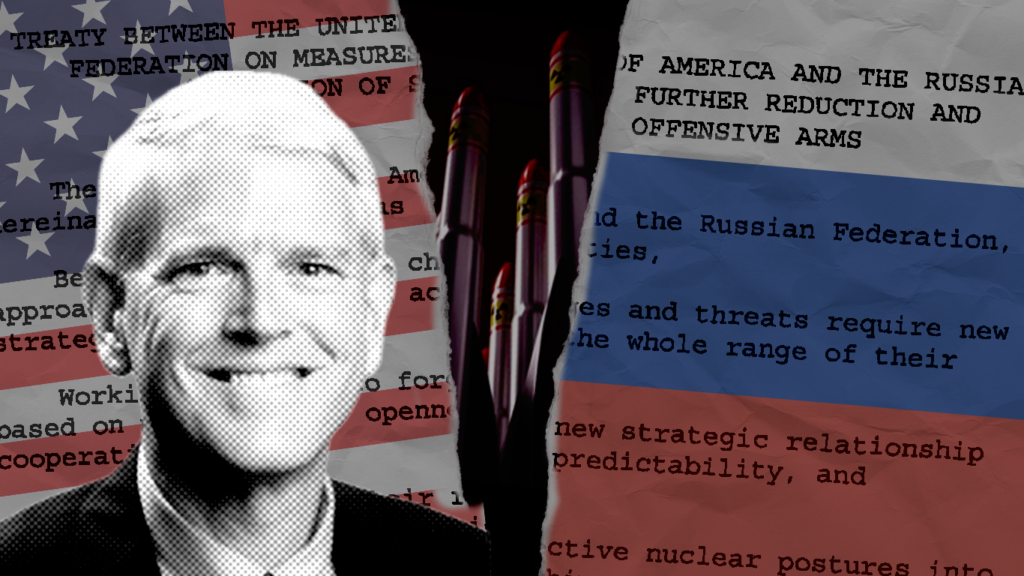
The 2010 New Strategic Arms Reduction Treaty (New START) required that the United States and Russia reduce their strategic nuclear forces to levels not seen since the 1960s. The treaty expires on Thursday. After that, there will be no agreement constraining the US and Russian nuclear weapons levels—for the first time in nearly three decades.
Neither Washington nor Moscow (or Beijing for that matter) shows real interest in pursuing nuclear arms control now, which leaves the prospects of an ensuing nuclear arms race fairly high.
In September, Russian President Vladimir Putin proposed that Russia and the United States mutually extend observance of New START’s numerical limits for one year after February 5. Putin’s offer did not include implementation of the treaty’s verification measures, and Russian officials continue to link discussion of strategic stability and future nuclear arms control to broader “positive changes in Washington’s policy toward Russia.”
At the time, US President Donald Trump called Putin’s proposal “a good idea.” But then in January, Trump said of New START, “if it expires, it expires. We’ll just do a better agreement,” adding that China should be included. The Kremlin says it has received no formal response from Washington.
Absent a last-minute surprise this week, New START will lapse with no agreed plan for US-Russian—let alone US-Russian-Chinese—talks on a follow-on treaty or broader strategic stability issues.
Beijing has shown no interest in taking part in nuclear arms discussions with Washington. This seems inconsistent with the Chinese desire to be regarded as a responsible great power and its declared doctrine of minimal deterrence. China’s nuclear arsenal is growing faster than that of any country, and Beijing has provided no transparency about its ultimate nuclear plans.
Despite proposing to extend New START’s numerical limits, Moscow’s refusal to continue the treaty’s verification measures probably made the offer less attractive in Washington. It also does not help that, in October, Putin touted two strategic nuclear weapon programs—the Poseidon nuclear-armed, nuclear-powered underwater drone and the Burevestnik nuclear-armed, nuclear-powered cruise missile—that New START’s limits do not capture.
Meanwhile, other than Trump’s occasional, off-the-cuff expressions of interest in arms control, Washington shows no effort—and seems to have no real interest—to engage either Moscow or Beijing. The prospect of having to deter both Russia and China (the so-called two-nuclear-peer challenge) may partially explain this; some regard New START’s limits as too confining. The Strategic Posture Commission’s 2023 report recommended consideration of a number of steps—including uploading warheads on strategic ballistic missiles that now carry fewer than their maximum loadings—that would raise deployed US strategic warheads above the level allowed by New START.
Any US decision to exceed New START’s limits would almost certainly trigger a corresponding decision by the Russians. That could also cause China to increase its (unknown) target for its arsenal. Both Moscow and Beijing will closely follow President Trump’s Golden Dome missile defense plan and examine its significance for the effectiveness of their strategic offensive forces.
This likely means an arms race, one that might only conclude when a key lesson of the 1960s is recalled: If one builds up its nuclear arms and the other side—or sides—does the same, it likely will not achieve a net increase in one’s security, but it will increase costs and nuclear risk.
On balance, extending observation of New START’s numerical limits for one year would make sense if accompanied by US-Russian talks on what comes next.
While China is building its nuclear arsenal, it still has a long way to go to match the US and Russian nuclear levels and become a true peer competitor. In late 2024, the Defense Department estimated that China would grow its current arsenal from 600 nuclear warheads to 1,000 in 2030. (The Pentagon has not repeated its 2023 projection that the number would rise to 1,500 by 2035.) That compares to a total US nuclear arsenal of 3,700 nuclear warheads and a Russian total of 4,300, not counting the two countries’ warheads that have been retired but not yet dismantled.
The force levels suggest that space remains for a US-Russian discussion on nuclear and related issues without China, and also excluding US allies Britain and France, which together possess some 500 nuclear warheads. This bilateral discussion could address not just the strategic nuclear weapons limited by New START but all US and Russian nuclear arms. It should also deal with the offense-defense dilemma, the question of missile defense, as well as confidence- and transparency-building measures that could reduce nuclear risk.
In parallel, Washington could push the UN Security Council’s five permanent members—Britain, China, France, Russia, and the United States—to make better use of the process established in 2010 to discuss nuclear arms. The five might address confidence- and security-building measures. The United States and Russia still observe an agreement on pre-notifying launches of intercontinental and submarine-launched ballistic missiles, and Russia and China have a similar arrangement. Why not combine the two for a multilateral pre-notification agreement among the five powers?
None of these tracks will be easy to follow. Aside from the complex specific arms control issues in play, trust between Washington and Moscow has fallen to an abysmally low point. As for the UN Security Council P5 process, it has not shown much ambition to date.
Still, it would be worthwhile for the US government to suggest such a two-track approach, even if prospects for early success appear low. There is value in getting US and Russian officials, as well as officials from the three other permanent members, to talk about these questions. It certainly seems preferable to sleepwalking into an arms race.
Together, we make the world safer.
The Bulletin elevates expert voices above the noise. But as an independent nonprofit organization, our operations depend on the support of readers like you. Help us continue to deliver quality journalism that holds leaders accountable. Your support of our work at any level is important. In return, we promise our coverage will be understandable, influential, vigilant, solution-oriented, and fair-minded. Together we can make a difference.
Keywords: China, Donald Trump, New START, New START expires, Russia, United States, Vladimir Putin, arms control
Topics: Nuclear Weapons
Get alerts about this thread
0 Comments
Oldest

Steven Pifer
Steven Pifer is an affiliate of Stanford's Center for International Security and Cooperation, a nonresident senior fellow with the Brookings ... Read More