India opens the door to private investment in nuclear energy, raising liability concerns
By Anand Kshirsagar | Voices of Tomorrow | May 8, 2026
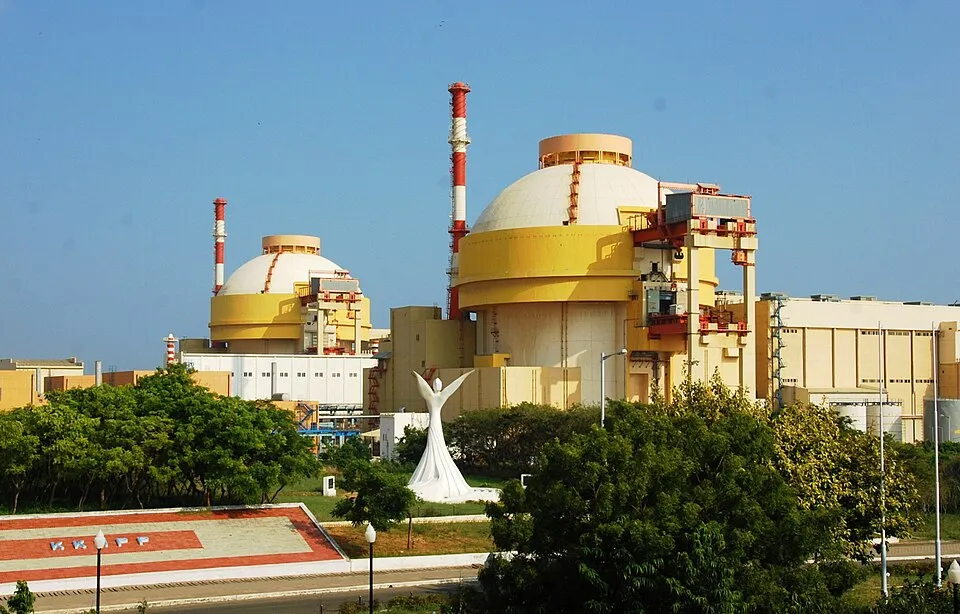 The Kudankulam Nuclear Power Plant is India’s largest nuclear power station. Units 1 and 2 (shown here) began sending power to the grid in 2013 and 2016, respectively. Four more reactors are under construction. Legislation passed by the Indian government in late 2025 will facilitate private partnerships at projects like this Russian-backed power plant.
Listen to this article:
Listen to this article
--:--
This audio was generated using an automated voice. Learn more.
In December 2025, the Indian Parliament passed a major reform that will transform the country’s nuclear energy sector. By opening the sector to private and foreign investment, the legislation marks a significant shift from the previous system of strict central government control.
The Sustainable Harnessing and Advancement of Nuclear Energy for Transforming India Bill, also known as the SHANTI Bill (from the Sanskrit word for “peace”), repeals two earlier laws governing India’s nuclear sector and replaces them with a single consolidated legal framework. According to the government, the new law will unlock private sector participation across a wide spectrum of nuclear activities including nuclear power generation, reactor supply and operation, nuclear fuel mining, and research and development across the nuclear fuel cycle.
Despite being led by alliances of various political parties over time, India’s government has long remained committed to achieving self-reliance in the field of nuclear energy. The SHANTI Bill, however, represents a significant shift in India’s energy policy. Prime Minister Narendra Modi and other leaders have argued that expanding private investment in nuclear energy is essential to meeting the country’s growing energy needs.The legislation is also positioned as a crucial step toward achieving India’s long-term climate and energy goals: reaching 500 gigawatts of renewable energy generating capacity by 2030 and 100 gigawatts of nuclear power capacity by 2047 and moving toward economy-wide decarbonization by 2070. Most significantly, policy makers claim that opening the nuclear sector to private investment will address the “investment crunch” that has long constrained the expansion of nuclear power in India.
Yet the nuclear policy shift embodied in the SHANTI Bill warrants sustained public debate in India and beyond. Nuclear energy decisions carry far-reaching consequences for public safety, environmental protection, national security, and democratic accountability—especially in a country that houses nearly one-fifth of the world’s population. More specifically, the legislation raises a question that lies at the heart of nuclear governance everywhere: When a nuclear accident occurs, who ultimately bears the costs?
A decisive shift in governance. By repealing both the Atomic Energy Act of 1962 and the Civil Liability for Nuclear Damage Act of 2010, the new law opens the nuclear sector to private and foreign participation on an unprecedented scale. It removes the operational monopoly of the Nuclear Power Corporation of India and establishes a new statutory regulatory framework that is nominally accountable to Parliament.
To understand the significance of this shift, it is necessary to revisit India’s earlier nuclear policy framework. India was among the first developing countries to articulate an independent nuclear vision. Under the political leadership of Jawaharlal Nehru and the scientific stewardship of Homi J. Bhabha, India adopted a dual-purpose nuclear doctrine often described as “atoms for peace” alongside “atoms for national defense.”
From the outset, India’s civilian nuclear strategy emphasized self-reliance and strong state control. Licensing for mining atomic minerals, producing or using nuclear materials, and trading nuclear equipment was restricted to government entities. Radiation-related activities required approval from the Atomic Energy Regulatory Board, reinforcing the idea that nuclear energy was a sovereign function rather than a commercial enterprise.
India’s commitment to nuclear self-reliance was further reflected in its ambitious three-stage nuclear program. The first stage focused on pressurized heavy water reactors that produce plutonium as a byproduct. The second stage aimed to develop fast breeder reactors capable of generating additional plutonium while converting thorium into fissile uranium. The third stage envisioned advanced reactors powered primarily by thorium—a resource India possesses in abundance.
This strategy was designed to overcome India’s limited uranium reserves and ultimately achieve thorium-based nuclear energy independence. Despite this long-term vision, nuclear power has remained a marginal component of India’s energy mix. The country currently operates 24 nuclear reactors with a combined capacity of less than 8,000 megawatts, contributing less than three percent of total electricity generation.
Global isolation. India’s nuclear development has also been shaped by international geopolitics. Following nuclear tests in 1974 and 1998, India faced prolonged global isolation. It declined to sign the Nuclear Non-Proliferation Treaty and the Comprehensive Nuclear Test Ban Treaty, arguing that these regimes entrenched an unequal global nuclear order.
As a result, India was excluded from global nuclear fuel and technology markets for decades, limiting its ability to import uranium, reactor designs, and advanced expertise. A partial breakthrough came with the United States–India Civil Nuclear Cooperation Initiative, finalized in 2008, which enabled India to re-enter the global nuclear marketplace.
In response, India’s Parliament enacted the Civil Liability for Nuclear Damage Act in 2010. The law established strict operator liability under the “polluter pays” principle and allowed operators to seek a right of recourse from suppliers in cases involving defective equipment or gross negligence. Ironically, the Bharatiya Janata Party—which currently governs India—opposed the legislation when it was not in power, arguing that it did not go far enough in ensuring supplier accountability.
Limits on liability. The new bill not only opens India’s nuclear energy industry to new private investment but also significantly restructures the liability regime governing nuclear accidents. It sharply limits the civil liability of nuclear plant operators and weakens references to supplier liability—an issue that foreign reactor manufacturers such as Areva and Hitachi GE Vernova have long raised in negotiations with India. Compensation for nuclear accidents is no longer tied to the scale of damage suffered by victims. Instead, it is capped according to the installed capacity of nuclear plants.
Even for the largest power plants, operator liability is capped at 3,000 crore rupees (approximately $319 million). Smaller plants carry proportionately lower liability limits. Penalties for regulatory violations are also constrained, with maximum fines of one crore rupees (roughly $106,000)—even in cases involving serious breaches. Victims face strict time limits on bringing legal claims: 10 years for property damage claims and 20 years for personal injury.
Critics argue that the liability caps fall dramatically short of the cost of historical nuclear disasters. Cleanup costs from the Fukushima Daiichi nuclear disaster have exceeded $180 billion, while the long-term economic consequences of the Chernobyl disaster continue to run into hundreds of billions of dollars.
Government claims that insurance pools or liability funds could cover the gap have been met with skepticism, given the absence of insurance markets capable of underwriting nuclear risk at such scales. Critics fear the bill creates a legal fiction of insurability while leaving taxpayers responsible for catastrophic costs.
Also, the SHANTI Bill remains largely silent on criminal liability in the event of nuclear accidents. It does not clearly address negligence, falsification of safety data, suppression of incident reports, or sabotage. By failing to define criminal accountability, the legislation risks insulating corporate actors from legal scrutiny and undermining the constitutional principle of equality before the law.
The bill fundamentally alters the social and legal contract between the Indian state and its citizens in the event of such incidences. India’s historically marginalized communities—including tribal and nomadic communities, fishing communities, Dalits (formerly “untouchables”), unorganized contract laborers, and rural populations—will likely be among the most vulnerable to displacement caused by large-scale infrastructure projects. By limiting nuclear liability and accountability, the SHANTI Bill could also make these communities vulnerable to the long-term and intergenerational consequences of potential nuclear disasters.
For many Indians, the shadow of the Bhopal gas tragedy still looms large. The failure to hold corporate actors fully accountable for one of the world’s worst industrial disasters left a deep imprint on Indian public consciousness. The prospect of privately operated nuclear facilities has revived fears of regulatory failure, corporate impunity, and delayed justice in the cases of potential nuclear disasters.
Other objections to the SHANTI bill. Concerns about regulatory independence further complicate the picture. While the bill grants statutory status to the Atomic Energy Regulatory Board, appointments remain controlled by the Department of Atomic Energy, with no independent selection or parliamentary confirmation process. The regulatory board’s mandate remains limited primarily to technical safety questions. The bill leaves unresolved questions about nuclear disaster response in India’s federal structure. It does not clearly define the roles of central, state, and local governments during nuclear emergencies or outline the mechanisms needed to coordinate response and recovery.
Security concerns also remain largely unaddressed. Privately operated nuclear facilities could potentially introduce new vulnerabilities—from cyberattacks and espionage to illicit trafficking of nuclear materials. The bill offers little clarity regarding how national security agencies would coordinate oversight in such scenarios.
Privatization may also intensify problematic labor relations within the nuclear sector. Construction, maintenance, and waste handling in large infrastructure projects frequently rely on informal contract labor. Without strong regulatory oversight, these workers may face higher radiation risks and weaker protections. The SHANTI Bill offers little clarity on occupational safety standards, long-term health monitoring, or compensation for radiation exposure.
The bill also raises questions about India’s longstanding goal of nuclear self-reliance. Expanded foreign investment could deepen technological dependence rather than facilitating meaningful knowledge transfer. Imported reactor systems often lock countries into proprietary supply chains, long-term fuel contracts, and foreign maintenance agreements—sidelining reactor designs developed by Indian scientists.
Finally, the legislation is largely silent on long-term nuclear waste management and on-site waste disposal. Without clear plans for storage, disposal, and decommissioning funding, privately operated nuclear plants could leave future generations with unresolved radioactive legacies.
A profound shift. India’s growing and increasingly affluent population will undoubtedly require a diverse mix of renewable and non-renewable energy sources, and nuclear power can contribute to stable baseload electricity generation. Yet the SHANTI Bill is not merely an energy reform. It represents a profound shift in how risk, responsibility, and accountability are distributed in one of India’s most consequential sectors.
If the legislation proceeds without stronger safeguards, it risks creating an asymmetric system in which domestic and foreign investors in the nuclear energy sector will gain access to profits, while the risks and consequences of potential nuclear accidents will be borne by the Indian public. The question is not whether nuclear energy should play a role in India’s future. Rather, it is whether the legal architecture governing that future ensures that technological progress does not come at the expense of democratic accountability, public safety, and environmental justice.
Together, we make the world safer.
The Bulletin elevates expert voices above the noise. But as an independent nonprofit organization, our operations depend on the support of readers like you. Help us continue to deliver quality journalism that holds leaders accountable. Your support of our work at any level is important. In return, we promise our coverage will be understandable, influential, vigilant, solution-oriented, and fair-minded. Together we can make a difference.
Keywords: India, SHANTI Bill, liability, nuclear energy
Topics: Climate Change, Nuclear Energy, Nuclear Risk, Opinion, Voices of Tomorrow

Anand Kshirsagar
Anand Kshirsagar is a Harris Merit Scholar and holds a Master of Public Policy from the Harris School of Public Policy at the University of Chicago, ... Read More














Leave a Reply