Four US presidents failed to stop North Korea’s nuclear buildup. Trump still has a shot
By Joe Cirincione | Analysis | December 18, 2025
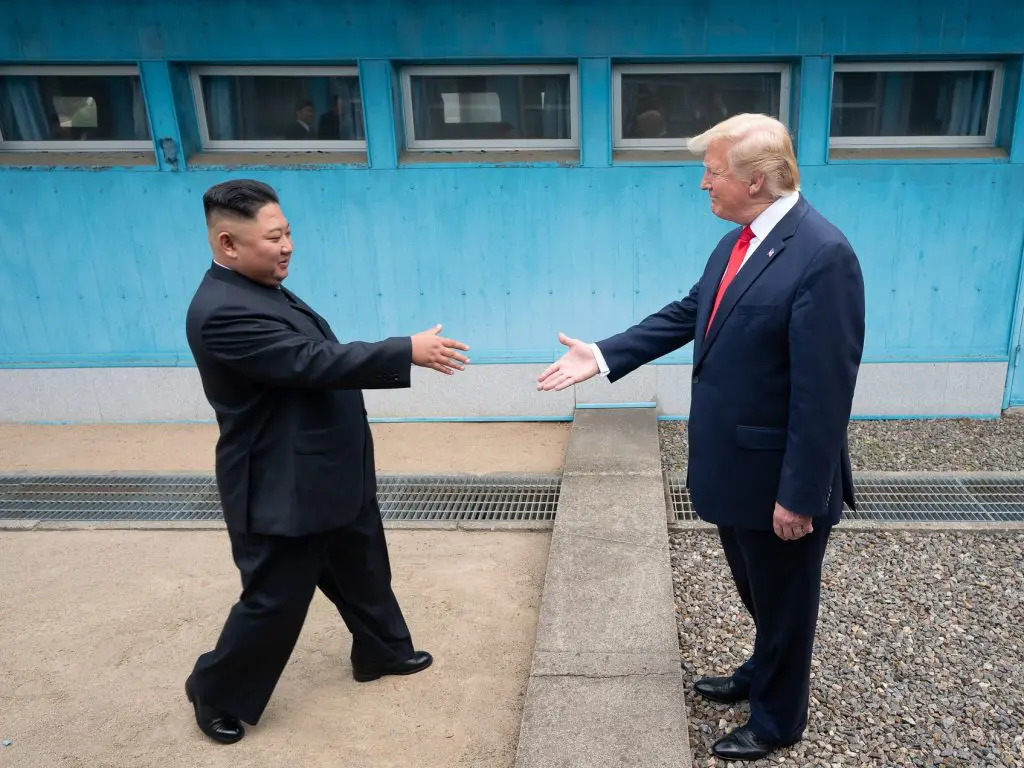 US President Donald Trump meets Kim Jong-un at the Korean Demilitarized Zone, June 30, 2019. Credit: Public Domain.
Although he has carried it to new extremes, Donald Trump did not invent the ideological purge of skilled government officials. When George W. Bush became president in 2001, his administration demoted Joel Wit from a senior position at the State Department because he had played a key role in negotiating and implementing the 1994 Agreed Framework with North Korea.
Much like the Iran nuclear deal two decades later, the accord had effectively blocked all of North Korea’s pathways to a bomb. It froze, rolled back, and eventually eliminated North Korea’s ability to produce any material and equipment for nuclear weapons.
But that wasn’t enough for the incoming Bush administration.
Bush’s national security advisor, John Bolton, convinced the president to pull out of agreements he considered appeasement. “We don’t negotiate with evil, we defeat it,” Vice President Dick Cheney reportedly said at the time. The rest is history: In 2002, President Bush pulled out of the Anti-Ballistic Missile Treaty, promising that without the treaty’s restrictions, the United States would soon have a shield that could protect the country from ballistic missile attack; In 2003, he invaded Iraq, promising to find and eliminate Saddam Hussein’s imaginary weapons of mass destruction and spread democracy throughout the Middle East; and in 2004, he dissolved the Agreed Framework, promising that pressure would soon compel the North Korean dictatorship to comply or collapse.
None of those goals was realized. In fact, all of these fantasies backfired, creating disasters, destroying essential nuclear guardrails, triggering billions in unnecessary spending, and killing hundreds of thousands of people needlessly in the Iraq war.
Joel Wit, now at the Stimson Center, comes back with a new book, Fallout: The Inside Story of America’s Failure to Disarm North Korea, that tracks four decades of failed US policy toward North Korea—a period interrupted only by brief diplomatic successes. Wit’s book shows that ideological arrogance and political cowardice are not confined to one party. If Republicans often fell victim to hubris and the belief that military power can resolve all conflicts, Democrats pull back from engagement, fearful that it will make them look weak or distract them from domestic issues.
Policy leaves a track record that allows one to go back and examine successes and failures, documenting what officials promised against the outcome of their decisions. But outside a limited number of historians, experts and scholars rarely do so. If they did, it would become evident that the only policy that has ever worked to restrain and reverse North Korea’s nuclear program has been engagement and diplomacy, not pressure and threats. But Democrats and Republicans alike have long ignored this lesson.
Washington’s obsession with disarming North Korea. Wit does go back and examine past US policies toward North Korea. His book shows how, in the span of four US administrations, North Korea went from being a tiny, impoverished nation that in the early 2000s lacked both nuclear weapons and missiles that could travel much beyond its borders, to now a country with dozens of nuclear warheads and a growing arsenal of long-range ballistic missiles that can deliver them to any part of the United States.
This was preventable, Wit argues: “Four administrations had multiple opportunities to stop Pyongyang but failed.”
Barack Obama and Joe Biden share blame with Bush and Donald Trump. Over 560 pages, Wit walks through the opportunities and mistakes of each administration, often in gripping, first-person, “I was there” detail. Without excusing the bellicosity, paranoia, and truly evil nature of North Korea’s successive dictators or underestimating the difficulties involved, Wit makes a strong case that solutions existed—and still exist.
Wit’s bottom line is one that I share. “Washington consistently overrates its ability to influence other countries. Failing to understand those countries and what shapes their behavior has led to a host of US foreign policy failures, such as Vietnam, Iraq, and Afghanistan. North Korea, because of the nuclear threat it poses, could be the most dangerous example of that failure.”
In short, successive US administrations failed to learn from past mistakes but kept their overconfidence intact. It’s Bill Clinton who came closest to sealing a deal that would have stopped North Korea’s nuclear program before it became truly dangerous. He even sent Secretary of State Madeline Albright to Pyongyang to set up a final agreement, but then deferred going himself in 2000 to finalize it, believing that Vice President Al Gore could wrap it up when he took over. But Clinton’s hesitation and failure to prioritize the North Korean nuclear question ultimately let the bird in hand slip away.
Bush inherited a successful diplomatic process, but he surrounded himself with aides and a vice president who had built their careers railing against arms control agreements. After the 9/11 attacks, Bush lumped North Korea into his “Axis of Evil.” When the North Koreans were caught enriching uranium in what Washington thought was a violation of the 1994 agreement, Bolton had found “the hammer” he needed to kill the pact. He, Cheney, and Bush thought threats would force Pyongyang to surrender. They failed badly: Instead of bending, North Korea quadrupled its plutonium stockpile and conducted its first nuclear test in 2006.
Barack Obama inherited this failure, but he, too, struck out. “North Korea is the biggest blemish on President Barack Obama’s nonproliferation record,” former US director of the International Institute for Strategic Studies Mark Fitzpatrick wrote in 2016. Obama tried another approach—“strategic patience”—thinking that waiting for the North Koreans to give in to US demands would bring them back to the negotiating table. Instead, “Pyongyang’s four nuclear tests and more than 50 missile and rocket launches during the past eight years have given it a capacity to rain nuclear warheads on its regional adversaries and a good start to be able soon to reach the US homeland,” Fitzpatrick says.
Then Trump came close to a breakthrough deal with Kim Jong-un at the 2019 Hanoi summit. But at the last minute, the president foolishly listened to Bolton instead of his lead negotiator, Steve Biegun. Trump scuttled the step-by-step reduction plan worked out by Biegun in favor of Bolton’s demand that North Korea give up all its weapons in exchange for vague US promises. Again, North Korea—all too aware of how that kind of deal had worked out for Libyan dictator Muammar Gaddafi—walked away and turned to Russia to build up its arsenal.
Biden largely ignored the North Korea problem, piling on sanctions instead of engaging. “Strategic patience is dangerous in 2023 for the same reason it was dangerous when the Obama administration practiced it a decade ago,” Washington Post columnist Josh Rogan wrote. “When there’s no diplomacy, North Korea accelerates its weapons programs and grows closer to US adversaries—and the risk of conflict rises. Engaging the Kim regime is hard. Not engaging it is much worse.”
Is Trump ready this time? Wit details some reasonable steps Trump could now take toward North Korea, and there are some signs that the president might try. Secretary of State Marco Rubio said during his 2025 Senate confirmation hearing that the United States should focus on preventing a crisis and lowering the risk of an inadvertent war “between South Korea and North Korea, maybe including Japan at this point, and ultimately the United States.” If Rubio and Trump seriously want to engage with Kim, they have experts in the administration who worked with Steve Biegun, including Under Secretary of State for Political Affairs Allison Hooker, and who could help resurrect a more personal approach of leader to leader.
Ironically, Trump’s warming relations with Vladimir Putin’s Russia could help with Kim Jong-un, given the new, tight Moscow-Pyongyang relationship. Kim might accept a phone call with Trump, for example. A summit might be possible too, at which Trump could offer to ease US sanctions and—continuing his first administration’s approach—flip the script and offer diplomatic relations with North Korea, followed by a breakthrough nuclear agreement.
“The two objectives—denuclearization and risk reduction—are not mutually exclusive,” Wit says. “Slowing the growth of Pyongyang’s [weapons of mass destruction] arsenal, by halting missile and nuclear tests, could be the first step in moving toward denuclearization while also calming tensions and reducing the risk of war.”
Outlining possibilities, however, does not mean any of them are likely to become reality. One year on, the second Trump administration is already proving to be the most incompetent in US history. This nuclear football may well be fumbled again into the next administration. If there is any chance for the next president to pull the United States back from being “one mistake away from nuclear war,” as Wit says, it will have to begin with a thoughtful critique of past administrations’ failures.
Now would be a good time to start that critical review, and Fallout is our collective invitation to do so. The book should be essential reading for anyone in Washington hoping to rein in North Korea’s rapidly expanding nuclear arsenal, so that maybe next time, US officials will have learned from their predecessors’ mistakes.
Together, we make the world safer.
The Bulletin elevates expert voices above the noise. But as an independent nonprofit organization, our operations depend on the support of readers like you. Help us continue to deliver quality journalism that holds leaders accountable. Your support of our work at any level is important. In return, we promise our coverage will be understandable, influential, vigilant, solution-oriented, and fair-minded. Together we can make a difference.

Joe Cirincione
Joseph Cirincione is a nuclear policy analyst and author with over 35 years of experience in the field. ... Read More











Leave a Reply