Trump doesn’t need the Golden Dome in Greenland. He needs a stronger NATO
By Igor Moric | Analysis | February 3, 2026
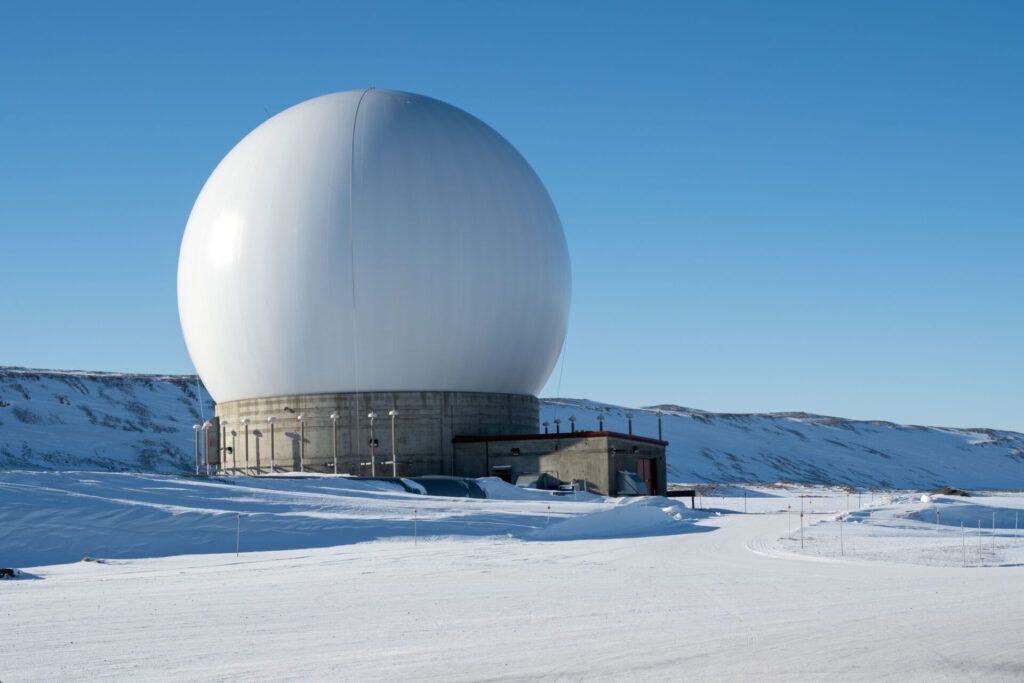 The Pituffik Space Base in Greenland has already an upgraded early warning radar system that can detect and track ballistic missiles for US strategic missile defense. (Photo: US Space Force/Kaitlin Castillo)
In recent weeks, President Donald Trump increased rhetorical pressure on Greenland, saying that acquiring it was essential to national security and warning that the United States was going to take it over the easy or the hard way. Asked how far he was willing to go to acquire Greenland as he was boarding Air Force One to attend the World Economic Forum in Davos, Trump told reporters: “You’ll find out.”
Ahead of the forum, Trump threatened a new round of tariffs against European countries that deployed military personnel to the Denmark-administered island. But he reversed course four days later after meeting with NATO Secretary General Mark Rutte in Davos, claiming that a framework for a future deal on Greenland had been reached.
President Trump has repeatedly linked the need to acquire Greenland with the Golden Dome missile shield, an ambitious system aimed to defend the entirety of the United States’ mainland against all aerial threats, including ballistic, hypersonic, and advanced cruise missiles. In Davos, he reiterated that Greenland was essential to “build the greatest Golden Dome ever built,” calling it a “very brilliant, but highly complex system.” The president argued that it “can only work at its maximum potential and efficiency, because of angles, metes, and bounds, if this Land is included in it.”
But placing an interceptor in Greenland would have no significant benefit for the current strategic missile defense of the United States.
Unworkable problem. Today’s US ballistic missile system consists of 44 interceptor missiles deployed at two locations: Fort Greely, Alaska and Vandenberg Space Force Base, California. These sites are close to the potential trajectories of nuclear-armed intercontinental ballistic missiles (ICBMs) launched from central and eastern Russia and China.
In theory, adding a third interceptor site in Greenland could provide additional engagement opportunities for missiles launched from western Russia crossing the Arctic and North Atlantic. In practice, however, a Greenland-based interceptor site would add no meaningful value to the existing US strategic missile defense. Scripted tests performed over the last 20 years show that ballistic missile interceptors succeed at a rate just above 50 percent—essentially a coin toss. And even this result is obtained under ideal conditions, with no countermeasures and with incoming missiles carrying only a single warhead.
In the event of nuclear war, Russia’s roughly 330 land-based ICBMs and 10 to 11 operational nuclear-armed ballistic missile submarines (SSBNs) have the capacity to deliver on the order of 2,000 nuclear warheads to the US homeland. This figure does not include penetration aids and decoys, potentially in numbers comparable to or far greater than the warheads. According to the 2025 American Physical Society, the issue of effectively discriminating warheads from decoys remains unsolved for US mid-course missile defense.
Given the size of the Russian arsenal, the probability that existing US land-based interceptors could stop a full-scale nuclear attack approaches zero. An additional interceptor site in Greenland—or even several of them—would not change that conclusion.
Precisely because land-based interception of ICBMs is a technically unworkable problem and has been since the 1960s, President Reagan proposed the Strategic Defense Initiative (SDI) in 1983. The program sought to place missile interceptors in space, close to where ICBMs would be launched, to destroy them before they reach orbit and while they are still big, bright, and slow-moving targets.
Derisively nicknamed “Star Wars” even before it was cancelled, SDI was a technological failure, with study after study demonstrating how it could be easily evaded and penetrated. Moreover, the cost dynamics overwhelmingly favored the attacker: It remains cheaper to launch a missile from ground than to put an anti-missile in space.
A new (golden) hope. In January 2025, President Trump decided to give space-based missile defense another go and announced the Golden Dome (initially called “Iron Dome for America”). Now, after a year of study, the Pentagon claims it has finalized the baseline architecture and is already reviewing an implementation plan. The program’s director, Space Force Gen. Michael Guetlein, recently said that “a solid plan is in place” and that details are being shared with selected defense firms and Congress.
Despite $25 billion having been approved by Congress for initial work on the Golden Dome, no details about the proposed system have been publicly shared.
What we do know is that Space Force is seeking a capability to “defend an entire nation against ballistic missiles and other aerial threats” by mid 2028 and that initial prototype contracts were awarded to multiple firms to develop space-based interceptors designed to shoot down missile threats within a few minutes of launch—that is, in their boost phase. (These companies have not been identified, and neither is the value of the awarded contracts.) Space Force also issued a separate request for space-based interceptors for midcourse missile defense, intended to engage missiles after they reach orbit but before they overfly the United States.
These interceptors would continuously orbit the Earth, providing coverage of all locations from which a missile could be fired toward the United States, including land-based ICBM sites deep within Russian and Chinese territory and potential locations of ballistic missile submarines at sea. According to the American Enterprise Institute, a robust defense of the US homeland against missile threats would require more than 85,000 space-based interceptors costing some $3.6 trillion. But even this would not provide full protection against large-scale nuclear attacks.
In case of a conventional attack, some leakage may be acceptable. But in the case of a nuclear attack, any missed interception would be catastrophic.
In addition to legacy programs such as the Space Based Infrared System, the Golden Dome would rely on a new network of hundreds of sensing and communication satellites placed across multiple orbits, providing space-based early missile-warning and missile-tracking capabilities. According to Space Force’s Space Development Agency, more than 80 such satellites are already in orbit as part of the Proliferated Warfighter Space Architecture.
But the Government Accountability Office recently released a report stating that the Space Development Agency is overestimating the technology readiness of some critical elements it plans to use, and that the program is already failing to meet its goals and operator needs.
Shared strategic value. None of the publicly announced Golden Dome components requires control of Greenland. Its geographical location provides no logical benefit to a space-based architecture of interceptors and sensors. Greenland’s primary contribution to US strategic missile defense is through the Upgraded Early Warning Radar operated by the Space Force at the Pituffik Space Base (formerly Thule Air Base) on Greenland. This is a phased-array radar designed to detect and track ballistic missile threats, information critical for the interception of ICBMs with land-based interceptors—not the Golden Dome.
The Pituffik base was established and operates under the 1951 Greenland Defense Agreement between the United States and Denmark. This agreement was placed under NATO’s collective defense framework in support of the alliance’s objectives of committing members to individually and collectively strengthening their national resilience and defense capabilities. The 1951 agreement grants the United States extensive rights to establish and operate military bases in Greenland.
Even though that agreement allows the United States to operate as many bases in Greenland as it deems necessary, the current US military presence is minimal. At the height of the Cold War, the Pituffik base stationed over 10,000 personnel. Today, there are only about 150, and Pituffik is the only US base in Greenland. Since the end of World War II, the United States has abandoned over 20 other sites, leaving hazardous waste buried in the melting ice and refusing to clean it up.
Greenland may not be essential for the Golden Dome, but it is strategically valuable and rich in resources. President Trump has previously described Greenland’s defense situation as inadequate from a US perspective, arguing that Russia or China would move in if the United States does not.
He may be right. But there is no reason for the United States to continue underwriting European security as it has done throughout and since the end of the Cold War. Europe today has the economic power to fund its own defense.
Arctic security should be managed among NATO allies through the collective efforts of all and under the alliance’s framework, with a far stronger European and US contribution. The recent deployment of European troops to Greenland signals that allies are finally stepping up and assuming greater responsibility. To improve interoperability with US forces and demonstrate unity, this presence should become permanent and expand to additional European countries.
The United States would be wise to welcome it.
Together, we make the world safer.
The Bulletin elevates expert voices above the noise. But as an independent nonprofit organization, our operations depend on the support of readers like you. Help us continue to deliver quality journalism that holds leaders accountable. Your support of our work at any level is important. In return, we promise our coverage will be understandable, influential, vigilant, solution-oriented, and fair-minded. Together we can make a difference.
Keywords: Denmark, Donald Trump, Golden Dome, Greenland, ICBM, NATO, Russia, Trump administration, United States, missile defense
Topics: Nuclear Risk
Get alerts about this thread
0 Comments
Oldest

Igor Moric
Igor Moric is an associate research scholar in the Program on Science and Global Security (SGS) at Princeton University. Before joining Princeton, he ... Read More