
Nuclear weapon test Bravo, conducted as part of a series of tests referred to as Operation Castle, was exploded by the US military at Bikini Atoll in the Marshall Islands on March 1, 1954. Bravo was the first US test of a deliverable thermonuclear bomb (“H-bomb”) and was expected to have a six-megaton yield, the equivalent of six million tons of TNT. In fact, the explosion was more than double that—15 megatons—and one thousand times more powerful than the atomic bomb that destroyed Hiroshima. (Image courtesy of US Energy Department via Wikimedia Commons)
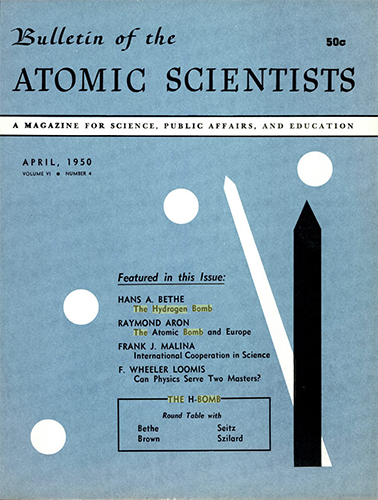
(Article originally published in the April 1950 issue of the Bulletin of the Atomic Scientists, Vol. 6, Issue 4, pages 99-104, https://doi.org/10.1080/00963402.1950.11461231)
In this article I shall discuss some of the scientific, moral, and political aspects of the hydrogen bomb. On the technical side, I shall try to clarify the many misconceptions which have crept into the discussions in the daily press. On the political side, I wish to take up the moral issue and the meaning of the H-bomb in the general framework of our foreign relations. [Further scientific information is given in an article by Dr. Ridenour in the March issue of the Scientific American in which the effect of the bomb on the military situation is also evaluated.]
Impossibility of complete mass-energy conversion
Everybody who talks about atomic energy knows Einstein’s equation E=mc2; thus the energy release in a nuclear reaction can be calculated from the decrease in mass. In the fission of the uranium nucleus, one-tenth of 1 per cent of the mass is converted into energy; in the fusion of four hydrogen nuclei to form helium, seventenths of 1 per cent. When these statements are made in newspaper reports, it is usually implied that there ought to be some way in which all the mass of a nucleus could be converted into energy, and that we are merely waiting for technical developments to make this practical. Needless to say, this is wrong. Physics is sufficiently developed to permit the statement that there will never be a way to make a proton or a neutron or any other nucleus simply disappear, its mass being converted into energy.
It may be objected that physics does know of processes in which particles simply disappear and their total mass is converted into energy. The oldest and most important example is the positive electron, discovered by Anderson in 1932, and now familiar in every physics laboratory: When this particle meets a negative electron (the particle found in every atom), it can happen that the two annihilate each other. The energy liberated is 2 mc2, with m the mass of the electron (positive and negative electrons have the same mass), and this energy appears in the form of gamma radiation. This, however, is not a practical method to produce energy because the positive electron must first be created. This creation is the inverse of the annihilation process; a gamma ray of high energy E creates a pair of electrons, one positive and one negative; the energy 2 mc2 is consumed in the creation of their mass, while the rest of the energy of the gamma ray is given to the electrons as kinetic energy.
Similar processes are the creation and annihilation of mesons, particles not normally found in nature in the free state. All these phenomena in which the entire mass of particles is transformed into energy, have one thing in common: they involve at least one particle which does not normally occur in nature and which must first be created, and this creation process consumes as much energy as is afterwards liberated. The very fact that energy is liberated when they disappear makes these particles, positron, meson, etc., unstable, so that they do not “live long” and thus have to be created each time before they can be observed. Physicists believe that there is also an “anti-proton” of negative electric charge which can be annihilated by combination with the ordinary proton, just as a positive and a negative electron. This particle has not yet been observed, but it can be predicted that it too has a short life, and that in its creation as much energy must be spent as will be liberated in its annihilation. The complete destruction of a particle is therefore not a feasible way to release energy, not even theoretically.
All the nuclear processes from which energy can be liberated, involve the rearrangement of protons and neutrons in nuclei, the protons and neutrons themselves remaining intact. Hundreds of experimental investigations have taught us, through the last thirty years, how much energy can be liberated in each transformation. Fission of heavy nuclei (splitting into two smaller ones) and fusion of light ones (combination of two or more nuclei to form a larger one) can release energy. Only the fusion of the very lightest nuclei, however, releases large amounts of energy. For example, in the fusion of four hydrogen nuclei to form helium, 0.7 per cent of the mass is transformed into energy, but when four helium nuclei are in turn fused into oxygen the mass decreases by only 0.1 per cent, and the fusion of two silicon atoms, if it ever could occur, would release less than 0.02 per cent of the mass. There is thus no prospect of using elements of medium atomic weight for the release of nuclear energy.
Rate of reaction
The main problem in the release of nuclear energy, however, is not the amount of energy available—there are plenty of nuclear reactions in which it is large enough—but whether there is a mechanism by which the release can proceed at a sufficient rate. This consideration is almost invariably ignored by science reporters who seem to be incurably fascinated by the equation E=mc2. The rate of reaction is governed by entirely different factors in fission and fusion: Fission takes place when a nucleus of uranium or plutonium captures a neutron. The fission reaction will proceed as long as there are neutrons present, and it will proceed at an accelerated rate if the neutrons multiply, as they do in a lump of uranium which has more than the critical mass. The temperature has no important influence on the fission reaction; no matter how slow a neutron, it can enter a uranium nucleus and cause fission. This is because the neutron has no electric charge and is therefore not repelled by the nucleus.
In fusion reactions, on the other hand, two nuclei must come in contact, both of which have positive electric charges. For instance, in the “carbon cycle” which is mainly responsible for the energy of the stars, a proton must collide and react with a nucleus of carbon or nitrogen. Since both nuclei are positively charged, there are strong forces of electric repulsion between them. To overcome these, the nuclei must approach each other with great speed. In the laboratory this is achieved by giving very high velocities to a very few nuclei; this method is inefficient because it is unlikely that one of the fast “projectiles” will hit a target nucleus before it loses most of its energy to the electrons which also are present in the atoms of the target. Therefore, in this laboratory method, the energy released by nuclear reactions is always much less than the energy invested initially in accelerating the particles. This obviously makes the method impractical for the production of nuclear power.
The only known way in which energy can actually be extracted from light nuclei is by thermonuclear reactions, i.e., nuclear reactions which proceed at exceedingly high temperatures. The prime example of thermonuclear reactions are the processes in the interior of the stars, where temperatures are of the order of twenty million degrees centigrade. At this temperature, the average energy of an atom is still only 1,700 electron volts, much less than the energies given to nuclear particles in “atom smashers.” But in the star, all atoms, nuclei, and electrons, have high kinetic energy, so that they are not slowed down by colliding with each other, in contrast to the projectiles in the “atom smashers.” They will keep their high speeds “forever.” In spite of the high temperature, the nuclear reactions in stars proceed at an extremely slow rate; only 1 per cent of the hydrogen in the sun is transformed into helium in a billion years. Indeed it would be catastrophic for the star if the reaction went much faster.
The temperature at the center of a star is kept high and very nearly constant by an interplay of a number of physical forces. The main point is that the radiation which is produced in the nuclear reactions can escape from the star only with great difficulty. A quantum of radiation which is emitted by one atom will be absorbed by another atom before it has gone one-tenth of an inch; in other words, stellar matter is very “opaque.” The absorption of the quantum increases the energy of the second atom, which after a while emits a new quantum. The latter travels in a random direction unrelated to that of the old quantum. Thus, light does not proceed from the interior of the star to the surface in a straight line (which would take about three seconds) but in an extremely complicated zigzag path, by “diffusion.” It can be calculated that in our sun the escape of radiation from the center takes about 10,000 years. A corollary of this slow diffusion of radiation is that the temperature at the surface of the star is much lower than in the interior; for the sun, these temperatures are 6,000 and 17,500,000 degrees, respectively. This keeps the emission of radiation from the surface moderate and prevents the cooling of the interior. Conditions in the star adjust themselves in such a way that the energy production in the center exactly corresponds to the loss of radiation from the surface: Any deviation which might occur is quickly eliminated; the star is an excellent thermostat.
Only the very large size of stars makes it possible to maintain permanently in their interior temperatures which make significant energy production by nuclear reactions possible. A star weighing one-tenth as much as the sun would produce so little energy that it would not be visible (some such stars have been detected by the infra-red radiation they emit). The largest planet in the solar system, Jupiter, is so small that it could not maintain nuclear reactions; and the earth, of course, is smaller still. This rules out the possibility that the earth’s atmosphere, or the ocean, or the earth’s crust, could be set on fire by a hydrogen bomb, and the earth converted into a star. Because of the small mass, radiation would carry away the nuclear energy much faster than it is developed, and the temperature would drop rapidly so that the nuclear reaction would soon stop.
The materials for thermo-nuclear reactions
If thermo-nuclear reactions are to be initiated on earth, one must take into consideration that any nuclear energy which may be released will be carried away rapidly by radiation so that it will not be possible to keep the temperature high for a long time. Therefore, if the reaction is to occur at all, it must occur very quickly. Reaction times of billions of years, like those in the sun, would never lead to an appreciable energy release on earth; we must rather think in millionths of a second. On the other hand, while the stellar reactions can only use the elements which happen to be abundant in stars, notably ordinary hydrogen, we can choose any element we like for our thermo-nuclear reactions. We shall obviously choose those with the highest reaction rates.
The reaction rate depends first of all, and extremely sensitively, on the product of the electric charges of the reacting nuclei. The highest rates will, therefore, be obtainable from a reaction between two hydrogen nuclei because hydrogen has the smallest possible charge, one elementary unit. (The principal reactions in stars are between carbon, of charge six, and hydrogen.) Next, we can choose any of the three isotopic hydrogen nuclei, of atomic weight 1 (proton), 2 (deuteron), or 3 (triton). This choice is again easily made because these isotopes undergo different types of nuclear reactions. A fusion of two protons—the pp reaction—has long been known to proceed exceedingly slowly; a proton lives an average of 100 billion years at the center of the sun until it disappears by this reaction. As pointed out in Ridenour’s article, the situation is quite different for the reactions between the heavy forms of the hydrogen nucleus, called the deuteron and the triton. Measurements have shown that for this type of fusion the reaction rates are quite high.
Conditions necessary for the reaction
A further variable governing the rate of thermo-nuclear reactions is density. The more atoms there are per unit volume, the greater the chance for a nuclear collision. Whether the temperatures required to start a thermonuclear reaction between heavy hydrogen nuclei, even under the most favorable practical conditions, can be achieved on earth is a major problem in the development of the fusion bomb. To find a practical way of detonating such bombs will require much research and considerable time.

Effects of hydrogen bomb
What would be the effects of a hydrogen bomb? Its power would be essentially unlimited and would increase as the amount of heavy hydrogen that can be carried in the bomb. For instance, if the bomb is carried by a submarine it might be much larger and therefore more powerful than if carried by a plane. For the sake of argument, however, we shall assume an energy release a thousand times greater than the Hiroshima bomb. The radius of severe destruction by blast at Hiroshima was a mile, and this radius will increase as the cube root of the power; an H-bomb will therefore cause almost complete destruction of buildings up to a radius of ten miles. A single bomb can obliterate almost all of greater New York or Moscow or Lon don, or any of the largest cities of the world. See Figure 1.
About 30 per cent of the casualties in Hiroshima were caused by the flash—the intense burst of heat radiation from the bomb—fatal burns being frequent up to distances of 4,000 or 5,000 feet. The radius of heat radiation would increase even more than that of blast, namely by the square root of the power, or by a factor of thirty. This would make flash burn from an H-bomb lethal up to 20 miles or more. Numbers are too easily written down and read; one must visualize what it would mean if Chicago, for instance, with all its suburbs and most of their inhabitants were wiped out in a single flash. ( Figure 2 shows area of flash effects on New York and surrounding area.)
Radioactivity
In addition to blast and heat radiation, there are nuclear radiations. Some of these are instantaneous; they are emitted by the exploding bomb itself and may be absorbed by the bodies of persons in the bombed area. Others are delayed; these come from the radioactive nuclei formed as a consequence of the nuclear explosion, and they may be confined to the explosion area or widely distributed.
The bombs, both A and H, emit gamma rays and neutrons while they explode. Either of these radiations can enter the body and cause death or radiation sickness. All nuclear radiation casualties in Hiroshima and Nagasaki were due to this instantaneous nuclear radiation. However, the range over which the neutrons (and gamma rays) have a lethal effect will not be much greater than for the A-bomb, in spite of their much greater number. It is therefore likely that most of the people who would get a lethal dose of radiation would be killed in any case by flash burn or by collapsing or burning buildings. If tritium is used, neutrons of high energy (14 Mev) are emitted which travel farther than deuterium neutrons (3 Mev), but the main conclusion is not changed.
The persistent radioactivity formed is of two kinds, the fission products formed in the bomb itself, and the radioactive nuclei formed by the neutrons which are emitted by the bomb. Since the H-bomb must be initiated by an A-bomb it will produce at least as many fission products as the latter. Like the A-bomb, the H-bomb can be exploded high up, in which case there will be little radioactive contamination of the bombed area, or it may be detonated on the ground in which case there will be much.

The main increase in radioactive effect is due to the neutrons which are emitted by the H-bomb. They may be absorbed by the bomb case, by rocks and other matter on the ground in the bombed area, or by the air. In any case, radioactive nuclei will be formed. Those formed on the ground will contaminate the center of the bombed area for some time, but probably not very long because the constituents of soil and buildings do not form many long-lived radioactive nuclei by neutron capture. On the other hand, the bomb case could be so designed that it would become highly radioactive in the explosion in which it would at the same time disintegrate; the radioactive atoms would then be carried by the wind over a large area of the bombed country and might be very dangerous, especially if a very large bomb or several bombs are exploded. (This danger has been described by Dr. Teller in an article in the Bulletin in February 1947, “How Dangerous Are Atomic Weapons?” p. 35-35.)
If the neutrons go into the air, they are finally captured by nitrogen nuclei which are thereby transformed into the radioactive isotope carbon 14. This isotope has a very long half-life, namely, 5,800 years. However, just because of its long life, the radioactivity is weak, and even if many bombs are exploded, the carbon 14 is not likely to become dangerous.
The moral issues
The decision to proceed with the development of hydrogen bombs has been made. I believe that this decision settles only one question and raises a hundred in its place. What will the bomb do to our strategic position? Will it give us back the superiority in armament which we possessed before the Russians obtained the A-bomb? Will it improve our chances of winning the next war if it comes? Will it diminish the likelihood of seeing our cities destroyed in that war? Will it serve to avert or postpone war itself? How will the world look after a war fought with hydrogen bombs?
I believe the most important question is the moral one: Can we, who have always insisted on morality and human decency between nations as well as inside our own country, introduce this weapon of total annihilation into the world? The usual argument, heard in the frantic week before the President’s decision and frequently since, is that we are fighting against a country which denies all the human values we cherish, and that any weapon, however terrible, must be used to prevent that country and its creed from dominating the world. It is argued that it would be better for us to lose our lives than our liberty; and this I personally agree with. But I believe that this is not the question; I believe that we would lose far more than our lives in a war fought with hydrogen bombs, that we would in fact lose all our liberties and human values at the same time, and so thoroughly that we would not recover them for an unforeseeably long time.
Whoever wishes to use the hydrogen bomb in our conflict with Russia, either as a threat or in actual warfare, is adhering to the old fallacy that the ends justify the means. The fallacy is the more obvious because our conflict with Russia is mainly about means. It is the means that Russia is using, both in dealing with her own citizens and with other nations, that we abhor; with their professed aim of providing a decent standard of living for all, we have little quarrel. Therefore I believe we would invalidate our cause if we were to use in our fight, means that can only be termed mass slaughter.
What do we stand for in our conflict with Russia? We believe in personal liberty and human dignity, the value and importance of the individual, sincerity and openness in the dealings between men and between nations, prosperity for all, and peace based on mutual trust. Many of these values are denied and suppressed by the dictatorship of the Kremlin, and others, as far as we can see, are given only lip service.
However, the defenders of Russia will protest that all this is done to bring the Golden Age of Socialism to the world, to give every worker, and indeed every citizen, his fair share in the national product. This is an aim which seems worthy enough. We would probably argue that Marx’s thesis that capitalism did not give a fair share to the workers may have been right a hundred years ago but has ceased to be so, that in fact Capitalist America comes very close to the ideal of the fair share to everyone, much closer probably than Communist Russia. We might also argue that private enterprise will ensure a larger share to everyone than government enterprise, and we do argue this point in all friendship with Socialist Britain.

But all this is not the main point of our conflict with Russia: What we deeply disagree with are the methods which the Russian Government uses in pursuing its aims and which it believes to be necessary in the “initial phase” of communism which by now has lasted thirty-three years. The regimentation of the private lives of all citizens, the systematic education toward spying upon one’s friends, the ruthless shifting of populations, regardless of their personal ties and preferences, the labor camps with their inhuman treatment, the suppression of free speech, the falsification of history in dealing both with its own citizens and with other nations, the violation of promises and treaties and the distorted interpretations of these violations which are offered in excuse—these are some of the Soviet methods which are hateful to the people of the Western World. But they are methods, not aims, and if we wish to fight against them, our methods must be clean.
We believe in peace based on mutual trust. Shall we achieve it by using hydrogen bombs? Shall we convince the Russians of the value of the individual by killing millions of them? If we fight a war and win it with H-bombs, what history will remember is not the ideals we were fighting for but the method we used to accomplish them. These methods will be compared to the warfare of Genghis Khan, who ruthlessly killed every last inhabitant of Persia.
Originally, the American method of waging war was aimed at saving lives as much as possible. The First World War, especially in its first years, had been a frightening example of the need less sacrifice of hundreds of thousands of soldiers in fruitless frontal attack. All the warring nations in the Second World War, and the American High Command particularly, were determined not to repeat this slaughter. So we substituted the war by machines for the war by soldiers wherever possible, and the war against production for the war at the battle front. But with the advent of the atomic bomb, and especially the hydrogen bomb, mechanical warfare has defeated itself. Instead of saving lives, it takes more lives; instead of one soldier, it kills a hundred civilians. It is time to reconsider our real intentions.
The results of war with hydrogen bombs
What would an all-out war fought with hydrogen bombs mean? It would mean the obliteration of all large cities, and probably of many smaller ones. It would mean the killing of most of the inhabitants of the cities by direct action of the bombs, and possibly of many more people by radioactivity. Many of the survivors would perish for lack of shelter, others from hunger. The devastation that we have seen in Germany, and which overwhelmed many American visitors when they first saw it, would be nothing compared with the effects of hydrogen war.
After such a war, nothing would remain that resembles present civilization. The fight for mere survival would dominate everything. The destruction of the cities might set technology back a hundred years or more, and in the struggle for the bare necessities of life it would be difficult to rebuild any considerable number of factories. In a generation, even the knowledge of technology and science might disappear because there would be no opportunity to practice them. Indeed it is likely that technology and science would be suspected as works of the devil, having brought such utter misery upon man, and that a new Dark Age would begin on earth.
Theoretically, technology, factories, worldly goods are nothing to the moralist, even less than his life. But we know what physical destruction does to the moral values of a people. We have seen how many Germans, already demoralized by the Nazis, lost all sense of morality when during and after the war the bare necessities of life, food, clothing, and shelter were lacking. Democracy, human decency were empty words: There was no reserve strength left for such luxuries. If we have learned any lesson from the aftermath of World War II, it is that physical destruction brings moral destruction.
We have learned that prosperity is the best shield against communism and dictatorship, and in this knowledge we have poured billions into Western Eu rope to restore her economy. This generosity has won us more friends than anything else we did. But after the next war, if it were fought with atomic and hydrogen bombs, our own country would be as grievously destroyed as Europe and Russia, and we could no longer afford this generosity. It would be every one for himself, and every one against the other. If we had any intention of preventing renewed attacks upon ourselves, we could do so only by brute force, the very thing we are fighting against.
In all this, I have assumed that we would win this next war. What if we don’t? In a Soviet-dominated world, our only hope would be that we could resist the occupation spiritually, and that thereby the ethical standards we believe in would be gradually reestablished. How can we expect to have this moral strength if we already regard moral considerations as secondary?
Why present all these arguments against H-bombs, and not against atomic bombs in general? Is there so much difference? Is an atomic bomb moral and a hydrogen bomb immoral, and if so, where does the distinction begin? I believe there was a deep feeling in this country that the use of atomic bombs on Japan had been a mistake, and that these bombs should be eliminated from national armaments. This feeling, indeed, was one of the prime causes of President Truman’s offer of international control in 1945. We know that the negotiations for control have not led to success as yet. But our inability to eliminate atomic bombs is no reason to introduce a bomb which is a thousand times worse.
When atomic bombs were first introduced, there was a general feeling that they represented something new, that the thousandfold increase of destructive power from block-buster to atom bomb required and made possible a new approach. The step from atomic to hydrogen bombs is just as great again, so we have again an equally strong reason to seek a new approach. We have to think how we can save humanity from this last disaster. And we have to break the habit which seems to have taken hold of this nation, of considering every weapon as just another piece of machinery, and as fair means to win our struggle against Soviet Russia.
Doubtful military value of H-bombs
We have talked about the moral issues which should prevent us from using hydrogen bombs as if we were sure that we alone would have them, and sure that they would contribute to our victory. The situation is rather the opposite. We can hardly expect to have a monopoly on hydrogen bombs. If we ever had any illusions on this, the events of the last months should have destroyed them. Russia has the atomic bomb. She has undoubtedly been helped in her efforts by the secret information she received from Dr. Fuchs, which presumably included many of the vital “secrets” of our project. But knowing how another group of scientists has put together the bomb does not by itself make a bomb: The prime requirements for this still are a group of highly capable scientists, a country determined to make this weapon, and a great industrial effort. We know now, if we ever doubted it, that Russia has all of these. If Fuchs had given his information to Spain, for instance, it would hardly have been understood, it would presumably not have been used and, even if used, it would almost certainly not have led to success. For the Russian scientists, on the other hand, the information must have resolved many doubts as to which steps to take next in their technical development, and it must have saved them a lot of costly and futile parallel developments.
Their obvious competence will presumably again bring success to the Russians when they try to develop the H bomb. However, it would be wrong for us to believe, as we often seem to, that their decisions and their successes are independent of our own. Our decision to make the H-bomb indicated that we consider this project feasible and may well have caused them to make the same decision. This is the reason why I think our decision should have been made in secret if at all; but this became impossible when the advocates of the H-bomb used public statements as a means of exerting pressure on the President. If the Russians were already working on the H-bomb before our decision they will now have increased their effort.
Who will have the hydrogen bomb first, nobody can predict. We like to assume that we shall be first. If so, I still refuse to believe that the United States, through possession of this weapon, would start a “preventive” war. This would violate all the fundamental beliefs of this nation, and that these beliefs are still strong is shown by the history of the past four years: we did not start a war although we had the monopoly of the atomic bomb. Clearly, then, the time will come when both Russia and this country have H bombs. Then this country will be much more vulnerable than Russia: We have many more large cities, which would be inviting targets, and many of these lie near the sea so that they need not be bombed by plane but could be reached by submarine and perhaps a relatively short-range rocket. I think it is therefore correct to say that the existence of the hydrogen bomb will give us military weakness rather than strength.
But what, say the advocates of the bomb, if the Russians obtain the H bomb first? Would this not create a peril to our nation against which we must guard by speedy development? If the Russians have the bomb, Dr. Urey argued in a speech just before the President’s decision, they may confront us with an ultimatum to surrender. I don’t believe we would accept such an ultimatum even if we did not have the H-bomb, nor that we would need to. I do not think that the hydrogen bomb is going to win a war in one stroke. True, our cities may be devastated in the first days of the war, and this would cripple our ability to conduct a long war with all modern weapons. But it would not seriously affect our power for immediate retaliation. Our atomic bombs, whether “old style” or hydrogen, and our planes will presumably be so distributed that they cannot all be wiped out at the same time, and would hence still be ready to take off and reduce the country of the aggressor to at least the same state as our own. The large bomb will bring untold destruction but no military decision.
I believe that “old fashioned” A bombs would be sufficient to “even the score” in case of an initial Russian attack with H-bombs on this country. In fact, because of the greater number available, A-bombs may well be more effective in destroying legitimate military targets including production centers, and thus to equalize once more the military potential of the two countries. H-bombs, after all, are only “useful” against the largest targets of which there are very few in Russia. But suppose one would want to be in a position to retaliate with H-bombs as well, in case of a Russian attack: Then the reason why the United States is building them is to prevent the Russians from using them against us, if only for fear of our retaliation. And this reason, it seems to me, is the only one which has any validity at all.
Steps toward atomic control
We have come to the conclusion that it is morally indefensible and militarily of very doubtful value to add the hydrogen bomb to our arsenal as simply another weapon. On the other hand, we found that our possession of these bombs might possibly put us into a better position if Russia, at some time in the future, should present us with an ultimatum based on her possession of this bomb. In that case, our development of the bomb would serve only the one purpose of providing the Russians with an added motive for not using the H-bomb against us. The only reason for our development of the bomb would then be to prevent its use, not to use it.
If this is our reason, we can contribute much to the peace of the world by stating this reason openly. This could, for instance, be done by a declaration, either by Congress or by the President, that the United States will never be the first to use the hydrogen bomb unless the bomb is used against us or one of our allies.
A solemn pledge of this kind was proposed in a press statement by twelve physicists, including myself, on February 4. It still appears to me as a practical step toward relief of the international tension, and toward “freedom from fear” for the world. The pledge would indicate our desire to avoid needless destruction, it would reduce the likelihood of the use of the hydrogen bomb in the case of actual war, and it would largely eliminate the danger that the H-bomb itself would precipitate a war. Such a danger always exists with any super weapon because each side may hope to gain an initial advantage by a surprise attack. We have shown that this advantage is probably illusory in the case of the hydrogen bomb. But still, the thought of the initial advantage persists, and in order to be sure to have the initiative, the military may decide to take action at a time when war could otherwise still be averted.
If we do not make this pledge, the hydrogen bomb would almost surely be used. Indeed, once war breaks out, our military leaders would be blamed if they did not start it with a full-scale hydrogen bomb attack. If the pledge is made, they would be blamed if they did so. When war breaks out, actions are largely automatic; the time for sober and constructive thought, even about war plans, is in peacetime.
If we were to use hydrogen bombs first, we would have to expect immediate retaliation, and the destruction of our great cities would be a certainty. If we do not use them, we can, of course, not be sure that we will save our cities. The pledge may not be relied on by our adversaries, but at least it would throw a certain amount of doubt into their minds and they might decide to wait and see. Perhaps they would not wish to provoke the certain use of the bomb by throwing the first one. Moreover, if they started a war, they would probably hope to capture our country intact, as far as possible, and to exploit its wealth rather than to conquer a heap of rubble.
We have proposed unilateral action, rather than an international treaty on this pledge. We have done this because negotiations with Russia are known to be long and frustrating, and international action without Russia would be meaningless. The pledge, on the other hand, would involve only this country, it could be made quickly, and it could not again lead to the dis appointment of a breakdown of negotiations. On the other hand, we certainly would not want to exclude a pact with Russia on this subject: This might be the first point on which the two countries could agree, and this in itself would be important.
For, obviously, the pledge can only be a first step. What we really want is a workable agreement on atomic energy, as part of our efforts toward a lasting peace. Much has been said in the last few weeks about new negotiations on atomic control. Opinions vary from that of Senator McMahon who proposed to spend 50 billion dollars for rehabilitation of war devastated countries including Russia in exchange for an atomic settlement, to that of Senator Tydings who declared that an atomic settlement would now be unacceptable to this country unless it were coupled with general disarmament which he has advocated for a long time. Both of these viewpoints, and those of many other Senators, show the desire of this country for some agreement. At the same time there are persistent reports from the New York Times correspondent in Moscow that the Russians might like to negotiate. It seems to me that too much is at stake to miss any such opportunity.
On the other hand, President Truman has voiced the fears of many of us when he stated recently that there is no security in agreements with the Russians because they break them at will. He referred to the agreements of Yalta and Potsdam in 1945. Since then, we have learned much about Russian methods, and the Russians have found that we do not retreat as easily as they apparently imagined in 1945. This more realistic mutual appraisal makes it much more likely that we could now come to arrangements which neither side would regret afterwards.
Obviously, in any negotiation, both sides have to be willing to make concessions, and to consider primarily the mutual advantage, rather than their superiority over the other.
The situation in atomic energy has changed through the Russian development of the A-bomb and through our decision on the H-bomb. To leave both of these uncontrolled would be against the best interests of both countries.
If we can seriously negotiate with the Russians, the scope should probably be as broad as possible. But the situation would already be eased if we could agree to eliminate the greatest menace to civilization, the hydrogen bomb.
Together, we make the world safer.
The Bulletin elevates expert voices above the noise. But as an independent nonprofit organization, our operations depend on the support of readers like you. Help us continue to deliver quality journalism that holds leaders accountable. Your support of our work at any level is important. In return, we promise our coverage will be understandable, influential, vigilant, solution-oriented, and fair-minded. Together we can make a difference.
Keywords: Bikini, Nuclear Weapons Testing, atomic bomb, hydrogen bomb
Topics: Magazine, Nuclear Weapons
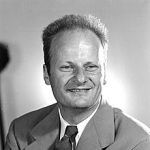
Hans Bethe
Hans Bethe, professor of physics at Cornell University, is noted for his discovery of the thermo-nuclear origin of the sun’s energy. He was ... Read More













This is world’s best article on Hydrogen Bomb. I was just trying to do research on different nations who developed lethal weapons to destroy the Humanity and I found this one. Thank u for your information