The recent past and foreseeable future of the Bulletin of the Atomic Scientists: a conversation
By John Mecklin | December 10, 2025
Visitors check out an infinity chamber at the "Futurium" in Berlin, a venue where significant national and international developments in scientific, technical and social research are to be presented and discussed among the government, the scientific community, industry, and society. (Photo credit: JOHN MACDOUGALL/AFP via Getty Images)
The recent past and foreseeable future of the Bulletin of the Atomic Scientists: a conversation
By John Mecklin | December 10, 2025
I could fill a book or two with absolutely justified encomiums about this storied magazine as it enters 80th year in publication. The Bulletin of the Atomic Scientists’ early leaders, supporters, and contributors—Einstein and Oppenheimer, among many others—are even now famous enough among the general public to be referenced by last name only. Their efforts to bring some sanity and control to the world’s approach to nuclear weaponry are legendary and engaging enough, in the narrative sense, to be included in Pulitzer Prize-winning books (see Kai Bird and Marty Sherwin’s American Prometheus and Dick Rhodes’ The Making of the Atomic Bomb) and Oscar-winning motion pictures like 2023’s Oppenheimer.
But eminent historians David Kaiser and Benjamin Wilson chronicled those early efforts brilliantly for an issue of the magazine produced to celebrate the Bulletin’s 70th anniversary.[1] And in this especially dangerous and unsettled time—the most dangerous time in the nuclear era, I believe—I wanted to focus on what the Bulletin has been more recently and where it should go in the next decade or two to keep the Doomsday Clock away from midnight. Hence the rest of this issue, which offers views on the future of our four primary coverage areas—nuclear weapons and energy, climate change, biological threats, and other disruptive technologies, including notably artificial intelligence—from top experts of varied perspectives and generations.
To help me introduce this issue and give readers an inside view of the Bulletin’s recent history and possible future, I asked Kennette Benedict for a bit of her time. Benedict was the Bulletin’s executive director when she appointed me as editor in chief in 2014, but by then, she’d already been helping the Bulletin survive, reorganize, and grow for more than 25 years. Because of her long connection as a funder of, top executive in, and now senior adviser to the magazine, I knew Kennette could help take readers of this 80th anniversary issue behind the scenes a bit, where they might see how the large, successful, and growing Bulletin of today was built atop the contributions of so many supporters—financial, intellectual, and journalistic; famous and not—over so many interesting and dangerous decades.[2]
Mecklin: So how did you first encounter the Bulletin of the Atomic Scientists; when did you first learn of it?
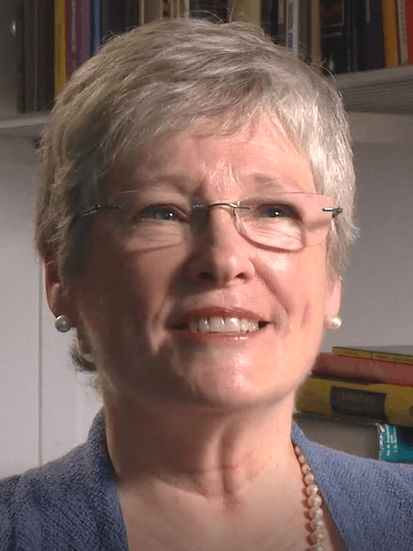
Kennette Benedict: I learned about the Bulletin when I worked at the MacArthur Foundation. Ruth Adams, director of the International Peace and Security program, hired me in 1987. Ruth had been a past editor of the Bulletin of the Atomic Scientists, although she rarely talked about it. I learned a tremendous amount from her about nuclear weapons and the prospects for disarmament, as I did, as well, from the many scientists whom the foundation funded who were involved in international security issues at major universities and policy institutes around the world and through the Pugwash Conferences on Science and World Affairs.
Victor Rabinowitch, the son of Eugene Rabinowitch, the first editor of the Bulletin, came to the MacArthur Foundation as vice president for programs. Soon after he arrived, and after Ruth retired, I was promoted to director of the International Peace and Security Program in 1991. Over the next decade I had opportunities to recommend grants to support the Bulletin and learned a great deal about the history, the mission, and the extraordinary scientists involved in the Bulletin.
Mecklin: So let’s veer into characters a bit. Ruth Adams[3] is something of a character. Why don’t you talk about her for a little while?
Benedict: She was amazing. She was, in many ways, a polymath and very generous especially in supporting young people. Ruth was extremely well-read—she read everything, from murder mysteries to quantum physics to nuclear weapons—and very smart and said what she thought. She was Eugene Rabinowitch’s research assistant while she was studying for a master’s degree at the University of Chicago, And that’s how she got involved with the Bulletin right at its beginning in 1945 and later with Pugwash,[4] where Eugene was also a major organizer.
Mecklin: So for our younger readers: Eugene was the founding editor of the Bulletin, and Vic was his son, correct?
Benedict: Correct.
In those early days of the scientists’ movement, Ruth was usually the only woman in a roomful of male nuclear physicists and scientists. Name any nuclear physicist from Joseph Rotblat[5] to Murray Gell-Mann,[6] she would have known them. She held the floor, in many of these meetings, by smoking a pipe. This was very unusual, for a woman to have a pipe, and she knew what she was doing. She would hold the pipe and put the tobacco in and start a sentence and then start lighting it. Everyone had to wait for her to finish lighting the pipe before she continued. So she was able to hold the room until she had finally had her say. She was a force, and people loved her.
She could be controversial, no question about it. But once she got to know you, you were friends for life. She was magnificent to me as a mentor and as a friend.
Although Ruth was dedicated to nuclear disarmament, she was also a humanist interested in the political and social forces that lead to tensions, international conflict, and the possible use of nuclear weapons. She and I saw eye to eye on the larger framework of nuclear security and worked well together to advance a broad agenda at the MacArthur Foundation.
Mecklin: And so you went to the Bulletin as executive director roughly when?
Benedict: October 2005. I remember it vividly.
Mecklin: And this was after how many years at MacArthur?
Benedict: Almost 20 years at MacArthur.
Mecklin: So how did they ever convince you to go over to the Bulletin?

Benedict: I’d been at the foundation, funding academics and experts in universities and policy institutes on a broad international security agenda, for almost two decades. And after a while you get, believe it or not, you get tired of being everyone’s best friend. Victor [Rabinowitch] had already retired from the MacArthur Foundation and was chair of the board of the Bulletin. He sensed that I was ready for a new challenge and was fairly persistent. The Bulletin was having financial difficulty, along with other difficulties. The board had just hired a new editor, Mark Strauss, but they were looking for someone to take on the executive leadership.
At first, I said I didn’t think this was a job for me. The turning point came when I talked to communications people at the MacArthur Foundation, and they drooled over the Doomsday Clock.[7] They recognized it as a magnificent communication device, and anyone who had anything to do with the Clock would be in a great position to get messages to a broad public about the dangers of nuclear weapons.
At that point—this was 2005—nuclear weapons were fading from the political landscape. It was after the 9/11 terrorist attack, and the focus had shifted to dealing with non-state actors. But the big problem was still nuclear weapons. And I thought, “Well, maybe we could really do something with the Clock.”
While I had been at the MacArthur Foundation, we provided funding for the first press conference the Bulletin ever had in 1998 when they moved the minute hand of the Clock after India and Pakistan tested nuclear weapons. I saw how that got picked up in the news, and I began to understand how powerful the symbol could be. I had also sought to move more of the science and expertise out into the public arena. I had worked for 20 years with some of the most extraordinary scientists and social scientists in the world, and I saw how all that knowledge was locked up in universities. There was a role for publications to make it much more accessible to a broad public. So it was partly Victor’s persuasiveness, and partly understanding what the Clock and the magazine might do to bring expertise and knowledge to a larger public that attracted me to the leadership position at the Bulletin.
Mecklin: After you came, that was sort of the start of what the Doomsday Clock has become now. And I remember one Clock announcement that was both in England and Chicago. Why don’t you talk about that a little bit? How did that happen?
Benedict: That was the first big Clock announcement we had. We held it in 2007, but it seemed like a long process of convincing the board that this was a good idea, convincing them that we needed a redesign of the Clock to make it more prominent—also to include climate change, as well as other technologies, which was a big change, a big shift.
What I was doing was going back to the beginnings of the Bulletin. If you read the early issues, the founders were very interested in all sorts of technologies and how they can benefit people or be harmful. And the Bulletin, as I read it, needed a reinvigoration. It was everywhere, in terms of subject matter: human rights, regional conflicts—it just was all over the map. I felt like it needed to have much more of a focus based in the scientific community. So we returned to that focus, and climate change was a big part of that.
Frankly, I got some pushback from some on the board and from others who thought we would dilute the mission of the Bulletin by expanding it to other technologies. But I thought it was already in the DNA of the Bulletin, and I just needed to elevate it to the Clock. Then we invited Michael Beirut of the Madison Avenue design firm Pentagram[8] to redesign the Clock for us pro bono, which he did enthusiastically.
For the first unveiling of the new design, with the addition of climate change to the agenda, we thought it would be great to have the big rock stars in science; Stephen Hawking was that rock star, and he was on the Bulletin’s Board of Sponsors. Martin Rees,[9] whom I knew from my time at the MacArthur Foundation and was also one of the Bulletin’s Sponsors and then-president of the Royal Society, the UK’s national academy of sciences, agreed to host a transatlantic press announcement of the Clock at the Royal Society in London.
I also called the president of the American Association for the Advancement of Science and asked if he would lend us their auditorium for the announcement. Finally, one of my great backers, Pam Solo of the Civil Society Institute, provided financial support and offered the use of her communications firm. Scott Stapf and his team were extremely helpful in coordinating the event, communicating with the press, and getting the transatlantic link together. It was a pretty amazing effort actually, but we did it. It worked.
On January 17, 2007, we had tremendous uptake in the press. CNN broadcast the announcement live, and it was just an amazing pick up by the media. It was overwhelming. I mean, we were on every outlet from Fox News to CNN and everything in between; ABC and CBS did interviews with me, and many newspapers picked up the whole event. It made a big splash, and I was really grateful. It was an extraordinary group effort.
And it really landed the Bulletin and the Clock where we wanted them to be, right in the public eye, with most of the media taking us seriously. It took a while for the New York Times to take us seriously, but they did finally after several years. The Chicago Tribune thought that adding climate change was diluting our message, as some on our board thought, as well. But I think we made the right decision on that. I have no regrets about it.

Mecklin: I remember back when I joined the Bulletin, board members were still having those arguments about climate change, although they were receding somewhat.
To bring up an issue that I don’t know how much detail you want to go into, but through its early years up to when you joined it, the Bulletin had financial difficulties; let’s say it was sort of a hand-to-mouth kind of thing. You had to negotiate that when you came. The Clock was part of gaining more notice, but obviously, there was also an outreach to get different kinds of funding. What did you do? I mean, the cupboards were bare when you came. I know that.
Benedict: What a lovely way to put it. Well, before I left the MacArthur Foundation, I talked to then-President Jonathan Fanton and said I know that I’ll need to raise a lot of money here and so got a commitment from him to help start it out. I also knew a lot of people in the foundation world, and because I’d read a lot of grant proposals, I knew how to write a proposal.
I knew who to call at many different foundations. Victor Rabinowitch was very helpful with several foundations and got the proposal before a number of them. I also had friends at the MacArthur Foundation who were very supportive. Soon after I came to the Bulletin and before grant money arrived, I said to one of my former colleagues who had been supporting my move to the Bulletin that I wasn’t sure how I was going to make payroll the next month. And he said, “Well, how much money do you need?” I think it was something like $30,000. Not much, but I if I didn’t get it, it was going to be bad.
Immediately, he said “You’re going to call up 10 friends, and you’re going to say you need to raise $30,000 in the next week, and you would like them each to donate $3,000. And you’re going to start right now because I’m going to put up $3,000 dollars to start the ball rolling.”
So I did. I called up 10 people; friends, neighbors, people whom I’d known both in the foundation and outside of the foundation and managed to raise something like $30,000 in a week. Some board members helped out; Marjorie Benton[10] and Lee Francis were very helpful to me at the beginning, as was Bill Revelle when he came to the board.[11]
In the first two or three years we managed to get the ship righted, shall we say. We got a grant from NATO, I remember, through board member Tom Pickering,[12] who had been ambassador to Russia and was also a good friend and colleague. We also had money from Lounsbery[13] and the Carnegie Corporation, as well as MacArthur. One of the first people I hired was Kendal Gladish, who had a gift for fund-raising with individual donors, as well as for writing promotional material to support our efforts. So, I just went through contacts and picked up the phone. With a lot of help from friends and colleagues, that was the way I did it.
We also had tremendous support from the University of Chicago. Tom Rosenbaum, who later became provost, was on the Bulletin board when I arrived. He helped us secure office space gratis at the Harris School of Public Policy in perpetuity, which was a great help in those early days and reinforced our historic ties to the university, where it all began.
The other major change was restructuring the board of the Bulletin in 2008. In part, to help with fund-raising and financial matters, I realized that we needed a governing board that would devote its attention to the financial and communications health of the organization, and a science and security board that would advise on editorial content and make the decision about moving the hand of the Doomsday Clock. That change contributed enormously both to the financial health of the organization and to deepening the scientific authority of the Bulletin.
Mecklin: And at the time that you came on, because of the financial problems, things changed with the editorial side of the Bulletin, also. There were people that had to be let go. Why don’t you just describe for me what the changes were that you had to put in place in the first few years after you came?
Benedict: Yes. Editorial.
Well, part of it was refocusing—focusing much more on science, technology, and security issues, which hadn’t necessarily been the forte of the editors at the time. I think though the biggest change that shook things up was going digital. Those editors were really dedicated to print magazines and were not digital-savvy people. I was very fortunate to have Jim Grisius, who was the person who handled basic IT infrastructure but also was very good and smart about all things digital; he was the one who helped me with the staff pull together a new look, a new way of thinking about the Bulletin. The chair of the board at the time, the late Cathy Cranston, had been publisher of the Harvard Business Review and then went on to work at Fast Company, and she was the one who urged me to think hard about going digital, saying that we would get to a younger audience, which is what we were after.
As she put it: “You know, I think we need to get out of the manufacturing and shipping business”—manufacturing and shipping a print magazine.
So I felt that digital was the way to go. It would save us a lot of money. It would also put us in front of many more people simultaneously. The magazine would get to European audiences, as it turned out to those in Asia, Latin America, and the Middle East as well.
So we did a lot of research. It was not an easy path. I think the editors at that point,
many of whom were really committed to print magazines, just weren’t sure they saw a future for themselves. And so one-by-one they left, and I was, believe it or not, for about three weeks without an editor altogether.
That was when I hired Mindy Bricker[14] as editor, and she was a godsend. She took on everything—recruiting new authors, redesigning the website, convincing me to write a monthly column to provide more content, and recruiting you to the Bulletin.
Mecklin: I remember right before I came on, the Fukushima accident[15] happened, and you had to put out a special issue on the Fukushima incident in 2011, I think, if I remember right. There were Mindy and maybe one or two part-time people. So you and the office coordinator were writing stories, too.
Benedict: Yes. And we recruited nearly half of the board members to write articles.
The other piece of this was that through another colleague, Bernie Reilly of the Center for Research Libraries, who had a contact at Google, we managed to get Google to digitize all the back issues of the Bulletin,[16] starting in 1945. The purpose of that was not only to get it up on a platform so that anybody could look at it for free, but also to show libraries and other publishers that this could be an attractive proposition for them.
That’s when we partnered with Sage Publications[17] to make sure that we had continuous visibility in libraries around the world. In China, in Iran, in Russia, and elsewhere people could read the Bulletin at the same time everybody else could. So we were able to reach a much wider and broader and international audience, which is what we’d hoped for.
Mecklin: From those beginnings, the Bulletin has built a remarkably international audience; about half the readers now are outside the US. There aren’t very many publications like that have that sort of international reach; I think you may have got an inkling of it when you were there. It’s an incredibly young audience, too. Something like 50 percent of our readers are under 35 and 70 percent under 45. These are demographics that some other publications would die for. And that’s mostly because of that decision to go digital. It was sort in some sense required, because of finances. But it was also ahead of other legacy media.
Benedict: It definitely was. And people warned me that, “Oh my God, it’s not going to work.” And the older people said, “Well, you’re going to lose me as a reader.” And I thought, “Oh well, that’s going to happen, it’s true. But donate anyway.”
So John, what was your impression when you first got to the Bulletin?
Mecklin: It was dual. It was: “Wow, this is kind of a thin operation here.” It was everybody doing about 12 jobs at once.
Benedict: Yes.
Mecklin: But the real reason that I came to the Bulletin was that the possibilities of the magazine were obviously enormous. You needed to build on it. You needed to do the right things. But it had and still has such a unique niche. There are no competitors to what the Bulletin does. Nobody else is covering man-made existential risks; it’s just its own thing.
And it has the Clock, right? Even now, even today, I go to a party, I tell people what I do, and they look at me with that blank look, right?
Benedict: Yes.
Mecklin: And then I say the Doomsday Clock, you know? And they know the Doomsday Clock. So the potential was just so obvious, and I think it was clear in the first couple of years that I worked with you and that you realized the potential to really grow greatly. Did you feel that?
Benedict: Well, not every day, since I was trying to raise money all the time [laughter]. But yeah, I understood the potential. And as you said, it’s the only publication that deals with these existential risks every day of the week, every week of the year. It’s also the only communications design that derives its authority from the scientific and research community.
People sometimes make fun of the Clock, they say all sorts of things about it, but they pay attention to it, and that’s the main thing, to be able to keep these issues in front of the public. The longer I was there, the more I saw the potential. And I also just sometimes felt—this isn’t going to sound right—but I felt that scientists were feeling frustrated because they’ve got all this deep knowledge, and people weren’t really paying attention to it. I felt that the editorial team could work so well with some of these folks in writing articles and getting them into a format that was accessible to a broad audience. I think that is really the major mission of the Bulletin.
Mecklin: When I first came to the Bulletin, one of the things I found really attractive was that
you could send an e-mail or pick up the phone and talk to almost any major scientist in the world. They would answer. They would help. That’s kind of unimaginable for most journalists, who are usually trying just to get people to respond. Here, the experts would be coming to us: “Did you know this? Would you like me to write a story about that?”
Benedict: Talk to me, John, a little bit about your interest in AI, because artificial intelligence was one of the first things you talked about when you came to the Bulletin. And I thought it was important, too. But you really, you really took it on, and you were absolutely right about that. So tell me how you thought about that, back then?
Mecklin: I’d lived somewhere with a little institute that dealt at a very high level with a lot of cutting-edge AI projects,[18] and I knew a guy there. I used to go to his presentations at night, and it was clear to me—this is what, 2006 or so—that AI was going to be a major deal. And when I came here, we were sort of scrambling and a little underfunded…
Benedict: Um-hmmm.
Mecklin: … and when I started in 2011, we had three, as they call them, verticals or coverage areas: nuclear, climate and biosecurity. And that last category eventually morphed into disruptive technologies, and I just saw that name change as this fascinating opportunity. What could be more disruptive than advances in artificial intelligence? And your friend Martin Rees was also early to artificial intelligence as a potentially existential risk. He was over at the Cambridge Center for the Study of Existential Risk, and he was early to that, too.
So we were doing stories about the ethical dimensions of advancing artificial intelligence fairly early, and that sort of set up the publication to be a place for people who are concerned about the potentially existential dimensions of AI, and particularly the idea that we might create a superintelligence that would turn us all into pets or kill us all.
Initially I was just interested in it, but now, a decade on, we have launched into a year-long artificial intelligence project that includes major investigative reporting efforts that the Future of Life Institute has given us significant funding for.
But in a way, the expansion of coverage beyond the nuclear threat came from your decisions back then, too; I remember when it looked like, with the Soviet Union dissolved and all of that, that nuclear weapons were going to be a concern of the past, right? So this expanded remit—to climate and other threats—sort of naturally fit into the Bulletin‘s view of itself today. Which, as you said, even though it’s often not known in the general public, is extremely similar to what the founders of the Bulletin thought and felt. They were talking about a whole range of technologies all the time.[19]
It wasn’t like climate raised its head when Kennette Benedict was named executive director. There was a Bulletin cover story in 1978 on climate change.[20]
Benedict: Right. And if you look at those back issues, there really was a lot of interest in just every possible technological advance. I think Rabinowitch stated in one of his essays that we’re really interested in how technology can be used for good, but we also know it can be used for ill. And so it was the science and technology role in society, really, and in world civilization, that was important to them. The Bulletin was born out of the Manhattan Project, obviously, but these were really smart, interesting, intellectually engaged people, and so I felt like it was in the DNA of the Bulletin to recover that and bring it into the current era.
Mecklin: I think I’m going to wind up by asking you about what you see as the future of the Bulletin. I’ve taken a solid 45 minutes of your time already here.
Benedict: Oh, horrors [laughter]. The future of the Bulletin. My goodness. Well, I just hope you go from strength to strength. My immediate successor, Rachel Bronson, has done a magnificent job developing outreach programs and bringing the arts community in conversation with the scientific and technical communities to raise awareness of the existential risks that the Bulletin addresses.
I don’t see a time when there won’t be a need for this publication, for this information. And I guess I haven’t really thought too much about what might be different. I think the new CEO, Alex Bell, has been very open about her interest in communication via public events, and so if there are other things that can be done in that vein, that would be great.
I also wanted to ask you about how you’ve managed the multimedia portion of the Bulletin, which is something that I dreamt about when I was there, and you have executed really quite well. I’ve been very impressed with some of the work you’ve done, and I would hope that you’d be able to do more of that.
You didn’t know [Nobel laureate] Leon Lederman,[21] but he was one of the Bulletin’s staunchest supporters. He can be seen in photographs moving the clock hands, but he wanted us to do television. And he tried to get Bill Kurtis, a local Chicago television personality, to take that on and do television programming. Well, television isn’t where it’s at now. But the idea was to have something that’s more simply visual.
There are other media that could be useful if you had the money and the time and talent to do it that would make these issues even more vivid. I just noticed that there are some films coming out in the next few months about nuclear weapons, which is phenomenal. But that could be another avenue for expression, especially in this time when young people want visual. You know that’s always the struggle: to get them interested.
Mecklin: It’s an interesting question as to the mix, right? We do a lot on different social media channels, including some of the video-based channels, and are doing ever more on YouTube. We now have two multimedia editors—up from none when I came—and they’re both really talented. And one of them on his own just said, “How about I do video versions of the Nuclear Notebook?” Which I thought…
Benedict: Oh, yes.
Mecklin: … I mean, as you know, this is a column we’ve published since the 1980s, and it’s not exactly known for its light and lively style. It’s pretty much just the facts, ma’am. Very straightforward. But Erik English started doing these videos, and the one on the US nuclear arsenal that he put up, I think in January, has been viewed about 100,000 times.[22]
So every nuclear notebook, we’re getting 80,000 to 100,000 views.
Benedict: Wow.
Mecklin: The growth of the audience of the Bulletin over the last decade has been dramatic.
Not even counting those alternate platforms, just our website, attracts roughly 600,000 readers a month, which is 15 or 20 times what it was when I got there.
And this comes from sets of dedicated people building on what other people passed down the line to them, which is a wonderful thing to watch, really. So now I will gift back to you the leadership of the Bulletin for 10 minutes. What do you think? What should the Bulletin do and be over the next five to 10 years?
Benedict: One of my major concerns, since I teach at a university, is how little young people know about nuclear weapons. And part of this is because these are state secrets. AI isn’t a state secret. Climate change is not a state secret. Nuclear weapons are a state secret.
And what I would love to see is to have the Bulletin—aspects of it, anyway—in the curriculum of every high school and college in the United States, at least.
The US is still the leader on these issues, and people just don’t know about nuclear weapons. We don’t talk about them, and I don’t know how to make that happen. Movies are helpful. The environmental movement did a pretty good job of getting young people informed, either through polar bears floating on icebergs or whatever technique, they managed to inform a lot of people about what climate change is and even the science of it.
They’ve heard about climate change, and they probably have an opinion. And they hear about gene splicing and all that stuff. But when you ask them how many nuclear weapons there are in the world, and what’s the potential harm they can do, you just draw a blank still. And that’s not right.
So I guess that’s what I’d like to see an emphasis on: bringing this to a kind of standard curriculum across the country. I don’t have any other particular vision about the Bulletin. I think you’re doing such a fantastic job, frankly, John, and I think Alex Bell seems to have really terrific instincts about all this. So I hope that you will spread your wings even further, and cover the Earth.
Endnotes
[1] That history of the Bulletin, “American Citizens as public citizens: 70 years of the Bulletin of the Atomic Scientists,” can be read here: https://thebulletin.org/archive/american-scientists-as-public-citizens-70-years-of-the-bulletin-of-the-atomic-scientists/#post-heading. An issue in celebration of our 75th year is available here: https://www.tandfonline.com/toc/rbul20/76/6?nav=tocList
[2] Among the many who have had a hand in the Bulletin’s success I want to point out former president and CEO (and current senior adviser) Rachel Bronson specifically and specially. Her thought, work, and care are evident in almost every successful aspect of the organization today. I feel lucky to have worked with her for a decade.
[3] Ruth Adams was the editor of the Bulletin in two different time periods. See: https://www.nytimes.com/2005/03/14/us/ruth-adams-81-editor-of-atomic-bulletin-dies.html/
[4] For more information on the Pugwash Conferences on Science and World Affairs see: https://pugwash.org/
[5] See: https://www.nobelprize.org/prizes/peace/1995/rotblat/facts/
[6] See: https://www.nobelprize.org/prizes/physics/1969/gell-mann/biographical/
[7] See: https://thebulletin.org/doomsday-clock/#nav_menu
[8] See: https://www.pentagram.com/
[9] For background on Martin Rees, Lord Acton, see: https://www.cser.ac.uk/team/martin-rees/
[10] Benton served twice on the Bulletin’s Governing Board in the last two decades. She has been a US Commissioner, International Year of the Child; US Ambassador to UNICEF; the Public Delegate to the United Nations; a Co-Chair of Americans for SALT; and Special Advisor to the United Nations Disarmament Commission. She was also co-founder of the Peace Museum in Chicago, Illinois.
[11] Lee Francis and Bill Revelle are current members of the Bulletin Governing Board.
[12] Pickering’s four-decade-long career in Foreign Service included ambassadorships in Russia (1993–1996); India (1992–1993); to the United Nations (1989–1992); Israel (1985–1988); El Salvador (1983–1985); Nigeria (1981–1983); and Jordan (1974–1978).
[13] See: https://www.rlounsbery.org/
[14] Mindy Kay Bricker was editor in chief of the Bulletin from 2011 to 2013 and went on to editorial posts at Foreign Policy and The New Republic magazines. See: https://www.linkedin.com/in/mindy-kay-bricker-b725032/
[15] See: https://thebulletin.org/tag/fukushima/
[16] See: https://books.google.com/books/about/Bulletin_of_the_Atomic_Scientists.html?id=XAgAAAAAMBAJ
[17] See: https://www.sagepub.com/about. The Bulletin now uses Taylor & Francis for university library and other group subscriptions. See: https://www.tandfonline.com/toc/rbul20/current
[18] The Institute for Human and Machine Cognition was founded in Pensacola, Florida, and, at that time, led by Kenneth Ford, a computer scientists and AI expert who had worked at NASA, among other government posts. See: https://www.ihmc.us/
[19] As Bulletin founding editor Eugene Rabinowitch wrote, “It was anticipated that the atom bomb would be only the first of many dangerous presents from Pandora’s box of modern science. Consequently, it was clear that the education of man to the realities of the scientific age would be a long, sustained effort.
[20] “Is Mankind Warming the Earth?” by William W. Kellogg. See: https://www.tandfonline.com/doi/abs/10.1080/00963402.1978.11458464
[21] See: https://www.nytimes.com/2018/10/03/science/leon-lederman-died-particle-accelerators.html
Together, we make the world safer.
The Bulletin elevates expert voices above the noise. But as an independent nonprofit organization, our operations depend on the support of readers like you. Help us continue to deliver quality journalism that holds leaders accountable. Your support of our work at any level is important. In return, we promise our coverage will be understandable, influential, vigilant, solution-oriented, and fair-minded. Together we can make a difference.
Get alerts about this thread
0 Comments
Oldest

John Mecklin
John Mecklin is the editor in chief of the Bulletin of the Atomic Scientists. Previously, he was editor in chief of Miller-McCune ... Read More