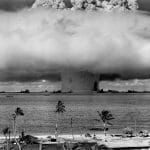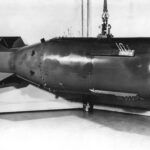
Observers wear safety goggles as they watch the test of an 81-kiloton atomic bomb during Operation Greenhouse on Enewetak Atoll on April 8, 1951. The explosion was the first in a series of tests designed to develop a thermonuclear weapon (better known today as the hydrogen bomb, but referred to back then as the “Super”). Credit: Brookings Institution/Defense Special Weapons Agency. The same image was also used on the cover of Nuclear Statecraft: History and Strategy in America’s Atomic Age.
The Bulletin of the Atomic Scientists was founded very near the beginning of the nuclear age, just a few months after American atomic bombs decimated two Japanese cities at the end of World War II. From that point on, the magazine has focused relentlessly on both sides of a wicked nuclear dual-use problem: how best to reduce or even eliminate the possibility of a nuclear war that could end civilization, while maximizing the peaceful uses of nuclear energy, from the production of electricity to the diagnosis and treatment of disease and beyond. For this issue, we asked both long-established and younger, emerging experts in nuclear weapons and nuclear energy policy to look forward from 2025 and tell us what we should be concerned about and how we should focus that concern to reduce danger and improve lives.
The experts are all impressive: Bulletin president and CEO Alex Bell, whose resume includes long service in important roles in the US State Department dealing with nuclear arms control, disarmament, and proliferation issues; Bob Rosner, a theoretical physicist, former director of the Argonne National Laboratory, and founder of the University of Chicago’s Energy Policy Institute (EPIC); Héloïse Fayet, a research fellow at the Security Studies Center and head of the Deterrence and Proliferation research program at the French Institute of International Relations; and Aditi Verma, an assistant professor of nuclear engineering and radiological sciences at the University of Michigan, where she directs the Critical Masses lab. Their perspectives are varied and worth reading together for anyone interested in safely navigating the coming decades of our increasingly complex nuclear age.
— John Mecklin, Editor in Chief
Together, we make the world safer.
The Bulletin elevates expert voices above the noise. But as an independent nonprofit organization, our operations depend on the support of readers like you. Help us continue to deliver quality journalism that holds leaders accountable. Your support of our work at any level is important. In return, we promise our coverage will be understandable, influential, vigilant, solution-oriented, and fair-minded. Together we can make a difference.
Keywords: energy, nuclear risk, nuclear weapons
Topics: Magazine, Nuclear Energy, Nuclear Risk, Nuclear Weapons
Get alerts about this thread
0 Comments
Oldest

John Mecklin
John Mecklin is the editor in chief of the Bulletin of the Atomic Scientists. Previously, he was editor in chief of Miller-McCune ... Read More