Nuclear family: A child of the Manhattan Project contemplates its 80th anniversary
By Leslie Schover | Personal Essay | July 16, 2025
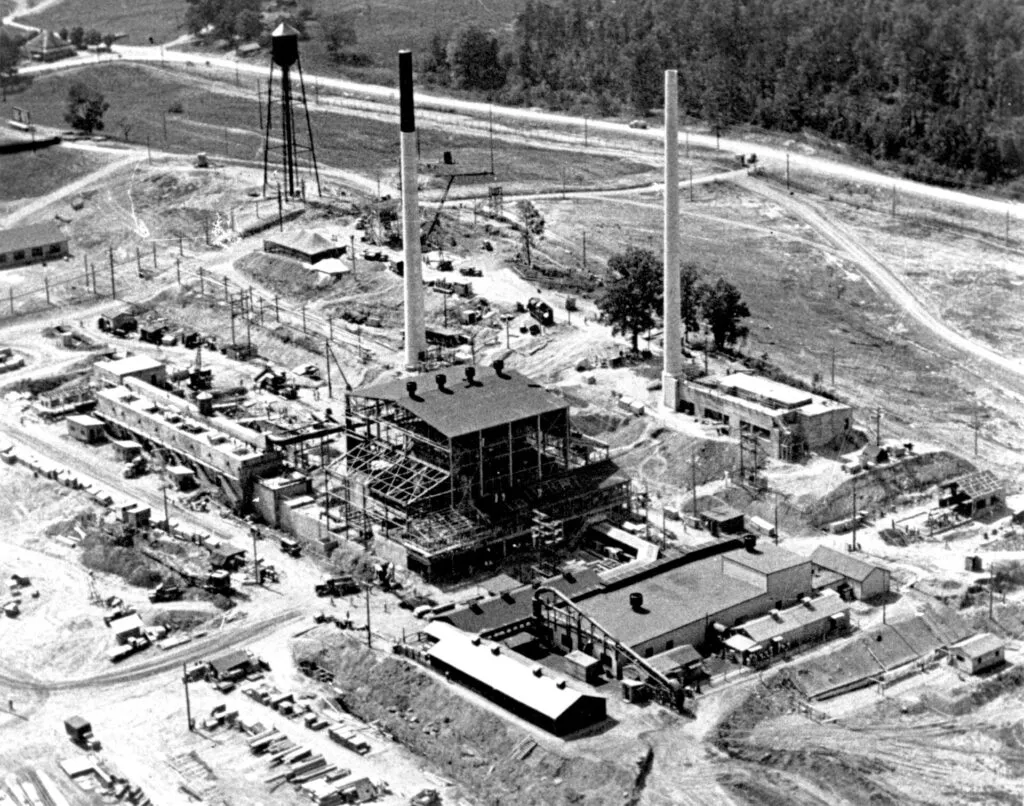 Gen. Leslie Groves directed DuPont to mobilize personnel to build the air-cooled Graphite Reactor and a plutonium-separation pilot plant at the X-10 site in what would become Oak Ridge. The facility, shown in August 1943, was intended to demonstrate plutonium production and separation, and Groves directed the University of Chicago Metallurgical Laboratory to supply the managers and scientists to operate it. (Credit: US Energy Department)
My father, Donald Schover, was an electronics research assistant at the University of Chicago’s Metallurgical Laboratory (or Met Lab)—the same lab where Enrico Fermi and his team achieved the first human-made self-sustaining nuclear chain reaction—and then at Oak Ridge National Laboratory in Tennessee with the group headed by Charles D. Coryell, a chemist who was working on developing a process for the chemical separation of uranium and plutonium.
Although my father never earned a college degree, he was one of the 67 signers of the Oak Ridge version of the Leo Szilard petition asking President Harry Truman in July 1945 not to use the bomb in Japan without a prior harmless demonstration of its devastating power. After the war, he had a long and successful career as an electronics and systems engineer, in an age when you could still be an autodidact.
Entering the Manhattan Project. When Coryell recruited my father, the research group desperately needed an instrumentation technician. At the time, my father was working for Peter Jensen, designing loudspeakers for battleships, but a physics undergraduate friend pleaded for him to look at a more important position. The Coryells invited both my parents to dinner at their home. My mother, then 20, had married my father and gotten pregnant, forcing her to drop out of the University of Chicago. For some mysterious reason, perhaps to convince my father to join the group, Coryell told them about the atomic bomb and his mission to create the first gram of plutonium. It sounded truly more important than designing loudspeakers. Back at home that night, my mother asked Dad if he was going to take the job. “Honey, I don’t think I have a choice,” he replied.
My older sister was 10 when I was born, in 1952. Growing up during the Cold War, I knew early on that my parents had been part of the Manhattan Project. I was one of many children instructed to hide under a school desk at the wail of a warning siren, although the training was sometimes disguised as a tornado drill. I recall the iconic Duck and Cover film of 1951, with Bert the Turtle admonishing children like me to drop their bikes and crouch next to a wall in the event of a nuclear attack. Even more vividly, I remember watching television as the Cuban Missile Crisis unfolded, my parents and I cowering in our certainly inadequate basement and wondering if we were living our last hours. I remember asking my father, “Why aren’t we building a bomb shelter?”, and being devastated when he told me that it would not help.
No regrets. When I was 17, the Public Broadcasting System (better known now as PBS) showed the newly declassified films of the injuries of survivors of the Hiroshima and Nagasaki bombings. Again, I watched them sitting next to my father. “How do you feel now about working on the Manhattan Project?” I challenged him. “You have to understand, honey,” he replied, “that we thought the Nazis were working to develop the bomb, too. Our whole rationale was to beat them to it.” He was equally proud of his certificate of service in the Manhattan Project and of his signature on the Oak Ridge petition to Truman.
When I was in high school, my father worked on a project with engineers from Toshiba that included making several lengthy trips to Japan. He visited Hiroshima and fell in love with Japanese culture. (The Japanese engineers delighted in mocking his efforts to learn a few phrases of their language.) Still, although he was angry that Nagasaki had been attacked, my father did not feel guilty about working on the bomb. He believed that Gen. Leslie Groves and his coterie wanted to see how a plutonium bomb would perform on a wartime target, after observing the destruction of Hiroshima by the uranium version. He also believed that using the bomb had saved as many as a million American soldiers who would have died invading Japan, a statistic that many historians now consider a highly doubtful government overestimate. I do not think my father ever read the analyses suggesting that Japan would have had to surrender when the Soviet Union declared war on them, two days after the bombing of Hiroshima.
My father lived to be 87, despite a hefty accidental exposure to gamma rays during his time at Oak Ridge. In the last few years of his life, he gave talks to senior citizen groups about the Manhattan Project, focusing on the technical achievements and life in Oak Ridge. His small role remained one of his proudest achievements.
My curiosity about my parents’ wartime experiences was renewed by revelations in 2019 about the Soviet atomic spy Oscar Seborer, and then again in 2022 when investigative journalist Ann Hagedorn published her book Sleeper Agent about another Soviet spy, George Koval, who had spent some months in Oak Ridge. I was very curious about whether my parents knew either agent. Both worked in the X-10 nuclear laboratory at Oak Ridge at the same time as my father. Although both spies were a few years older than my father, like him, they were electronics engineers from first-generation Ashkenazi Jewish families—enough to imagine them knowing each other. But unlike my father, who was a lifelong liberal democrat, Seborer and Koval were communists. Even more intriguing, Koval was a radiation safety officer, although I think my father’s accidental exposure occurred before Koval’s time in Oak Ridge.
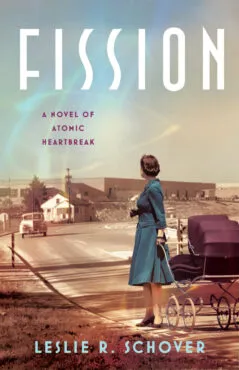
Filling mysteries with fiction. Sadly, both my parents were long deceased by that time, so I could not ask them. But I was so inspired as to write a novel incorporating their many wartime stories. While researching it, I came across a lengthy volume of interviews with Charles Coryell, A Chemist’s Role in the Birth of Atomic Energy, published in 2012 by the interviewer, Joan Bainbridge Safford, and Julie Coryell, his daughter. After Julie and I became great friends, I understood for the first time the actual role my father had during the Manhattan Project. I had always assumed he had worked with a group of physicists, not chemists. The Coryell group’s work on the chemical separation of plutonium was less well-known than their crowning achievement of creating large amounts of a radioactive isotope, barium 140, which was needed at Los Alamos to test the design of the trigger for the plutonium bomb.
Julie and I still haven’t been able to solve the mystery of why Coryell told my parents about the bomb, although Julie notes that his instinct was always to be as open and equitable as possible. From his interviews, it was not his common practice to give so much information to potential employees during the war. I may also never know whether my parents ever met with Koval or Seborer. (In my novel, I imagined a love triangle between the wife in the young couple and the Soviet spy.) After a deep dive into wartime atomic espionage, I no longer view the Soviet spies in the Manhattan Project simply as traitors: At the time, many nuclear scientists hoped that a new world governmental organization would assume responsibility for nuclear weapons and nuclear energy after the war. The Soviets were still allies with the United States until the very end of the war. Except for Klaus Fuchs, I believe that all those Manhattan Project scientists who passed information to the Soviets were Jewish. Given the pervasive antisemitism in the 1940s, families like the Seborers and Kovals ping-ponged between the United States and the Soviet Union, hoping to find a country where they could belong. Although they received US citizenship, real acceptance was not forthcoming.
It has taken me most of my life to fully appreciate the experiences that shaped my parents when they were only in their 20s. In this year of the 80th anniversary of the atomic bombings, let’s not forget the dilemmas that our parents faced in wartime. But let’s not let history repeat itself, either.
Together, we make the world safer.
The Bulletin elevates expert voices above the noise. But as an independent nonprofit organization, our operations depend on the support of readers like you. Help us continue to deliver quality journalism that holds leaders accountable. Your support of our work at any level is important. In return, we promise our coverage will be understandable, influential, vigilant, solution-oriented, and fair-minded. Together we can make a difference.
Leslie Schover
Leslie R. Schover is a retired clinical psychologist who served on the faculties of The Cleveland Clinic Foundation and the University of Texas, M. ... Read More






Leave a Reply