Trump cuts pose existential threat to the next generation of scientists
By Chad Small | Opinion | July 10, 2025
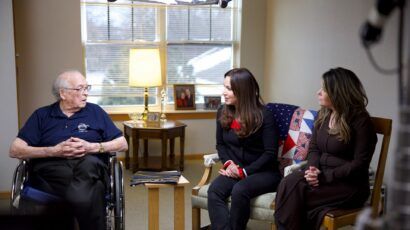
 The author presents some of his research on atmospheric rivers at an event organized by Learning the Earth with Artificial Intelligence and Physics (LEAP), an NSF Science and Technology Center launched in 2021 at Columbia University. (Photo: LEAP)
American science is under attack. Thousands of scientists and other staffers across various federal science agencies are being laid off. US spending on scientific research and development, which is often hundreds of billions of dollars per year more than peer nations, is cratering. The second Trump Administration has proposed catastrophic budget cuts—in some cases almost 50 percent—to instrumental science agencies like NASA, the National Science Foundation, and the National Oceanic and Atmospheric Administration. At the same time, droughts, wildfires, and floods are all changing in frequency and intensity as the climate changes.
I’m not the first person to argue that these cuts come at a time when the world can least afford them. Senior scientists have been working overtime to explain why our research matters. Many of these conversations focus on the immediate threats these cuts pose to our work, and to the safety and security of Americans. But the future is also in jeopardy.
For the last three years, I have been studying rainfall extremes in midlatitude regions and the tropics at the University of Washington, working towards my PhD in atmospheric and climate science. From this precarious, early-career perch, I can say I am extremely concerned about the long-term viability of this work.
How Trump’s funding cuts impact early career scientists like me—graduate students and postdoctoral researchers—will reverberate through the geosciences for decades, long after the federal budget settles this year. Funding cuts are uniquely challenging for early-career scientists because our near-term and long-term job prospects, domestically and abroad, are often tied to federal funding. It doesn’t help that the choices made by this administration are exacerbating existing pressure points in the early-career pipeline.
Just two percent of people living in the United States have PhDs, and an even smaller fraction have a doctorate in the sciences. In 2015, nearly 90 percent of PhD graduates could not get a tenure-track position at an American university within three years of finishing their degree. That number has only grown in the last 10 years. In the past, however, graduates might only have needed one postdoctoral research position before finding a tenure-track job. Some found employment directly out of graduate school. Now, multiple postdoctoral research positions are virtually a prerequisite to even be a competitive applicant in the academic job market.
The increasing scarcity of tenure-track jobs has pushed many early career scientists away from academia. Recent graduates have sought employment in government laboratories or research centers, nongovernmental organizations, and the private sector.
The closest experience to working in academia is in a government laboratory or research center. Scientists can work on big questions with great job security, and these research centers often make groundbreaking discoveries. Scientists affiliated with NOAA’s Geophysical Fluid Dynamics Laboratory have won both the Nobel Peace Prize and the Nobel Prize in Physics. But even under the first Trump administration, those jobs began to seem less secure.
Sydney Kramer, a postdoctoral researcher at Columbia University, said sweeping changes to agency mission directives at NASA, NOAA, and NSF during Trump’s first term made her wary of going into the federal science workforce. She said she did not “want to be at the whim” of changing political decisions about which science questions deserve answers.
Last November, Kramer was hired at Columbia University to work on a project that would assess coastal resilience and vulnerability to extreme weather. Before she could even begin working, the project was caught up in the federal government’s proposed funding cuts.
“The day I started, I walked in to meet everybody, and they were like, ‘oh, I’m sorry, what you were supposed to be doing is not a thing anymore,’” she said.
Because Kramer signed her contract before the cuts, Columbia was obligated to keep her position, and her advisors worked to find her a similar project to work on. Eventually, the funding to carry out her original project was restored. The experience has left her even more anxious about the possibility that her current funding could be pulled at any time. This is why she’s still open to looking for a job in the private sector when her postdoctoral research position ends.
She’s not the only early-career scientist rearranging their goals.
“I was hoping to go more into the public sector, working at an international nonprofit,” Laurel DiSera, who recently completed her PhD in Earth and Environmental Sciences at Columbia University, said.
But now she worries that those jobs will go to more experienced scientists recently fired from the federal workforce. Hoping to get a jump on a brutal job market, DiSera opted to defend her dissertation this spring instead of next fall.
“I think really the problem for me was starting to see that all these people in the market, either in the international landscape or in the US workforce, were going to be losing their jobs and then competing with me for the positions that I would be applying for, and they already have experience,” she said.
Many early-career and experienced scientists alike have been considering research positions abroad. But the influence of American science is more global than many realize. DiSera mentioned that a friend of hers in the United Kingdom said that funding cuts in the United States are beginning to affect their European counterparts.
“Projects that were either fully funded by the United States through, like, USAID, for example, or I know of some projects that were required to have multiple countries on the grant, bringing money from their own country,” she said. “But if the United States was footing a large chunk of the bill for the project, for example, then the whole system kind of erodes.”
Going abroad might also take scientists away from the regions and communities that are central to their work. That’s what concerns Vanessa Sun, a second-year PhD student in atmospheric sciences at the University of Utah, who studies ozone concentrations in Salt Lake City.
“I’m going to be pretty qualified at the end of my PhD specifically to do an analysis of a city and figure out how do we improve our air quality for certain pollutants,” she said. “I’m really passionate about that, and I’d really love to be able to do that for our country, for the American public.”
Sun’s experience highlights an unsettling dilemma that those who are relatively new to the United States are currently forced to consider while pursuing a scientific career. More than half of all PhD holders in STEM in the United States are immigrants. The children of immigrants make up almost 20 percent of all graduate students in the United States.
Using your education to make your adopted country—or the one your parents adopted—safer and more resilient is a choice that many atmospheric scientists proudly make every day. My own research interests were shaped by my upbringing. My parents are immigrants from the Caribbean, and I largely grew up on Staten Island. Hurricane Sandy and the remnants of Hurricane Ida brought tropical cyclone risks, particularly extreme rainfall, home for me. This made me even more passionate about understanding intensifying climate risks.
Trump’s funding cuts also mean there will be fewer graduate students admitted to science programs. My department at the University of Washington usually matriculates between eight and 12 students for each incoming PhD cohort. The incoming cohort for this fall is four students.
Well-endowed private universities will be better equipped to weather federal funding cuts than their public counterparts. In May, the Trump administration froze $2.2 billion in research grants to Harvard. While much of Harvard’s $53 billion endowment is restricted for specific uses, some of it will likely be used to offset grant losses while the university seeks legal relief. The University of Washington, my university, receives $1.3 billion annually in federal grants—the most of any public university in America. With an endowment of $6.6 billion, there would be absolutely no wiggle room if we lost all of our federal grants. As it stands, hundreds of millions of dollars in research funding could be in jeopardy. In the short term, universities like ours can have graduate students work as teaching assistants to pay their salaries. But this isn’t a sustainable solution because a department would need many more undergraduates in order to have enough teaching work to sustain the same number of graduate students.
Public universities are the most affordable gateways into research for students who may not come from wealthy, well-resourced backgrounds. The way these cuts affect students from under-resourced backgrounds weighs heavily on Sun. She was an undergraduate at a university without many research resources.
“The absolute only way, in my position, to be able to get any research experience, was to do an NSF [Research Experiences for Undergraduates] program,” she explained.
The Research Experiences for Undergraduates program supports intensive research for undergraduates in a research area funded by the NSF. These programs explicitly bring together students from different institutions and from various demographic backgrounds to learn how to do research. Many PhD students were once Research Experiences for Undergraduates students. “Without the NSF [Research for Undergraduates] program, I wouldn’t have gotten this opportunity; I really don’t know what I would have done honestly in that situation,” Sun added.
Proposed cuts to the NSF have halted this program for this upcoming summer, and potentially in perpetuity. Sun was hoping to mentor students coming to the University of Utah working in her research group.
At least for graduate students, their financial stability appears tied to how they are being funded: through grants or fellowships. Grants usually come through your research advisor and are effectively contracts between a research group and a federal agency dictating that certain research with specific objectives will be completed. Many graduate students are funded this way. Fellowships, however, come with a bit more research flexibility and usually fund students directly (often for a set number of years). Students funded on grants are directly in the crosshairs of prospective cuts because these cuts directly name certain grants. Fellowships aren’t usually targeted as directly. They usually are affected if the office of education or science within a certain agency is explicitly slated to lose funding. And even then, there’s usually flexibility in how cuts can be shouldered in that scenario.
I’m currently funded on a fellowship that should extend through the 2026-2027 academic year. But that money is appropriated at the beginning of each fiscal year. Although the budget just passed, it will take time to see how funding cuts to federal science agencies affect various programs. I find myself in the same position as many other graduate students: in a state of limbo. We’re generally hoping for the best, but we really have no idea what will happen. And that’s true of most people in our field at all stages of their career.
Some senior scientists are doing great work liaising with congressional staffers to mitigate the cuts. But will this work? Your guess is as good as ours. What is certain is younger students from high school through university are watching what’s happening. The future of atmospheric science is going to be shaped by the youth who are seeing our country abdicate its role in advancing science and discovery. They’re seeing a country abandoning its duty to protect its citizens. I’m not clairvoyant enough to precisely predict how these sentiments will materially change our scientific enterprise, but I suspect basic research science is going to be a less attractive path for those still figuring out who they want to be. And I think that damage to the image of American science will linger for many generations.
Together, we make the world safer.
The Bulletin elevates expert voices above the noise. But as an independent nonprofit organization, our operations depend on the support of readers like you. Help us continue to deliver quality journalism that holds leaders accountable. Your support of our work at any level is important. In return, we promise our coverage will be understandable, influential, vigilant, solution-oriented, and fair-minded. Together we can make a difference.
Get alerts about this thread
0 Comments
Oldest

Chad Small
Chad Small is a former Bulletin editorial fellow. He is a freelance journalist, and PhD student in Atmospheric Sciences at the University of ... Read More